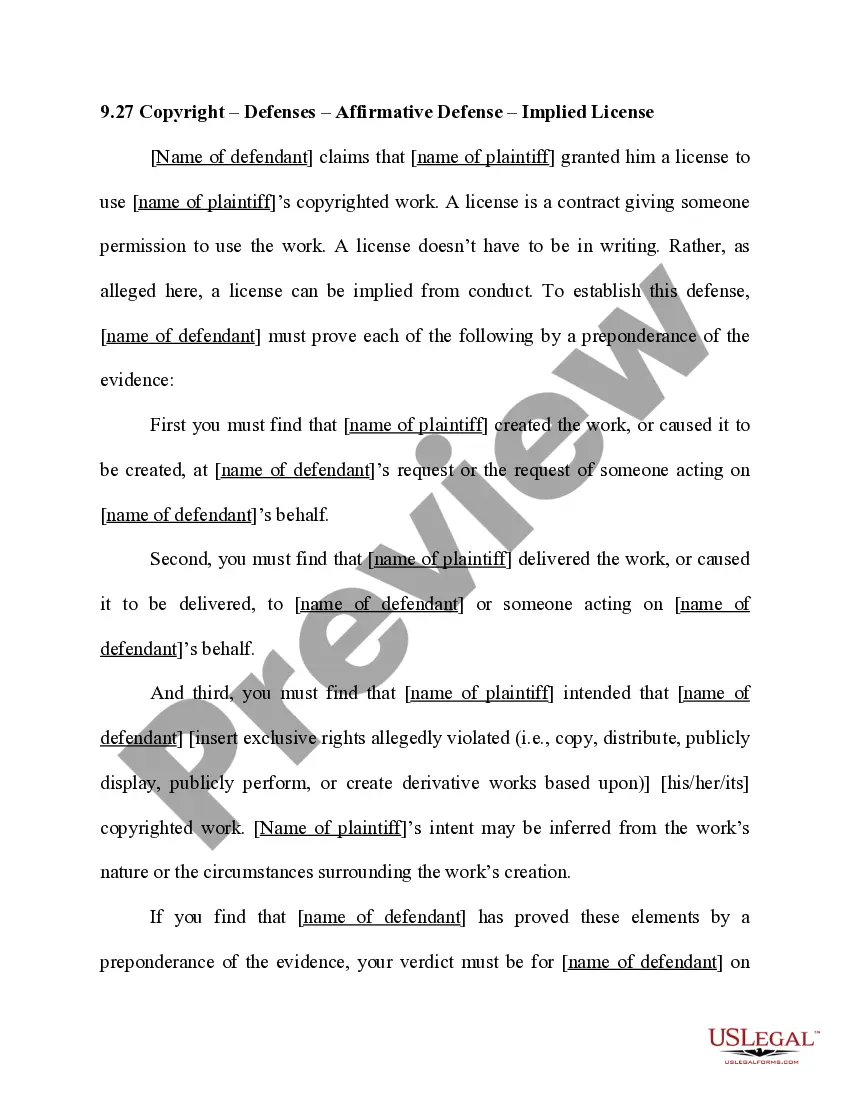
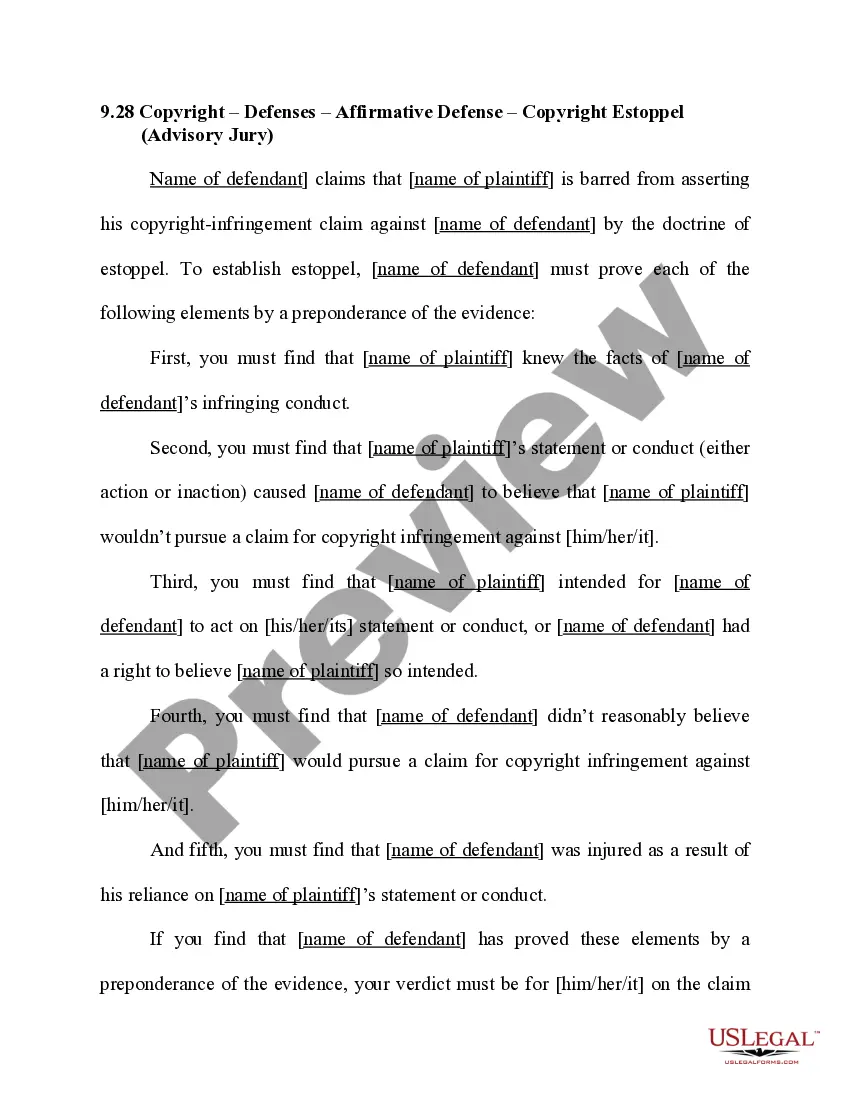
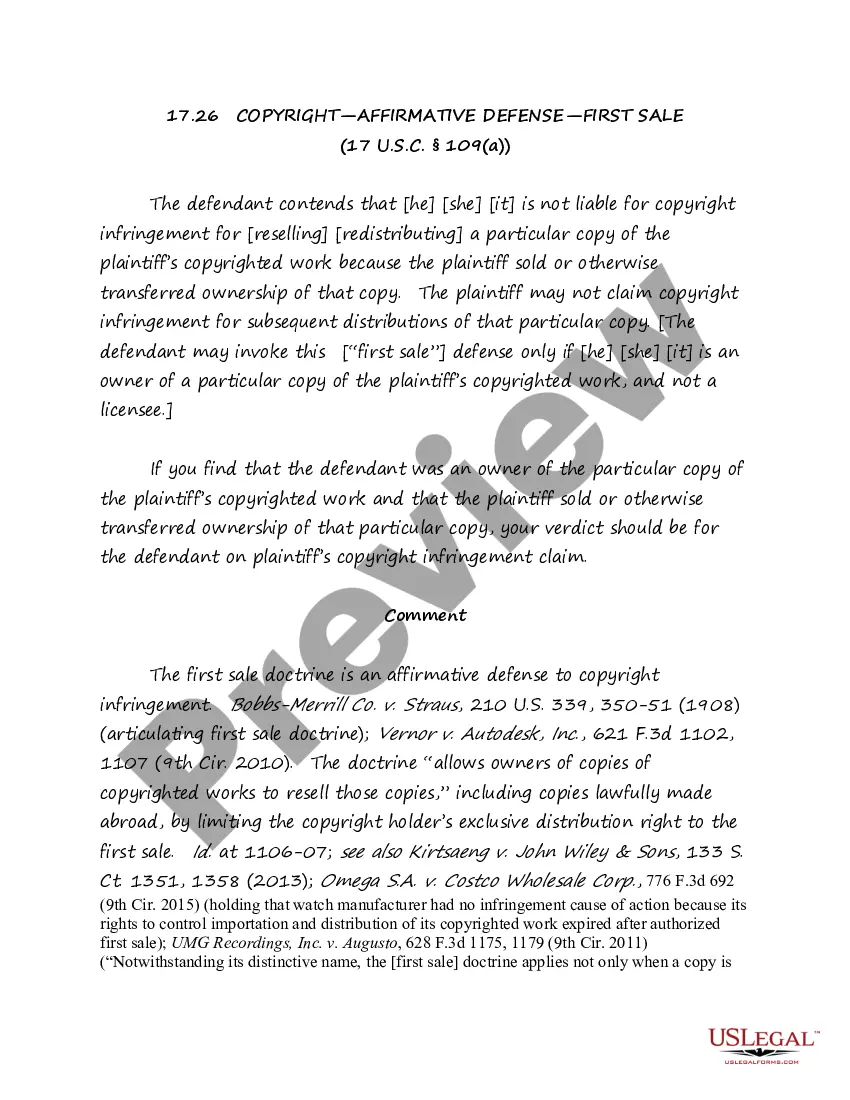
Copyright - Defenses - Affirmative Defense - First Sale
What is this form?
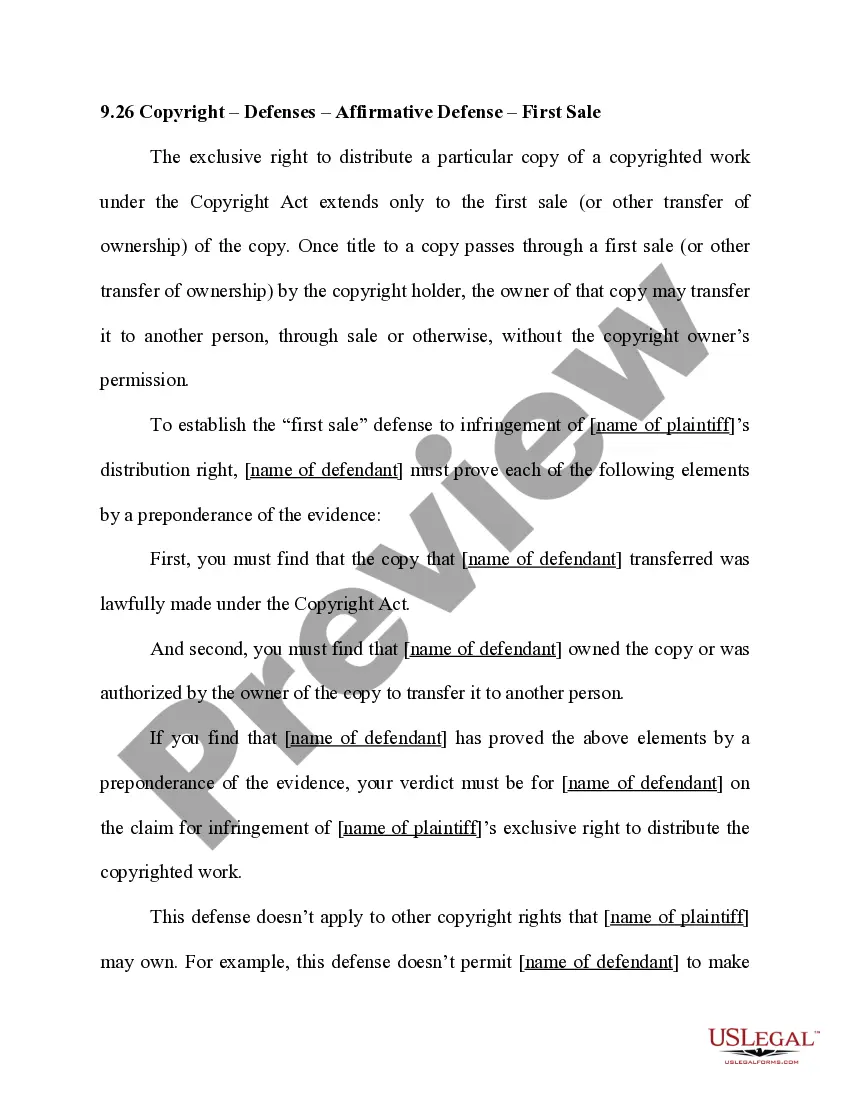
The Copyright â Defenses â Affirmative Defense â First Sale form provides essential guidance on the first sale doctrine in copyright law. This principle allows a copyright holder to sell or transfer ownership of a copyrighted item after the first authorized sale. In contrast to other copyright rules that restrict the reproduction and distribution of copyrighted works, this form specifically addresses circumstances under which a defendant can claim an affirmative defense against infringement claims based on the transfer of a specific copyrighted work. This form is vital for parties involved in copyright disputes related to distribution rights.
Key components of this form
- Definition of the first sale doctrine under the Copyright Act.
- Requirements for establishing the first sale defense, including lawful ownership and authorization.
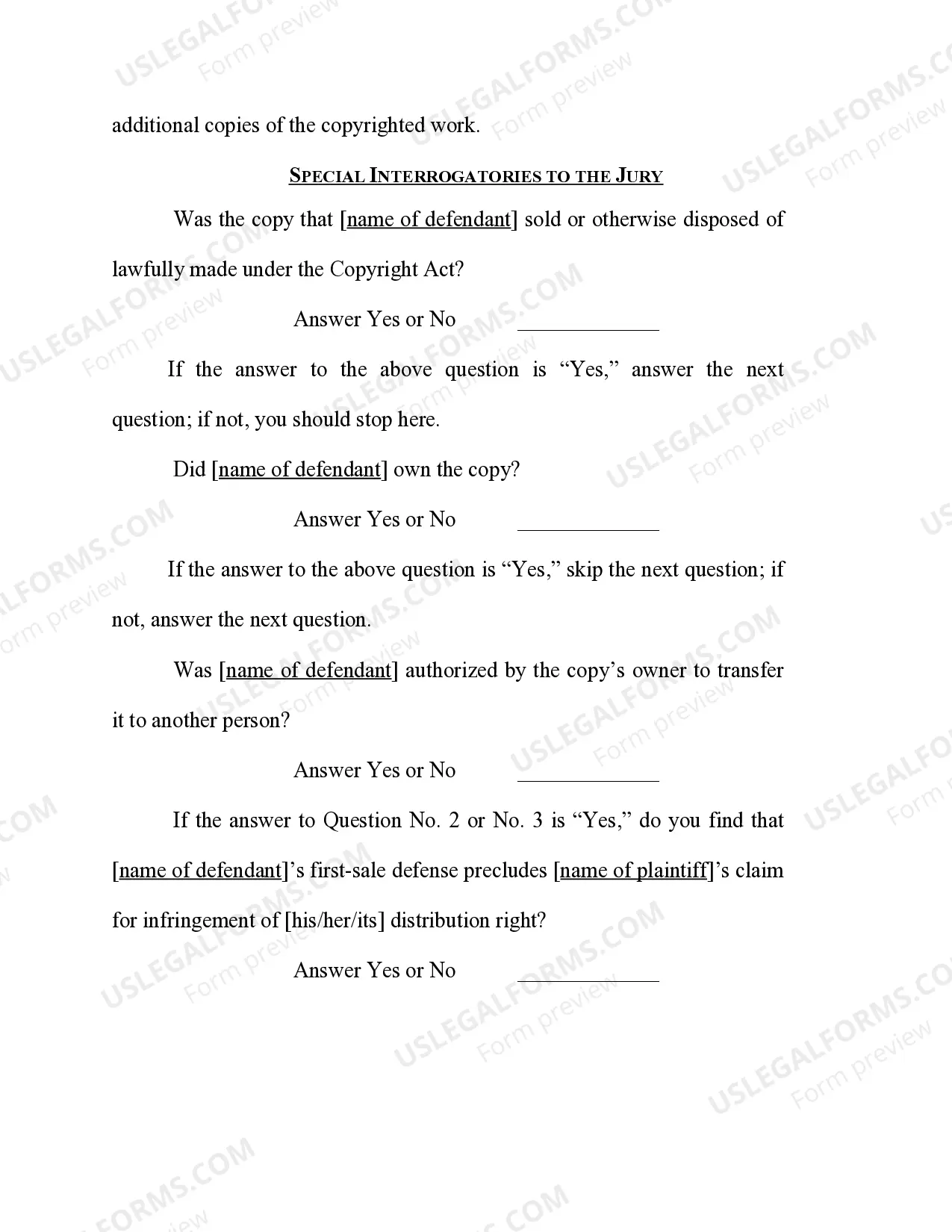
- Process for jury instruction regarding the assessment of the defendant's claims.
- Explicit limitations on the first sale defense regarding reproduction rights.
- Special interrogatories to guide jury deliberations on the case specifics.
When to use this document
This form is used in legal cases regarding copyright infringement, specifically when a defendant claims their distribution of a particular copy is legitimate under the first sale doctrine. Scenarios include situations where an individual or business sells, gives away, or otherwise transfers a physical copy of a copyrighted work and faces claims that such actions violate the copyright ownerâs exclusive rights. It is essential in helping defendants establish legal grounds for their actions without requiring permission from the original copyright holder.
Who this form is for
This form is intended for:
- Defendants in copyright infringement cases who sold or transferred a copyrighted item.
- Lawyers representing clients in copyright disputes involving distribution rights.
- Individuals or businesses needing to assert their rights under the first sale doctrine.
How to complete this form
- Identify the parties involved in the copyright dispute.
- Determine and verify whether the copy in question was lawfully made under the Copyright Act.
- Establish the ownership of the copy by the defendant or confirm authorization from the owner to transfer the copy.
- Prepare answers to special interrogatories that the jury will consider during deliberation.
- Review all completed sections to ensure clarity and correctness before submission.
Notarization guidance
This form does not typically require notarization unless specified by local law. There are no formal notarization requirements included in the content of the form itself. Always check local regulations to confirm.
Get your form ready online
Our built-in tools help you complete, sign, share, and store your documents in one place.
Make edits, fill in missing information, and update formatting in US Legal Forms—just like you would in MS Word.
Download a copy, print it, send it by email, or mail it via USPS—whatever works best for your next step.
Sign and collect signatures with our SignNow integration. Send to multiple recipients, set reminders, and more. Go Premium to unlock E-Sign.
If this form requires notarization, complete it online through a secure video call—no need to meet a notary in person or wait for an appointment.
We protect your documents and personal data by following strict security and privacy standards.

Make edits, fill in missing information, and update formatting in US Legal Forms—just like you would in MS Word.

Download a copy, print it, send it by email, or mail it via USPS—whatever works best for your next step.

Sign and collect signatures with our SignNow integration. Send to multiple recipients, set reminders, and more. Go Premium to unlock E-Sign.

If this form requires notarization, complete it online through a secure video call—no need to meet a notary in person or wait for an appointment.

We protect your documents and personal data by following strict security and privacy standards.
Common mistakes to avoid
- Failing to verify if the copy was lawfully made under the Copyright Act.
- Not properly establishing ownership or authorization for copy transfer.
- Overlooking the limitations of the first sale doctrine, especially regarding reproduction rights.
- Inconsistent or incomplete answers in the special interrogatories section.
Why use this form online
- Convenience of instant download for quick access to necessary legal documentation.
- Editability allows customization to fit specific case details and jurisdictional requirements.
- Reliability in using forms drafted by licensed attorneys to ensure legal validity.
Legal use & context
- The first sale doctrine applies to copyrighted physical items that have been legally obtained.
- Using this defense can preclude claims against the distribution of the first purchased copy.
- Limitations exist; the doctrine does not allow for the reproduction of copyrighted materials.
Summary of main points
- The first sale doctrine is crucial in copyright law for the distribution of personal copies.
- Successfully establishing this defense requires careful attention to ownership and authorization.
- Caution must be taken to avoid common pitfalls that could jeopardize the defense.
Looking for another form?

Form popularity
FAQ
The three basic elements of copyright: originality, creativity, and fixation. There are three basic elements that a work must possess in order to be protected by copyright in the US: Originality: To get a copyright, a work must be the original work of the author.
The ?first sale? doctrine (17 U.S.C. § 109(a)) gives the owners of copyrighted works the rights to sell, lend, or share their copies without having to obtain permission or pay fees. The copy becomes like any piece of physical property; you've purchased it, you own it.
Several cases suggest that in criminal copyright prosecutions, the United States must prove that the copyrighted work was not the subject of a first sale. Other cases, however, hold that the issue of a first sale is an affirmative defense that must be raised by the defendant.
Innocence (proving there was no reason to believe the work was copyrighted) The use is with a license agreement in place (this can shift liability to the licensor) Abandonment (a claim that the owner failed to enforce it's rights, thereby abandoning the right) Misuse of copyright by the copyright owner.
The elements in this instruction are explained in Instructions 17.6 (Copyright Infringement?Ownership of Valid Copyright?Definition), 17.14 (Copyright Infringement?Originality), and 17.17 (Copying?Access and Substantial Similarity). Copying and improper appropriation are issues of fact for the jury.
Innocent infringement is a potential defense where the infringer did not have notice of the copyright. The innocent infringer defense may be used when the defendant consciously and intentionally copies from the plaintiff's work, believing in good faith that his conduct does not constitute an infringement of copyright.
Generally, there are two main defenses that can be raised against a copyright infringement claim: (1) challenging the alleged copyright owner's claim to ownership; and (2) challenging an alleged violation of a right.