Copyright - Defenses - Affirmative Defense - Implied License
Overview of this form
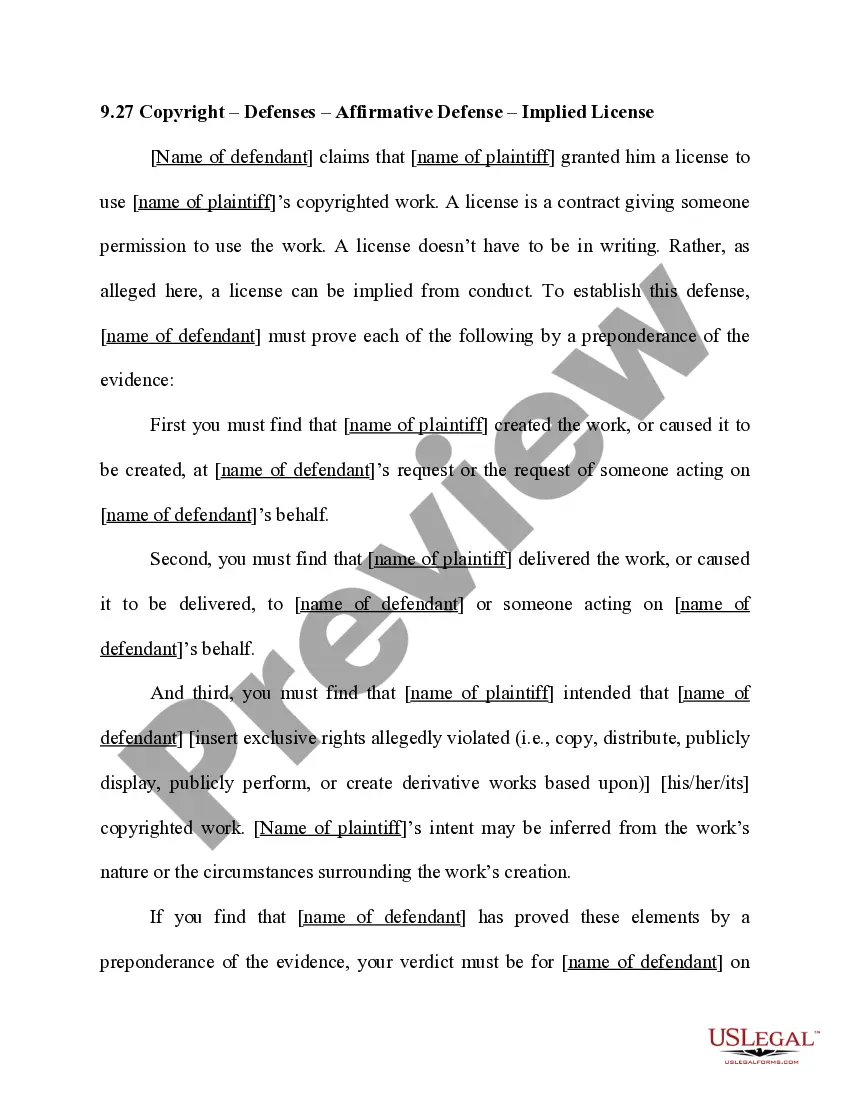
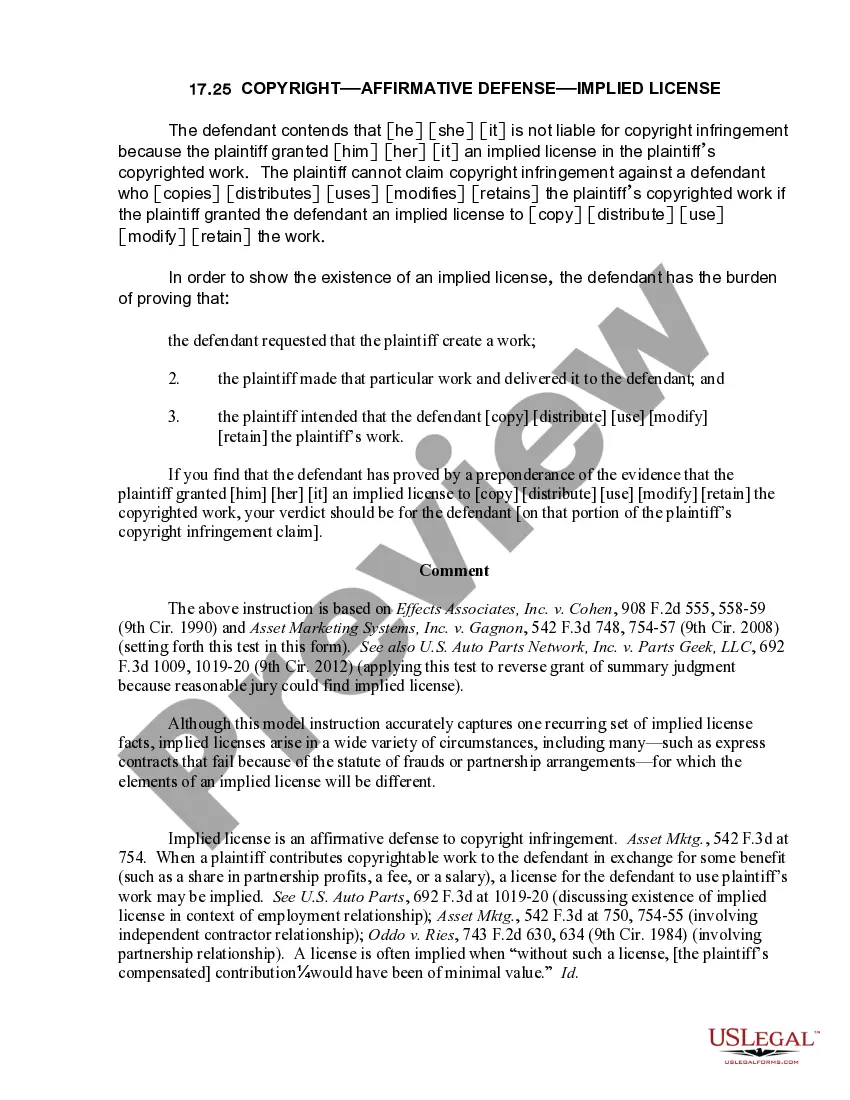
The Copyright - Defenses - Affirmative Defense - Implied License form provides a structured outline for establishing a defense in copyright infringement claims based on the assertion of an implied license. This legal form is essential for defendants in copyright cases who argue that they had permission to use a copyrighted work, even if no formal agreement was created. Unlike other copyright defenses, this one focuses specifically on the defense of implied license derived from the conduct of the parties involved.
What’s included in this form
- A claim that the plaintiff granted an implied license to use the copyrighted work.
- The requirement to prove the creation of the work at the defendant's request.
- The need to demonstrate that the work was delivered to the defendant or an agent.
- Proof of the plaintiff's intent regarding the use of their work.
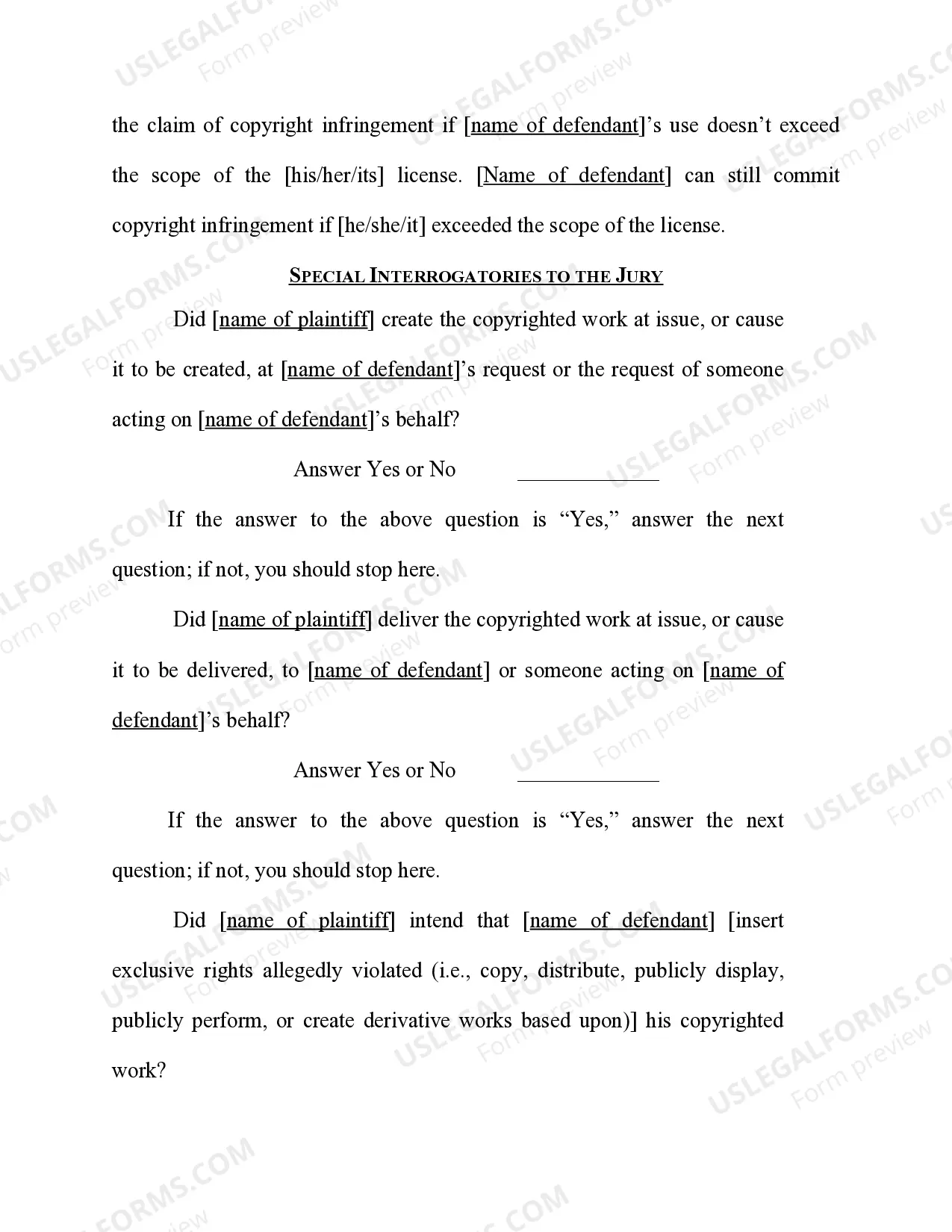
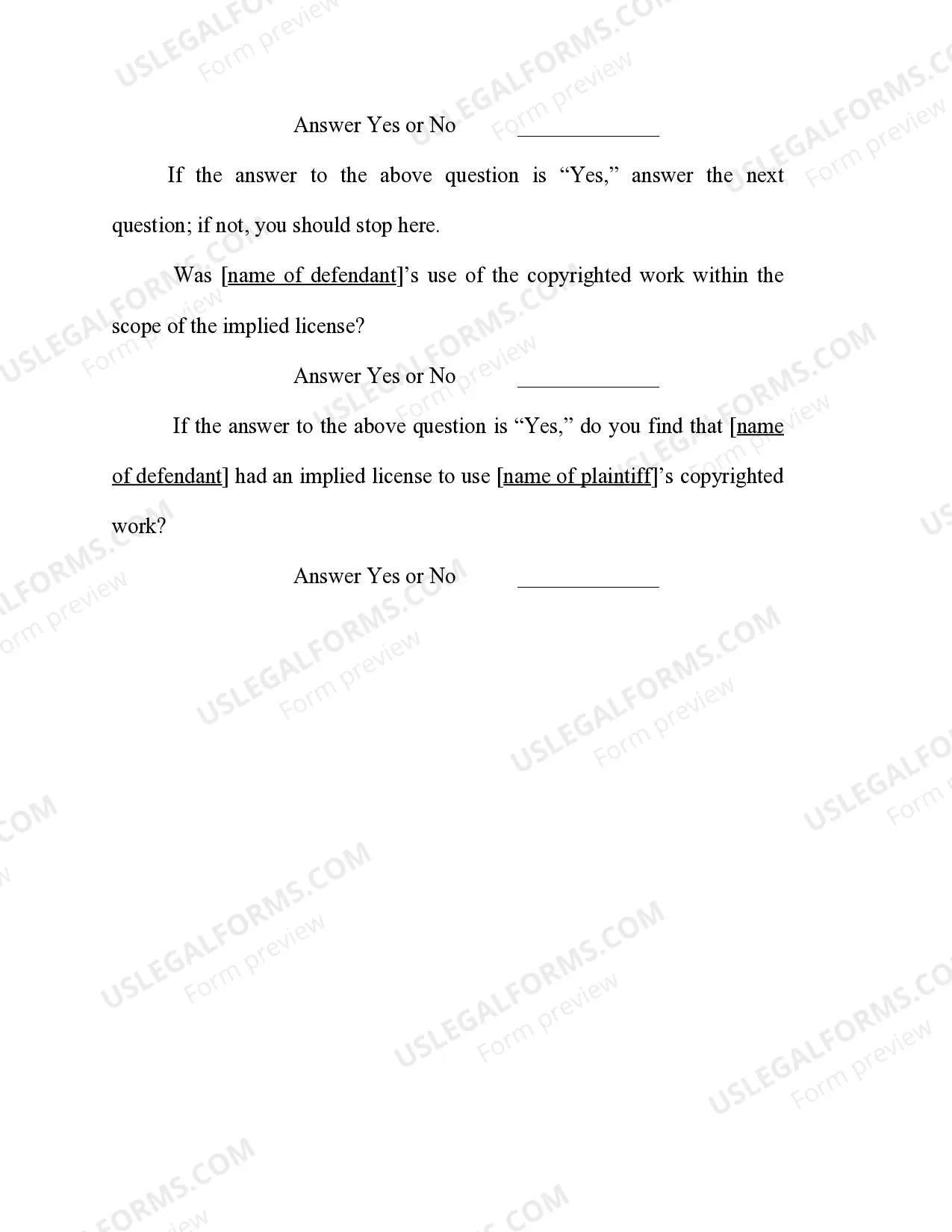
- Jury instructions that guide the evaluation of the stated elements.
When this form is needed
This form is used in legal scenarios where a defendant is accused of copyright infringement but wants to argue that they had an implied license to use the work. Common situations include creative collaborations, shared projects, or informal exchanges of copyrighted material where permissions were not explicitly documented but can be inferred from the relationship or actions of the parties involved.
Who needs this form
This form is intended for:
- Individuals or businesses that have been accused of copyright infringement.
- Defendants in copyright litigation who believe they have a valid claim of implied license.
- Legal professionals representing clients in copyright disputes.
Completing this form step by step
- Identify the parties involved: clearly state the names of the plaintiff and defendant.
- Document the circumstances under which the work was created or delivered.
- Specify the exclusive rights allegedly violated by the defendant.
- Answer the jury interrogatories regarding the work's creation, delivery, and intent.
- Ensure all elements are backed by evidence to support the claim of implied license.
Notarization requirements for this form
This form usually doesn’t need to be notarized. However, local laws or specific transactions may require it. Our online notarization service, powered by Notarize, lets you complete it remotely through a secure video session, available 24/7.
Get your form ready online
Our built-in tools help you complete, sign, share, and store your documents in one place.
Make edits, fill in missing information, and update formatting in US Legal Forms—just like you would in MS Word.
Download a copy, print it, send it by email, or mail it via USPS—whatever works best for your next step.
Sign and collect signatures with our SignNow integration. Send to multiple recipients, set reminders, and more. Go Premium to unlock E-Sign.
If this form requires notarization, complete it online through a secure video call—no need to meet a notary in person or wait for an appointment.
We protect your documents and personal data by following strict security and privacy standards.

Make edits, fill in missing information, and update formatting in US Legal Forms—just like you would in MS Word.

Download a copy, print it, send it by email, or mail it via USPS—whatever works best for your next step.

Sign and collect signatures with our SignNow integration. Send to multiple recipients, set reminders, and more. Go Premium to unlock E-Sign.

If this form requires notarization, complete it online through a secure video call—no need to meet a notary in person or wait for an appointment.

We protect your documents and personal data by following strict security and privacy standards.
Mistakes to watch out for
- Failing to provide adequate evidence to support the claim of implied license.
- Not clarifying the relationships and requests made between parties during the creation of the work.
- Neglecting to address the scope of the alleged license in the defense.
Why complete this form online
- Convenient access to legal document templates from anywhere with internet connectivity.
- Easy to edit and customize to fit specific case requirements.
- Reliability from professionally drafted templates reviewed by licensed attorneys.
Quick recap
- The implied license defense is crucial for defendants facing copyright infringement allegations.
- Evidence of intent and the relationship between parties is paramount in establishing this defense.
- This form helps structure your defense argument clearly and effectively.
Looking for another form?

Form popularity
FAQ
Implied Licenses The purpose of an implied license is to allow the licensee (the party who licenses the work from the copyright owner) some right to use the copyrighted work, but only to the extent that the copyright owner would have allowed had the parties negotiated an agreement.
What is copyright infringement? Recording a film in a movie theater. Posting a video on your company's website which features copyrighted words or songs. Using copyrighted images on your company's website. Using a musical group's copyrighted songs on your company's website.
To prove copyright infringement, the plaintiff must prove (1) ownership of a valid copyright (usually through the showing of a certificate of registration); (2) the defendant has copied the worN; and (3) such copying constitutes unlawful appropriation.
By a cinematograph films copyright or broadcast or by any means of photographs. Reproduction of the judicial proceeding or of a report of the judicial proceeding. Publication or reproduction of the musical, literary, dramatic, or artistic work in any work prepared by the secretariat of the legislature.
The plaintiff in a copyright infringement lawsuit has the burden of proving two elements: that they own a copyright, and that the defendant infringed it. To establish ownership of a valid copyright, a plaintiff must demonstrate that the work is original, and that it is subject to legal protection.
§ 107) One who is not the owner of the copyright may use the copyrighted work in a reasonable way under the circumstances without the consent of the copyright owner if it would advance the public interest. Such use of a copyrighted work is called a fair use.
Examples of Copyright Infringement Illegally downloading music files. Uploading someone else's copyrighted material to an accessible web page. Downloading licensed software from an unauthorized site. Modifying and reproducing someone else's creative work without making significant changes. Recording a movie in a theater.
Generally, there are two main defenses that can be raised against a copyright infringement claim: (1) challenging the alleged copyright owner's claim to ownership; and (2) challenging an alleged violation of a right.
Innocence (proving there was no reason to believe the work was copyrighted) The use is with a license agreement in place (this can shift liability to the licensor) Abandonment (a claim that the owner failed to enforce it's rights, thereby abandoning the right) Misuse of copyright by the copyright owner.