Copyright - Defenses - Affirmative Defense - Copyright Estoppel (Advisory Jury)
Understanding this form
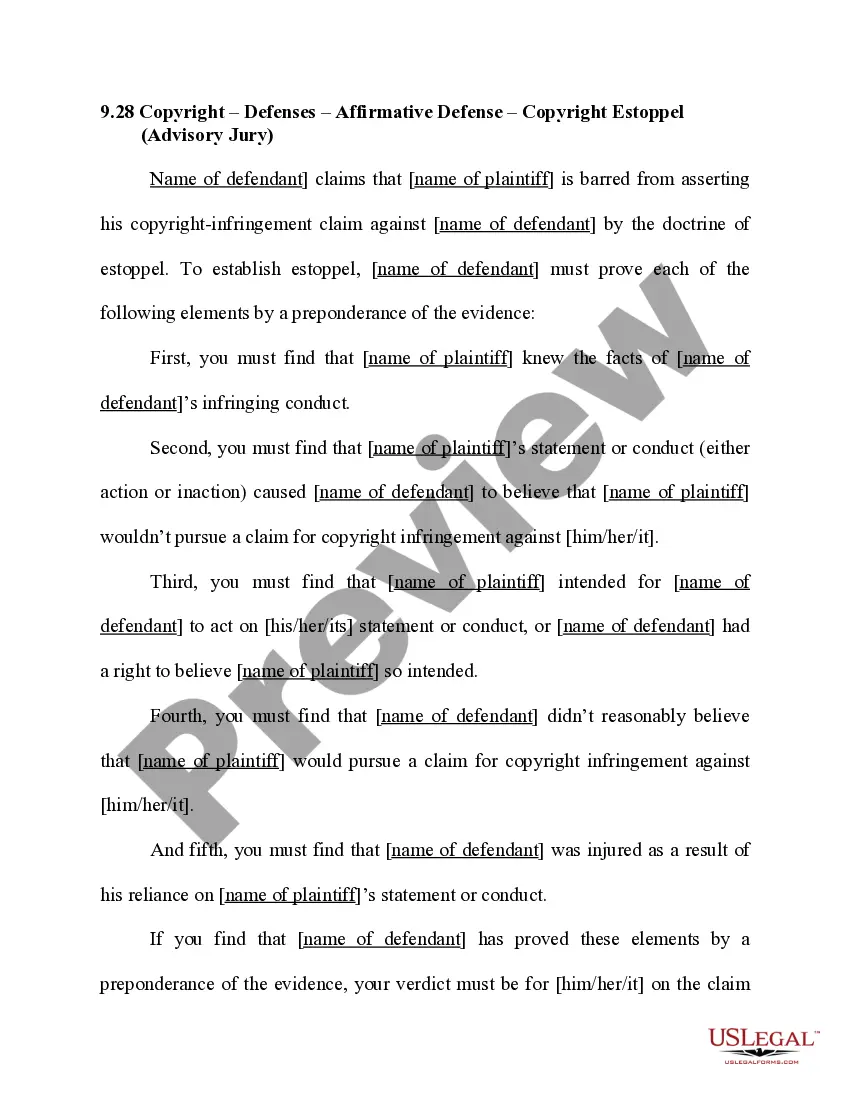
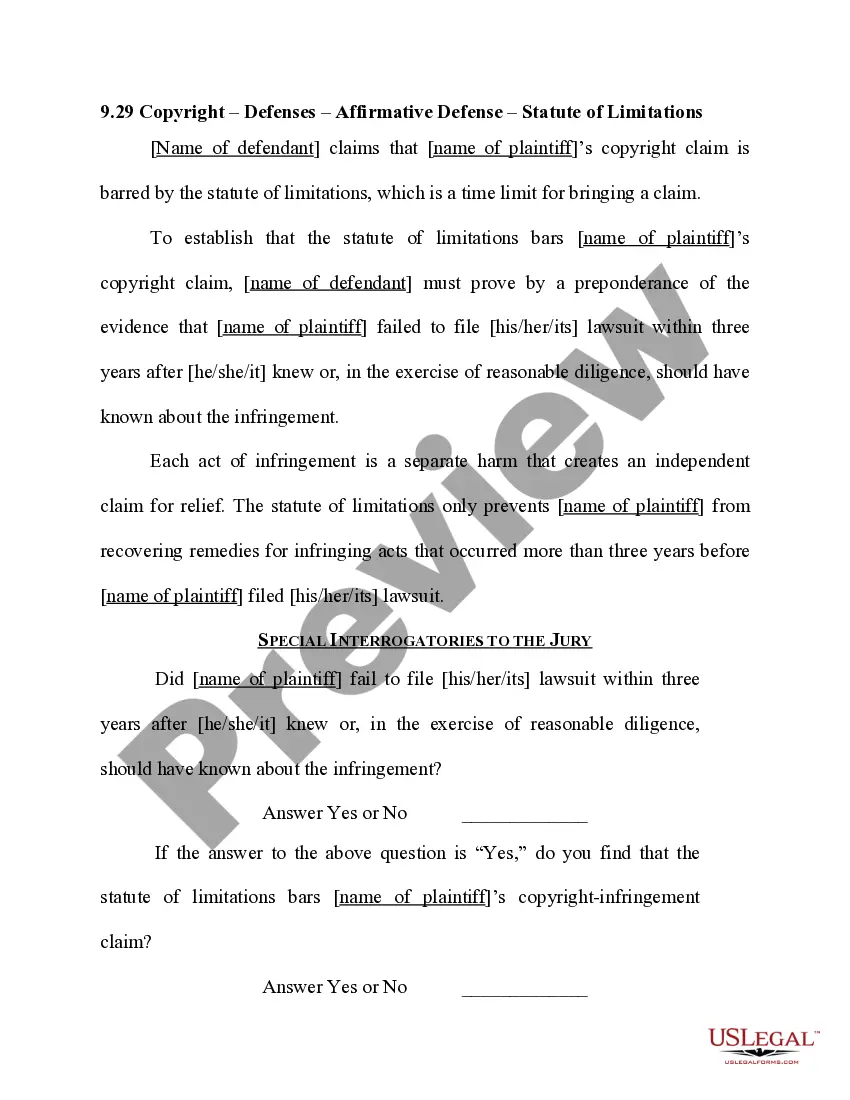
The Copyright - Defenses - Affirmative Defense - Copyright Estoppel (Advisory Jury) form provides a structured approach for defendants to establish that a plaintiff may be estopped from asserting copyright infringement claims. This form, based on Pattern Jury Instructions from the 11th Circuit Federal Court of Appeals, specifically outlines the elements that must be proven for a successful estoppel defense. It is essential for parties involved in copyright disputes to understand this form as it differentiates from other copyright defenses by focusing on the conduct and statements of the plaintiff that may have led the defendant to reasonably rely on them.
Key parts of this document
- Elements required to establish copyright estoppel.
- Interaction of the plaintiff's knowledge and conduct with the defendant's actions.
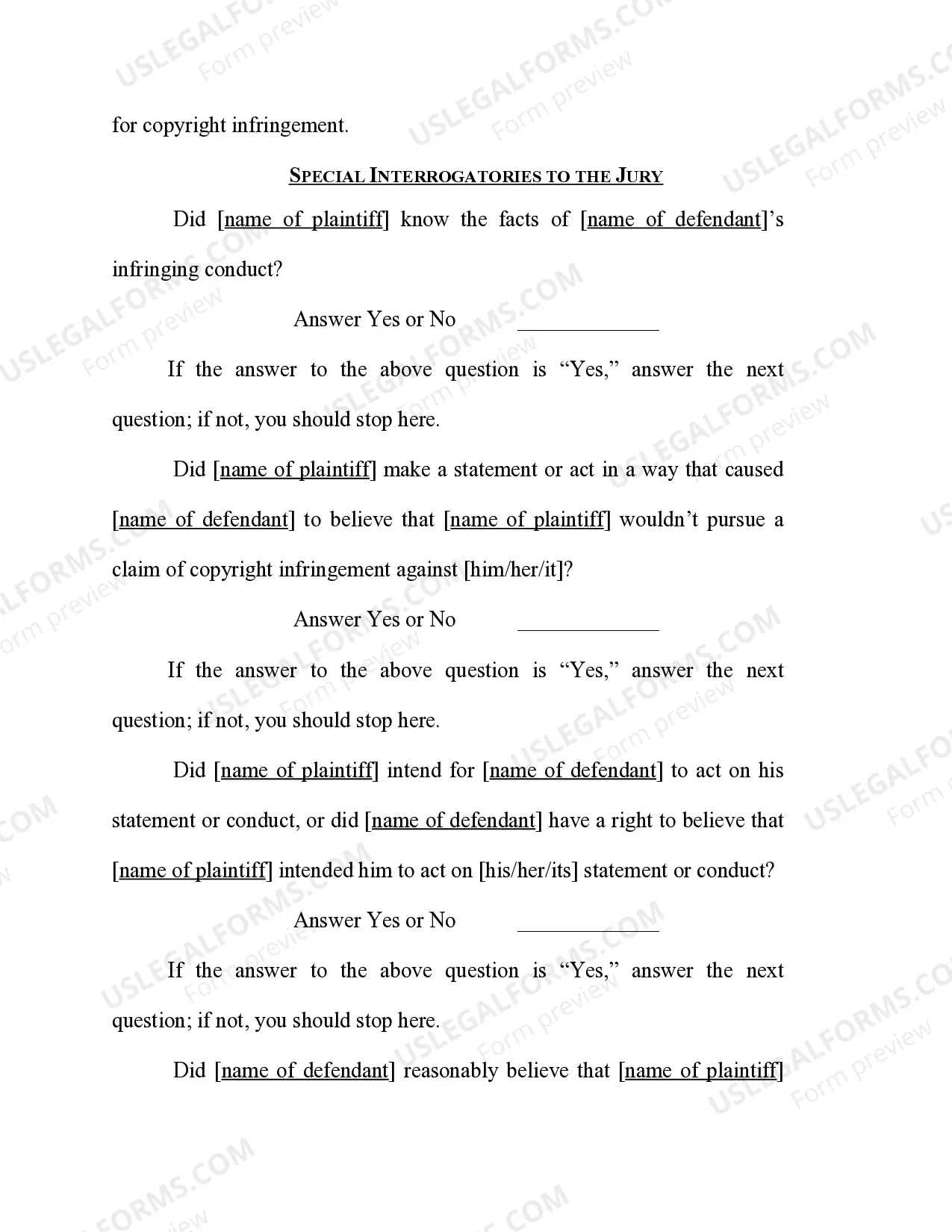
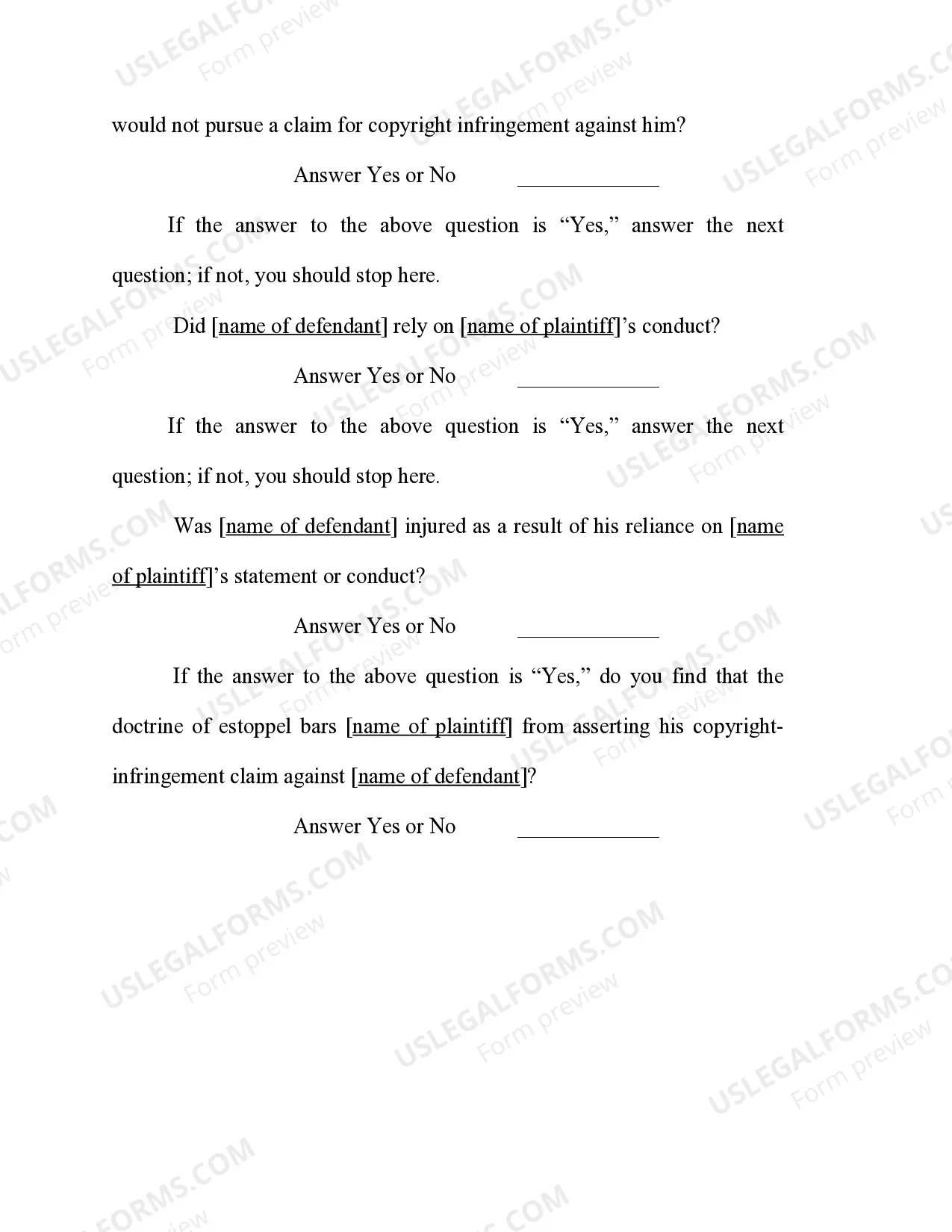
- Special interrogatories for the jury to assess each element of estoppel.
Situations where this form applies
This form is used in copyright infringement cases where the defendant believes that the plaintiff's prior conduct or statements may have led them to reasonably conclude that the plaintiff would not pursue a claim. It is relevant in situations involving artistic works, software, music, and any copyrighted materials where the rights of the parties are brought into question.
Who needs this form
This form is intended for:
- Defendants in copyright infringement lawsuits who seek to invoke estoppel as a defense.
- Legal professionals representing clients in copyright disputes.
- Parties wishing to understand the nuances of copyright law and the implications of a copyright estoppel defense.
How to complete this form
- Identify the parties involved, including the defendant and the plaintiff.
- Review and provide evidence supporting each element of estoppel as outlined in the form.
- Complete the special interrogatories by answering Yes or No to each question posed.
- Ensure that all claims for damages or injuries are substantiated with clear evidence of reliance on the plaintiff's conduct.
- Seek legal advice if unsure about any aspect of filling out this form properly.
Notarization requirements for this form
In most cases, this form does not require notarization. However, some jurisdictions or signing circumstances might. US Legal Forms offers online notarization powered by Notarize, accessible 24/7 for a quick, remote process.
Get your form ready online
Our built-in tools help you complete, sign, share, and store your documents in one place.
Make edits, fill in missing information, and update formatting in US Legal Forms—just like you would in MS Word.
Download a copy, print it, send it by email, or mail it via USPS—whatever works best for your next step.
Sign and collect signatures with our SignNow integration. Send to multiple recipients, set reminders, and more. Go Premium to unlock E-Sign.
If this form requires notarization, complete it online through a secure video call—no need to meet a notary in person or wait for an appointment.
We protect your documents and personal data by following strict security and privacy standards.

Make edits, fill in missing information, and update formatting in US Legal Forms—just like you would in MS Word.

Download a copy, print it, send it by email, or mail it via USPS—whatever works best for your next step.

Sign and collect signatures with our SignNow integration. Send to multiple recipients, set reminders, and more. Go Premium to unlock E-Sign.

If this form requires notarization, complete it online through a secure video call—no need to meet a notary in person or wait for an appointment.

We protect your documents and personal data by following strict security and privacy standards.
Avoid these common issues
- Failing to provide sufficient evidence on any of the elements required for estoppel.
- Not understanding the implications of each interrogatory question.
- Assuming estoppel applies universally without evaluating the specific circumstances of the case.
Advantages of online completion
- Convenience of accessing the form anytime and anywhere.
- Editability allows users to customize the form to their unique situation.
- Reliability of templates drafted by licensed attorneys to ensure adherence to legal standards.
Legal use & context
- This form is recognized in copyright law for establishing defenses against infringement claims.
- Effectiveness depends on meeting the specific criteria set forth in the form.
- Users should be aware of how local laws may influence the enforceability of the estoppel doctrine.
Looking for another form?
Form popularity
FAQ
To establish infringement, name of plaintiff must prove two things: First, you must find that name of plaintiff owned a valid copyright. And second, you must find that name of defendant copied the work's original components.
Courts usually require a copyright owner to prove that she owned the copyrighted work, and the defendant violated one of the exclusive rights of the copyright owner.
Generally, there are two main defenses that can be raised against a copyright infringement claim: (1) challenging the alleged copyright owner's claim to ownership; and (2) challenging an alleged violation of a right.
The plaintiff in a copyright infringement lawsuit has the burden of proving two elements: that they own a copyright, and that the defendant infringed it. To establish ownership of a valid copyright, a plaintiff must demonstrate that the work is original, and that it is subject to legal protection.
Innocence (proving there was no reason to believe the work was copyrighted) The use is with a license agreement in place (this can shift liability to the licensor) Abandonment (a claim that the owner failed to enforce it's rights, thereby abandoning the right) Misuse of copyright by the copyright owner.
The three basic elements of copyright: originality, creativity, and fixation. There are three basic elements that a work must possess in order to be protected by copyright in the US: Originality: To get a copyright, a work must be the original work of the author.
Innocent Infringer Defense Innocent infringement is one of the most common defenses in copyright infringement litigation.
The elements in this instruction are explained in Instructions 17.6 (Copyright Infringement?Ownership of Valid Copyright?Definition), 17.14 (Copyright Infringement?Originality), and 17.17 (Copying?Access and Substantial Similarity). Copying and improper appropriation are issues of fact for the jury.