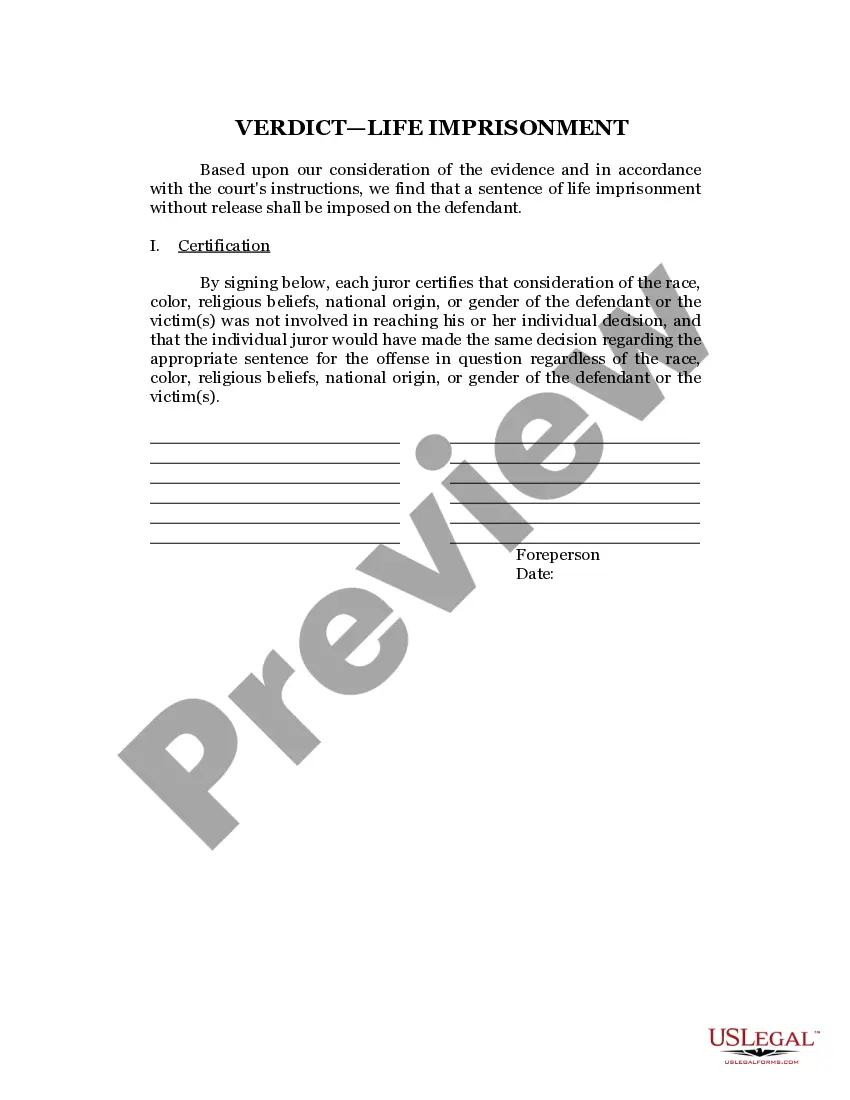
VERDICT-LIFE IMPRISONMENT
About this form
The VerdictâLife Imprisonment form is a legal document used by jurors to declare their decision on imposing a life sentence without the possibility of parole. This form is specifically for cases where the defendant is found guilty of a crime warranting such a severe penalty. It differs from other verdict forms that may be used for lesser sentences or different types of offenses.
Key parts of this document
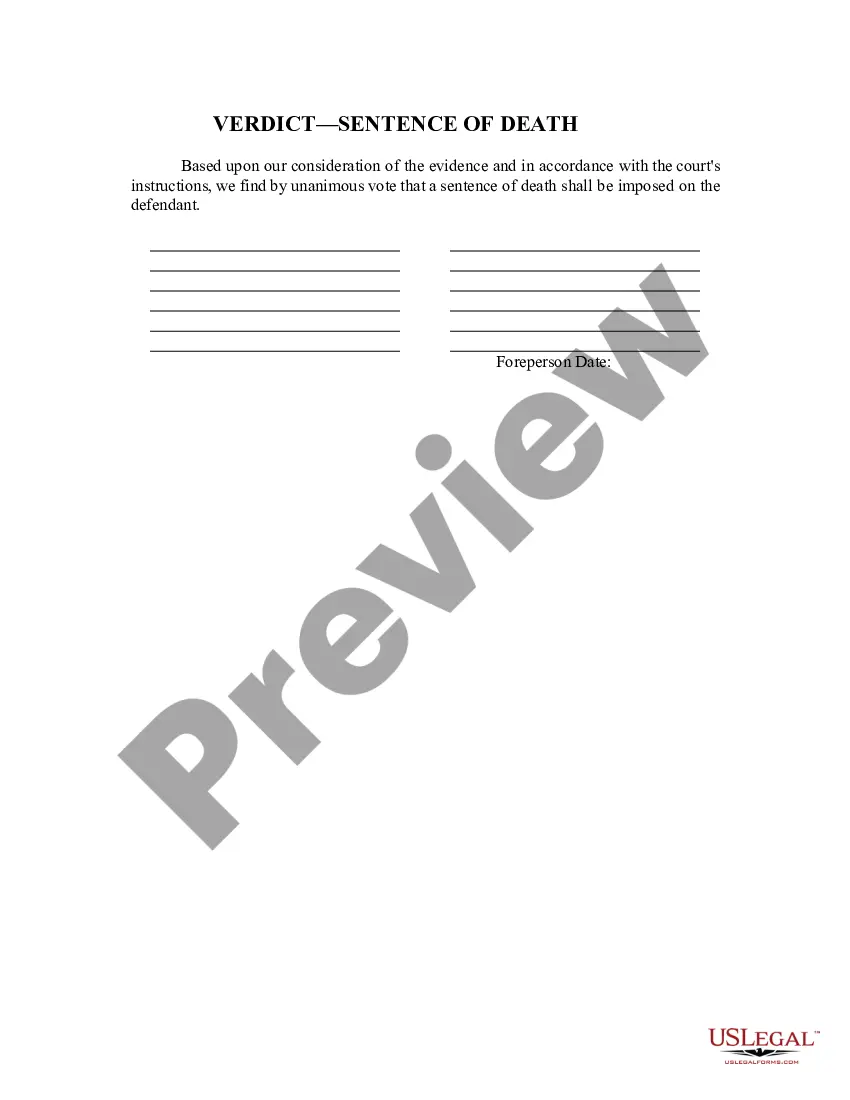
- The declaration of a life imprisonment sentence without parole.
- A certification clause, ensuring that the decision was not influenced by the race, color, religious beliefs, national origin, or gender of anyone involved.
- Signature lines for each juror, confirming individual accountability for the verdict.
- Space for the foreperson's signature and the date of the decision.
When this form is needed
This form is used during a criminal trial when the jury has determined that the defendant should be sentenced to life imprisonment without the possibility of release. It captures the consensus of the jurors after reviewing the evidence and following the court's instructions.
Intended users of this form
- Jurors involved in a criminal trial where life imprisonment is a potential sentence.
- The presiding judge overseeing the trial's procedural compliance.
How to prepare this document
- Indicate the decision to impose life imprisonment clearly at the top of the form.
- Each juror reviews and certifies their individual decision is free from bias.
- Jurors sign the form, with each juror providing their signature in the designated space.
- The foreperson should sign at the bottom and date the document to confirm the verdict.
Notarization guidance
This form does not typically require notarization unless specified by local law. However, it is essential for jurors to follow the specific protocols of the court to ensure the document's validity.
Get your form ready online
Our built-in tools help you complete, sign, share, and store your documents in one place.
Make edits, fill in missing information, and update formatting in US Legal Forms—just like you would in MS Word.
Download a copy, print it, send it by email, or mail it via USPS—whatever works best for your next step.
Sign and collect signatures with our SignNow integration. Send to multiple recipients, set reminders, and more. Go Premium to unlock E-Sign.
If this form requires notarization, complete it online through a secure video call—no need to meet a notary in person or wait for an appointment.
We protect your documents and personal data by following strict security and privacy standards.

Make edits, fill in missing information, and update formatting in US Legal Forms—just like you would in MS Word.

Download a copy, print it, send it by email, or mail it via USPS—whatever works best for your next step.

Sign and collect signatures with our SignNow integration. Send to multiple recipients, set reminders, and more. Go Premium to unlock E-Sign.

If this form requires notarization, complete it online through a secure video call—no need to meet a notary in person or wait for an appointment.

We protect your documents and personal data by following strict security and privacy standards.
Common mistakes to avoid
- Failing to have all jurors sign the form, which may invalidate the verdict.
- Not certifying that bias was not a factor in reaching the verdict.
- Inaccurate or incomplete completion of the form, leading to confusion in court proceedings.
Benefits of completing this form online
- Instant access to a legally vetted document, ensuring it meets current legal standards.
- Easy download and completion allows jurors to focus on their responsibilities without delay.
- Secure storage options are available, preserving the integrity of the juryâs decision.
Looking for another form?

Form popularity
FAQ
An example of a life sentence with the possibility of parole is when an offender is sentenced to serve a term of ?15 years to life.?
In some jurisdictions, a "life" sentence is a misnomer in that it can come with the possibility of parole. Depending on the state's law, a defendant may be eligible for parole after a set number of years, like 20, 25, or 40.
Life without parole is a sentence that means the convicted individual will spend the rest of their life in prison without the possibility of parole. This sentence is often seen as an alternative to the death penalty, and it is typically reserved for the most serious and heinous crimes.
In the United States, people serving a life sentence are eligible for parole after 25 years. If they are serving two consecutive life sentences, it means they have to wait at least 50 years to be considered for parole.
This is a prison sentence given to a convicted defendant in which they will remain in prison for their entire life and will not have the ability to a conditional release before they complete this sentence (see Parole).
Life imprisonment is any sentence of imprisonment for a crime under which convicted people are to remain in prison for the rest of their natural lives or indefinitely until pardoned, paroled, or otherwise commuted to a fixed term.
A life sentence from a federal court will therefore result in imprisonment for the life of the defendant unless a pardon or reprieve is granted by the President, if, upon appeal, the conviction is quashed, or compassionate release is granted.