MODIFIED ALLEN INSTRUCTION
What this document covers
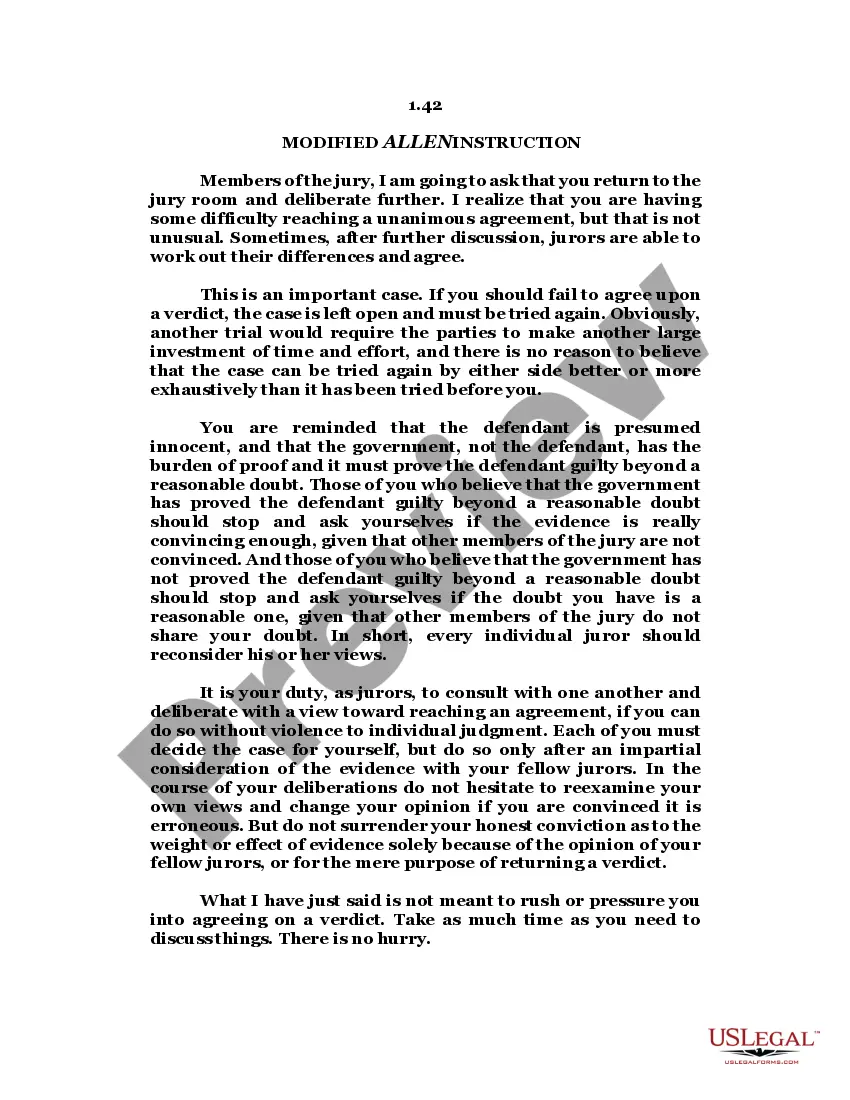
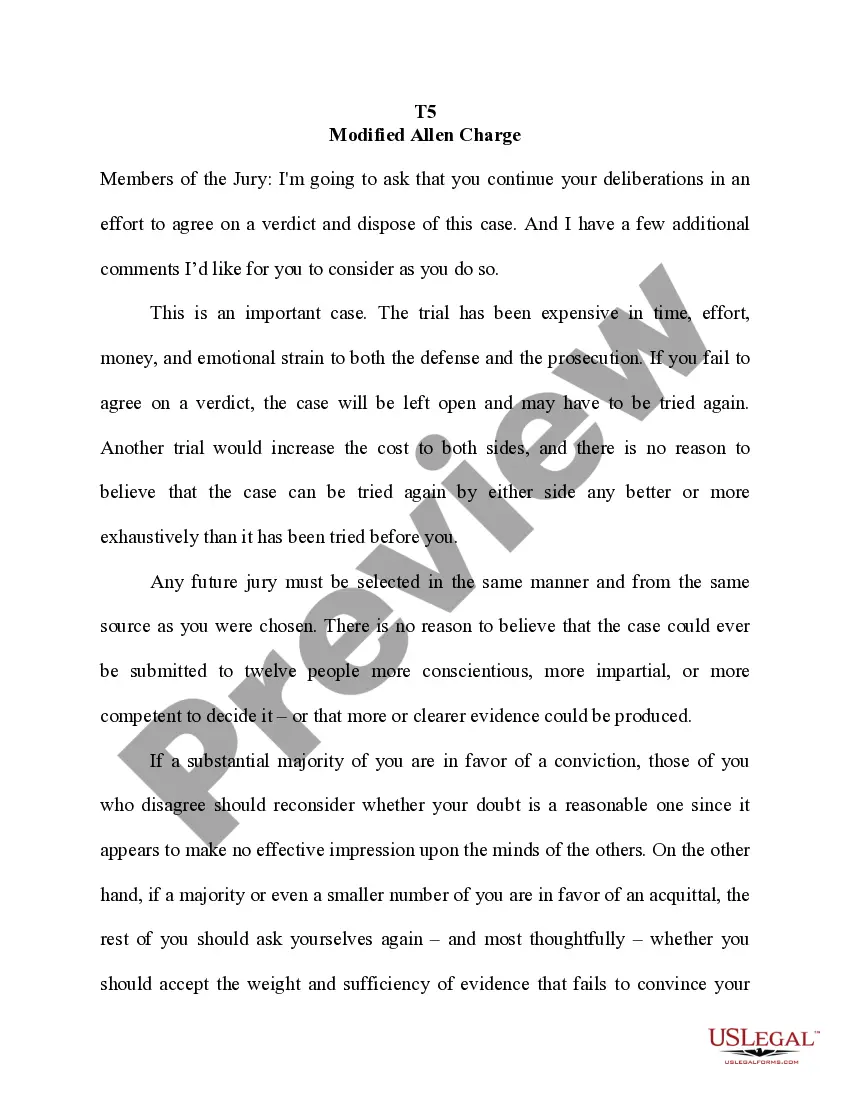
The Modified Allen Instruction is a legal guideline provided to a jury when they appear to be deadlocked in reaching a unanimous verdict. This instruction encourages jurors to continue deliberating, highlighting the importance of the case and urging them to reconsider their viewpoints. It emphasizes that reaching a verdict is crucial to avoid a retrial, which could be costly and time-consuming for all parties involved. This form is distinct as it combines elements of jury instructions with encouragement for open-mindedness during deliberations, aimed specifically at resolving deadlocks in jury discussions.
Key components of this form
- Encouragement for jurors to deliberate further.
- Reminders of the defendant's presumption of innocence and the government's burden of proof.
- Instructions for jurors to consider each other's opinions while maintaining their own convictions.
- Guidance to take the necessary time for discussions without pressure to agree.
- Caution against relinquishing honest opinions for the sake of reaching a verdict.
When to use this form
This form is utilized when a jury indicates they are unable to reach a unanimous verdict, also known as an impasse. The Modified Allen Instruction is appropriate in situations where the court believes that with further deliberation, the jury may be able to resolve their differences and arrive at a consensus. It is particularly relevant in criminal trials where the outcome significantly impacts the parties involved.
Who can use this document
- Judges overseeing a jury trial that has reached a deadlock.
- Legal practitioners who provide guidance to juries on their deliberation processes.
- Court clerks or other legal staff involved in jury management.
How to prepare this document
- Assess the current state of jury deliberations to confirm deadlock.
- Present the Modified Allen Instruction to the jury clearly and calmly.
- Allow jurors time to discuss the instruction amongst themselves.
- Encourage jurors to reflect on their own opinions while considering those of their fellow jurors.
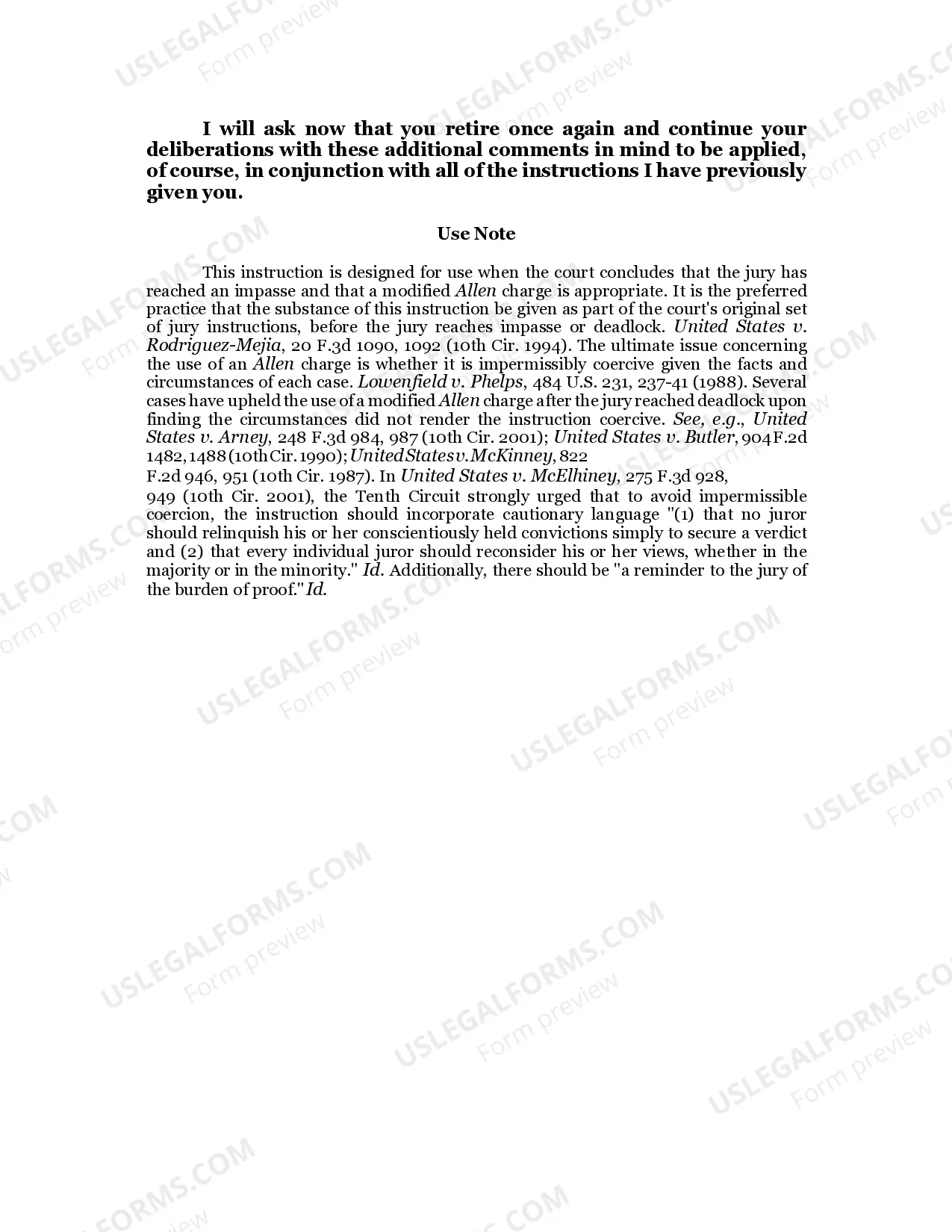
- Monitor the jury's progress and allow them to return to deliberation with the instruction in mind.
Notarization guidance
This form usually doesn’t need to be notarized. However, local laws or specific transactions may require it. Our online notarization service, powered by Notarize, lets you complete it remotely through a secure video session, available 24/7.
Get your form ready online
Our built-in tools help you complete, sign, share, and store your documents in one place.
Make edits, fill in missing information, and update formatting in US Legal Forms—just like you would in MS Word.
Download a copy, print it, send it by email, or mail it via USPS—whatever works best for your next step.
Sign and collect signatures with our SignNow integration. Send to multiple recipients, set reminders, and more. Go Premium to unlock E-Sign.
If this form requires notarization, complete it online through a secure video call—no need to meet a notary in person or wait for an appointment.
We protect your documents and personal data by following strict security and privacy standards.

Make edits, fill in missing information, and update formatting in US Legal Forms—just like you would in MS Word.

Download a copy, print it, send it by email, or mail it via USPS—whatever works best for your next step.

Sign and collect signatures with our SignNow integration. Send to multiple recipients, set reminders, and more. Go Premium to unlock E-Sign.

If this form requires notarization, complete it online through a secure video call—no need to meet a notary in person or wait for an appointment.

We protect your documents and personal data by following strict security and privacy standards.
Common mistakes
- Failing to provide the instruction clearly, causing confusion among jurors.
- Rushing jurors to reach a verdict before they are ready.
- Neglecting to emphasize the importance of the presumption of innocence during the instruction.
Advantages of online completion
- Convenient access to legally vetted instructions anytime, enhancing courtroom efficiency.
- Editable templates that can be customized to meet jurisdictional requirements.
- Reliable source of legal documents drafted by licensed attorneys.
Legal use & context
- The Modified Allen Instruction is widely recognized and utilized within the U.S. legal system.
- It serves to prevent mistrial outcomes when juries are deadlocked, aiming for fair resolution without coercion.
- It should be carefully crafted to avoid undue pressure on jurors, ensuring voluntary agreement on the verdict.
Key takeaways
- The Modified Allen Instruction helps juries overcome deadlocks without coercion.
- Jurors should maintain honest convictions while being open to discussion.
- This instruction emphasizes the duty of jurors to reach a fair verdict based on evidence presented.
Looking for another form?





Form popularity
FAQ
If there is a hung jury, the judge may order the jurors to deliberate further. This is known as an Allen charge and is generally only given once or twice. Often, juries will report that they are deadlocked after only deliberating for a short period of time.
Allen Charge refers to a set of instructions given to a jury when, after deliberation, it is unable to decide on a verdict. The purpose of the instruction is to encourage jurors to re-examine their opinions and attempt to reach a unanimous verdict if possible. Allen Charge is named after the case, Allen v.
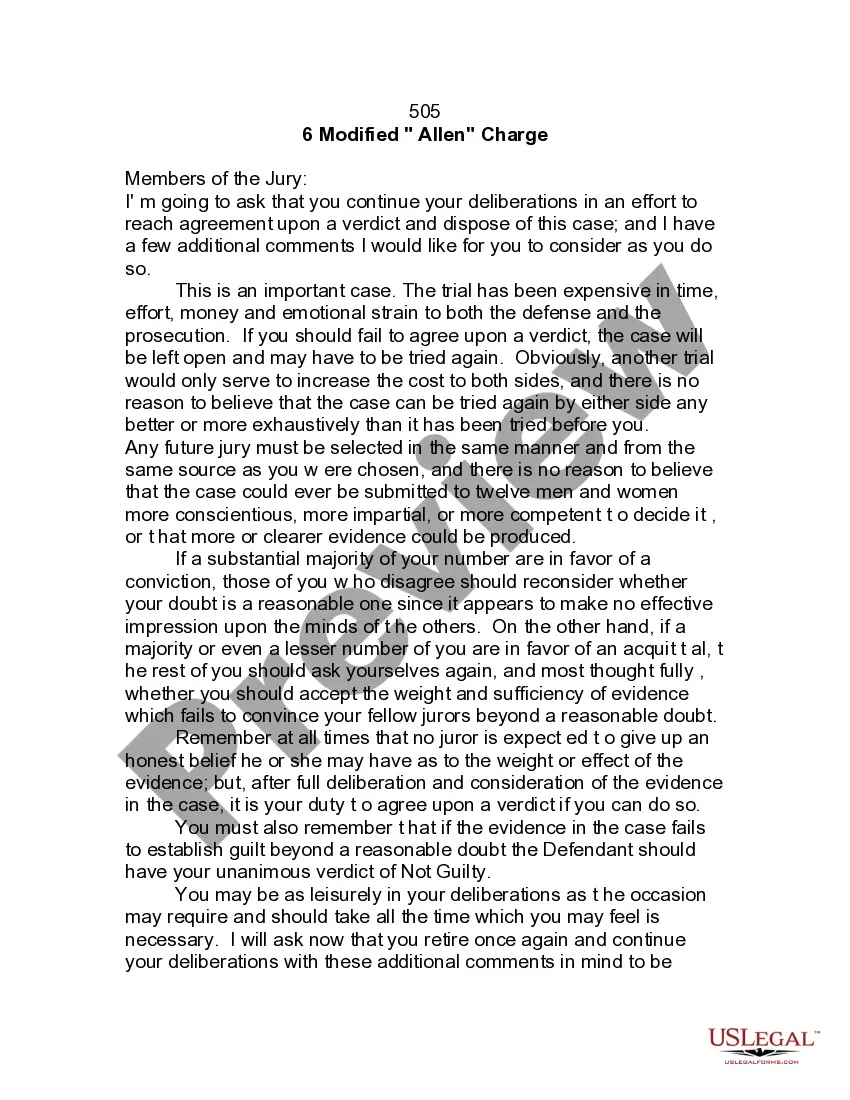
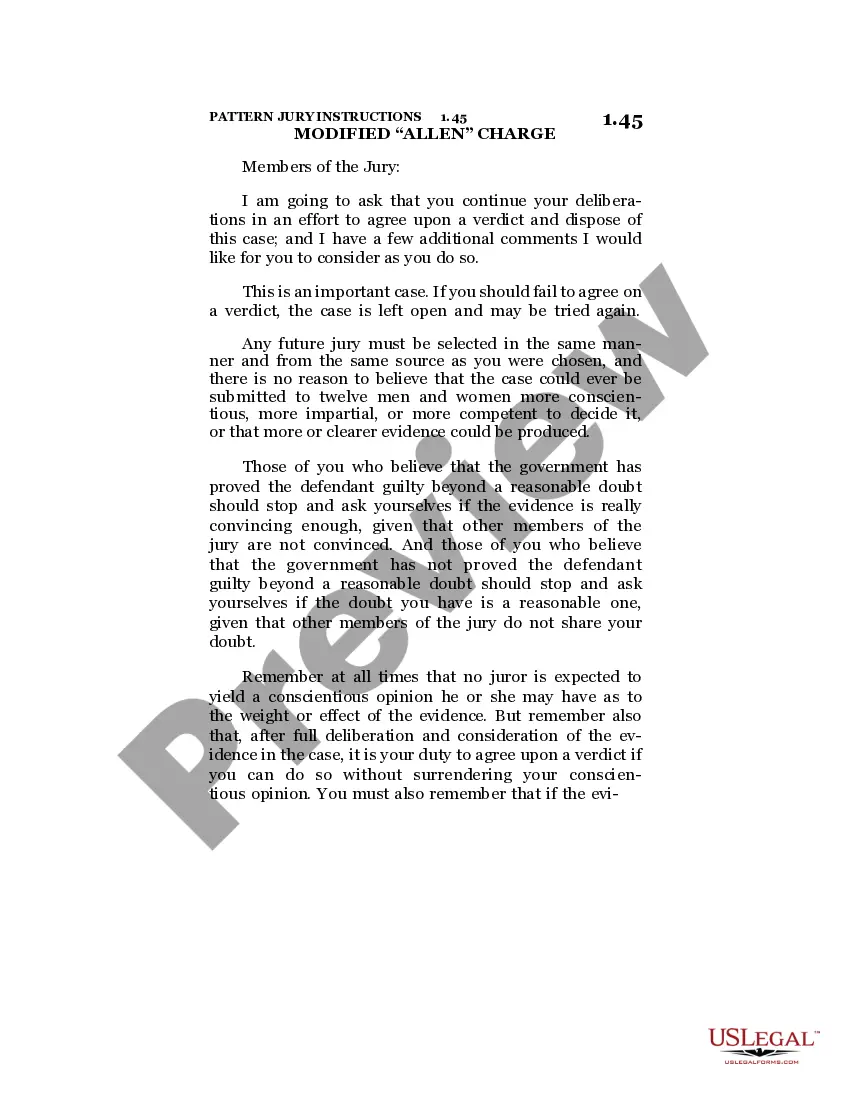
An example of a modified Allen Charge follows: Members of the Jury: I'm going to ask that you continue your deliberations in an effort to reach agreement upon a verdict and dispose of this case; and I have a few additional comments I would like for you to consider as you do so. This is an important case.
When jurors cannot agree on a verdict and report this to a judge, the judge may issue further instruction to them to encourage those in the minority to reconsider their position. These instructions are known as an Allen charge or, more casually, as a dynamite charge.
Allen charges (also referred to as dynamite, nitroglycerin, shotgun, or third-degree charges) refer to jury instructions given to a hung jury urging them to agree on a verdict.
Named after the case Allen vs. United States, 164 U.S. 492 (1896), an Allen charge is a supplemental jury instruction given by the court to encourage a dead-locked jury to try harder to reach a verdict.