Document and Information Request List for Secondary Stock Offering
What this document covers
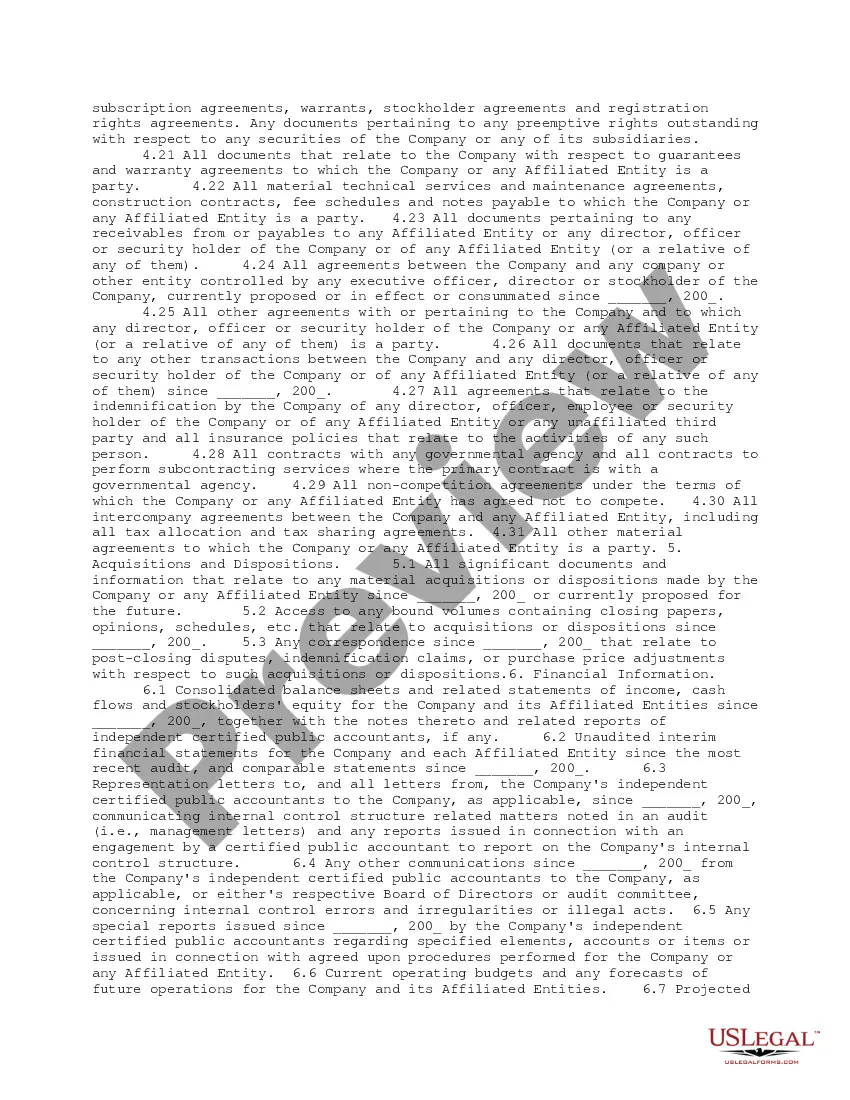
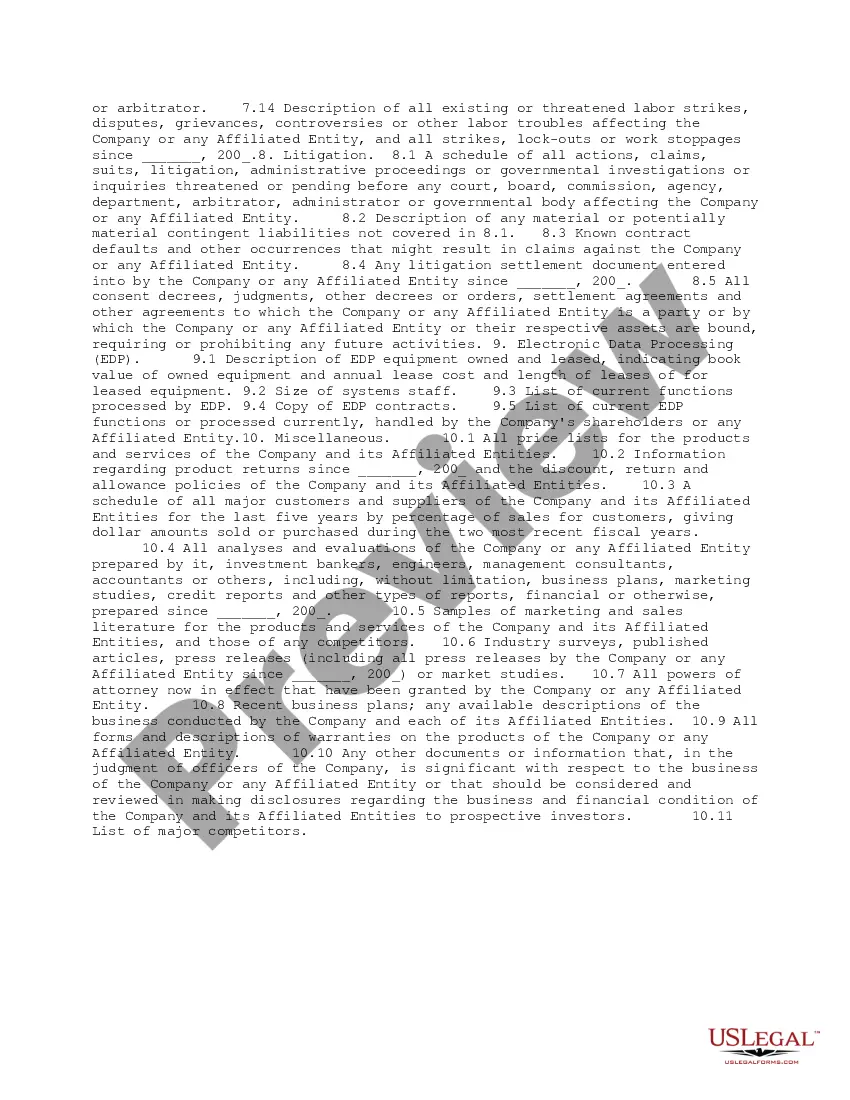
The Document and Information Request List for Secondary Stock Offering is a comprehensive checklist designed for companies preparing for a proposed public offering of common stock. This form helps organize the due diligence process by listing the necessary documents that must be gathered and submitted to the due diligence team. Unlike similar forms used during an Initial Public Offering, this request list focuses on updating information that may have changed since the initial offering, ensuring that all relevant and current data is considered for the secondary offering.
Key components of this form
- Request for corporate records, including articles of incorporation and bylaws.
- List of governmental regulations and filings relevant to the company's securities.
- Detailed documentation of financings, including loan agreements and credit arrangements.
- Information on material agreements that may affect the company's stock offering.
- Financial information, including consolidated balance sheets and financial statements.
- Litigation history and any pending legal issues impacting the company.







When to use this form
This form is necessary when a company is preparing for a secondary stock offering and needs to conduct thorough due diligence. It ensures that all relevant information is collected to provide potential investors with a clear understanding of the company's current state and financial health. Businesses should use this form when they have made significant changes to their operations, structure, or financial situation since their initial public offering.
Who can use this document
The following individuals and entities should consider using this form:
- Corporate executives and management teams preparing for a secondary stock offering.
- Legal teams or attorneys responsible for gathering due diligence documentation.
- Investment banks or financial advisors conducting due diligence for their clients.
- Compliance officers ensuring that all regulatory requirements are met.
How to complete this form
- Identify the firm responsible for the due diligence process and enter the name and details in the designated fields.
- Gather corporate records, including articles of incorporation and bylaws, as listed in the form.
- Compile financial documents, including recent balance sheets and income statements, as indicated.
- Collect governmental filings and any legal correspondence relevant to compliance and regulations.
- Review and update any previous documents gathered during the Initial Public Offering to ensure completeness.
- Submit the completed request list and all requested documents to the due diligence team.
Notarization guidance
This form does not typically require notarization unless specified by local law. However, it is advisable to consult with a legal professional to ensure compliance with any specific requirements relevant to your jurisdiction.
Get your form ready online
Our built-in tools help you complete, sign, share, and store your documents in one place.
Make edits, fill in missing information, and update formatting in US Legal Forms—just like you would in MS Word.
Download a copy, print it, send it by email, or mail it via USPS—whatever works best for your next step.
Sign and collect signatures with our SignNow integration. Send to multiple recipients, set reminders, and more. Go Premium to unlock E-Sign.
If this form requires notarization, complete it online through a secure video call—no need to meet a notary in person or wait for an appointment.
We protect your documents and personal data by following strict security and privacy standards.

Make edits, fill in missing information, and update formatting in US Legal Forms—just like you would in MS Word.

Download a copy, print it, send it by email, or mail it via USPS—whatever works best for your next step.

Sign and collect signatures with our SignNow integration. Send to multiple recipients, set reminders, and more. Go Premium to unlock E-Sign.

If this form requires notarization, complete it online through a secure video call—no need to meet a notary in person or wait for an appointment.

We protect your documents and personal data by following strict security and privacy standards.
Common mistakes to avoid
- Failing to gather all required documents, leading to delays in the due diligence process.
- Submitting outdated information that does not reflect the current status of the company.
- Neglecting to identify all relevant subsidiaries and affiliated entities for comprehensive reporting.
- Overlooking regulatory filings specific to the state where the offering will occur.
Why complete this form online
- Convenient access to essential documentation templates from anywhere.
- Editable form structure allows for customization based on specific company needs.
- Time-saving organization of information in a single document enhances the due diligence process.
- Easy updates as new documents become available or existing information changes.
Legal use & context
- This form serves as a formal request for updated due diligence information, essential for compliance with SEC regulations.
- Usage of this form can help mitigate legal risks associated with public offerings by ensuring all necessary information is collected and reviewed.
What to keep in mind
- The Document and Information Request List is essential for companies planning secondary stock offerings.
- Complete documentation facilitates a smoother due diligence process.
- Understanding state-specific requirements is crucial for compliance.
- Identifying key stakeholders helps streamline the information gathering process.
Looking for another form?


Form popularity
FAQ
Follow-on offerings can dilute existing shares considerably if the offering comes from the company because new shares are being created. Follow-on offerings from existing shareholders, however, do not dilute existing shares. Thus, it's important to know who the seller is.
To invite public to invest in the company shares. For the advertisement of an organization. For providing details of the share offer. To inform the public about investment security, so that the relevant public could make a more thoughtful and informed decision about investment.
A prospectus includes some of the following information: A brief summary of the company's background and financial information. The name of the company issuing the stock. The number of shares.
A prospectus is defined as a legal document describing a company's securities that have been put on sale. The prospectus generally discloses the company's operations along with the purpose of the securities being offered.
Organize your flow. The first step is outlining your document. Boast your credentials. Define your market niche. Know your investor perks & work 'em. Don't be shy about the risks. Research comps. Finally, get some cold hard numbers. Design with intention.
When a company makes a secondary offering, it's issuing more stock for sale, and that will bring down the price of the stock.With interest rates at or near historic lows, "Companies have been issuing equity to either pay down debt or to refinance it with cheaper debt that carries a lower interest rate," Cramer said.
A secondary offering is not dilutive to existing shareholders since no new shares are created. The proceeds from the sale of the securities do not benefit the issuing company in any way.In a follow-on offering, the company itself places new shares onto the market, thus diluting the existing shares.
Information in the final prospectus includes the number of shares issued, offering price, company's financial data. These three core statements are, risk factors, use of the proceeds, the dividend policy, and other relevant information.
A secondary offering is the sale of new or closely held shares by a company that has already made an initial public offering (IPO). There are two types of secondary offerings.The proceeds from this sale are paid to the stockholders that sell their shares.