Capital Markets Mortgage
About this form
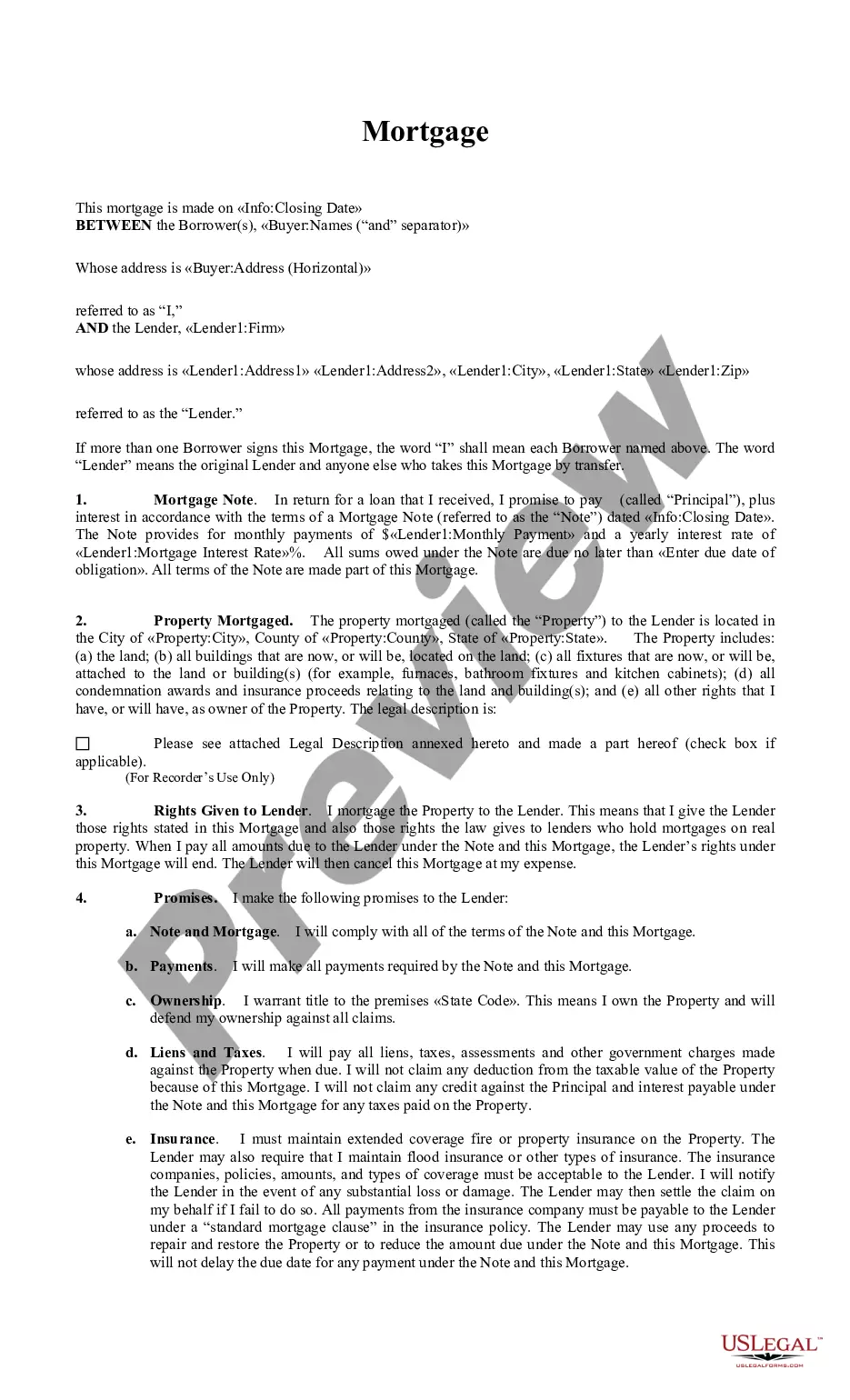
The Capital Markets Mortgage is a specialized legal document used in commercial real estate transactions. Crafted by industry professionals, it serves to secure loans related to small commercial properties. Unlike standard mortgages, this form is designed to facilitate securitization in the capital markets by providing a consistent framework for lenders and borrowers. It details the obligations, rights, and security structure involved in the mortgage process, relevant to those participating in commercial real estate financing.
Key parts of this document
- Definitions that clarify key legal terms and phrases used throughout the document.
- Details on property mortgaged, including descriptions of land and improvements.
- Terms outlining borrower obligations, including payment schedules and maintenance responsibilities.
- Clauses regarding insurance requirements and the handling of taxes associated with the property.
- Conditions related to any events of default and the lender's rights to remedies.
Common use cases
This form is typically used when securing a mortgage for small commercial properties that are intended to be pooled for secondary market transactions. It is necessary for borrowers who aim to facilitate better access to capital through structured, rated mortgage documents, particularly those seeking to refinance or purchase commercial real estate with lending support.
Who should use this form
- Commercial property owners looking to secure financing.
- Lenders in the commercial mortgage market who require a standardized document.
- Investors in commercial real estate who need clear documentation for securitization.
- Real estate professionals and attorneys involved in the drafting and reviewing of mortgage agreements.
How to complete this form
- Identify the borrower and lender, including legal names and addresses.
- Clearly describe the property being mortgaged, detailing its location and any relevant improvement specifics.
- Specify the loan amount and outline the payment terms as per the agreement.
- Detail insurance requirements and ensure compliance with all necessary laws related to the property.
- Include signature sections for both parties to confirm the acceptance of the terms outlined in the mortgage.
Does this form need to be notarized?
This form must be notarized to be legally valid. US Legal Forms provides secure online notarization powered by Notarize, allowing you to complete the process through a verified video call.
Get your form ready online
Our built-in tools help you complete, sign, share, and store your documents in one place.
Make edits, fill in missing information, and update formatting in US Legal Forms—just like you would in MS Word.
Download a copy, print it, send it by email, or mail it via USPS—whatever works best for your next step.
Sign and collect signatures with our SignNow integration. Send to multiple recipients, set reminders, and more. Go Premium to unlock E-Sign.
If this form requires notarization, complete it online through a secure video call—no need to meet a notary in person or wait for an appointment.
We protect your documents and personal data by following strict security and privacy standards.

Make edits, fill in missing information, and update formatting in US Legal Forms—just like you would in MS Word.

Download a copy, print it, send it by email, or mail it via USPS—whatever works best for your next step.

Sign and collect signatures with our SignNow integration. Send to multiple recipients, set reminders, and more. Go Premium to unlock E-Sign.

If this form requires notarization, complete it online through a secure video call—no need to meet a notary in person or wait for an appointment.

We protect your documents and personal data by following strict security and privacy standards.
Mistakes to watch out for
- Failing to accurately describe the property, which can complicate the security interest.
- Omitting necessary signatures or dates, rendering the document unenforceable.
- Not adhering to local laws governing the execution of mortgage documents.
- Neglecting to review the obligations outlined in the mortgage, leading to potential defaults.
Why use this form online
- Convenient access to the form anytime, from anywhere, facilitating quick completion.
- Editability allows for easy customization to meet specific transaction needs.
- Reliability of the format, ensuring compliance with legal requirements for documentation.
- Streamlined processes through integrated online features for notarization and filing.
Looking for another form?
Form popularity
FAQ
A primary mortgage lender makes money from the loan processing fees rather than the interest paid on the loan. These primary lenders often lend money to customers and then sell a large number of the notes to investors in the secondary market.Other private banks or financial institutions also buy mortgage notes.
Most capital market instruments, including mortgages (loans on real estate collateralProperty pledged as security for the repayment of a loan.), corporate bonds, government bonds, and commercial and consumer loans, have fixed maturities ranging from a year to several hundred years, though most capital market
The Nigerian capital market is principally a market for long-term investments where corporate equities and long-term debt securities are issued and traded. It is a market that is regulated by the Securities and Exchange Commission (SEC), which is the apex regulatory body of the Nigerian Capital Market.
Definition: Capital market is a market where buyers and sellers engage in trade of financial securities like bonds, stocks, etc. The buying/selling is undertaken by participants such as individuals and institutions. Capital market consists of primary markets and secondary markets.
A capital market is an organized market in which both individuals and business entities buy and sell debt and equity securities.Examples of highly organized capital markets are the New York Stock Exchange, American Stock Exchange, London Stock Exchange, and NASDAQ.
Capital markets products include securities, units in a collective investment scheme (CIS), over-the-counter (OTC) derivatives, exchange-traded derivatives and spot foreign exchange for the purposes of leveraged foreign exchange trading.
When budgeting, businesses of all kinds typically focus on three types of capital: working capital, equity capital, and debt capital.
Capital markets refer to the places where savings and investments are moved between suppliers of capital and those who are in need of capital. Capital markets consist of the primary market, where new securities are issued and sold, and the secondary market, where already-issued securities are traded between investors.
The most common capital market securities include stocks, bonds, and real estate investment trusts (REITs). Money markets are the markets for financial products with maturities of less than one year.