Like Kind Exchange Clauses: Contract for Real Property
What is this form?
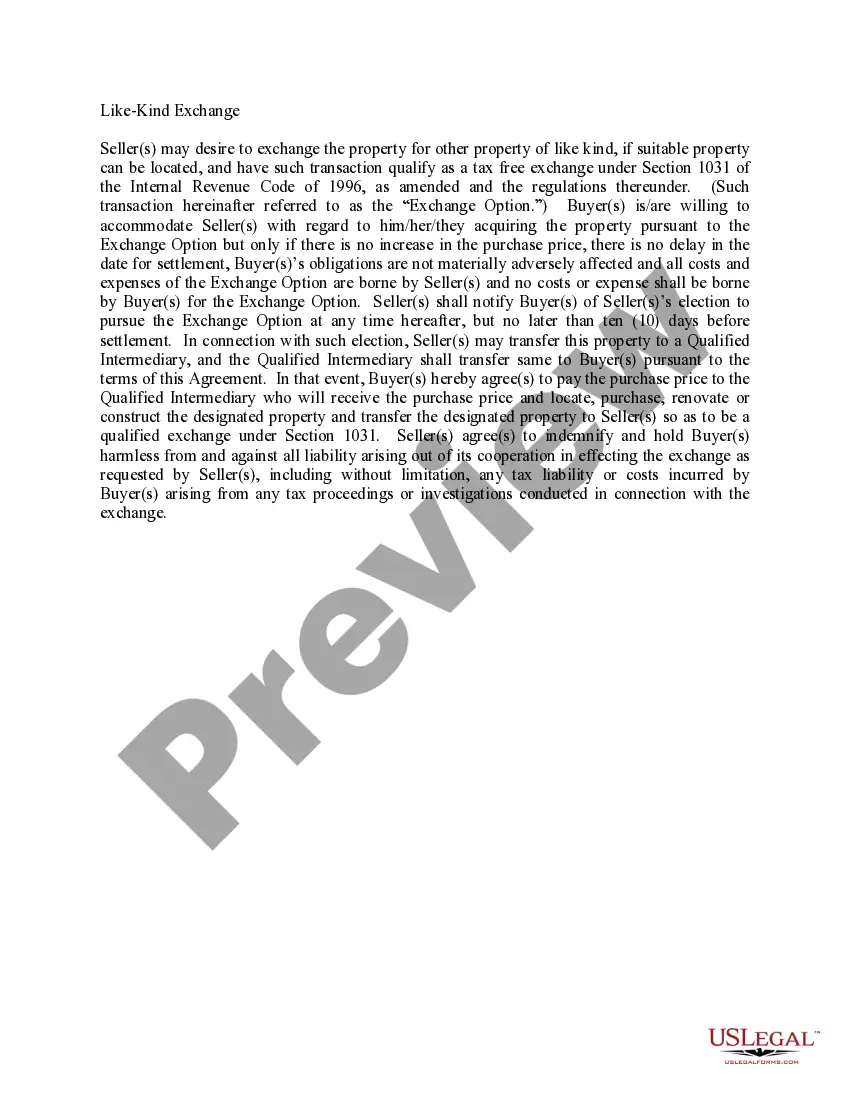
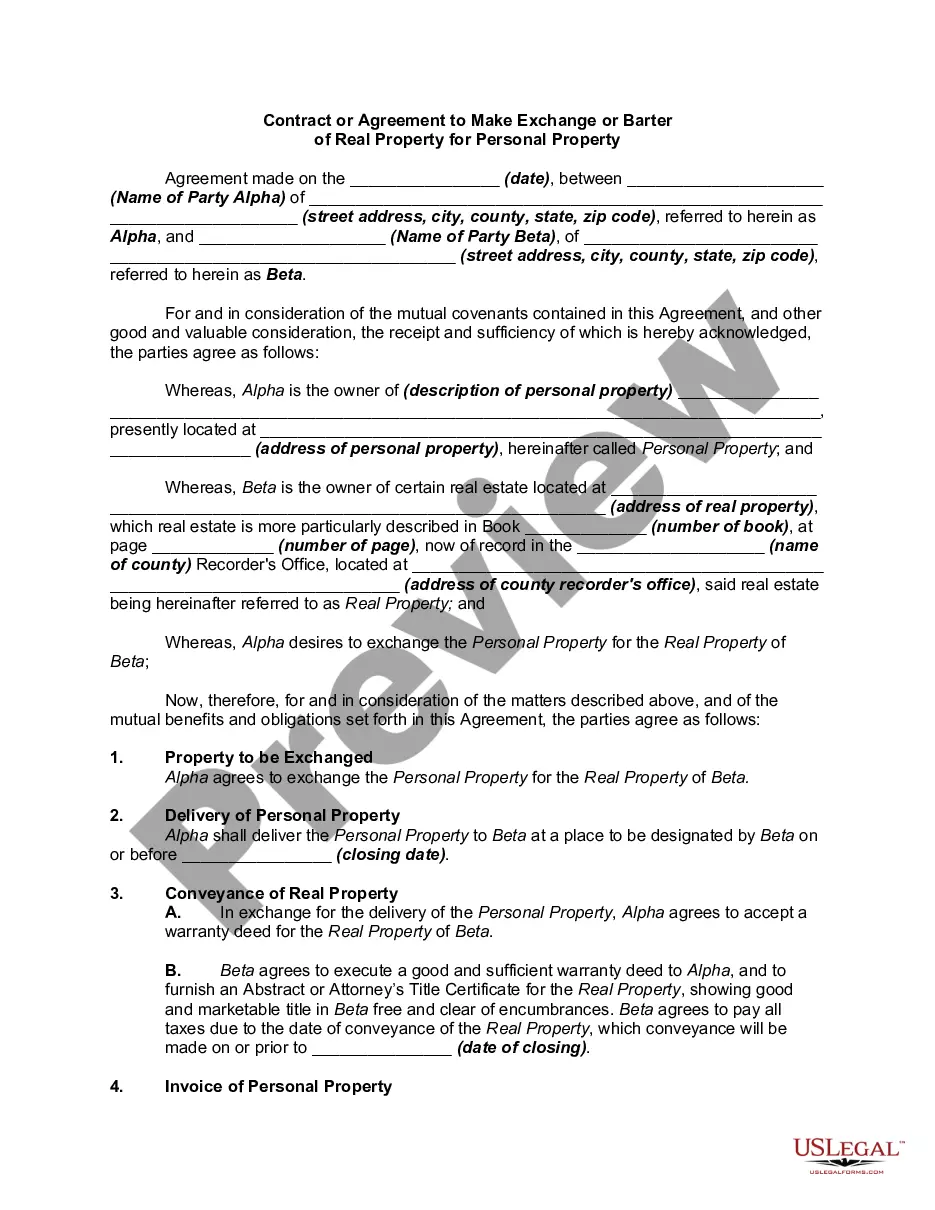
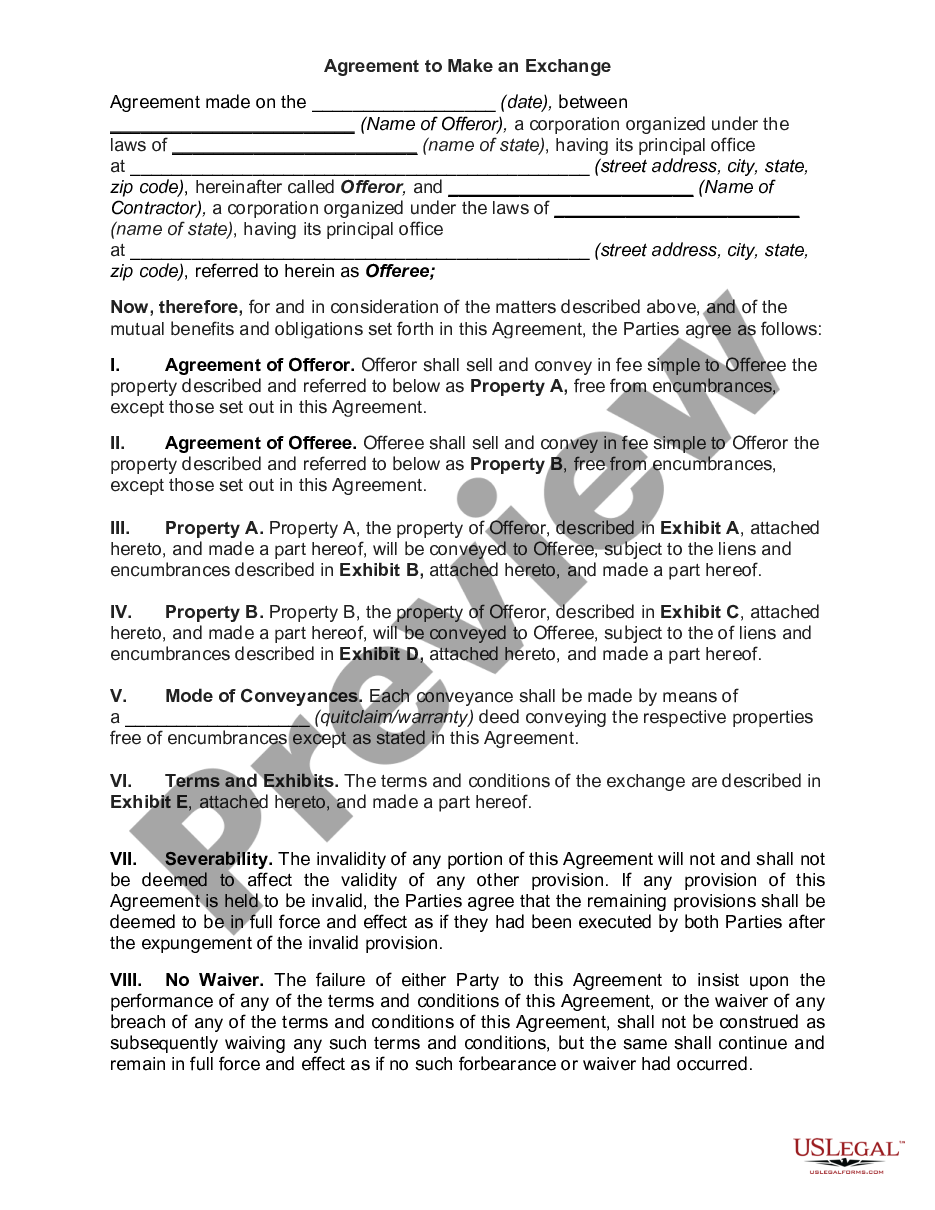
The Like Kind Exchange Clauses form is a legal document used in real estate transactions to facilitate a tax-deferred exchange of properties. This form outlines specific conditions under which a property seller can sell their property and acquire a new one that is of like kind, as allowed by Section 1031 of the Internal Revenue Code. It is essential for both buyers and sellers to understand their rights and obligations in the exchange process, distinguishing this form from standard real estate contracts by its focus on tax implications and exchange options.
Key components of this form
- Exchange Option: Specifies the conditions under which the seller may engage in a like-kind exchange.
- Buyer Cooperation: Stipulates the buyer's willingness to cooperate with the seller in the exchange process.
- Notification Requirement: Outlines the seller's obligation to notify the buyer about the intent to pursue the exchange.
- Indemnity Clause: Provides protection for the buyer against any liabilities arising from the exchange request.
When to use this document
This form should be used when a property seller wishes to take advantage of a tax-deferred exchange under Section 1031. It is particularly beneficial when the seller identifies a suitable like-kind property and needs to ensure that the buyer agrees to cooperate in facilitating the exchange without affecting the purchase price or settlement timeline. Common scenarios include investment properties being exchanged for other investment properties or commercial properties being swapped for similar commercial assets.
Who should use this form
This form is intended for:
- Property sellers seeking to defer capital gains tax through a like-kind exchange.
- Potential buyers willing to accommodate such exchanges in property transactions.
- Real estate agents and professionals involved in facilitating property exchanges.
Steps to complete this form
To complete this form, follow these steps:
- Identify the parties involved in the transaction, including the buyer and seller.
- Clearly specify the property that is the subject of the sale and any proposed like-kind properties involved in the exchange.
- Fill in the date by which the seller must notify the buyer about their intention to initiate the exchange.
- Ensure all indemnity terms are clearly stated, outlining the buyer's protections regarding liabilities from the exchange.
- Both parties should sign and date the form to make it legally binding.
Notarization guidance
This form does not typically require notarization unless specified by local law. It is recommended to check local regulations to confirm if notarization is necessary for the exchange-related documentation.
Get your form ready online
Our built-in tools help you complete, sign, share, and store your documents in one place.
Make edits, fill in missing information, and update formatting in US Legal Forms—just like you would in MS Word.
Download a copy, print it, send it by email, or mail it via USPS—whatever works best for your next step.
Sign and collect signatures with our SignNow integration. Send to multiple recipients, set reminders, and more. Go Premium to unlock E-Sign.
If this form requires notarization, complete it online through a secure video call—no need to meet a notary in person or wait for an appointment.
We protect your documents and personal data by following strict security and privacy standards.

Make edits, fill in missing information, and update formatting in US Legal Forms—just like you would in MS Word.

Download a copy, print it, send it by email, or mail it via USPS—whatever works best for your next step.

Sign and collect signatures with our SignNow integration. Send to multiple recipients, set reminders, and more. Go Premium to unlock E-Sign.

If this form requires notarization, complete it online through a secure video call—no need to meet a notary in person or wait for an appointment.

We protect your documents and personal data by following strict security and privacy standards.
Mistakes to watch out for
- Failing to notify the buyer within the required timeframe about the intent to pursue an exchange.
- Not clearly defining the like-kind properties, which can lead to confusion later in the transaction.
- Overlooking the indemnity clause, which can leave the buyer exposed to unexpected liabilities.
Benefits of completing this form online
- Convenience of completing the form online with guided instructions.
- Editability of the form allows users to customize it according to specific transaction needs.
- Reliability of using attorney-drafted templates, ensuring legal compliance and protection.
- The Like Kind Exchange Clauses form is designed to comply with federal tax regulations under Section 1031.
- It helps clarify obligations and requirements for both buyers and sellers, promoting smoother transactions.
- Using a properly drafted form reduces the likelihood of legal disputes related to property exchanges.
Summary of main points
- The Like Kind Exchange Clauses form is essential for facilitating tax-deferred property exchanges.
- It defines crucial terms in the exchange process, ensuring clear communication between the buyer and seller.
- Completing the form accurately is vital to protect all parties involved and fulfill legal requirements.
Looking for another form?
Form popularity
FAQ
Any real estate, except for one's own personal residence, is considered like-kind to any other real estate. Generally, any real estate property held for productive use in the trade or business or for investment qualifies for a like-kind exchange.
What Properties Are Not Considered Like-Kind? A Primary or Secondary Residence: An Exchanger's primary or secondary residence is not considered like kind and does not qualify for a 1031 exchange.
Property used primarily for personal use, like a primary residence or a second home or vacation home, does not qualify for like-kind exchange treatment. Both properties must be similar enough to qualify as "like-kind." Like-kind property is property of the same nature, character or class.
Securities, stocks, bonds, partnership interests, and other financial assets are excluded from the definition of like-kind property.
The Regulations allow identifying multiple properties. A Taxpayer may identify as many as 3 alternate properties of any value. If more than 3 properties are identified, the value of the 3 cannot exceed 200% of the value of the Relinquished Property unless 95% of the properties identified are acquired.
Under the Tax Cuts and Jobs Act, Section 1031 now applies only to exchanges of real property and not to exchanges of personal or intangible property. An exchange of real property held primarily for sale still does not qualify as a like-kind exchange.
Property used primarily for personal use, like a primary residence or a second home or vacation home, does not qualify for like-kind exchange treatment. Both properties must be similar enough to qualify as "like-kind." Like-kind property is property of the same nature, character or class.
Like-kind exchanges -- when you exchange real property used for business or held as an investment solely for other business or investment property that is the same type or ?like-kind? -- have long been permitted under the Internal Revenue Code.