Mississippi Assertion of Right to Be Present
What this document covers
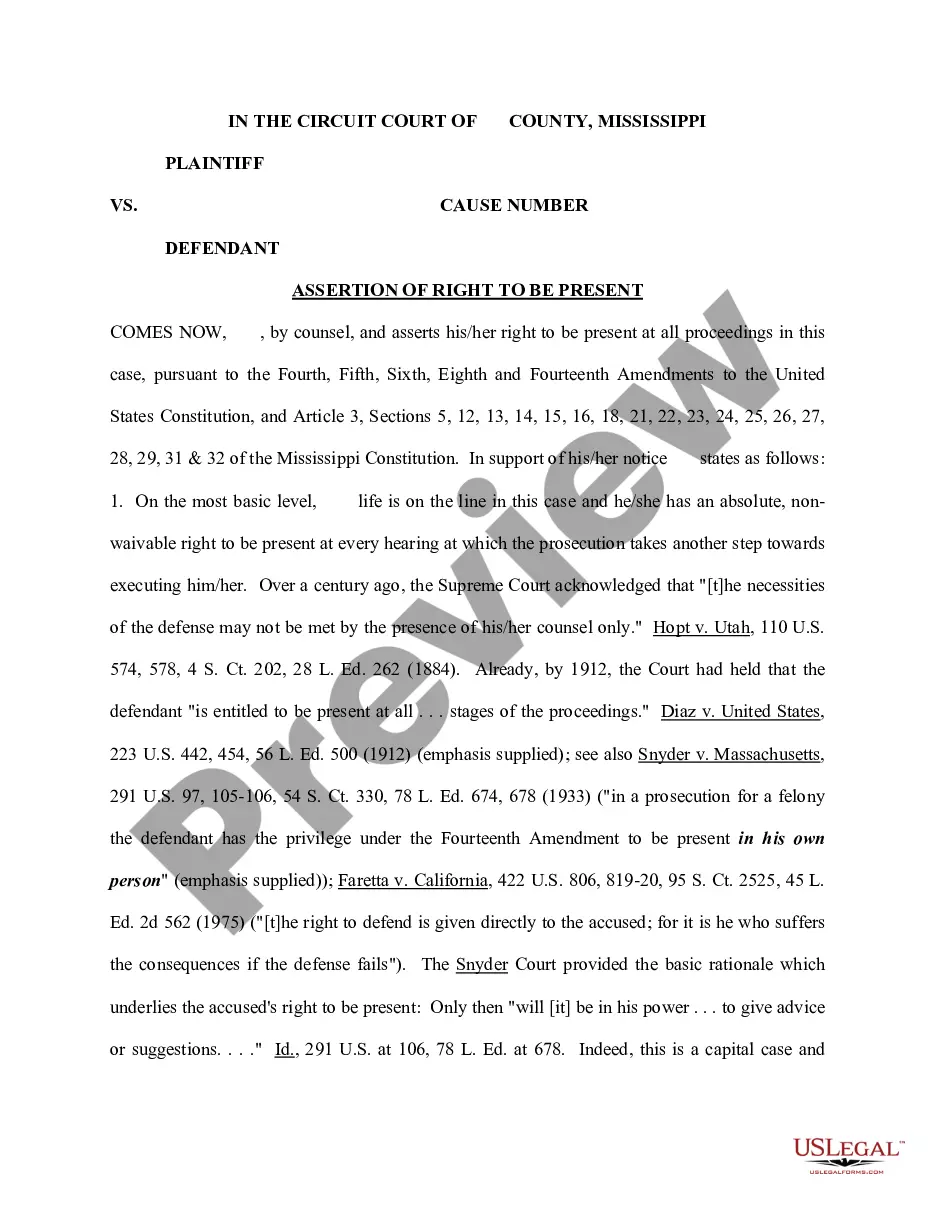
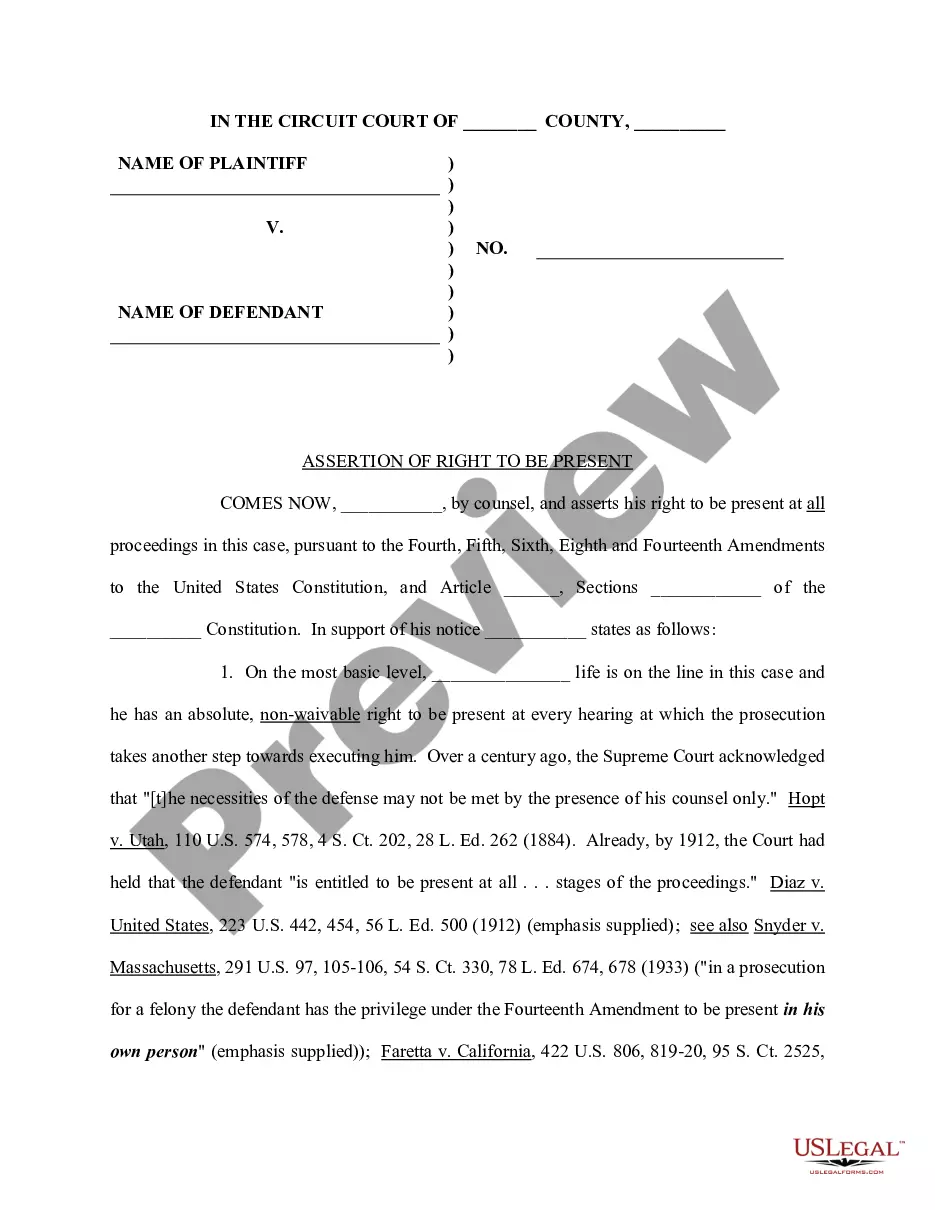
The Assertion of Right to Be Present is a legal document that affirms an individual's right to be physically present at various legal proceedings such as trials, depositions, and hearings. This form emphasizes a person's constitutional rights, ensuring they are included in all stages of their legal process. Unlike other forms that may focus on procedural matters, this form specifically addresses the fundamental right of presence as a crucial aspect of legal representation and fair trial rights.
Main sections of this form
- Identification of the plaintiff and defendant involved in the case.
- Citation of relevant constitutional amendments and legal precedents supporting the right to be present.
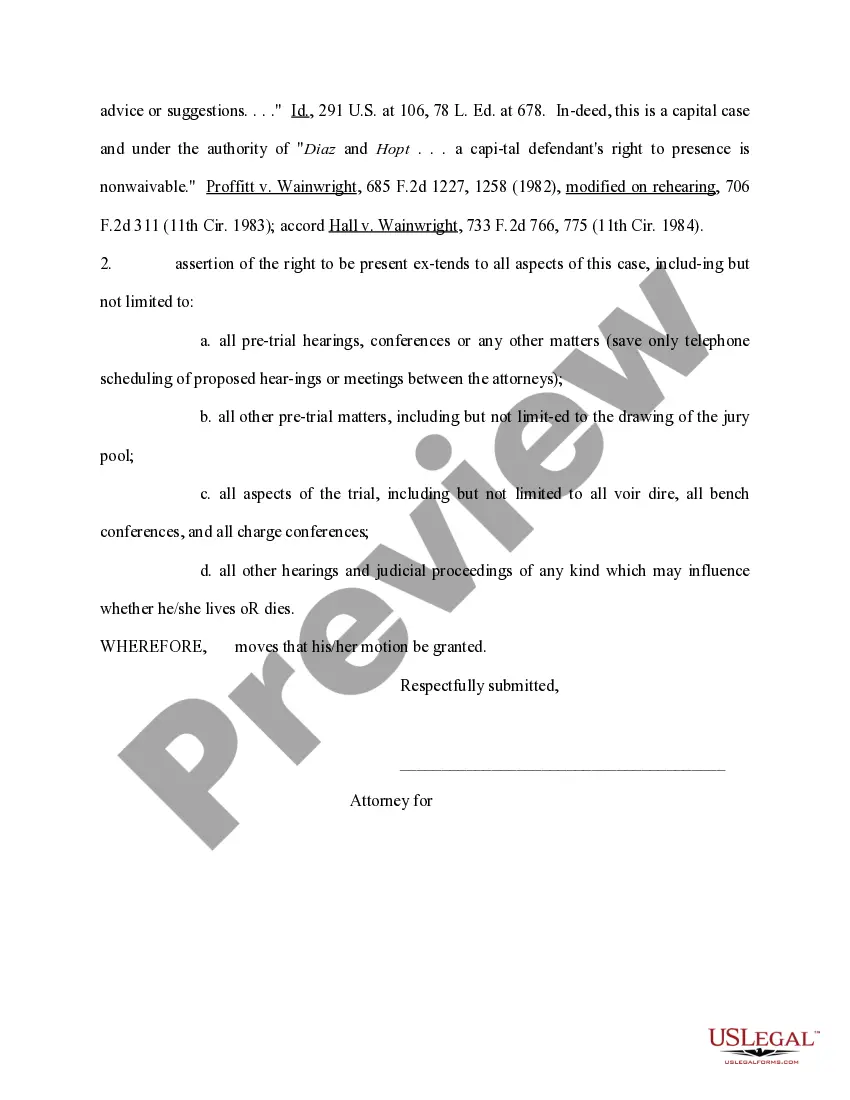
- Statements outlining the necessity of presence at all stages of the proceedings.
- A request for the court to grant the right to be present during all judicial activities.
- Signature of the attorney representing the individual making the assertion.
Situations where this form applies
This form should be used when an individual wants to ensure their presence at legal proceedings that affect their rights and outcomes, especially in serious cases such as capital offenses. Scenarios for its use include criminal trials, depositions, or various pre-trial hearings where the individual has a vested interest in the legal process.
Who this form is for
- Individuals facing serious legal charges, particularly in criminal cases.
- Defendants who seek to assert their right to personal presence in legal proceedings.
- Attorneys representing clients who require assurance of their client's attendance during critical hearings.
Steps to complete this form
- Identify the parties involved by entering the names of the plaintiff and defendant.
- Enter the cause number associated with the case.
- State the assertion of the right to be present clearly in the designated sections.
- Cite constitutional amendments and legal precedents that support your assertion.
- Include your attorneyâs signature and date at the end of the document.
Does this document require notarization?
This form does not typically require notarization unless specified by local law. However, consulting with a legal professional is advisable for specific situations or jurisdictions that may have different requirements.
Get your form ready online
Our built-in tools help you complete, sign, share, and store your documents in one place.
Make edits, fill in missing information, and update formatting in US Legal Forms—just like you would in MS Word.
Download a copy, print it, send it by email, or mail it via USPS—whatever works best for your next step.
Sign and collect signatures with our SignNow integration. Send to multiple recipients, set reminders, and more. Go Premium to unlock E-Sign.
If this form requires notarization, complete it online through a secure video call—no need to meet a notary in person or wait for an appointment.
We protect your documents and personal data by following strict security and privacy standards.

Make edits, fill in missing information, and update formatting in US Legal Forms—just like you would in MS Word.

Download a copy, print it, send it by email, or mail it via USPS—whatever works best for your next step.

Sign and collect signatures with our SignNow integration. Send to multiple recipients, set reminders, and more. Go Premium to unlock E-Sign.

If this form requires notarization, complete it online through a secure video call—no need to meet a notary in person or wait for an appointment.

We protect your documents and personal data by following strict security and privacy standards.
Common mistakes to avoid
- Failing to accurately identify all parties involved can lead to confusion or invalidation.
- Omitting relevant legal citations that support the assertion of rights may weaken the form's effectiveness.
- Not signing the form or having the attorney's signature missing can render the document incomplete.
Why complete this form online
- Convenient access to the form anytime, allowing for quick downloads and completions.
- Editability of the document enables personalization according to individual case needs.
- Reliable access to professionally drafted content tailored to legal standards.
Legal use & context
- The right to be present in legal proceedings is backed by established case law, ensuring defendants can participate actively in their defense.
- This form serves not only to assert rights but can also be a basis for appeals if the right to presence is violated.
- Utilizing this form appropriately is essential for securing procedural rights in legal contexts.
Main things to remember
- The Assertion of Right to Be Present form is vital for individuals ensuring their participation in critical legal proceedings.
- Accurate completion is crucial to uphold and protect constitutional rights within the judicial system.
- Understanding the formâs components and applicable state laws enhances its effectiveness and legal standing.
Looking for another form?
Form popularity
FAQ
In the criminal justice system, the term victim no longer merely describes a witness who the prosecution holds out to have suffered harm due to defendant's criminal conduct. Victim now defines an individual who is an independent participant in the criminal case under federal or state victims' rights laws.
Victims' rights are legal rights afforded to victims of crime. These may include the right to restitution, the right to a victims' advocate, the right not to be excluded from criminal justice proceedings, and the right to speak at criminal justice proceedings.
The criminal statute of limitations requires prosecutors to file criminal charges against a suspect within two years for misdemeanors and within five years for certain felonies, but there is no time limit in Mississippi for charges of murder, kidnapping, rape, burglary, robbery, larceny, and several other serious
The Right to Present the Defense Evidence Defendants are constitutionally entitled to: effectively present evidence central to their defense, call-witnesses to testify on their behalf, rebut evidence presented by the prosecution.
Remanded means that whatever was before the court was sent usually to a lower court but here it might be to a file.
Sixteen-year-old William Haymon has spent more than 500 days in an adult jail in rural Lexington, Mississippi. There are no state rules governing how long a person can be incarcerated without being formally charged with a crime.
5 Answers. Yes, you may call a defendant as a witness and compel the defendant to testify in a civil case.Also, when you call a defendant as a witness you may generally examine the witness with leading questions, which is something that you are not usually allowed to do with witnesses that you call in your own case.
The Act provides that 'identified' victims may be entitled to an order of restitution for certain losses suffered as a result of the commission of an offense, or losses that a defendant agrees to repay as part of a plea agreement. Victims may be either individuals or businesses.