Off Site Contamination Clauses: Contract for Real Property
Overview of this form
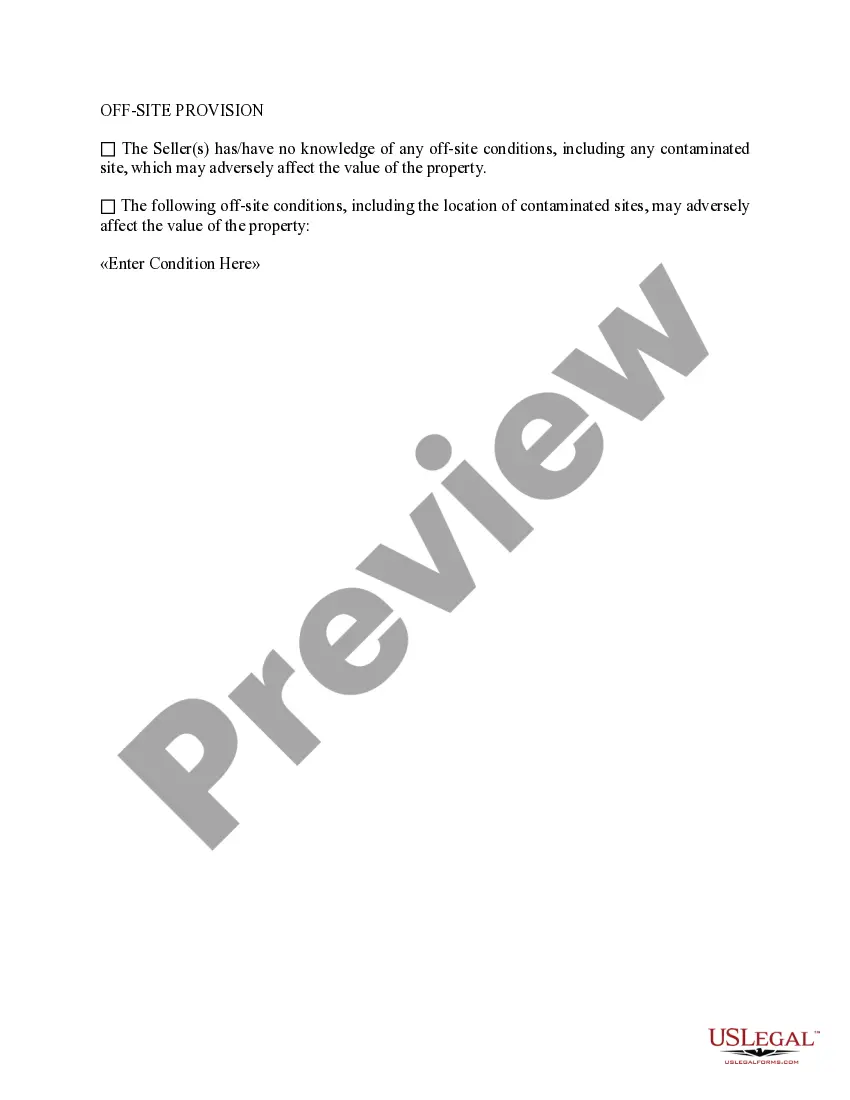
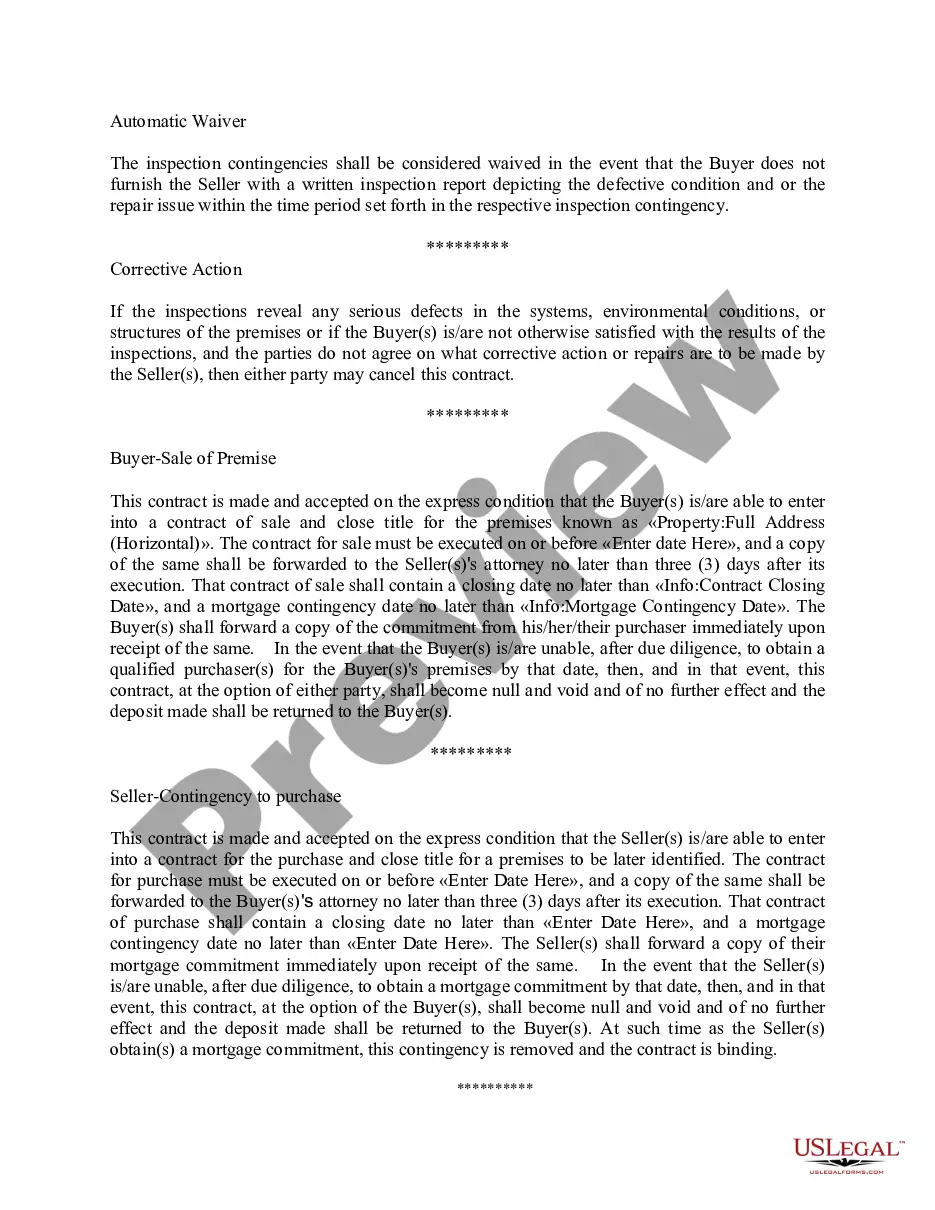
The Off Site Contamination Clauses: Contract for Real Property is a legal document used to outline the conditions regarding off-site contamination that may affect the value of real property. This form ensures that sellers disclose any known off-site conditions that could potentially diminish the property's value, providing crucial protection for the buyer. Unlike other real estate forms, this one specifically addresses environmental concerns and liability issues related to contamination from neighboring properties.
Main sections of this form
- Seller's disclosure of knowledge regarding off-site contamination.
- Identification of specific off-site conditions affecting property value.
- Legal language defining the enforceability of the contract clauses.
When to use this form
This form is used in real estate transactions when there is a need to address potential environmental contamination that may impact the property's value. It is particularly important when purchasing property near industrial areas, landfills, or sites previously used for hazardous materials. Buyers should use this form to protect their interests and ensure they are informed about any risks associated with off-site contamination.
Who can use this document
This form is intended for:
- Real estate sellers who are legally required to disclose environmental conditions.
- Buyers seeking to protect their investment in real property.
- Real estate agents facilitating transactions involving potentially contaminated properties.
Steps to complete this form
- Identify the parties involved in the transaction, including buyers and sellers.
- Specify the property address and any pertinent details related to the sale.
- Complete the section on seller's knowledge of off-site contamination and list any known conditions.
- Ensure all parties review and understand the clauses before signing.
- Sign and date the document to make it legally binding.
Does this document require notarization?
This form does not typically require notarization unless specified by local law. However, it is advisable to confirm any state-specific requirements regarding notarization to ensure its legal validity.
Get your form ready online
Our built-in tools help you complete, sign, share, and store your documents in one place.
Make edits, fill in missing information, and update formatting in US Legal Forms—just like you would in MS Word.
Download a copy, print it, send it by email, or mail it via USPS—whatever works best for your next step.
Sign and collect signatures with our SignNow integration. Send to multiple recipients, set reminders, and more. Go Premium to unlock E-Sign.
If this form requires notarization, complete it online through a secure video call—no need to meet a notary in person or wait for an appointment.
We protect your documents and personal data by following strict security and privacy standards.

Make edits, fill in missing information, and update formatting in US Legal Forms—just like you would in MS Word.

Download a copy, print it, send it by email, or mail it via USPS—whatever works best for your next step.

Sign and collect signatures with our SignNow integration. Send to multiple recipients, set reminders, and more. Go Premium to unlock E-Sign.

If this form requires notarization, complete it online through a secure video call—no need to meet a notary in person or wait for an appointment.

We protect your documents and personal data by following strict security and privacy standards.
Avoid these common issues
- Failing to disclose known off-site conditions.
- Leaving sections incomplete or vague regarding contamination knowledge.
- Not having all parties review the document thoroughly before signing.
Advantages of online completion
- Convenient access to legal templates drafted by licensed attorneys.
- Easy customization to fit specific property details.
- Secure storage and the ability to download forms instantly.
Looking for another form?
Form popularity
FAQ
Specific performance is the legal enforcement of a contract, typically after one party has breached the agreement. For example, a seller of a property executes a purchase agreement with a buyer and then decides they do not want to sell the property shortly thereafter.
Specific performance is a remedy in contract law that is most often applied in real estate litigation and disputes where a court issues an order requiring a party to perform a specific act, and to specifically perform ing to the terms of a contract.
A contractual remedy in which the court orders a party to actually perform its promise as closely as possible, because monetary damages are somehow inadequate to fix the harm. Most commonly ordered in cases involving real property and rare chattels.
Historically, under the Comprehensive Environmental Response, Compensation, and Liability Act (CERCLA, commonly known as Superfund), the owner or operator of a contaminated property could be held responsible for the property's cleanup, based solely on their current ownership of the property.
Adverse Environmental Condition means any violation of Environmental Laws applicable to the Properties including, without limitation, contamination or condition exceeding regulatory limits and not otherwise authorized by permit or law, resulting from any discharge, release, production, storage, treatment, seepage,
Remediation stands quite apart from restoration. This term applies to the thorough removal of pollutants or other potential contaminants from various types of location, to ensure ongoing safety. For example, mold remediation is a common solution sought out to tackle mold growth for lasting results.
A specific performance example is when a party defaults on its contractual obligation and is ordered by the court to fulfill said obligations. An alternative to the much more common award of monetary damages, specific performance is an injunction on a contract dispute often involving sensitive material or real estate.
Requirements for Specific Performance For a court to award specific performance as a remedy, several conditions must be met: A valid and binding contract must be in place. Monetary damages must be inadequate. Mutual obligation must be present, meaning both parties had duties to the other under the contract.