Mississippi Answer
Overview of this form
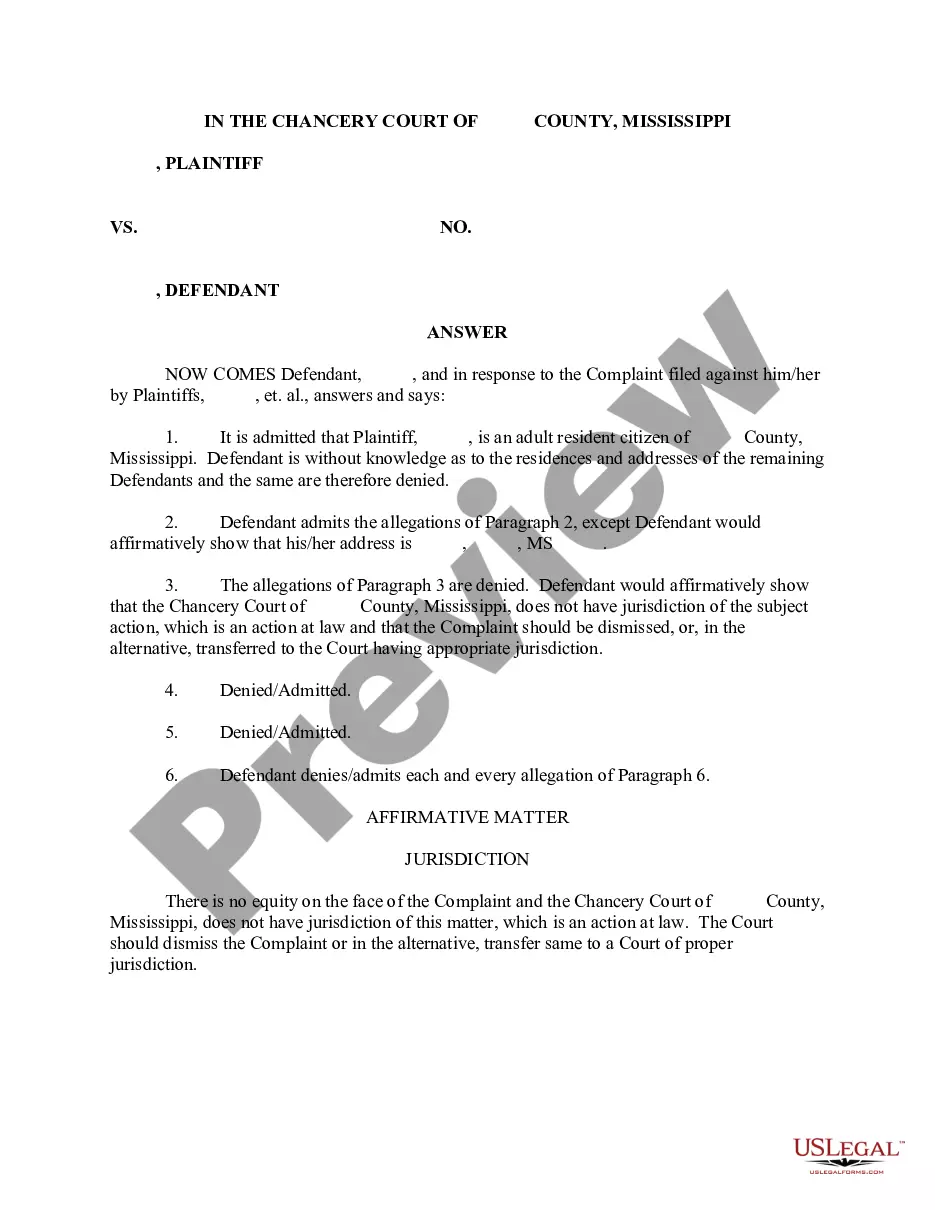
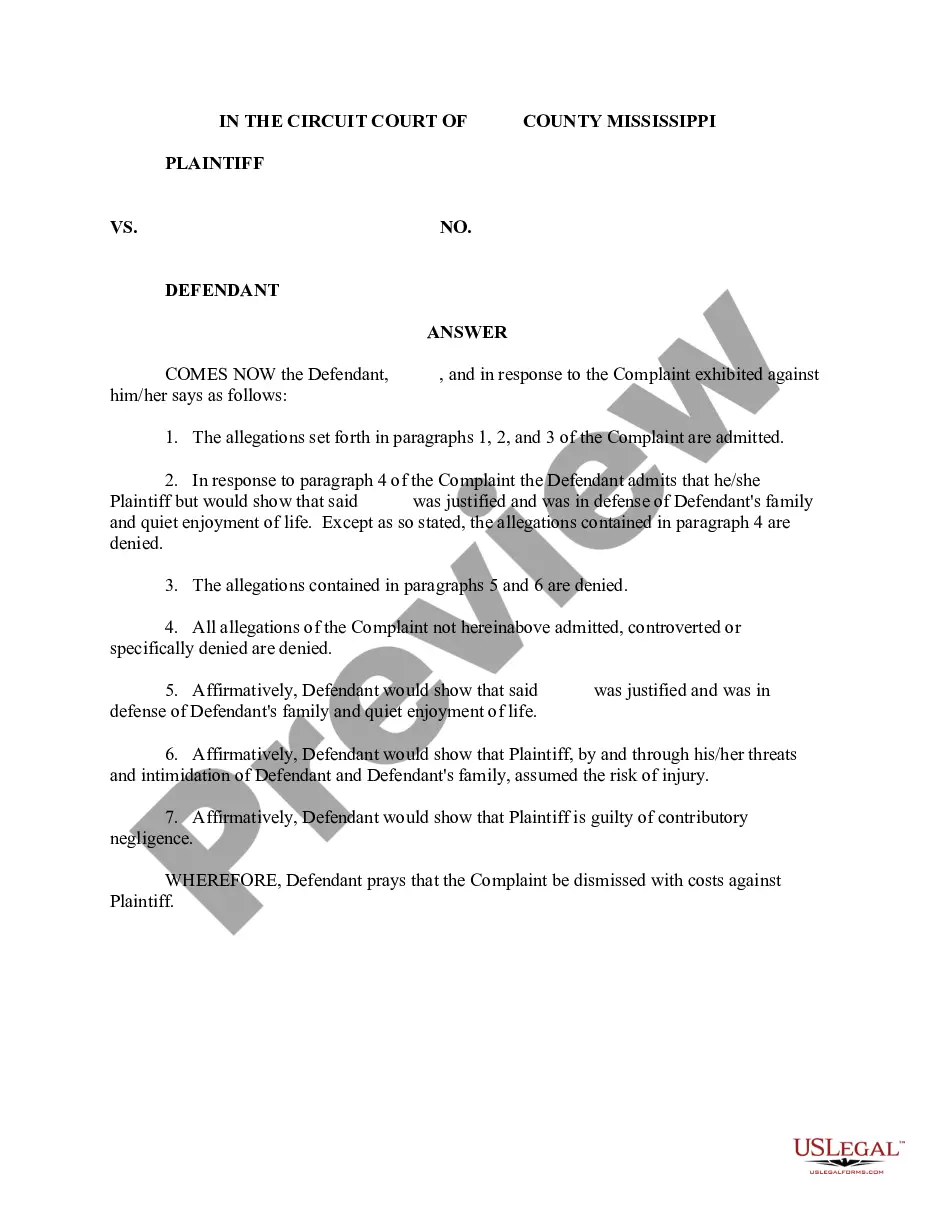
The Answer is a legal document used to respond to a Complaint in a property ownership dispute. This form allows the defendant to admit or deny allegations made by the plaintiff and to present affirmative defenses. The Answer differentiates itself from other legal forms by specifically addressing issues related to property ownership disagreements and providing a structured way for the defendant to respond to claims made in the lawsuit.
What’s included in this form
- Denial or admission of allegations: Indicates whether the defendant agrees with or disputes specific claims.
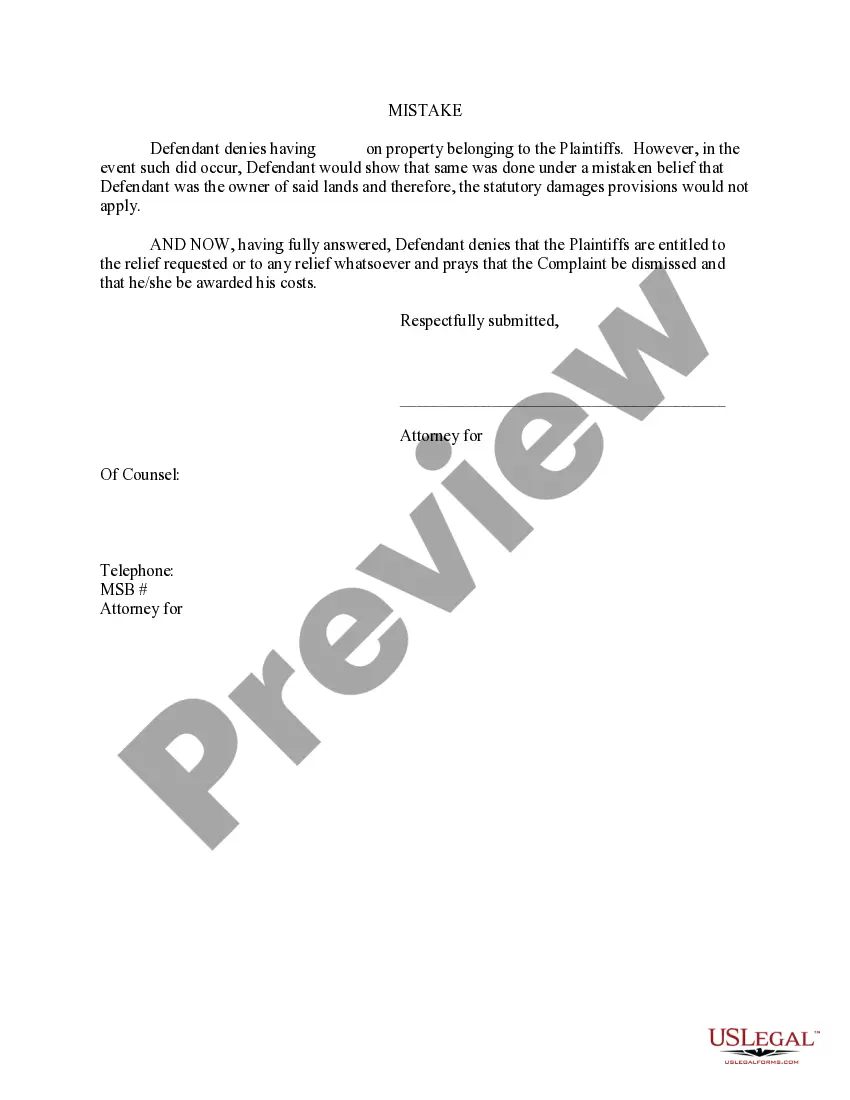
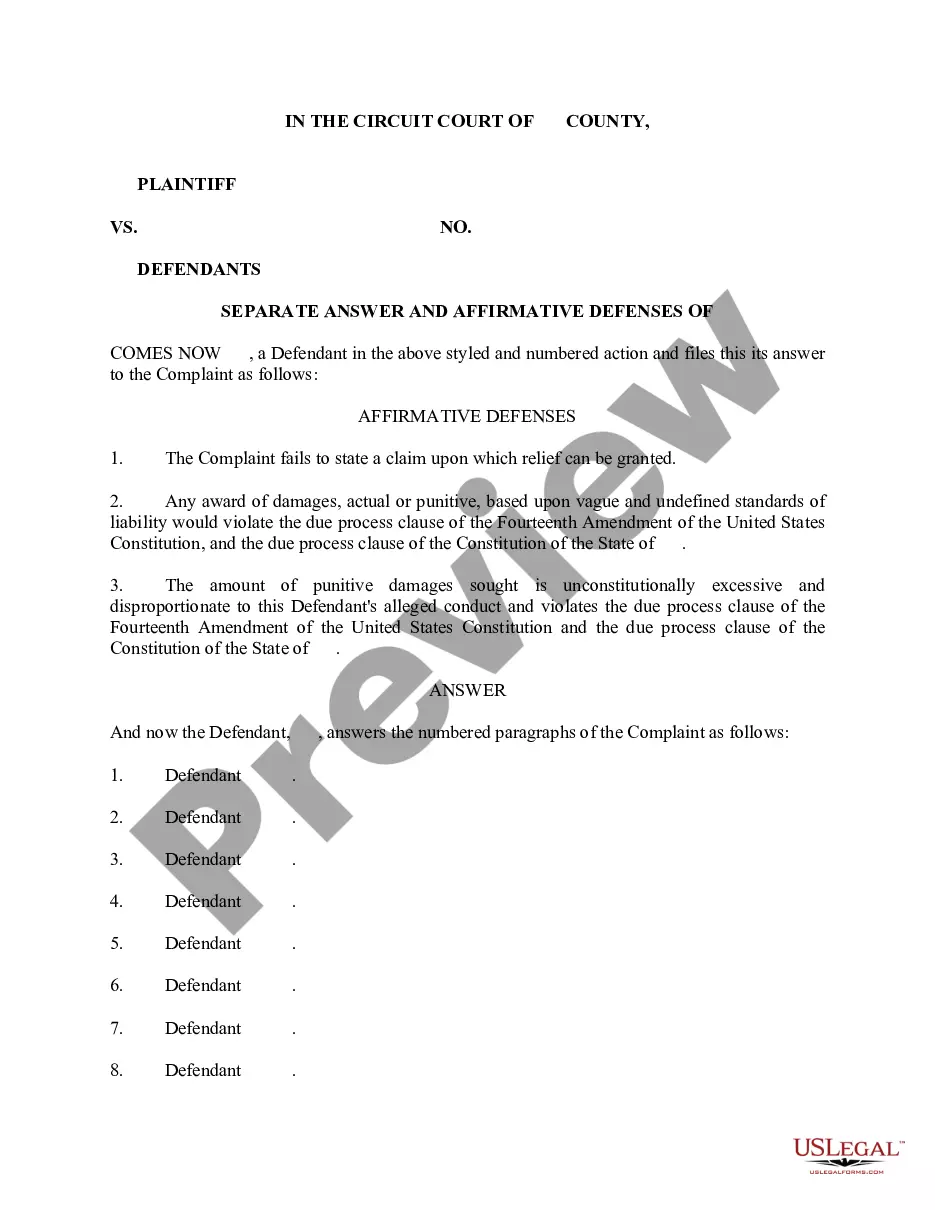
- Affirmative defenses: Contains defenses that may justify or excuse the defendant's actions.
- Request for dismissal: The defendant can request that the court dismiss the plaintiff's complaint.
- Signature line: A place for the defendant to sign, affirming the truth of the statements made in the Answer.
Situations where this form applies
This form should be used when a defendant receives a Complaint regarding a property ownership disagreement and must formally respond. Common scenarios include disputes over title ownership, claims of adverse possession, or disagreements over property boundaries.
Who should use this form
- Property owners involved in legal disputes.
- Anyone accused of unlawful ownership or use of property.
- Individuals who wish to assert defenses against claims made in a lawsuit.
Instructions for completing this form
- Identify the parties: Clearly state the names of the plaintiff and defendant.
- Specify the allegations: Review the Complaint and decide how to respond to each claim.
- Indicate admissions or denials: Mark which allegations you admit to and which you deny.
- List any affirmative defenses: Include any defenses you wish to present against the complaint.
- Sign and date the document: Ensure it is properly signed to be considered valid in court.
Does this document require notarization?
Notarization is generally not required for this form. However, certain states or situations might demand it. You can complete notarization online through US Legal Forms, powered by Notarize, using a verified video call available anytime.
Get your form ready online
Our built-in tools help you complete, sign, share, and store your documents in one place.
Make edits, fill in missing information, and update formatting in US Legal Forms—just like you would in MS Word.
Download a copy, print it, send it by email, or mail it via USPS—whatever works best for your next step.
Sign and collect signatures with our SignNow integration. Send to multiple recipients, set reminders, and more. Go Premium to unlock E-Sign.
If this form requires notarization, complete it online through a secure video call—no need to meet a notary in person or wait for an appointment.
We protect your documents and personal data by following strict security and privacy standards.

Make edits, fill in missing information, and update formatting in US Legal Forms—just like you would in MS Word.

Download a copy, print it, send it by email, or mail it via USPS—whatever works best for your next step.

Sign and collect signatures with our SignNow integration. Send to multiple recipients, set reminders, and more. Go Premium to unlock E-Sign.

If this form requires notarization, complete it online through a secure video call—no need to meet a notary in person or wait for an appointment.

We protect your documents and personal data by following strict security and privacy standards.
Typical mistakes to avoid
- Failing to address all allegations: Ensure you respond to each claim made in the Complaint.
- Not signing the document: An unsigned Answer may be disregarded by the court.
- Using vague language: Be clear and specific in your admissions and denials.
- Submitting after the deadline: Ensure the Answer is filed within the required time frame to avoid default judgment.
Benefits of using this form online
- Convenience: Easily download the form in your preferred format.
- Editability: Fill out the form on your computer, allowing for easy revisions.
- Legal reliability: Forms are drafted by licensed attorneys to ensure accuracy and compliance with state laws.
Looking for another form?
Form popularity
FAQ
Trespass is an area of criminal law or tort law broadly divided into three groups: trespass to the person, trespass to chattels, and trespass to land.
Mississippi is a Castle Doctrine state and has a stand your ground law. A person who is not the initial aggressor and is not engaged in unlawful activity shall have no duty to retreat before using deadly force if the person is in a place where the person has a right to be.
Mississippi has a stand your ground law that removes the duty to retreat before using deadly force in defense of oneself or another as long as the person is not the initial aggressor and is in a place they have a right to be.
So long as you are trespassing with the intent to commit any crime on the listed properties, and are caught you'll be charged with a felony and punished with a $5,000 fine or a five-year stay in prison or both.
Your Responsibilities As A Landowner However, in Mississippi a landowner owes no duty to a trespasser except to not willfully or wantonly injure him. In other words, don't shoot or assault a trespasser.
Mississippi trespass laws provide that trespassing is a misdemeanor with fines of $150-$250 for first offenses. For second offenses (occurring within five years), punishment can include fines of $250-$500 and possibly imprisonment for 10-30 days.
(i) Willfully opening, tearing down, or otherwise destroying any fence on the enclosed land of another, or opening any gate, bar, or fence of another and willfully leaving it open without the written permission of the owner, or maliciously tearing down, mutilating, or destroying any sign, signboard, or other notice