Employee Evaluation Form for Real Estate Agent
Overview of this form
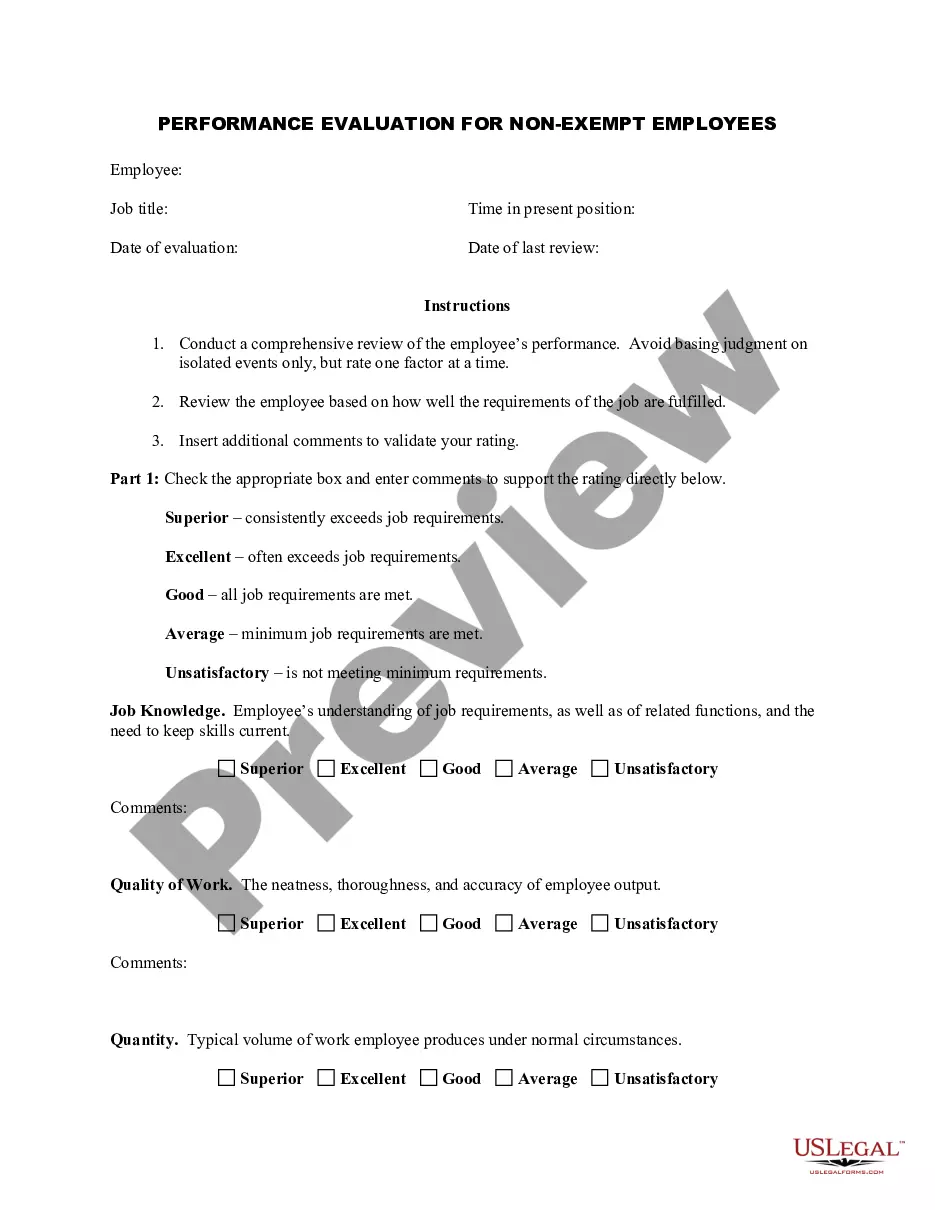
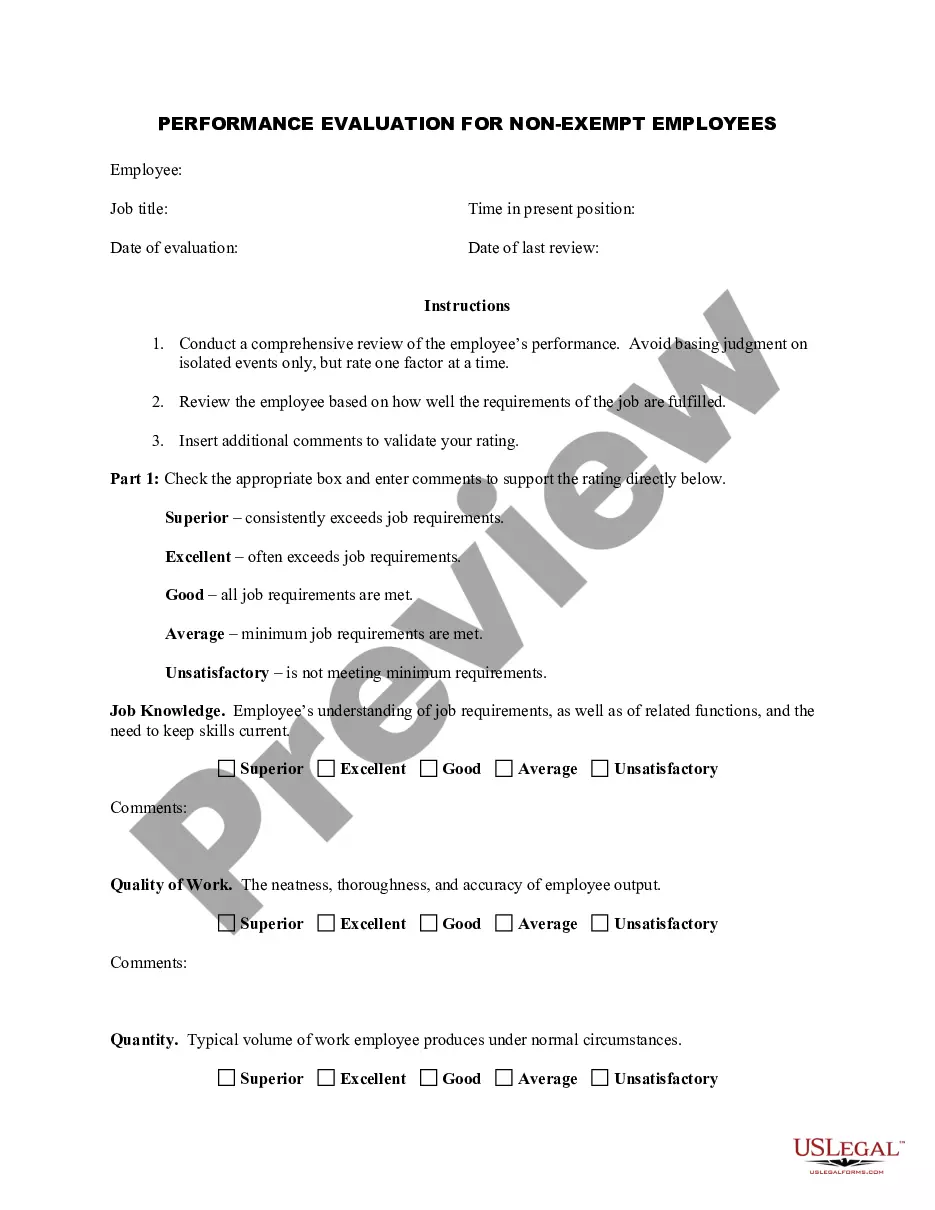
The Employee Evaluation Form for Real Estate Agents is a documented performance review tool designed to assess the job performance of real estate agents who are classified as non-exempt employees. This form is essential for systematically rating various aspects of an agent's job performance, such as job knowledge, quality of work, and cooperation with others. Unlike informal reviews, this structured form provides a clear format for feedback, ensuring that evaluations are thorough and fair.
Key components of this form
- Employee details: Collects the agent's name, job title, and evaluation dates.
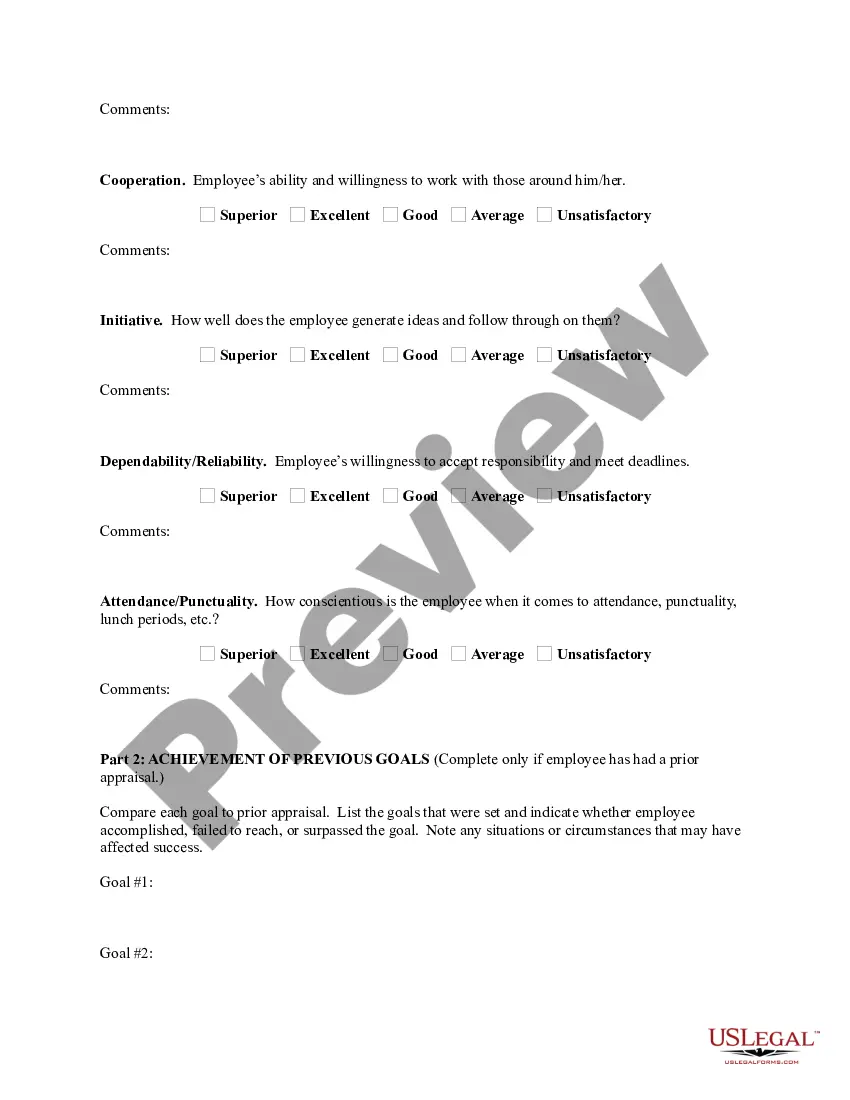
- Rating categories: Provides options to rate performance from "Superior" to "Unsatisfactory" across several job-related criteria.
- Comments section: Allows evaluators to provide detailed feedback and examples to support their ratings.
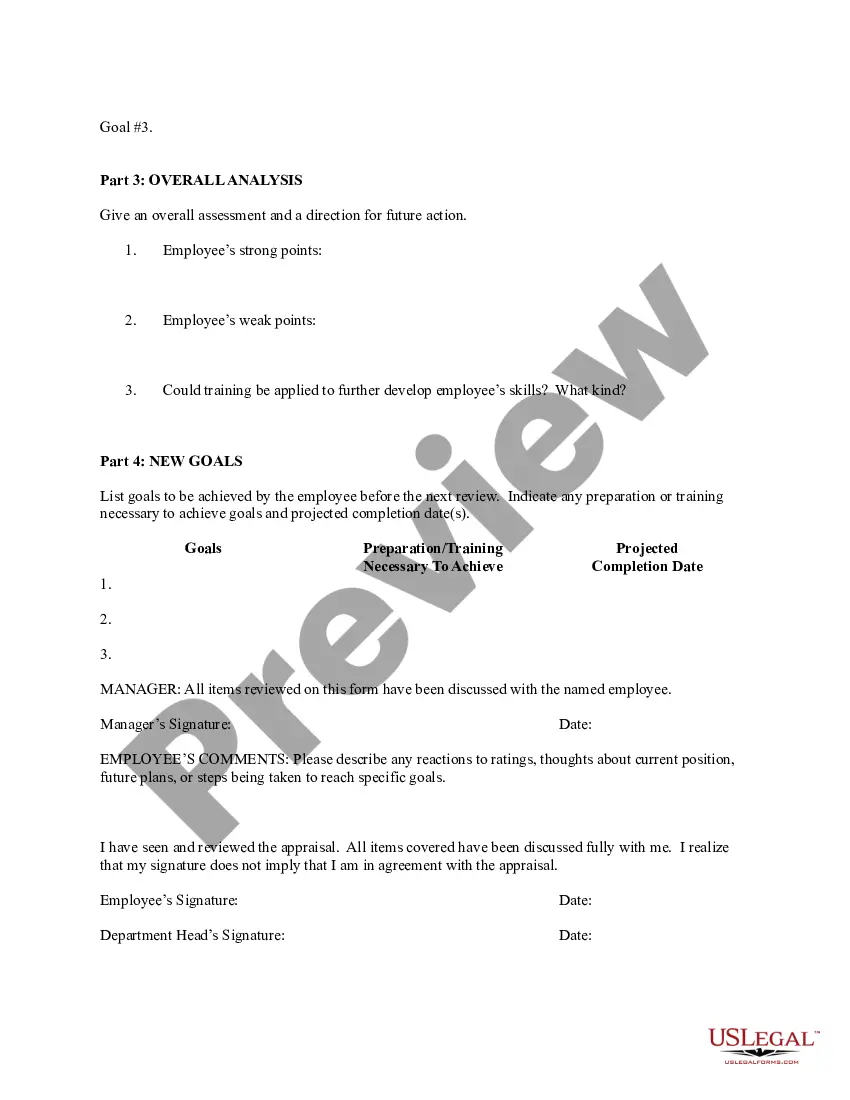
- Goals and achievements: Allows tracking of the employee's previous goals and the evaluation of whether they were met.
- Overall analysis: Summarizes strengths and areas for improvement with suggested future goals.
When this form is needed
This form should be used during regular performance reviews, typically on an annual or semi-annual basis. It is particularly useful when assessing the performance of real estate agents following the completion of a major project, renewal of contracts, or when significant changes in job responsibilities occur. Additionally, it can serve as a basis for making decisions related to promotions, salary adjustments, or further training.
Intended users of this form
- Real estate brokers looking to evaluate their agents' performance systematically.
- Human resources professionals involved in employee performance evaluations.
- Managers seeking to provide structured feedback to their team members.
- Real estate agents themselves, for personal development and self-assessment.
Steps to complete this form
- Enter employee information, including name, job title, and evaluation date at the top of the form.
- Score each performance category by checking the appropriate box that best reflects the employee's performance.
- Add comments in the designated sections to provide context and examples for the rating given.
- Fill out the section on previous goals, indicating whether they were achieved, not met, or exceeded.
- Complete the overall analysis, outlining strengths, weaknesses, and future goals for the employee.
- Both the manager and employee should sign and date the completed form to acknowledge the evaluation discussion.
Does this document require notarization?
This form does not typically require notarization unless specified by local law. It is essential to check state-specific regulations to ensure compliance.
Get your form ready online
Our built-in tools help you complete, sign, share, and store your documents in one place.
Make edits, fill in missing information, and update formatting in US Legal Forms—just like you would in MS Word.
Download a copy, print it, send it by email, or mail it via USPS—whatever works best for your next step.
Sign and collect signatures with our SignNow integration. Send to multiple recipients, set reminders, and more. Go Premium to unlock E-Sign.
If this form requires notarization, complete it online through a secure video call—no need to meet a notary in person or wait for an appointment.
We protect your documents and personal data by following strict security and privacy standards.

Make edits, fill in missing information, and update formatting in US Legal Forms—just like you would in MS Word.

Download a copy, print it, send it by email, or mail it via USPS—whatever works best for your next step.

Sign and collect signatures with our SignNow integration. Send to multiple recipients, set reminders, and more. Go Premium to unlock E-Sign.

If this form requires notarization, complete it online through a secure video call—no need to meet a notary in person or wait for an appointment.

We protect your documents and personal data by following strict security and privacy standards.
Mistakes to watch out for
- Failing to provide specific examples to support ratings, which can lead to misunderstandings.
- Relying on recent performance rather than the entire review period, which might skew evaluations.
- Not allowing enough time for both the manager and employee to discuss and review the evaluation together.
Advantages of online completion
- Easy access and retrieval, allowing both managers and employees to review evaluations at any time.
- Editability to customize comments and ratings, ensuring clarity and relevance to the specific employee.
- Reliable storage that keeps records secure and easily shareable, reducing the chances of lost paperwork.
Looking for another form?


Form popularity
FAQ
Review the employee's job description. Get a current copy of each person's job description and review the requirements. Highlight areas of improvement. Compare strengths and weaknesses. Recommend actionable goals. Provide constructive feedback. Welcome employee input.
The purpose of an employee evaluation is to measure job performance. Many evaluations provide quantitative measurements essential for a production-oriented work environment. Other employee evaluations provide employers with metrics regarding the quality of employees' work.
Communication. Collaboration and teamwork. Problem-solving. Quality and accuracy of work. Attendance, punctuality and reliability. The ability to accomplish goals and meet deadlines.
1) Attendance. Punctuality is one of the strongest virtues an employee can possess. 2) Innovation and Creativity. 3) Leadership. 4) Communication Skills. 5) Collaboration and Teamwork. 6) Time Management. 7) Customer Experience. 8) Problem Solving.
You deliver instructions and explain expectations with clarity and purpose. You listen well in meetings with colleagues. You frequently interrupt colleagues when they offer opinions or suggestions.
Be proud. One major goal of the self-evaluation is to highlight your accomplishments and recollect milestones in your professional development. Be honest and critical. Continuously strive for growth. Track your accomplishments. Be professional.
The form provides a tool for employees and supervisors to review the current job duties of a particular position and any external obstacles that an employee is encountering to complete their work.
Employee evaluation forms are used to formally review and document an employee's performance and get their acknowledgment that the evaluation took place. This is important in establishing a paper trail to support important HR decisions.
Gather information. List employee responsibilities. Use objective language. Use action verbs. Compare performance ratings. Ask open-ended questions. Use a point system.