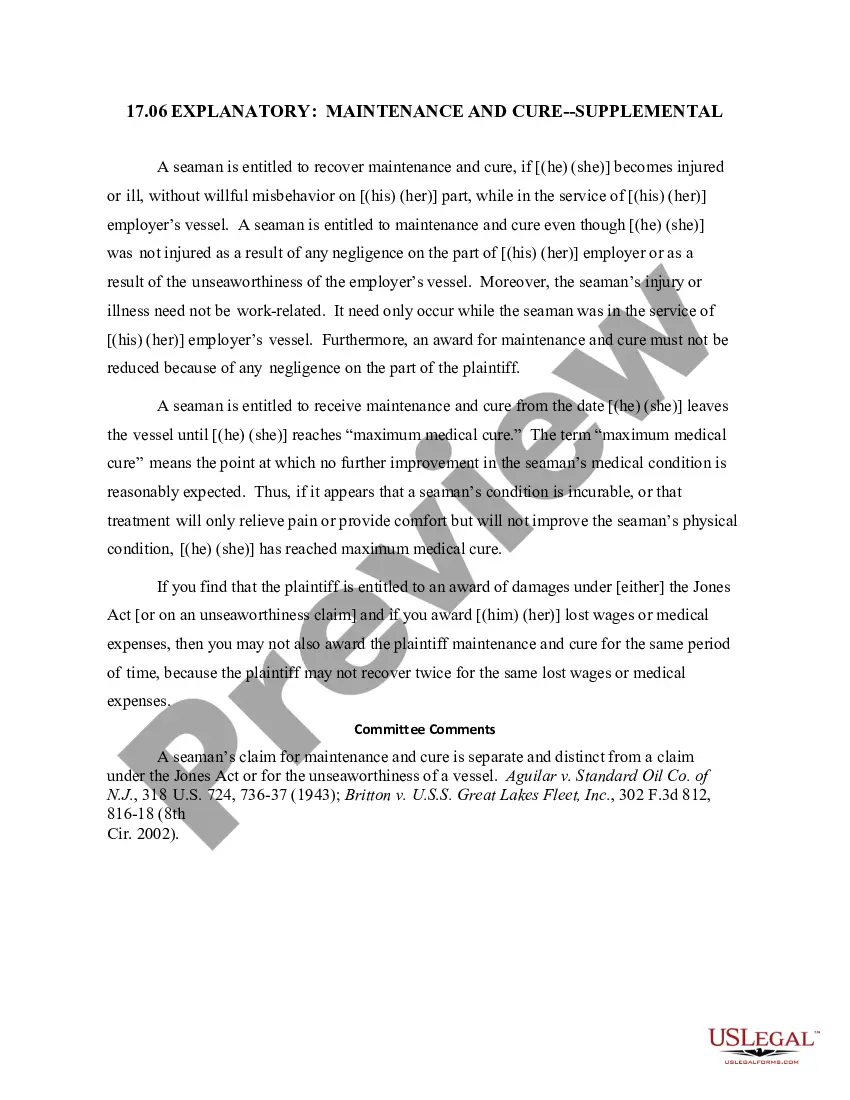
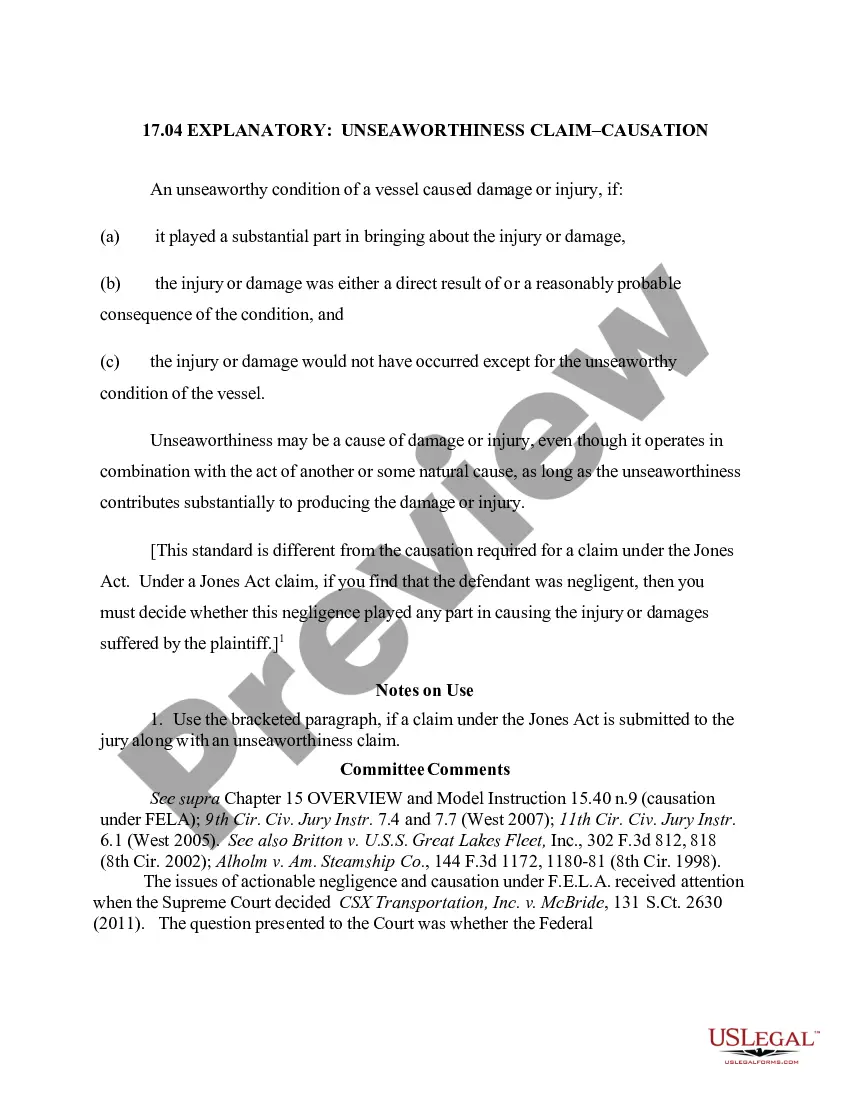
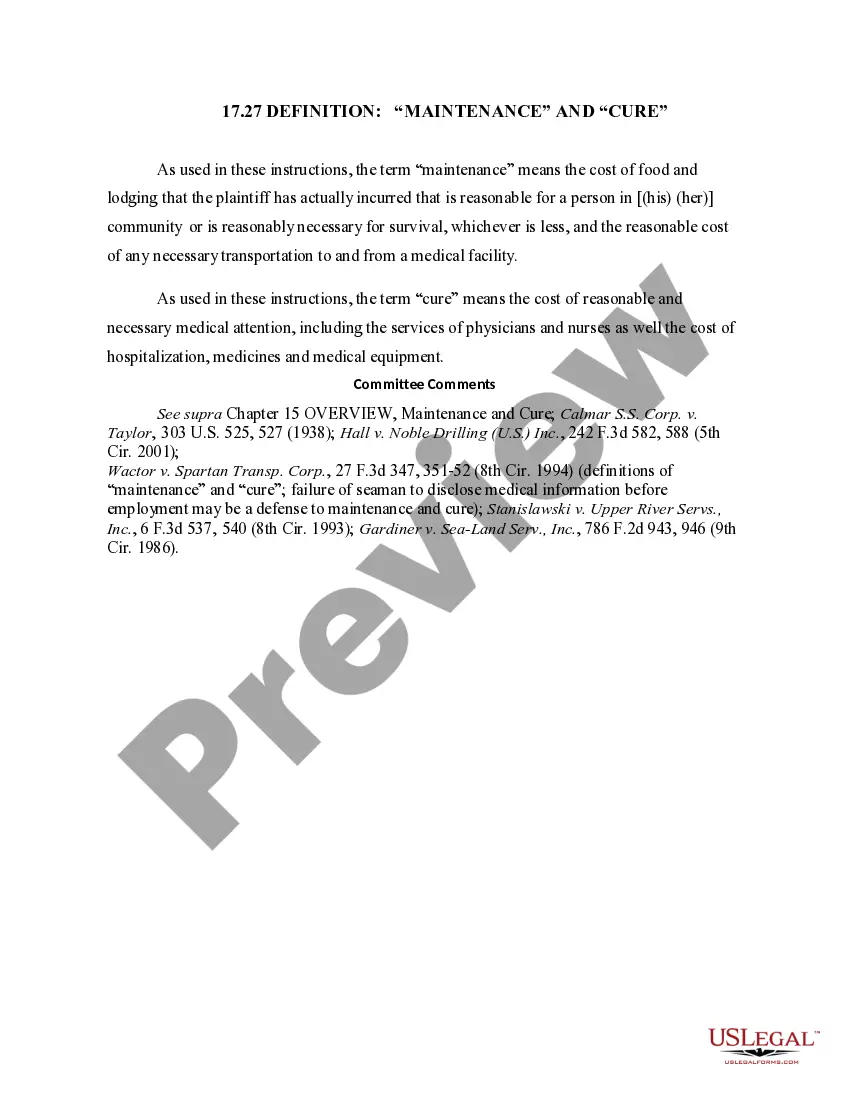
17.06 EXPLANATORY: MAINTENANCE AND CURE--SUPPLEMENTAL
What this document covers
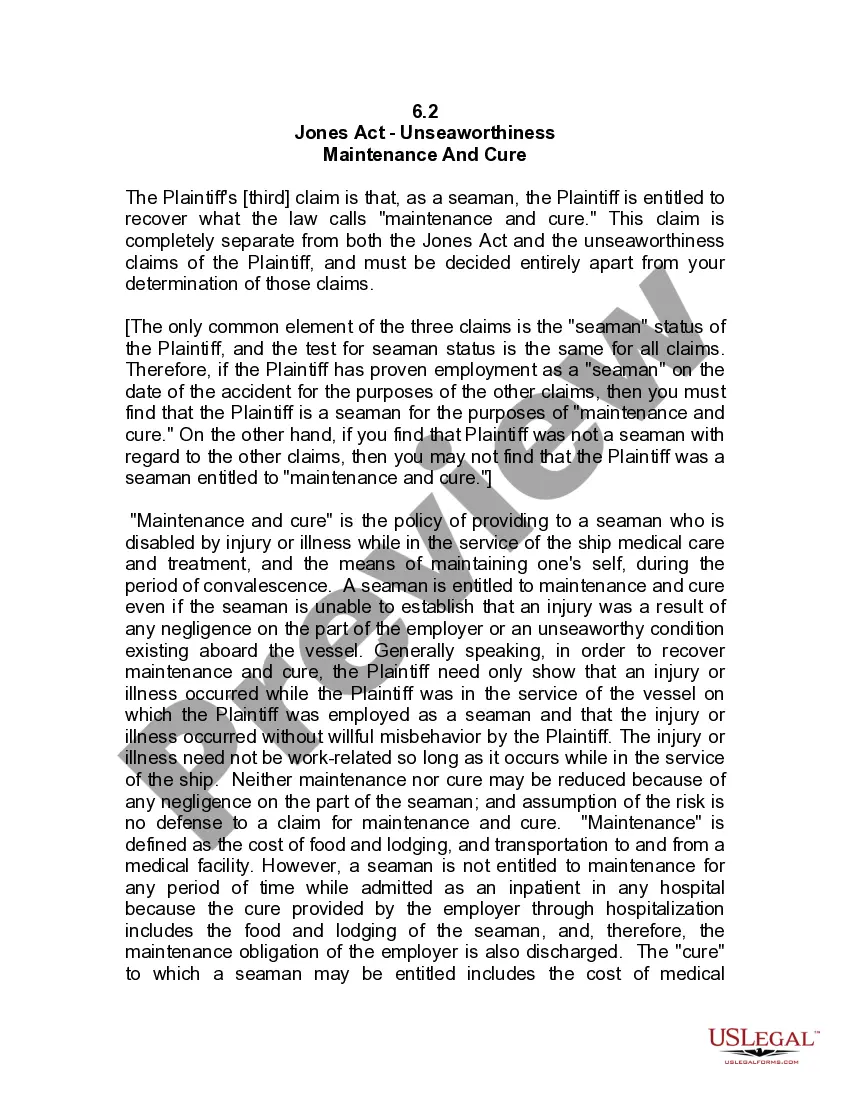
The 17.06 Explanatory: Maintenance and Cure--Supplemental form outlines the rights of seamen regarding maintenance and cure when they are injured or ill while in the service of their employerâs vessel. This form specifies that seamen are entitled to recover maintenance and care without needing to prove negligence from their employer. Unlike claims under the Jones Act, maintenance and cure claims are independent and focus solely on the welfare of the injured seaman.
What’s included in this form
- Definition of maintenance and cure entitlements for seamen.
- Details on the duration of benefits from departure until maximum medical cure.
- Clarification that injury or illness does not have to be work-related.
- An explanation of the term "maximum medical cure."
- Guidelines for the award process for damages without duplication of claims.
Situations where this form applies
This form is applicable when a seaman becomes injured or ill while serving on their employer's vessel. Use this form if you need to claim maintenance and cure for medical treatment and related expenses incurred after your departure from the vessel but while still under the employerâs care. It can also be utilized when a seaman requires clarification on their rights in cases where injury is not due to negligence or unseaworthiness.
Who should use this form
- Seamen who have sustained an injury or illness while in service of an employer's vessel.
- Legal representatives or advocates for seamen seeking to file for maintenance and cure remedies.
- Employers needing clarity on their obligations regarding maintenance and cure claims.
How to complete this form
- Identify the injured seaman and provide basic personal information.
- Detail the circumstances of the injury or illness pertinent to the claim.
- Specify the dates of service on the vessel and the last date of actual work.
- Document the medical treatment received, including dates and types of care.
- Include a declaration of any prior claims made under the Jones Act to avoid duplicate recovery.
Does this form need to be notarized?
This form does not typically require notarization unless specified by local law. However, it's recommended to consult with legal counsel to ensure compliance with specific regulations in your jurisdiction.
Get your form ready online
Our built-in tools help you complete, sign, share, and store your documents in one place.
Make edits, fill in missing information, and update formatting in US Legal Forms—just like you would in MS Word.
Download a copy, print it, send it by email, or mail it via USPS—whatever works best for your next step.
Sign and collect signatures with our SignNow integration. Send to multiple recipients, set reminders, and more. Go Premium to unlock E-Sign.
If this form requires notarization, complete it online through a secure video call—no need to meet a notary in person or wait for an appointment.
We protect your documents and personal data by following strict security and privacy standards.

Make edits, fill in missing information, and update formatting in US Legal Forms—just like you would in MS Word.

Download a copy, print it, send it by email, or mail it via USPS—whatever works best for your next step.

Sign and collect signatures with our SignNow integration. Send to multiple recipients, set reminders, and more. Go Premium to unlock E-Sign.

If this form requires notarization, complete it online through a secure video call—no need to meet a notary in person or wait for an appointment.

We protect your documents and personal data by following strict security and privacy standards.
Avoid these common issues
- Providing insufficient details about the injury or illness.
- Failing to differentiate between claims for maintenance and cure versus those under the Jones Act.
- Neglecting to include important medical documentation or timeline of treatment.
Advantages of online completion
- Convenience of downloading the form at any time.
- Editability to tailor the form to specific circumstances quickly.
- Access to reliable legal information drafted by licensed attorneys.
Legal use & context
- This form is essential for invoking rights under maritime law for maintenance and cure benefits.
- Claims must be backed by relevant evidence to support the seaman's circumstances.
- It is important to understand the legal distinctions between maintenance and cure claims and other employment-related claims.
Looking for another form?
Form popularity
FAQ
What is compensation? Compensation is money awarded to somebody who has been involved in an accident that wasn't their fault. It's a financial settlement that covers the costs and impact your injury has had on your life, now and into your future.
Your maintenance payments will be based on your household expenses, while cure payments will be based on your actual medical expenses. This is why it is important to keep diligent records of your costs so that you can establish them efficiently during the claims process.
Maintenance is a seaman's day-to-day living expenses. Cure is the seaman's medical costs. Employers are only obligated to pay maintenance and cure until the seaman is fit for duty, or until he has reached a point where additional medical treatment will not help him.
1. What is Maintenance and Cure? Maintenance and cure are no-fault benefits that injured seamen are entitled to under the Jones Act. These benefits include medical expenses and an allowance for day-to-day expenses.
Maintenance and cure is similar to a worker's compensation scheme in that the obligation to pay is not based on anyone's fault or negligence in causing the injury or illness and is considered ?quasi-contractual? as part of the terms of a seaman's employment on the vessel.
Maintenance is a seaman's day-to-day living expenses. Cure is the seaman's medical costs. Employers are only obligated to pay maintenance and cure until the seaman is fit for duty, or until he has reached a point where additional medical treatment will not help him.
Under the Jones Act, an injured seaman is entitled to receive daily compensation (maintenance) and medical (cure) payments from his or her employer. Your employer is legally required to make these payments to you regardless of who is at fault for your injuries.