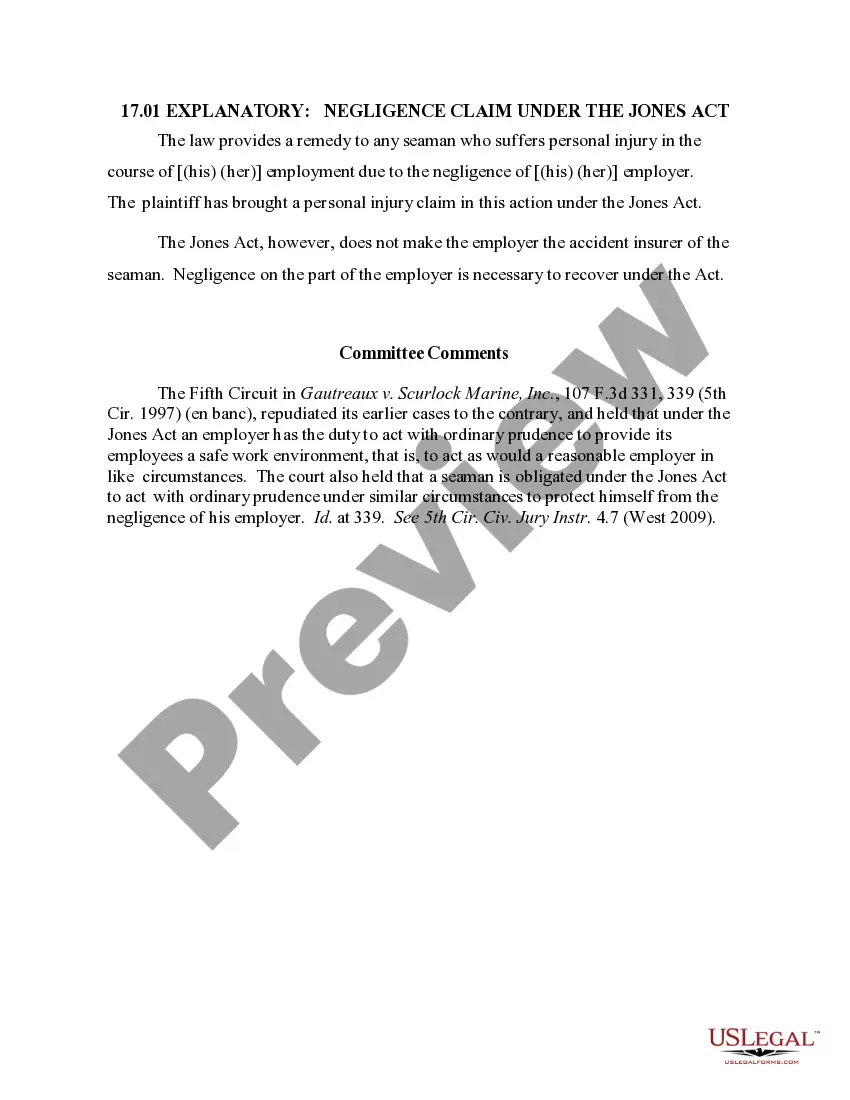
17.01 EXPLANATORY: NEGLIGENCE CLAIM UNDER THE JONES ACT
Overview of this form
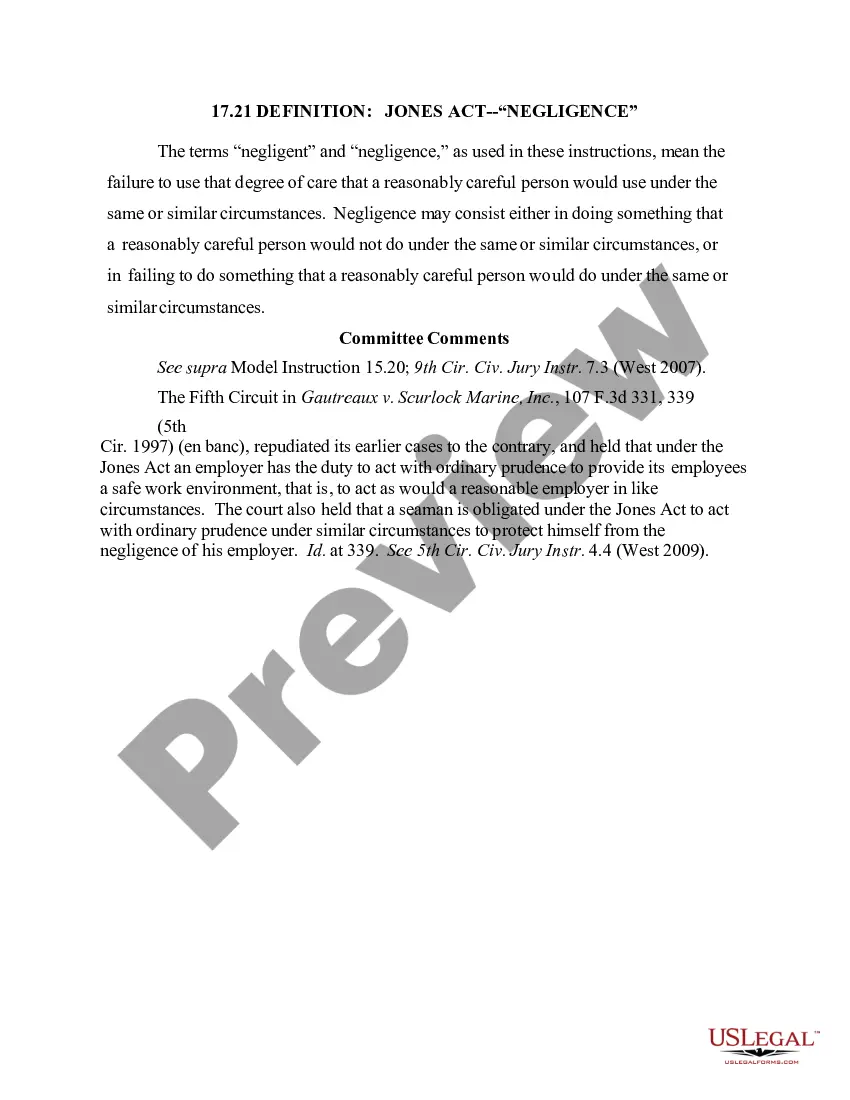
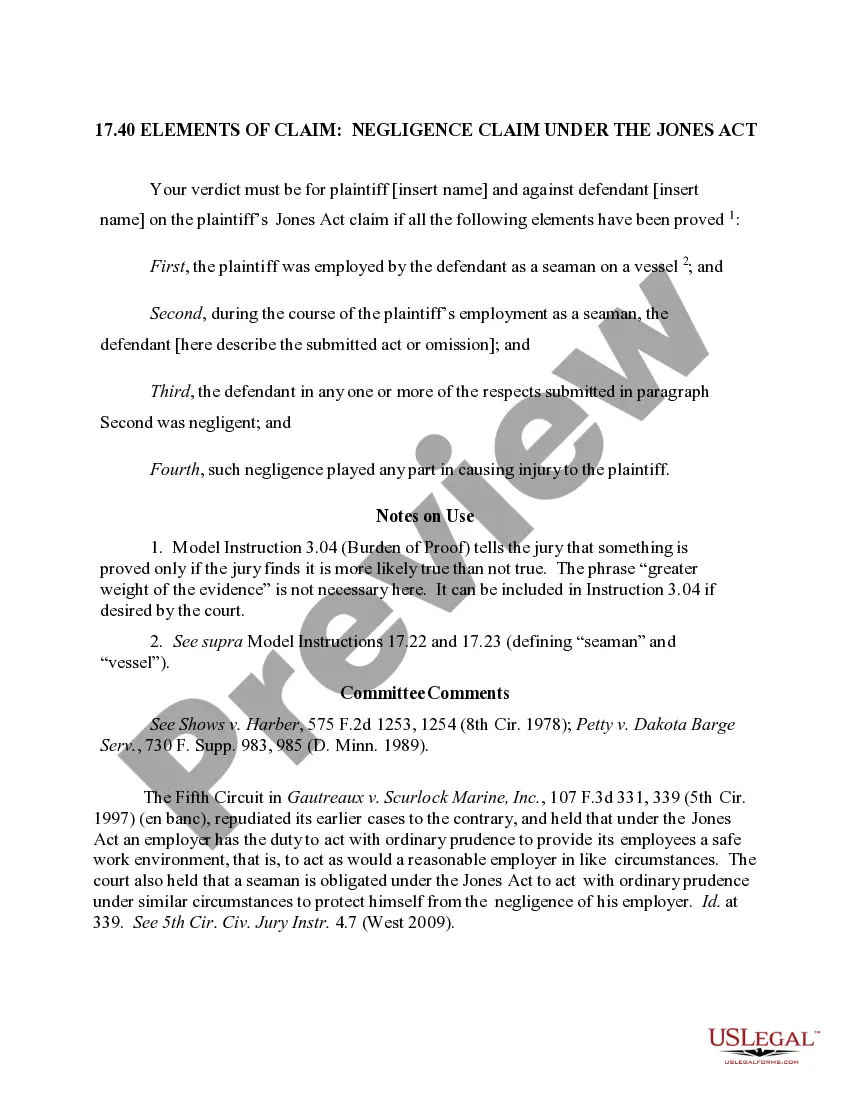
The 17.01 Explanatory: Negligence Claim Under the Jones Act is a legal document designed to help seamen file a personal injury claim against their employer for negligence. This form serves to clarify the requirements under the Jones Act, which protects seamen who are injured in the course of their employment. Unlike other personal injury claims, it specifically holds employers accountable for providing a safe working environment and requires proof of employer negligence for recovery.
Key parts of this document
- Identification of the plaintiff and defendant, including their relationship and roles.
- A clear statement of the claim, outlining the details of the negligence alleged.
- Details regarding the injury sustained by the seaman during employment.
- A section to demonstrate the employer's failure to uphold safety standards.
- References to relevant case law that supports the claim under the Jones Act.
When to use this form
This form should be used when a seaman experiences a personal injury related to their work and believes that this injury was caused by the negligence of their employer. Instances might include accidents due to unsafe equipment, lack of safety training, or other failures in duty of care. The form is crucial for legally documenting the claim and initiating the process for seeking compensation.
Who this form is for
- Seamen who have sustained injuries while on the job.
- Individuals seeking to hold their employer accountable for unsafe working conditions.
- Legal representatives working on behalf of seamen in personal injury cases.
Steps to complete this form
- Identify the parties involved by providing full names and roles (plaintiff and defendant).
- Detail the circumstances of the injury, including date and location.
- Specify the nature of the employer's negligence with supporting facts.
- Cite relevant case law or examples of similar negligence claims supporting your case.
- Sign and date the form to affirm accuracy and completion.
Notarization guidance
In most cases, this form does not require notarization. However, some jurisdictions or signing circumstances might. US Legal Forms offers online notarization powered by Notarize, accessible 24/7 for a quick, remote process.
Get your form ready online
Our built-in tools help you complete, sign, share, and store your documents in one place.
Make edits, fill in missing information, and update formatting in US Legal Forms—just like you would in MS Word.
Download a copy, print it, send it by email, or mail it via USPS—whatever works best for your next step.
Sign and collect signatures with our SignNow integration. Send to multiple recipients, set reminders, and more. Go Premium to unlock E-Sign.
If this form requires notarization, complete it online through a secure video call—no need to meet a notary in person or wait for an appointment.
We protect your documents and personal data by following strict security and privacy standards.

Make edits, fill in missing information, and update formatting in US Legal Forms—just like you would in MS Word.

Download a copy, print it, send it by email, or mail it via USPS—whatever works best for your next step.

Sign and collect signatures with our SignNow integration. Send to multiple recipients, set reminders, and more. Go Premium to unlock E-Sign.

If this form requires notarization, complete it online through a secure video call—no need to meet a notary in person or wait for an appointment.

We protect your documents and personal data by following strict security and privacy standards.
Mistakes to watch out for
- Failing to clearly state the specific negligence encountered.
- Omitting essential details about the injury and its impact.
- Not providing adequate evidence or case references to support the claim.
- Neglecting to properly identify all parties involved in the claim.
Why use this form online
- Convenience of downloading the form directly to your device.
- Easy editing options to ensure all necessary details can be added.
- Access to reliable templates drafted by licensed attorneys.
- Streamlined process helps expedite the filing of your claim.
Looking for another form?

Form popularity
FAQ
WHAT IS JONES ACT NEGLIGENCE. Under the Jones Act, an employer owes its crewmen a reasonably safe place to work. Your employer owes you a duty to use reasonable care to prevent your injury. Negligence is the failure to do something that a reasonably prudent person would do, or not do, under similar circumstances.
Doing so means you and your lawyer must prove the five elements of negligence: duty, breach of duty, cause, in fact, proximate cause, and harm. Your lawyer may help you meet the elements necessary to prove your claim, build a successful case, and help you receive the monetary award you deserve.
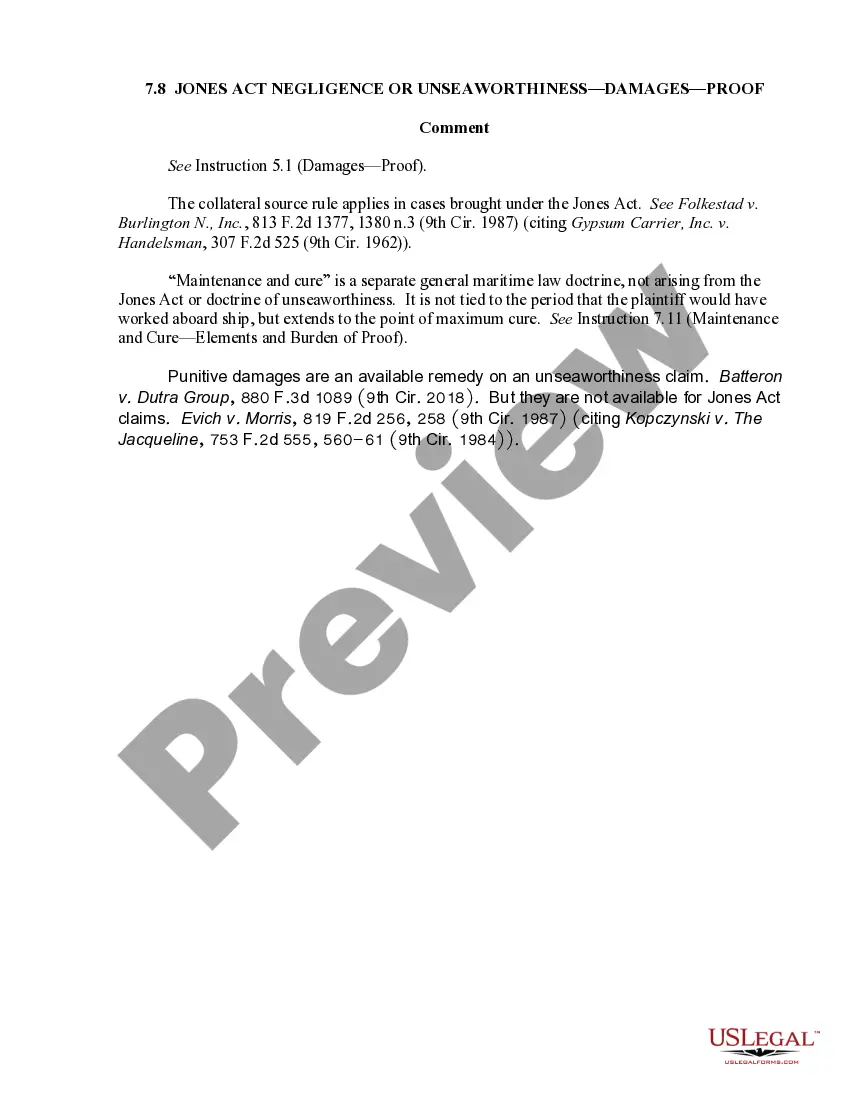
Damages Available Under the Jones Act Under the Jones Act, an injured seaman is entitled to recover damages for: lost earnings and lost earning capacity. past, present, and future, medical expenses, and. past, present, and future, pain, suffering, and mental anguish.
Negligence claims must prove four things in court: duty, breach, causation, and damages/harm. Generally speaking, when someone acts in a careless way and causes an injury to another person, under the legal principle of "negligence" the careless person will be legally liable for any resulting harm.
Unlike other types of personal injury claims, however, Jones Act claims have what is considered to be a "featherweight" burden of proof. This means that a judge or jury only has to be convinced that the employer's action or lack of action played a role?no matter how small?in causing the plaintiff's injury.
Negligence claims must prove four things in court: duty, breach, causation, and damages/harm.
What is a claim in negligence? Negligence is a tort and actionable in the civil courts. Essentially, negligence is typically the failure to act with due care causing harm to someone else. Harm can include personal injury, damage to property, and economic loss.
Identifying the Four Tort Elements The accused had a duty, in most personal injury cases, to act in a way that did not cause you to become injured. The accused committed a breach of that duty. An injury occurred to you. The breach of duty was the proximate cause of your injury.