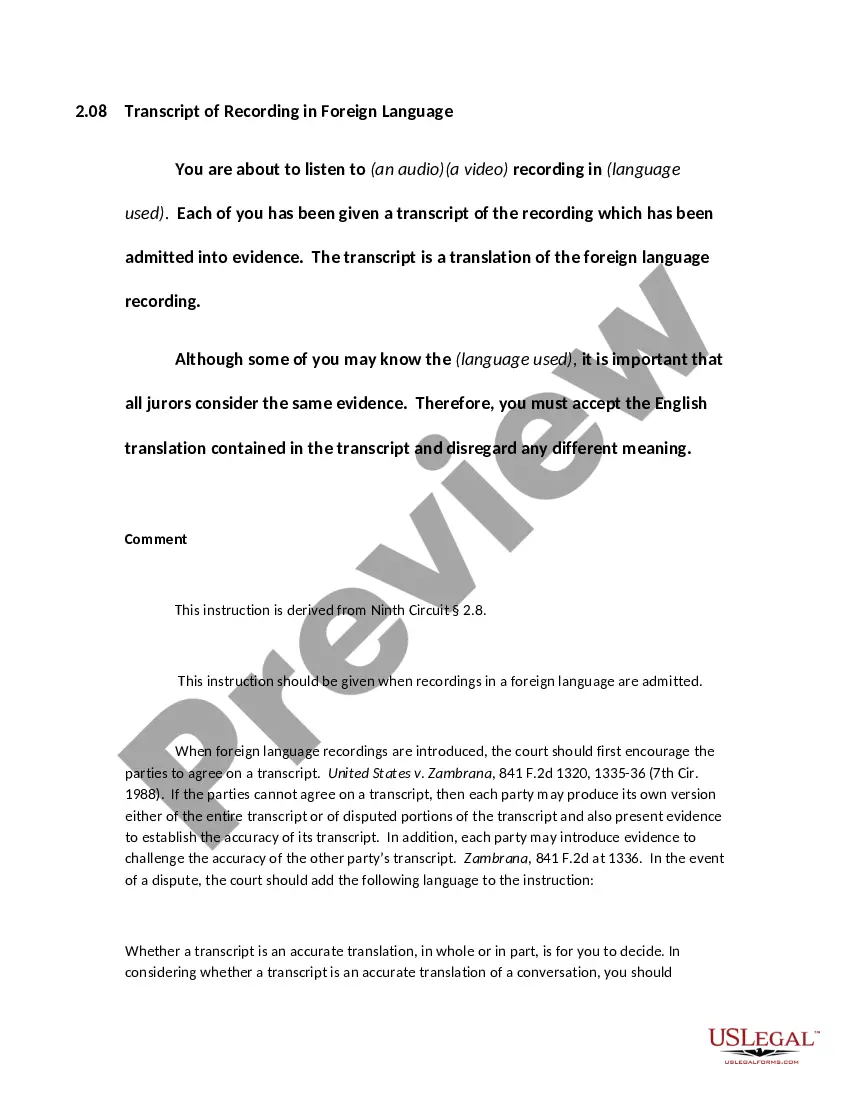
Transcript of Recording in Foreign Language
About this form
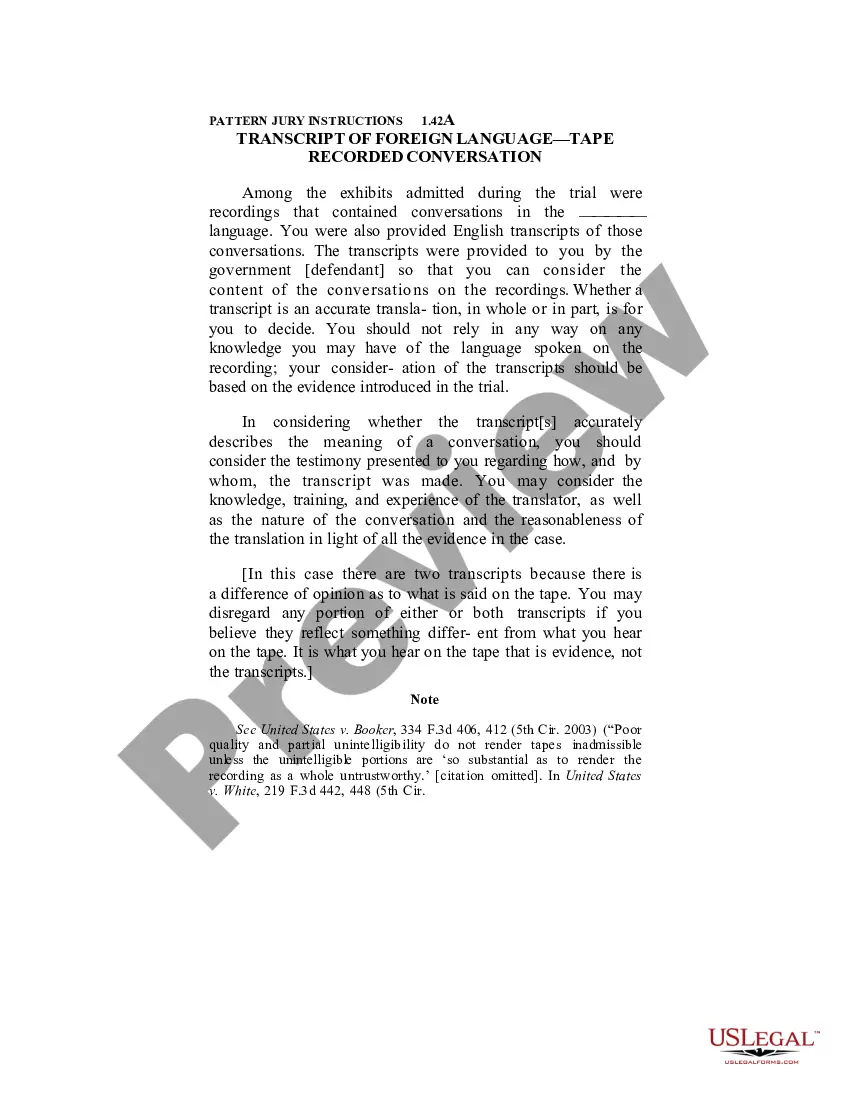
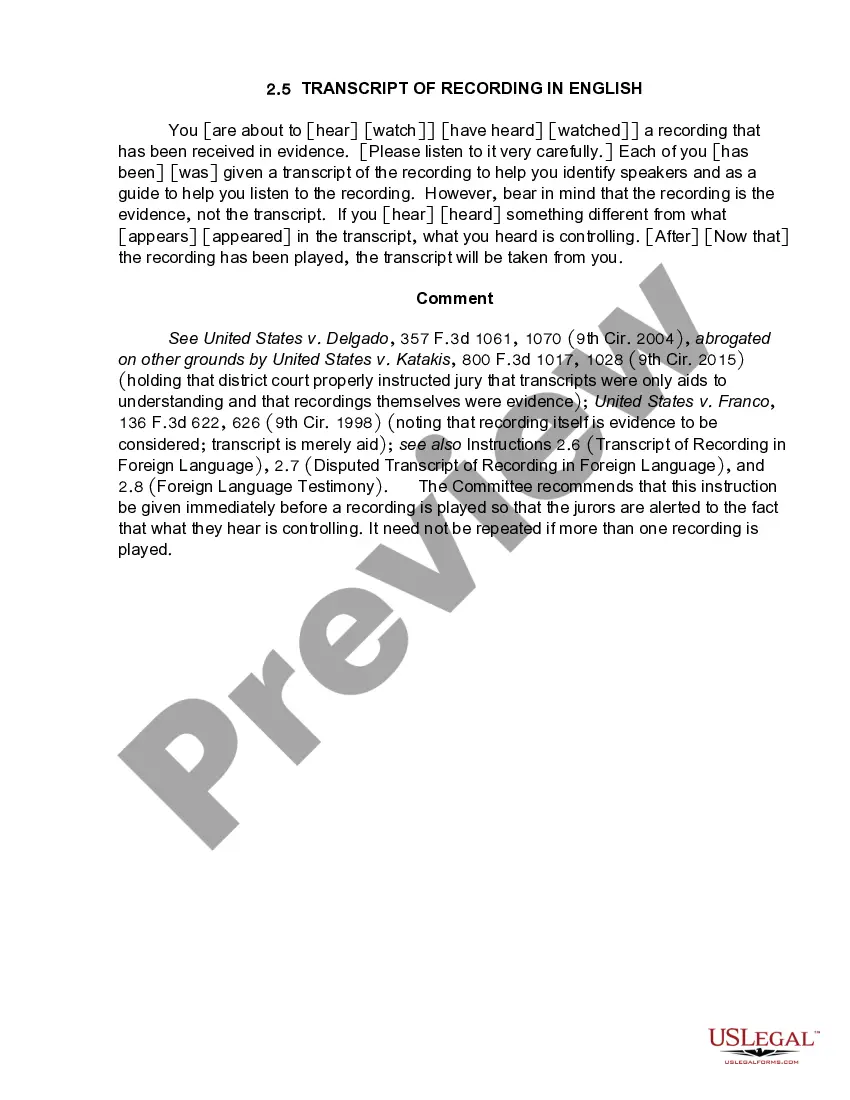
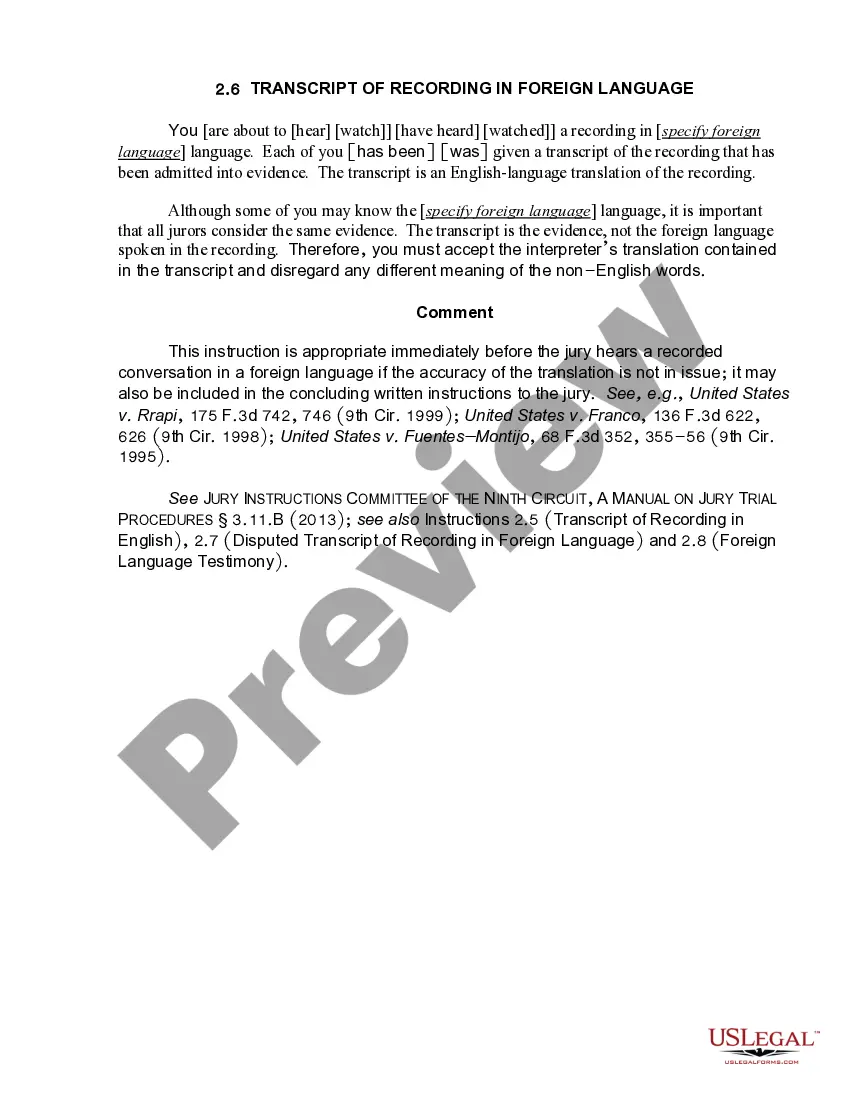
The Transcript of Recording in Foreign Language is a legal document that provides a written translation of an audio recording presented as evidence in court. This form is essential when juries are required to consider recordings in a language other than English, ensuring that all jurors have access to the same translated text. Unlike a regular transcript, this document serves to clarify misunderstandings that may arise from language differences during legal proceedings.
What’s included in this form
- Identification of the foreign language used in the audio recording.
- Inclusion of the English translation that is to be accepted as evidence.
- Instructions for jurors to disregard their own interpretations if they understand the foreign language.
- Clarification on the accuracy of the transcript versus the original recording.
- Guidance on how to evaluate the credibility of the translation and translator.

Common use cases
This form is used in legal cases where audio recordings in a foreign language are introduced as evidence. It is especially relevant in trials where the jury must rely on the provided translation to discuss and deliberate on the case effectively. The form ensures that all jurors are aligned in their understanding of the evidence presented, thereby upholding fair trial standards.
Who can use this document
- Legal professionals who need to submit evidence involving foreign language recordings.
- Prosecutors and defense attorneys representing clients in cases with multilingual evidence.
- Courts and juries required to consider translated recordings in their deliberations.
Steps to complete this form
- Identify the language used in the recording to ensure accurate translation.
- Prepare or obtain a comprehensive English translation of the recording.
- Include a statement affirming the translation is the version to be considered by the jury.
- Ensure all jurors receive the transcript for their reference during deliberations.
- Include instructions for jurors regarding the importance of accepting the provided translation.
Does this document require notarization?
This form does not typically require notarization to be legally valid. However, some jurisdictions or document types may still require it. US Legal Forms provides secure online notarization powered by Notarize, available 24/7 for added convenience.
Get your form ready online
Our built-in tools help you complete, sign, share, and store your documents in one place.
Make edits, fill in missing information, and update formatting in US Legal Forms—just like you would in MS Word.
Download a copy, print it, send it by email, or mail it via USPS—whatever works best for your next step.
Sign and collect signatures with our SignNow integration. Send to multiple recipients, set reminders, and more. Go Premium to unlock E-Sign.
If this form requires notarization, complete it online through a secure video call—no need to meet a notary in person or wait for an appointment.
We protect your documents and personal data by following strict security and privacy standards.

Make edits, fill in missing information, and update formatting in US Legal Forms—just like you would in MS Word.

Download a copy, print it, send it by email, or mail it via USPS—whatever works best for your next step.

Sign and collect signatures with our SignNow integration. Send to multiple recipients, set reminders, and more. Go Premium to unlock E-Sign.

If this form requires notarization, complete it online through a secure video call—no need to meet a notary in person or wait for an appointment.

We protect your documents and personal data by following strict security and privacy standards.
Avoid these common issues
- Failing to provide a complete translation of the recording.
- Not including instructions for the jury regarding the translation's use.
- Assuming jurors will apply their own understanding of the foreign language.
- Neglecting to ensure the translation is professionally done or verified.
Benefits of using this form online
- Convenience of instant access to downloadable legal forms.
- Editability allows users to customize the document as needed.
- Reliability from templates reviewed by licensed attorneys for accuracy.
Summary of main points
- This form is vital for ensuring fairness in trials involving foreign language evidence.
- Accurate translations help prevent misunderstandings in court proceedings.
- Legal professionals must ensure compliance with local jurisdictions when using this form.
Looking for another form?

Form popularity
FAQ
1. Provide a copy of the recording on a storage device (and the transcript if you intend to use one) to the other party (or his or her attorney) in advance of the court date. 2. Ask the court clerk to mark the storage device and/or transcript with an exhibit number.
Often judges will include in a pre-trial order that you must designate the deposition and parts of them you want to read into evidence....The basic legal procedure: file original deposition, ask the judge for permission, explain any failure to designate, read the deposition aloud into the record.
Foreign language transcription is the process of taking spoken words on an audio or video recording in one language and converting them into written text in another language.
How Do You Introduce Exhibits at Trial? Mark the exhibit for identification. Show the exhibit to the opposing attorney. Request permission to approach the witness or hand the exhibit to the bailiff (learn more about courtroom etiquette) Show the exhibit to the witness. Lay the proper foundation for the exhibit.
To present a document in court and enter it as evidence you usually need someone, a witness or a party (this could be you), to introduce it to the court. They will need to swear that it is the authentic document and may be needed to explain the content of the document.
You should lay some basic foundation, i.e., you asked the witness, ?Do you recall your deposition was taken on such date, you were sworn to tell the truth, you were given an opportunity to review and make corrections,? etc. You then read the portion of the deposition containing the inconsistent statement.