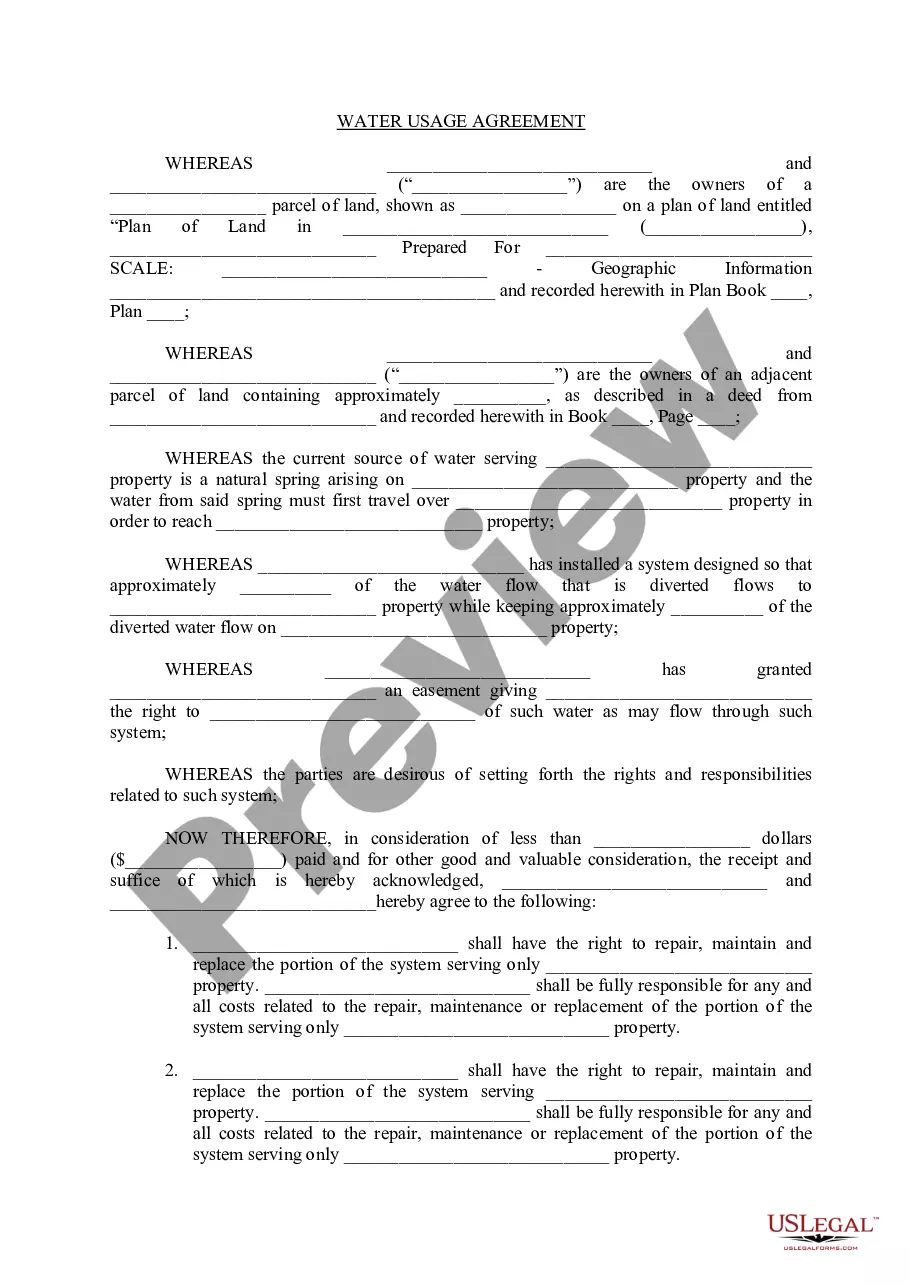
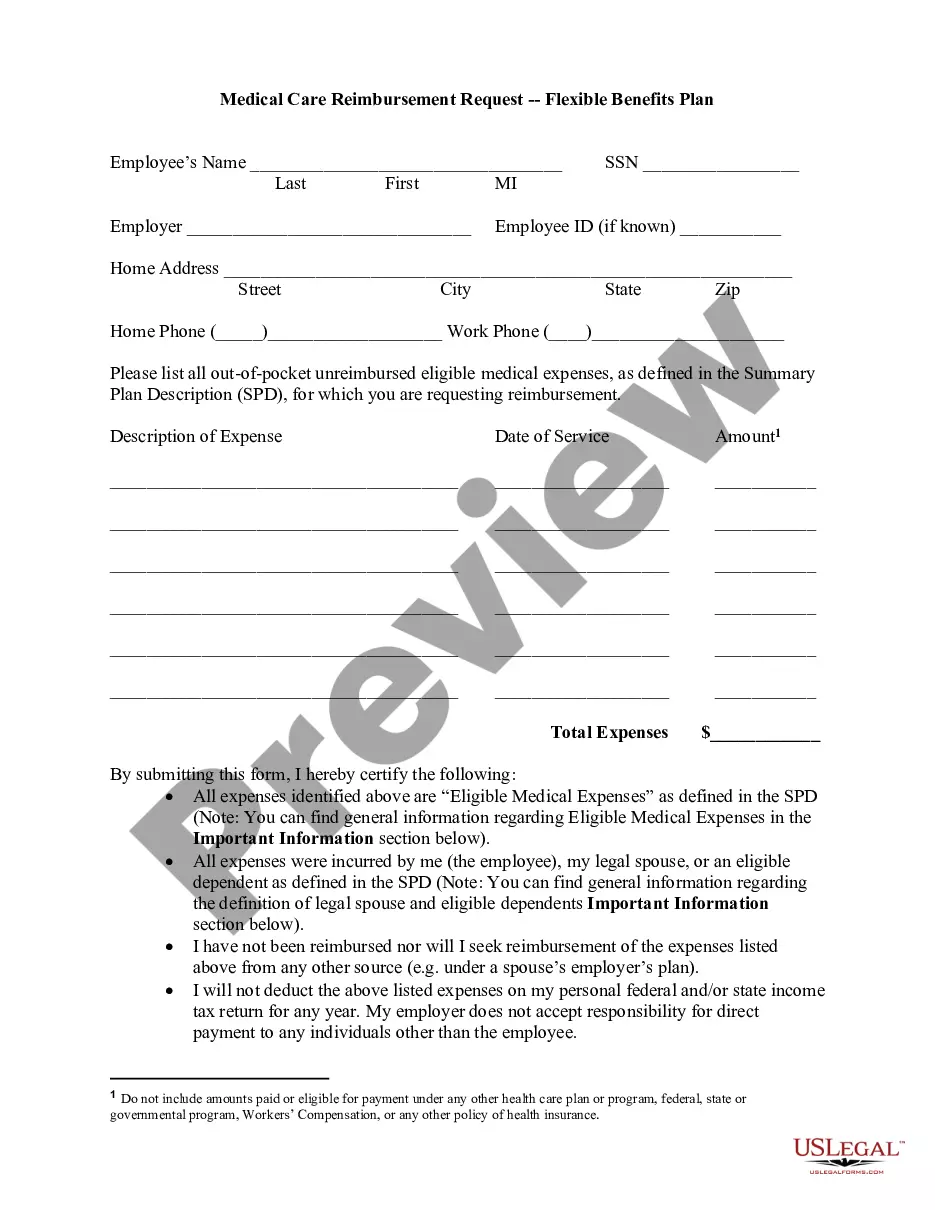
Medical Care Reimbursement Request - Flexible Benefits Plan
Overview of this form
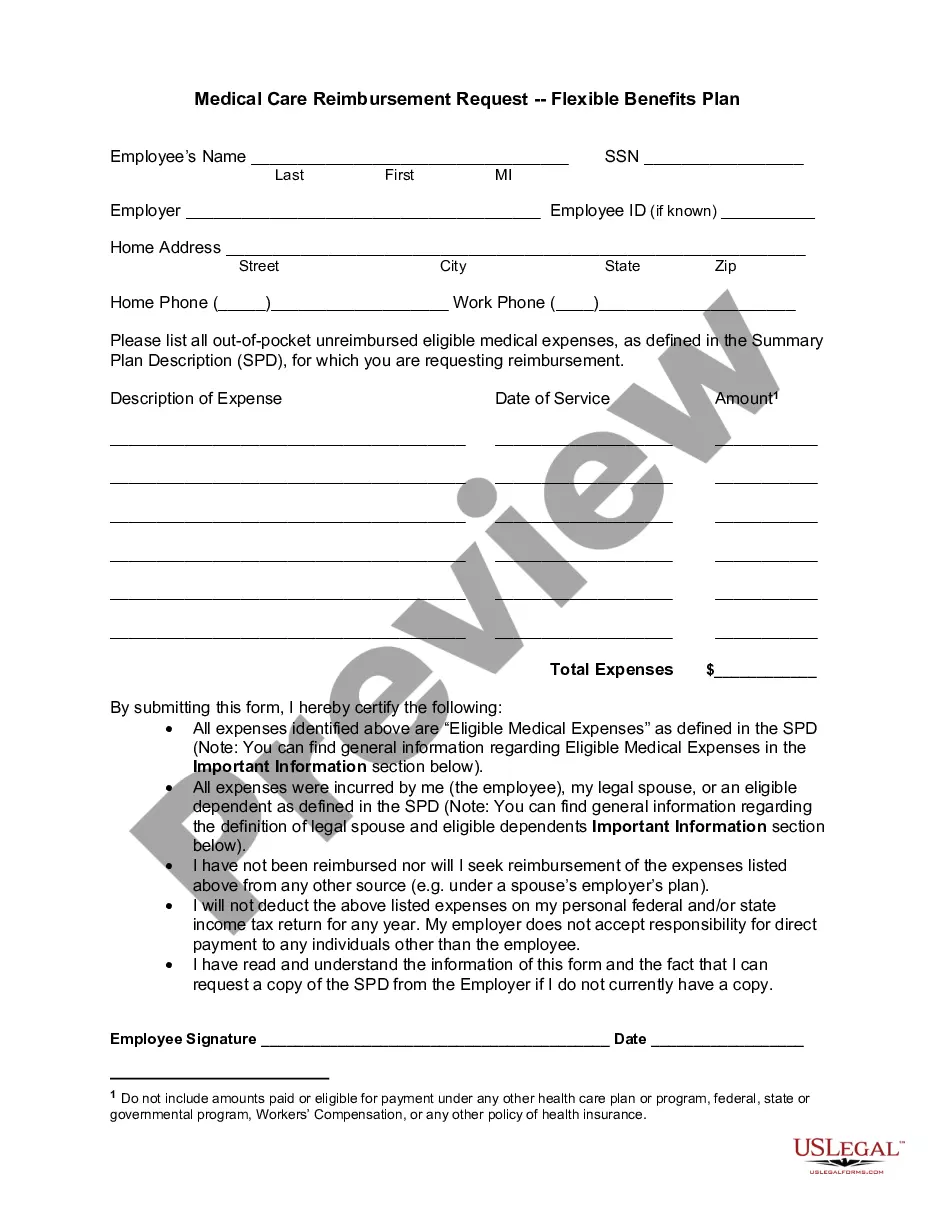
The Medical Care Reimbursement Request - Flexible Benefits Plan is a form used by employees to request reimbursement for eligible out-of-pocket medical expenses incurred under a flexible benefits plan. This form is essential for employees who want to utilize their benefits effectively and receive tax-advantaged reimbursements for qualifying medical costs, unlike other forms that may cover different types of expenses such as insurance premiums or personal care costs.
Key parts of this document
- Employee's personal information, including name, SSN, and contact details.
- A section to list unreimbursed eligible medical expenses with necessary details.
- A certification statement where employees affirm the authenticity of the submitted expenses.
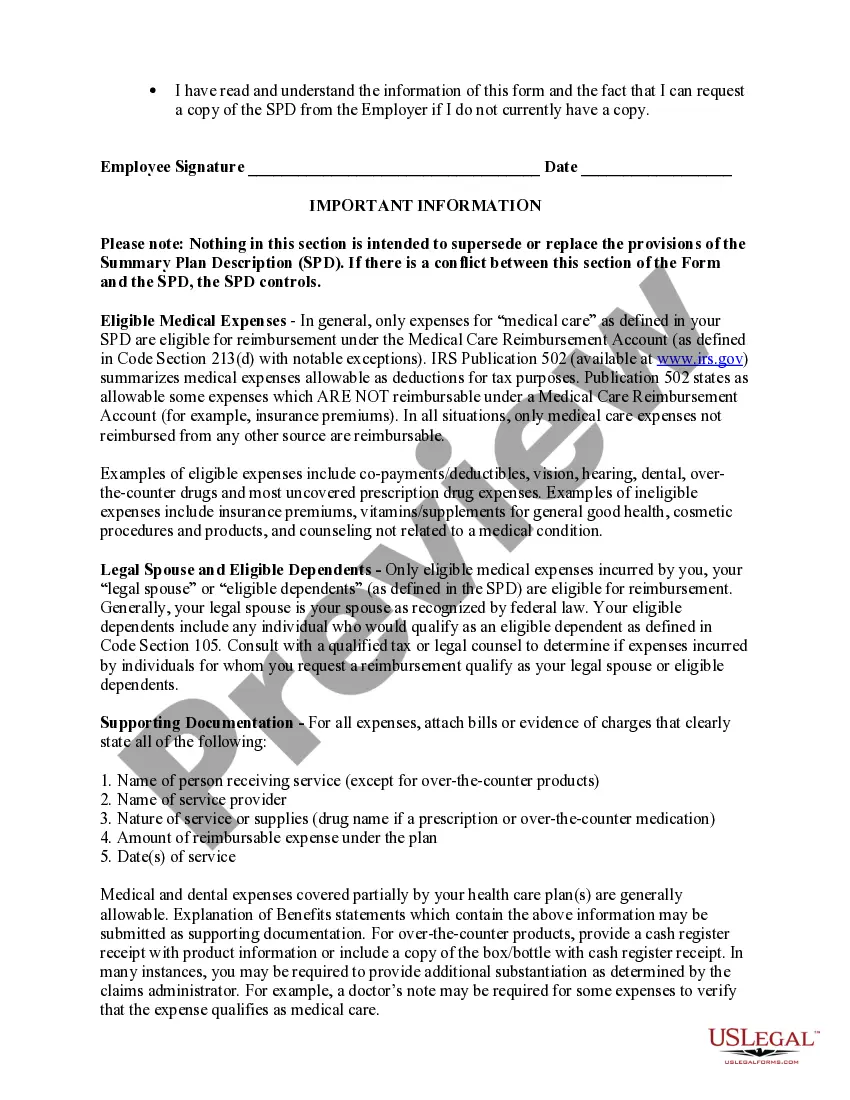
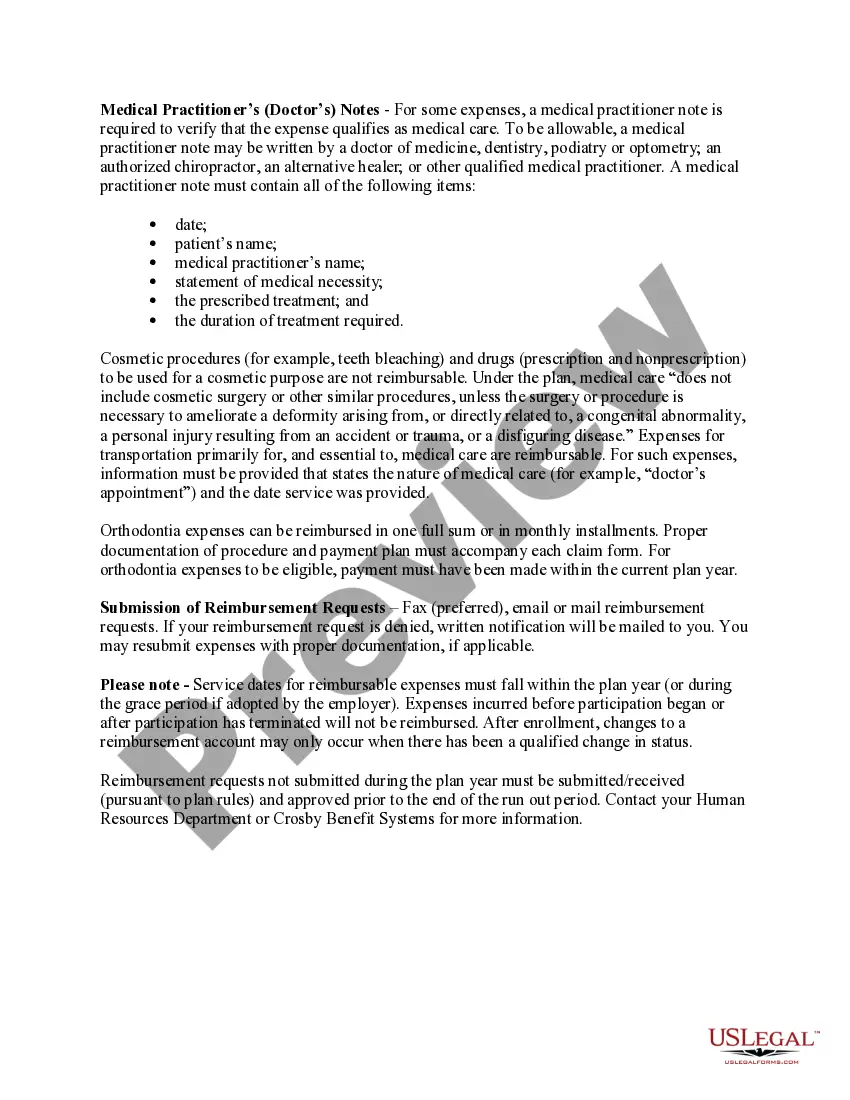
- Instructions for providing supporting documentation, such as bills and explanation of benefits.
- Additional notes regarding eligible medical expenses as defined in the Summary Plan Description.
When to use this form
This form is used by employees when they have incurred eligible medical expenses that have not been reimbursed through any other source. It is essential when claiming expenses such as co-payments, deductibles, or certain medical supplies and treatments. Employees should submit this form during the plan year to ensure they maximize their benefits.
Who should use this form
This form is intended for:
- Employees enrolled in a flexible benefits plan provided by their employer.
- Employees who have incurred out-of-pocket medical expenses eligible for reimbursement.
- Legal spouses and eligible dependents of employees seeking reimbursement for their medical expenses.
How to prepare this document
- Fill in your personal details, including your name, SSN, and contact information.
- List all eligible medical expenses with clear descriptions, dates of service, and amounts incurred.
- Attach required supporting documentation for each expense, ensuring it includes necessary details such as provider name and nature of service.
- Review the certification statement and sign the form to confirm accuracy.
- Submit the completed form according to your employer's instructions, ensuring it is done within the plan year.
Does this document require notarization?
Notarization is not commonly needed for this form. However, certain documents or local rules may make it necessary. Our notarization service, powered by Notarize, allows you to finalize it securely online anytime, day or night.
Get your form ready online
Our built-in tools help you complete, sign, share, and store your documents in one place.
Make edits, fill in missing information, and update formatting in US Legal Forms—just like you would in MS Word.
Download a copy, print it, send it by email, or mail it via USPS—whatever works best for your next step.
Sign and collect signatures with our SignNow integration. Send to multiple recipients, set reminders, and more. Go Premium to unlock E-Sign.
If this form requires notarization, complete it online through a secure video call—no need to meet a notary in person or wait for an appointment.
We protect your documents and personal data by following strict security and privacy standards.

Make edits, fill in missing information, and update formatting in US Legal Forms—just like you would in MS Word.

Download a copy, print it, send it by email, or mail it via USPS—whatever works best for your next step.

Sign and collect signatures with our SignNow integration. Send to multiple recipients, set reminders, and more. Go Premium to unlock E-Sign.

If this form requires notarization, complete it online through a secure video call—no need to meet a notary in person or wait for an appointment.

We protect your documents and personal data by following strict security and privacy standards.
Mistakes to watch out for
- Forgetting to attach supporting documentation for expenses.
- Submitting expenses incurred prior to enrollment in the flexible benefits plan.
- Requesting reimbursement for non-eligible expenses, such as insurance premiums or cosmetic procedures.
- Neglecting to sign the form, which can delay processing.
Why use this form online
- Convenient access from anywhere at any time, allowing for timely submissions.
- Printable and downloadable options ensure a reliable backup of your request.
- Editability allows you to easily correct any errors before final submission.
- Streamlined process that typically leads to quicker reimbursement compared to paper-based methods.
Legal use & context
- This form is legally binding as a request for reimbursement under the flexible benefits plan.
- It is important to adhere to the definition of eligible expenses as outlined in your Summary Plan Description (SPD).
- Reimbursement requests must comply with IRS regulations regarding medical care expenses.
Looking for another form?

Form popularity
FAQ
Remember, to be accepted for a claim, you'll need one of the two accepted forms of paperwork: an itemized receipt, or an Explanation of Benefits (EOB) form (which is typically used for eligible medical services).
An arrangement through your employer that lets you pay for many out-of-pocket medical expenses with tax-free dollars. Allowed expenses include insurance copayments and deductibles, qualified prescription drugs, insulin, and medical devices. You decide how much to put in an FSA, up to a limit set by your employer.
You cannot be reimbursed in advance for any services. Because FSA funds are available to you on the first day of your plan year, you must be able to receive full reimbursement for your contribution. So, if you opted in for $1,200 a year for your FSA, you could use that amount on the first day (if you wanted to).
With an FSA, you submit a claim to the FSA (through your employer) with proof of the medical expense and a statement that it hasn't been covered by your plan. Then, you'll get reimbursed for your costs. Ask your employer about how to use your specific FSA.
Insurance premiums are not eligible with a flexible spending account (FSA), but may be eligible with a health reimbursement arrangement (HRA) or a health savings account (HSA) for specific types of premiums only.
A Flexible Spending Account is an employee benefit that allows you to set aside money from your paycheck, pre-tax, to pay for healthcare and dependent care expenses. Unlike a Health Savings Account (HSA), an FSA is not administered by your health insurance. However, it can still help you save money on income taxes.
An acceptable health care FSA claim should include: Appropriate claim form. (Separate claim form for each individual) Signed. Dated. List Expenses. List Dates of Service. Identify whose expenses (participant, dependent) Amount of Claim. Appropriate receipts (see below)