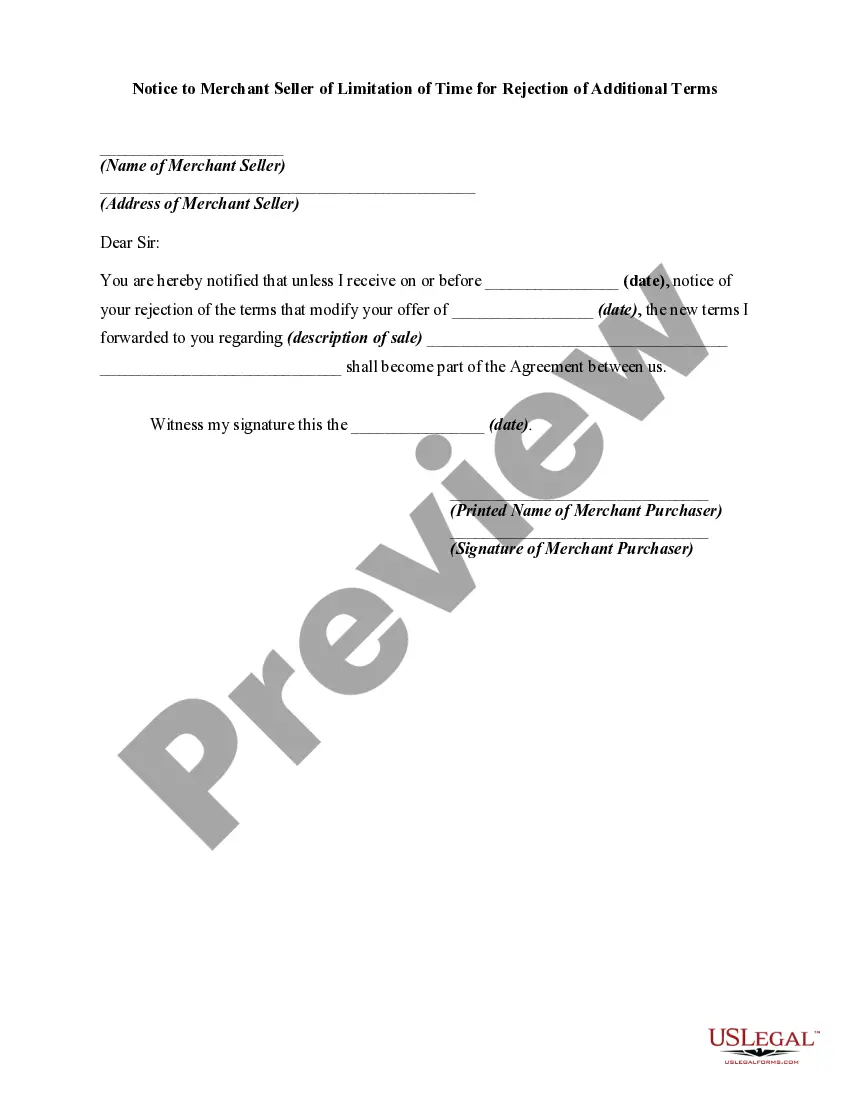
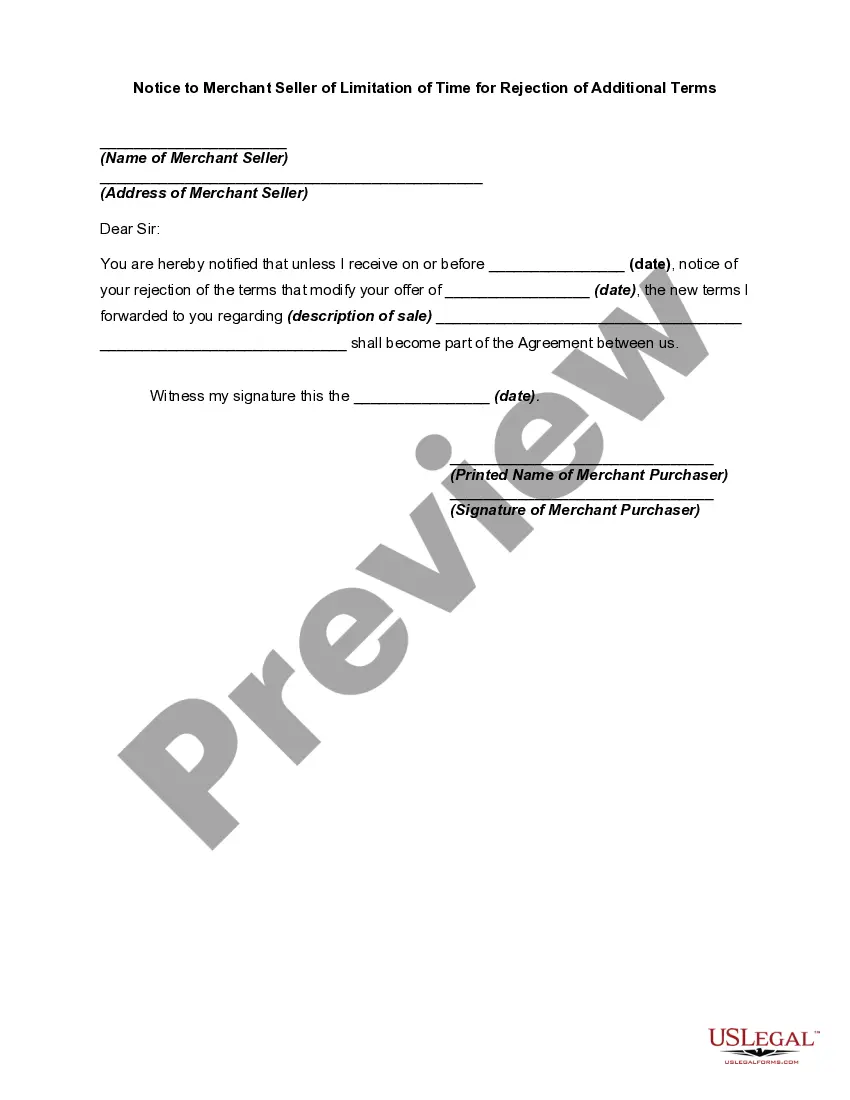
A Notice to Seller-Limitation of Time for Rejection is a document issued by a buyer to a seller that sets a specific deadline for the rejection of goods or services. This document specifies the date and time by which the buyer must reject the goods or services in order to receive a refund or replacement. It is usually issued following a purchase agreement that has been breached, allowing the buyer to exercise their rights to return the goods or services. There are two types of Notice to Seller-Limitation of Time for Rejection: an open-ended notice, which does not specify a deadline, and a closed-ended notice, which does specify a deadline.
Notice to Seller-Limitation of Time for Rejection
State:
Multi-State
Control #:
US-2508SB
Format:
Word;
Rich Text
Instant download
Description
Notice to Merchant Seller of Limitation of Time for Rejection of Additional Terms

How to fill out Notice To Seller-Limitation Of Time For Rejection?
US Legal Forms is the most easy and affordable way to find appropriate legal templates. It’s the most extensive online library of business and individual legal paperwork drafted and verified by attorneys. Here, you can find printable and fillable templates that comply with federal and local laws - just like your Notice to Seller-Limitation of Time for Rejection.
Obtaining your template takes just a few simple steps. Users that already have an account with a valid subscription only need to log in to the web service and download the form on their device. Later, they can find it in their profile in the My Forms tab.
And here’s how you can obtain a properly drafted Notice to Seller-Limitation of Time for Rejection if you are using US Legal Forms for the first time:
- Read the form description or preview the document to guarantee you’ve found the one meeting your needs, or find another one utilizing the search tab above.
- Click Buy now when you’re sure of its compatibility with all the requirements, and choose the subscription plan you prefer most.
- Create an account with our service, log in, and purchase your subscription using PayPal or you credit card.
- Choose the preferred file format for your Notice to Seller-Limitation of Time for Rejection and save it on your device with the appropriate button.
Once you save a template, you can reaccess it anytime - simply find it in your profile, re-download it for printing and manual fill-out or import it to an online editor to fill it out and sign more effectively.
Take full advantage of US Legal Forms, your trustworthy assistant in obtaining the required formal paperwork. Try it out!
Form popularity
FAQ
If you believe you're entitled to the deposit and the buyer disagrees, you have the option of taking legal action. Depending on the situation, you may also be able to sue a purchaser who breaches your contract for damages. An experienced real estate lawyer can help you understand what this entails.
Buyer's Remedies for Breach of Contract In addition to suing for damages, the buyer can request that the money they've already paid be returned. A suit for price is another remedy available for a contract breach. These suits involve the money that the buyer has paid for goods that were not delivered by the seller.
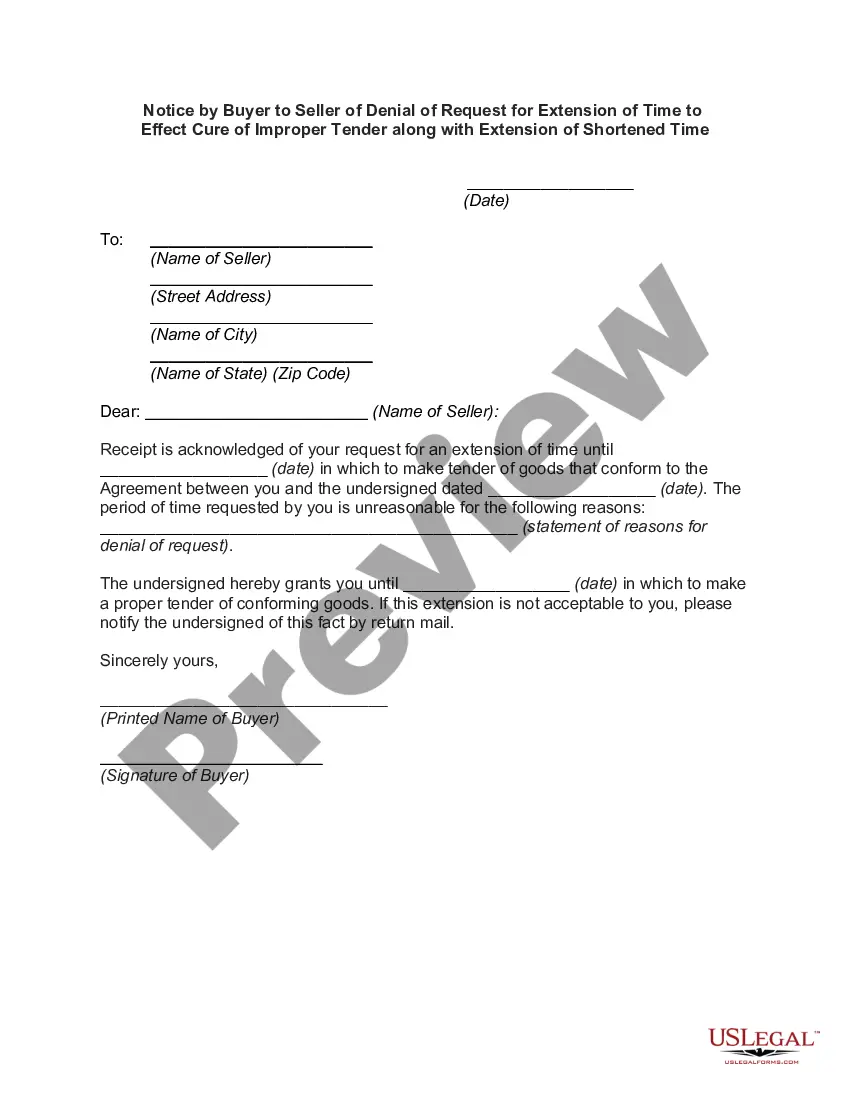
If a seller has delivered nonconforming goods that have been rejected, upon notice of an intent to cure, the seller automatically then has 15 days to deliver conforming goods.
If a buyer breaches a contract while the seller is still in possession of the goods, the seller can resell the goods and hold the buyer liable for any loss. exactly conform to the contract in every detail. If a buyer wrongfully refuses to accept goods that conform to a contract, the seller may recover damages.
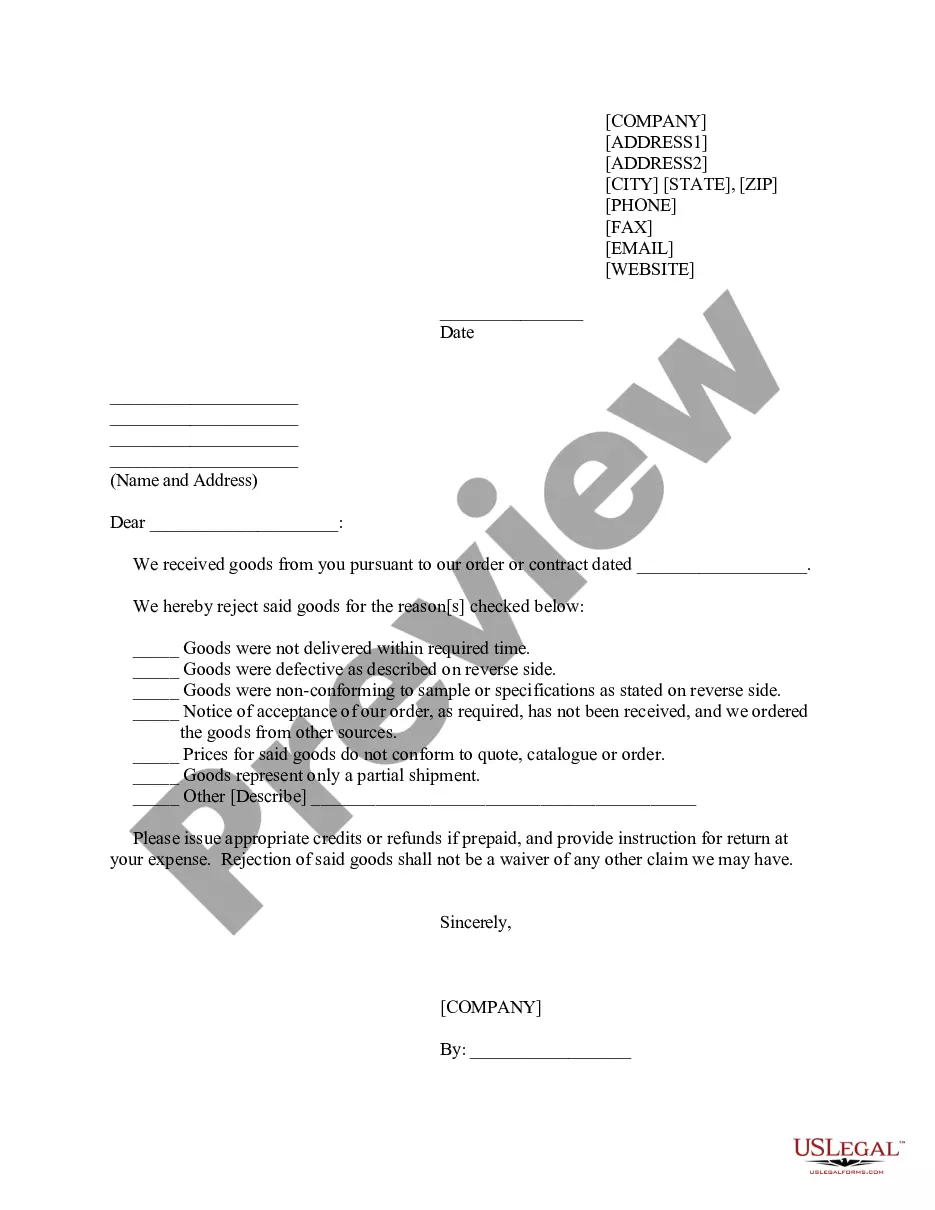
Process for Rejection of Goods The buyer is responsible for providing a notice of rejection letter to the supplier describing the defect(s) that renders the delivery as non-conforming to the Contract/PO, what the delivery and inspection criterion was, and how the delivered product does not conform.
Damages are usually awarded to an injured party for losses suffered as a result of the defaulting party's actions or non-actions. The purpose of an award of damages for breach of contract is to put the injured party in the position it would have been in had the contract been performed.
(2) Revocation of acceptance must occur within a reasonable time after the buyer discovers or should have discovered the ground for it and before any substantial change in condition of the goods which is not caused by their own defects. It is not effective until the buyer notifies the seller of it.
What is the time limit allowed for a buyer to bring a lawsuit for the seller's breach of contract? There is no statute of limitations for a buyer to bring such a lawsuit, since the Uniform Commercial Code seeks to preserve and advance the buyer's interests if the seller breaches the contract.