Louisiana Affidavit of Service for Court Date
What this document covers
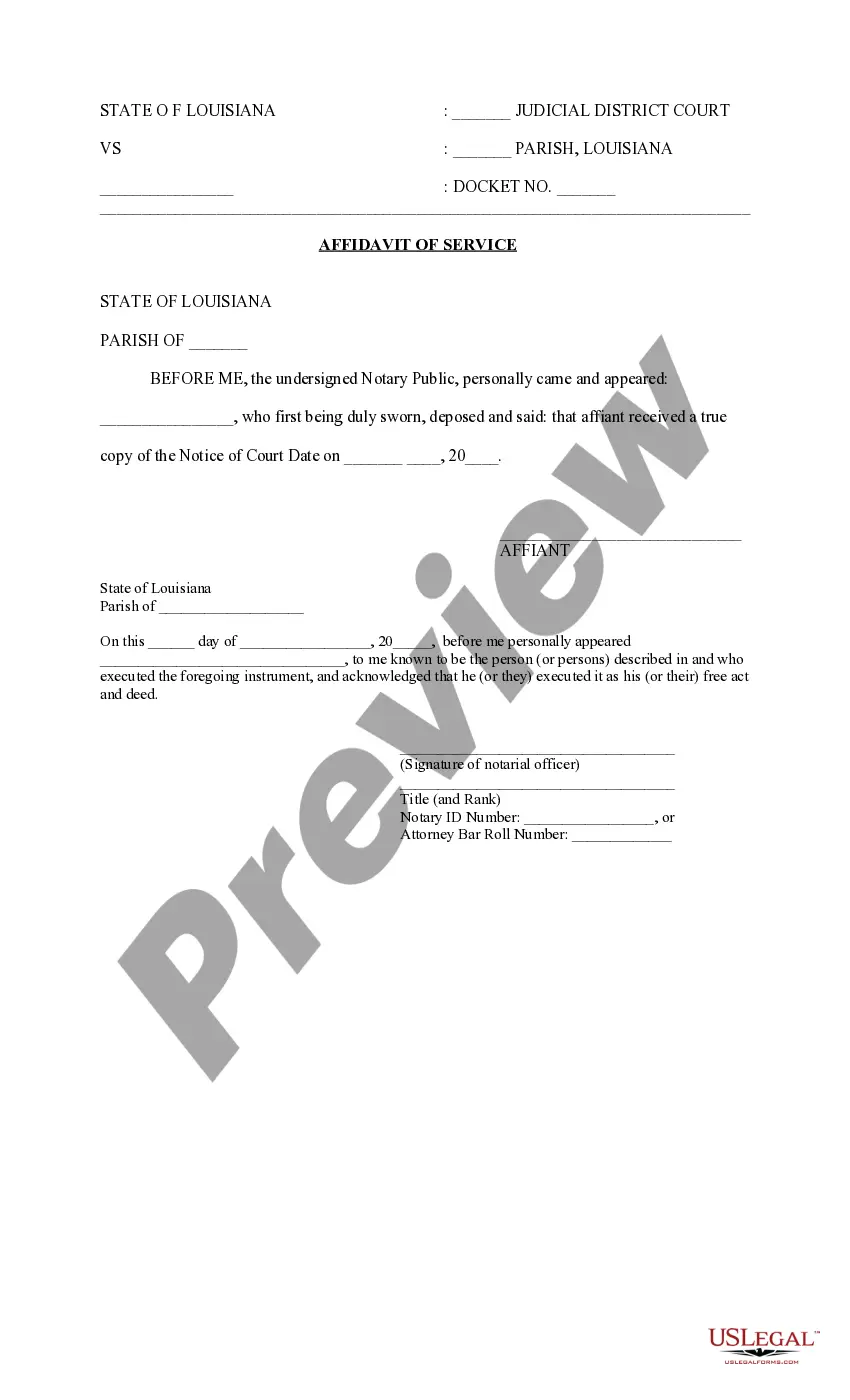
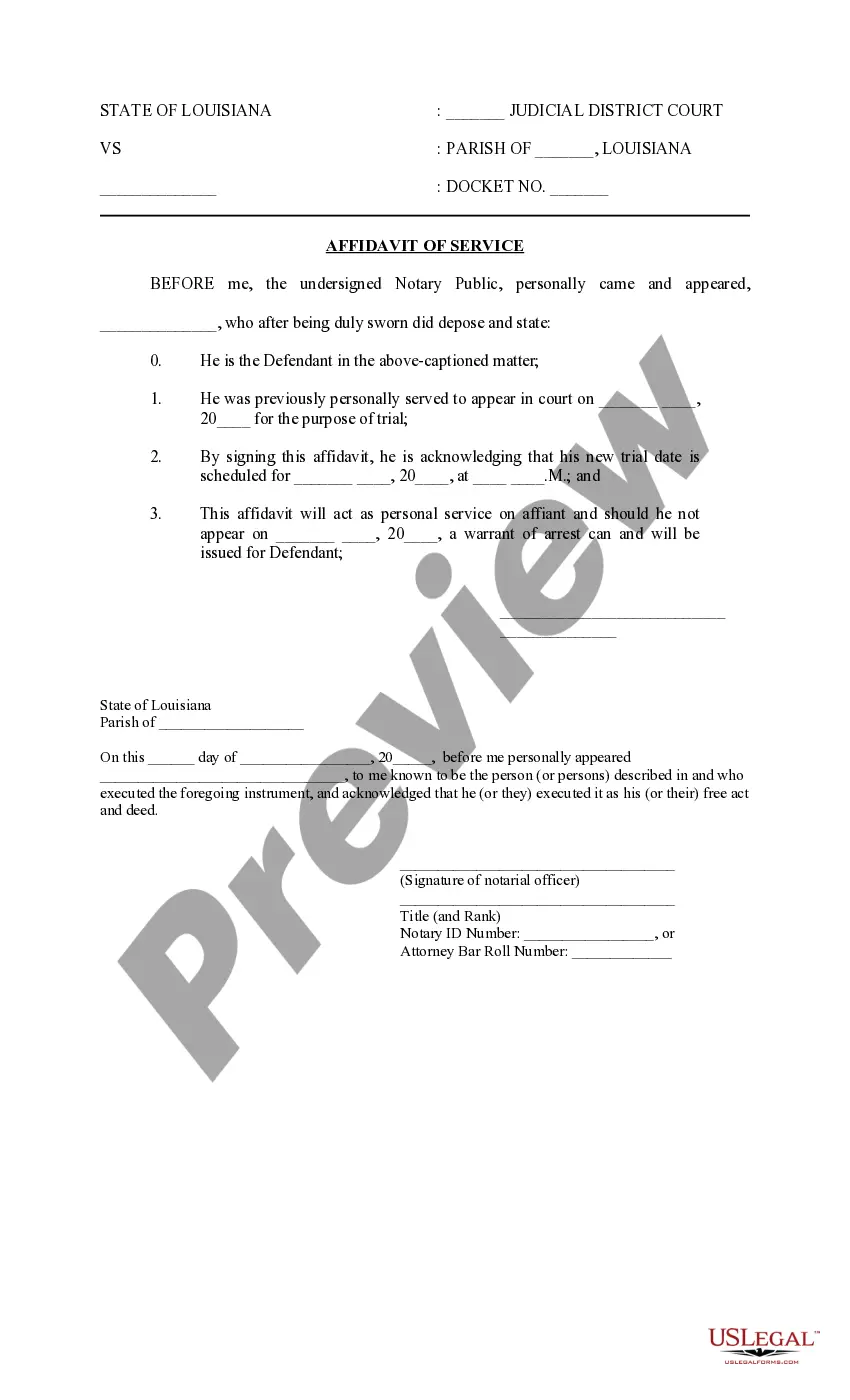
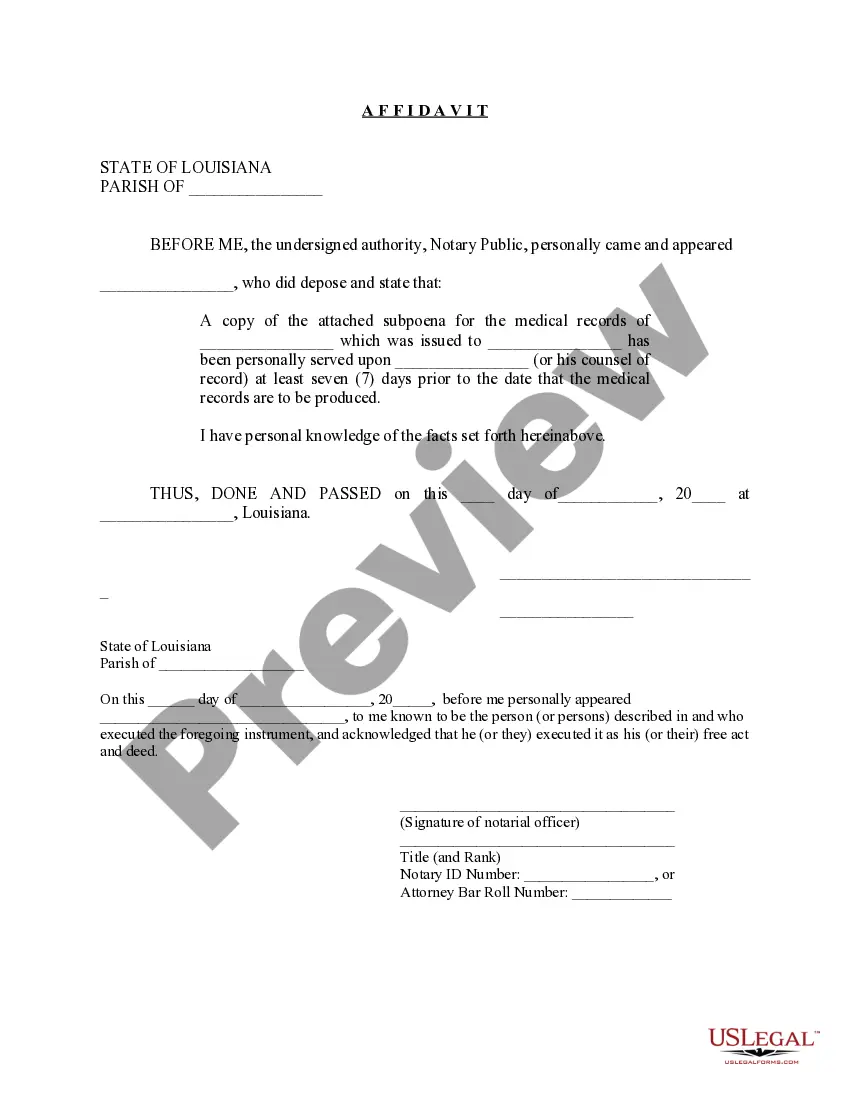
The Affidavit of Service for Court Date is a legal document that confirms a specific individual has been served with a Notice of Court Date. This form differs from similar documents because it provides a sworn statement from the affiant, confirming the date of service and the individual's identity. This is an important legal step to ensure all parties are properly notified of court proceedings, which is crucial for the fairness and integrity of the legal process.
Key components of this form
- Affiant's name: The individual who is making the sworn statement.
- Date of service: The date when the notice was delivered to the individual.
- Notary public section: Verifies the identity of the affiant and formally witnesses the signing of the affidavit.
- Docket number: The unique number assigned to the case by the court for identification.
- Signature lines: Areas for the affiant and the notary public to sign and date the document.

Common use cases
This form should be used when a party needs to provide proof to the court that a Notice of Court Date has been duly served to the relevant individual. Common scenarios include disputes in civil cases, family court matters, or any situation where attendance at court is required. It's essential for ensuring that all parties are adequately informed about court filings and hearings.
Who should use this form
- Individuals serving court documents to another party.
- Attorneys who are representing clients in legal matters requiring proof of service.
- Any party involved in litigation who needs to notify others about upcoming court dates.
How to prepare this document
- Identify the affiant: Fill in the name of the person making the statement.
- Enter the date of service: Specify the exact date when the Notice of Court Date was served.
- Provide the docket number: Enter the court's assigned number for the case.
- Sign before a notary: The affiant must sign the form in front of a notary public to validate the affidavit.
- Complete the notary section: The notary will fill in their information and signature, affirming that they witnessed the signing.
Notarization guidance
Yes, this form must be notarized to be legally valid. The notarization process ensures that the affiant's identity is confirmed, and the document is sworn before a legally authorized individual, such as a notary public. US Legal Forms offers integrated online notarization services, providing 24/7 availability through secure video calls, ensuring convenience and compliance with legal standards.
Get your form ready online
Our built-in tools help you complete, sign, share, and store your documents in one place.
Make edits, fill in missing information, and update formatting in US Legal Forms—just like you would in MS Word.
Download a copy, print it, send it by email, or mail it via USPS—whatever works best for your next step.
Sign and collect signatures with our SignNow integration. Send to multiple recipients, set reminders, and more. Go Premium to unlock E-Sign.
If this form requires notarization, complete it online through a secure video call—no need to meet a notary in person or wait for an appointment.
We protect your documents and personal data by following strict security and privacy standards.

Make edits, fill in missing information, and update formatting in US Legal Forms—just like you would in MS Word.

Download a copy, print it, send it by email, or mail it via USPS—whatever works best for your next step.

Sign and collect signatures with our SignNow integration. Send to multiple recipients, set reminders, and more. Go Premium to unlock E-Sign.

If this form requires notarization, complete it online through a secure video call—no need to meet a notary in person or wait for an appointment.

We protect your documents and personal data by following strict security and privacy standards.
Typical mistakes to avoid
- Failing to accurately complete the date of service.
- Not having the form signed in the presence of a notary public.
- Leaving fields blank that are required for verifying the identity of the affiant.
- Providing incorrect or missing docket numbers.
- Using unclear language that may confuse the statements made by the affiant.
Why complete this form online
- Convenient online access to a downloadable and editable form.
- Quick completion process to meet court deadlines.
- Reliability of templates drafted by licensed attorneys.
Summary of main points
- The Affidavit of Service for Court Date is essential for proving that legal notification has been made.
- It requires accurate completion and notarization for validity.
- This form is primarily used in Louisiana and must adhere to local court rules.
- Common errors can be avoided by carefully following instructions for completion.
Looking for another form?
Form popularity
FAQ
There are multiple reasons for being served papers. You could be getting a subpoena to testify in court. You might also have access to documents that could be considered evidence. You may not be thrilled by either of those options, but they're usually preferable to getting sued.
Generally, process servers make at least three attempts to serve somebody.
Louisiana doesn't license private process servers, but you may require court appointment to become a process server in Louisiana. In most cases, service is made by the local sheriff's office, or any private individual appointed by the court.
Generally, process servers make at least three attempts to serve somebody. These attempts are normally made at different times of day and on different days to maximize our chance of serving the papers.
A Simple Answer to "What Happens if a Process Server Can't Serve You?" The simple answer to your question is that the court continues without you. Evidence is brought forth without a rebuttal or defense from you and a judgment is issued.
You must allow Process Servers Zone 7 to 10 days from the time the Process Server receives the documents, for the documents to be served. If you require the documents to be served within 7 to 10 days you must select urgent service when paying and your documents will be given priority. What is Urgent Service?
The Louisiana Long-Arm Statute provides that a certified copy of the citation and petition "shall be sent by counsel for the plaintiff, or by the plaintiff if not represented by counsel, to the defendant by registered or certified mail, or actually delivered to the defendant by commercial courier, when the person to be
A legal process server delivers (serves) court documents to the defendant or individual listed on the legal document being served.Once a process server delivers the documents, an Affidavit of Service, also called a Proof of Service, is notarized and given to the party who requested the service.