Jury Instruction - Interference With Commerce By Extortion - Hobbs Act - Racketeering - Color of Official Right
What this document covers
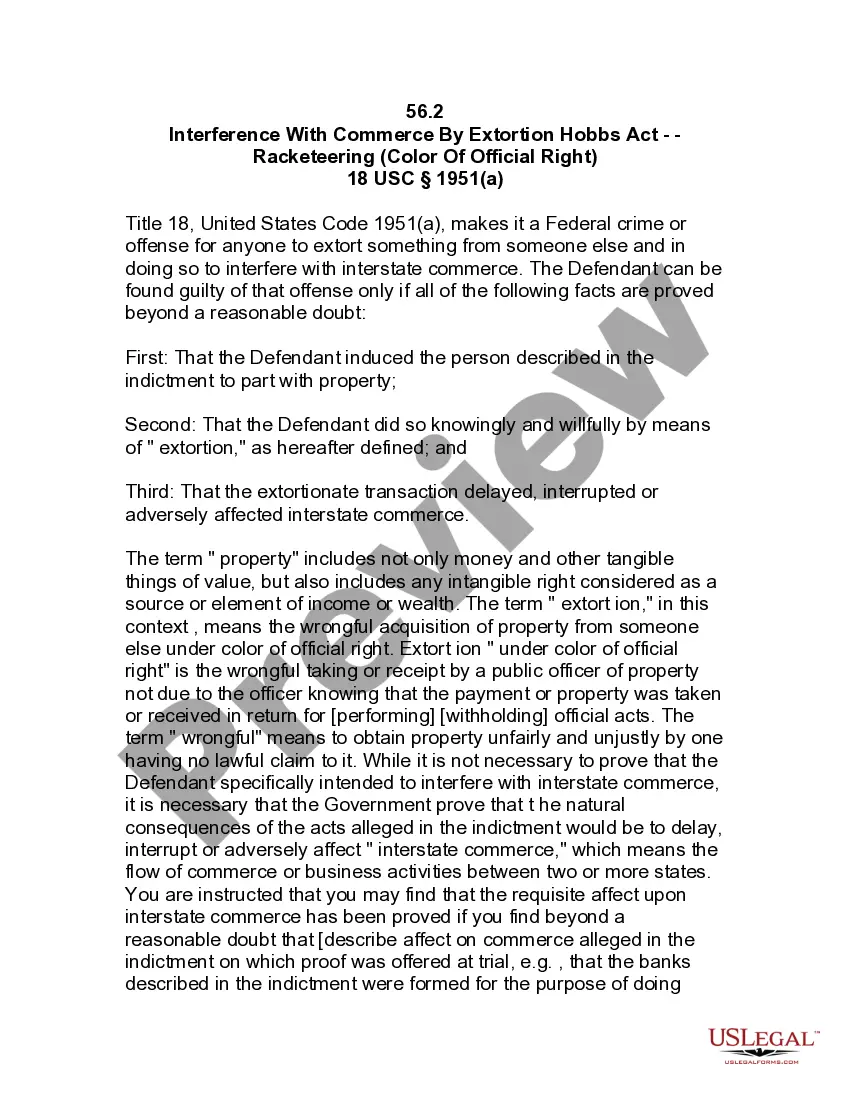
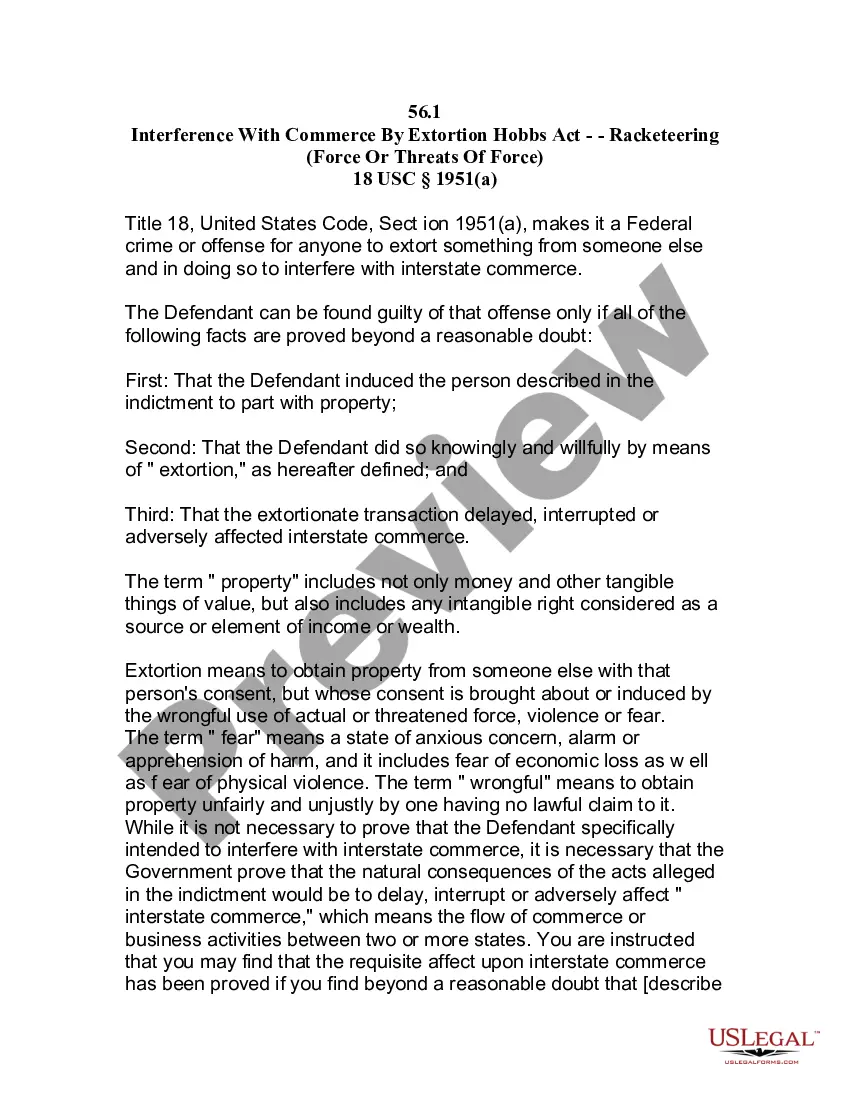
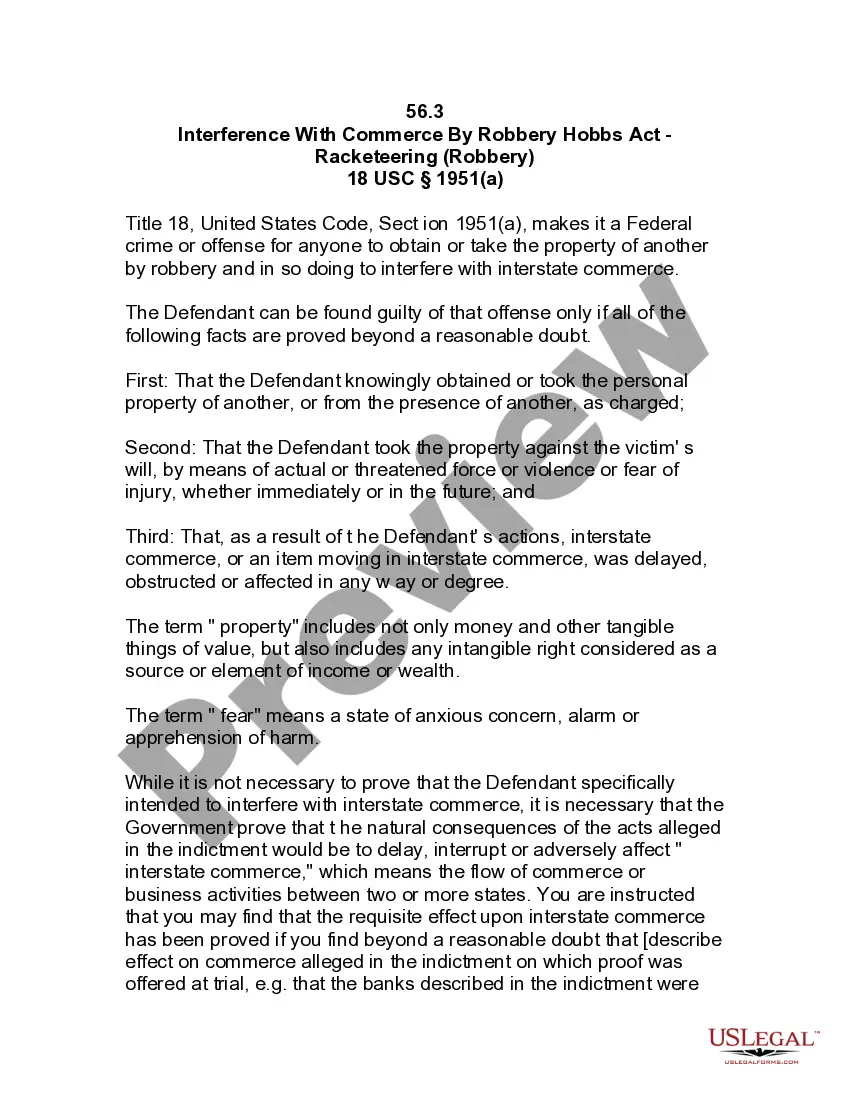
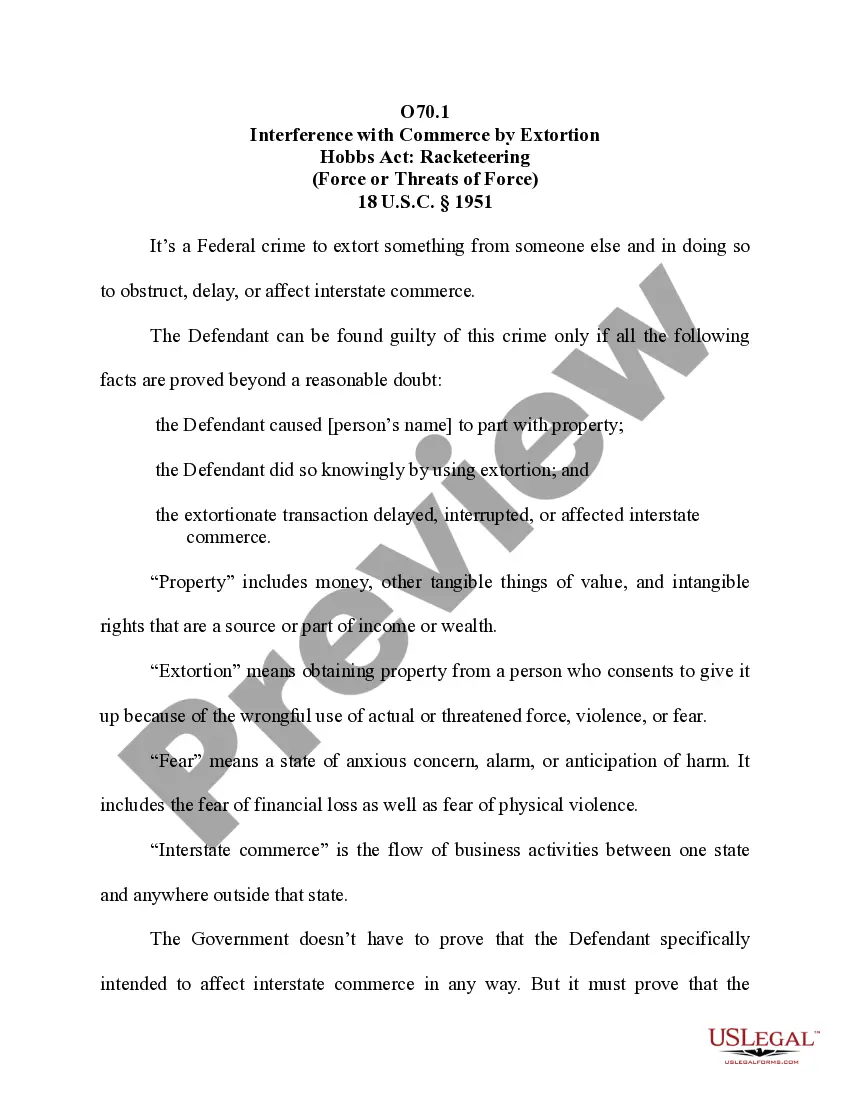
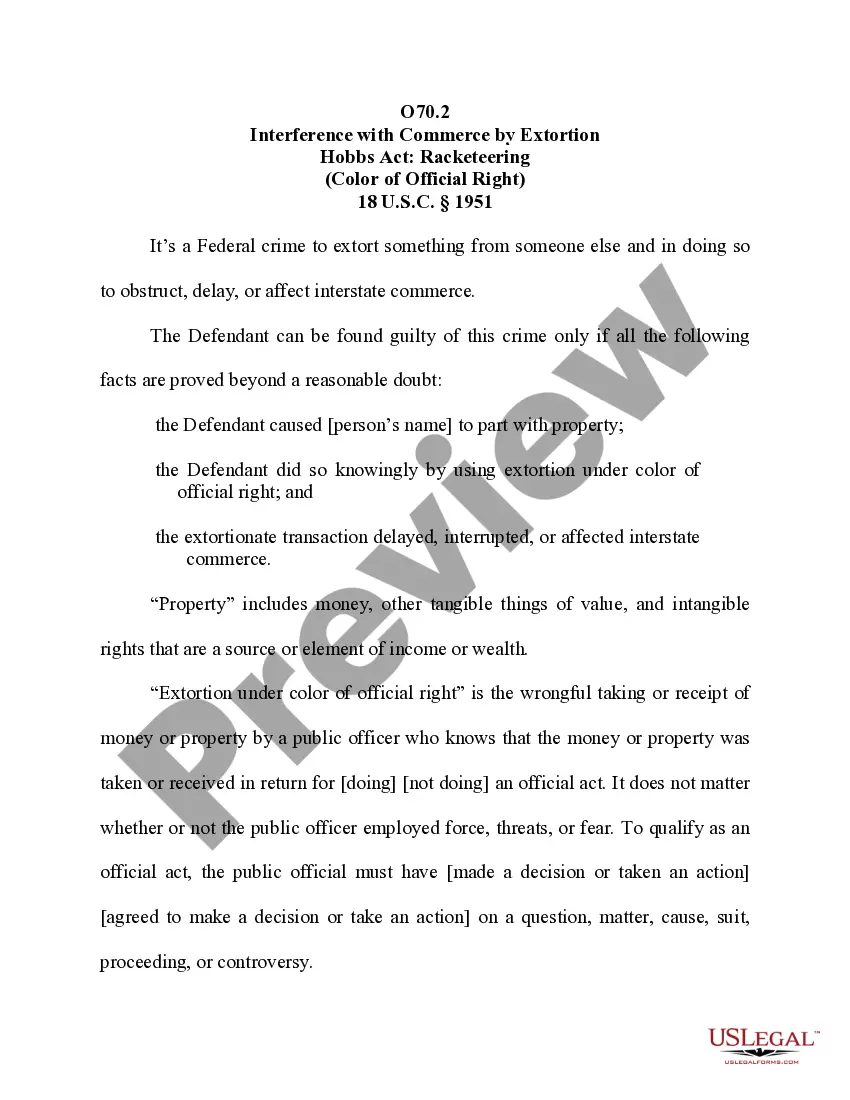
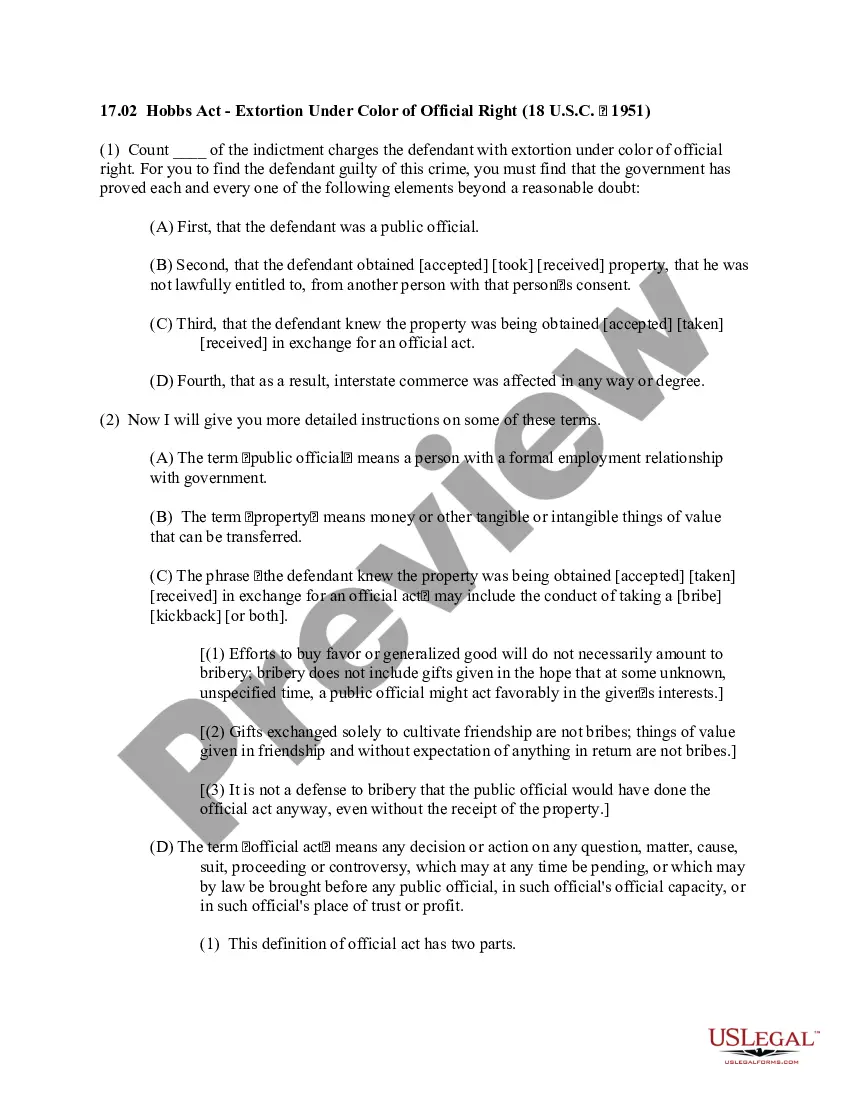
The Jury Instruction for Interference With Commerce By Extortion under the Hobbs Act focuses specifically on cases involving extortion that affects interstate commerce. This legal form provides sample jury instructions that are designed to guide jurors in understanding the elements of the offense according to 18 USC 1951(a). Unlike other legal instructions, this form is tailored to address the nuances of extortion under color of official right, emphasizing the criteria needed to establish guilt in federal cases.
Key components of this form
- Definition of extortion and its application under the Hobbs Act.
- Criteria for establishing the defendant's intent and actions.
- Explanation of how extortion must affect interstate commerce.
- Clarification of property definition, including intangible assets.
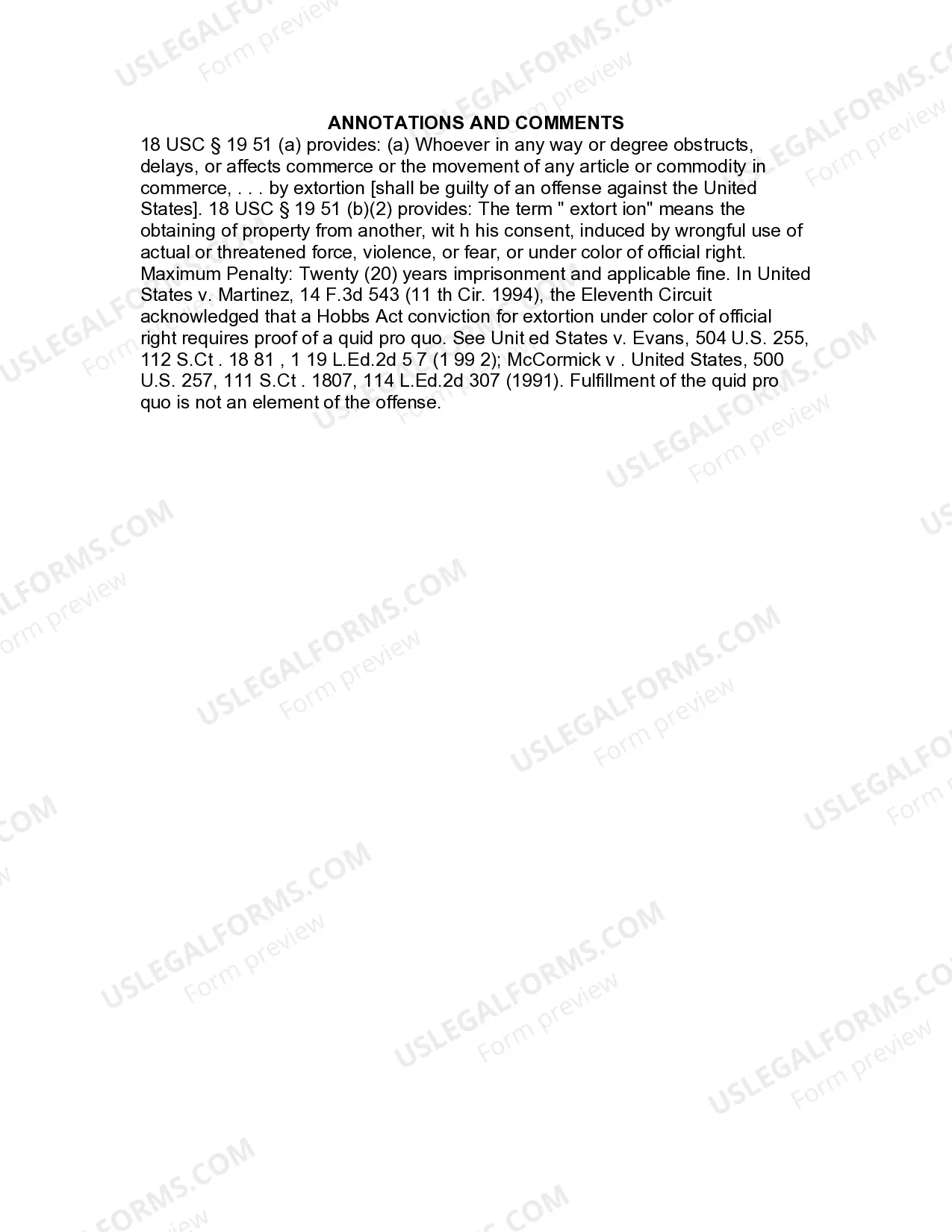
- Consequences of a conviction, including potential penalties.
When to use this form
This form is necessary when preparing jury instructions related to federal charges under the Hobbs Act for extortion that disrupts interstate commerce. Use this form in cases where a defendant is alleged to have wrongfully taken property under the guise of official authority, leading to implications for businesses operating between states.
Who needs this form
- Attorneys representing clients involved in federal extortion cases.
- Judges who need a reference for instructing juries on specific legal standards.
- Legal educators creating instructional materials for law students.
How to prepare this document
- Review the relevant statutory elements related to the Hobbs Act.
- Identify the parties involved in the case and their roles.
- Specify the alleged actions taken by the defendant.
- Clearly define the effects of those actions on interstate commerce.
- Incorporate case-specific evidence that supports the allegations.
Is notarization required?
This form does not typically require notarization to be legally valid. However, some jurisdictions or document types may still require it. US Legal Forms provides secure online notarization powered by Notarize, available 24/7 for added convenience.
Get your form ready online
Our built-in tools help you complete, sign, share, and store your documents in one place.
Make edits, fill in missing information, and update formatting in US Legal Forms—just like you would in MS Word.
Download a copy, print it, send it by email, or mail it via USPS—whatever works best for your next step.
Sign and collect signatures with our SignNow integration. Send to multiple recipients, set reminders, and more. Go Premium to unlock E-Sign.
If this form requires notarization, complete it online through a secure video call—no need to meet a notary in person or wait for an appointment.
We protect your documents and personal data by following strict security and privacy standards.

Make edits, fill in missing information, and update formatting in US Legal Forms—just like you would in MS Word.

Download a copy, print it, send it by email, or mail it via USPS—whatever works best for your next step.

Sign and collect signatures with our SignNow integration. Send to multiple recipients, set reminders, and more. Go Premium to unlock E-Sign.

If this form requires notarization, complete it online through a secure video call—no need to meet a notary in person or wait for an appointment.

We protect your documents and personal data by following strict security and privacy standards.
Common mistakes to avoid
- Failing to clearly establish the linkage between extortion and its impact on interstate commerce.
- Neglecting to define terms such as "wrongful" or "intangible rights" correctly.
- Using outdated legal precedents that do not reflect current interpretations of the Hobbs Act.
Benefits of using this form online
- Immediate access to professionally drafted jury instructions tailored for specific legal scenarios.
- Ability to customize the instructions to fit individual case details.
- Convenient download options, allowing for quick review and use in legal proceedings.
Legal use & context
- This form is significant in guiding jurors in understanding federal extortion laws.
- Misapplication of this form may lead to misunderstandings during trials.
- The instructions should accurately reflect the evidence presented and the specific case facts.
What to keep in mind
- Understanding the legal basis of the Hobbs Act is crucial for proper jury instructions.
- Extortion cases based on official right require careful definition of key terms.
- This form serves as a reliable resource for accurate and effective legal guidance.
Looking for another form?
Form popularity
FAQ
The wrongful taking by a public officer of money or property not due to him or his office, whether or not the taking was accomplished by force, threats, or use of fear.
Hobbs Act -- Generally. The Hobbs Act prohibits actual or attempted robbery or extortion affecting interstate or foreign commerce "in any way or degree." Section 1951 also proscribes conspiracy to commit robbery or extortion without reference to the conspiracy statute at 18 U.S.C. § 371.
Most states define extortion as the gaining of property or money by almost any kind of force or threat of violence, property damage, harm to reputation, or unfavorable government action.Extortion is a felony in all states.
The Hobbs Act prohibits actual or attempted robbery or extortion affecting interstate or foreign commerce "in any way or degree." Section 1951 also proscribes conspiracy to commit robbery or extortion without reference to the conspiracy statute at 18 U.S.C. § 371.
The Hobbs Act criminalizes both robbery and extortion:"extortion" means the obtaining of property from another, with his consent, induced by wrongful use of actual or threatened force, violence, or fear, or under color of official right.
That's why it's a federal crime for anyone acting under color of law to willfully deprive or conspire to deprive a person of a right protected by the Constitution or U.S. law. Color of law simply means the person is using authority given to him or her by a local, state, or federal government agency.
Interference in interstate commerce is any instance in which a person delays, obstructs or otherwise affects commerce. This can be the sale of or the movement of any type of commodity.
The deprivation of rights under color of law is a federal criminal offense which occurs when any person, under color of any law, statute, ordinance, regulation, or custom, willfully subjects any person on any U.S. territory or possession to the deprivation of any rights, privileges, or immunities secured or protected