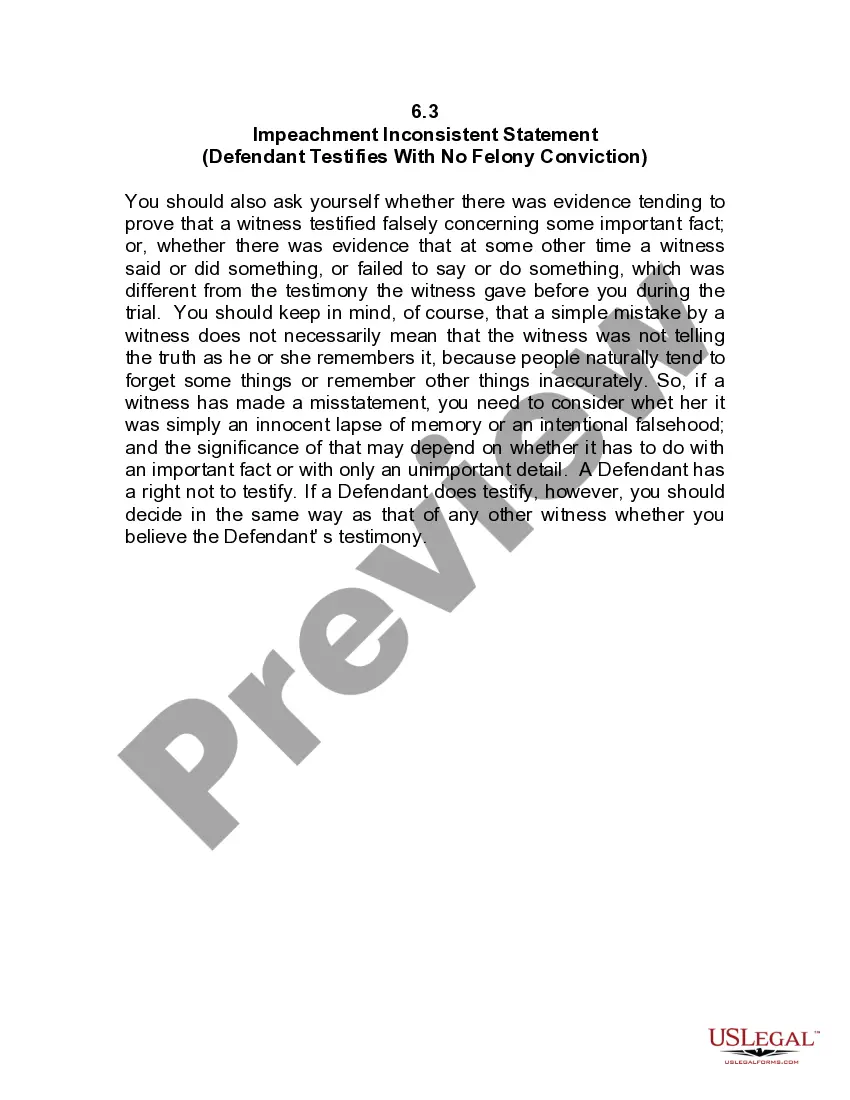
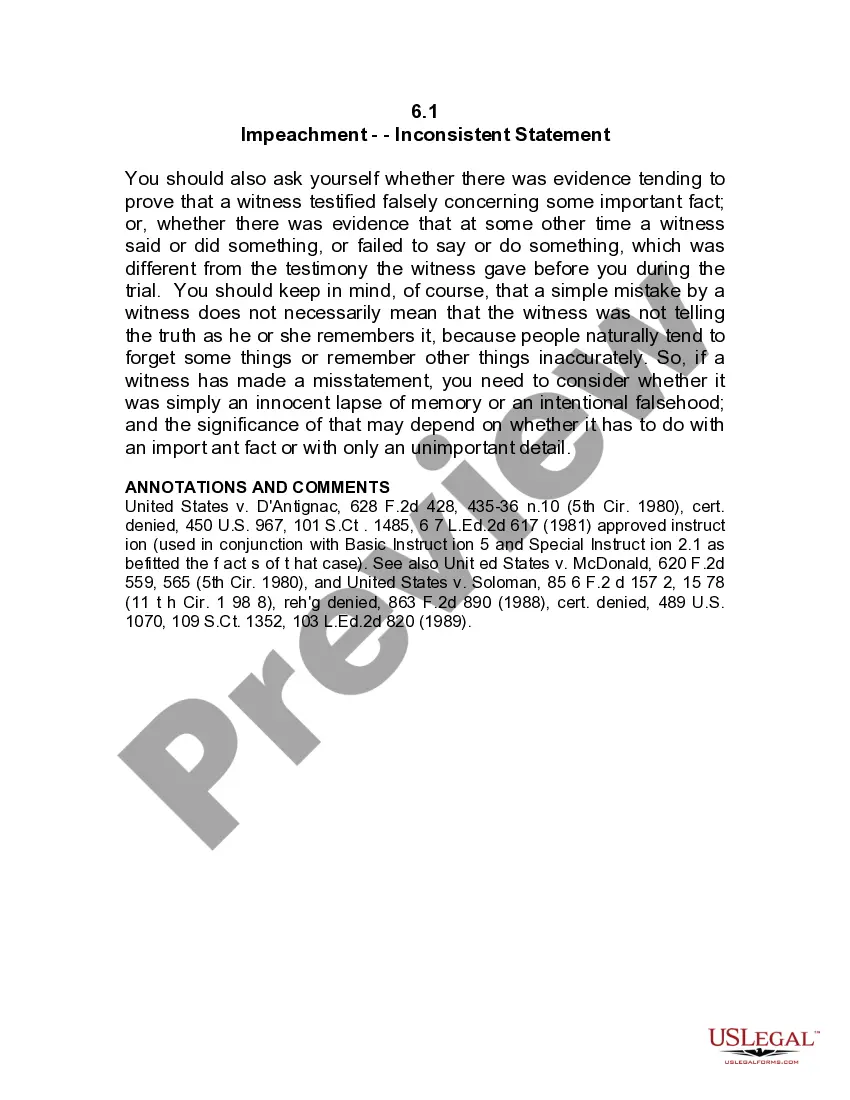
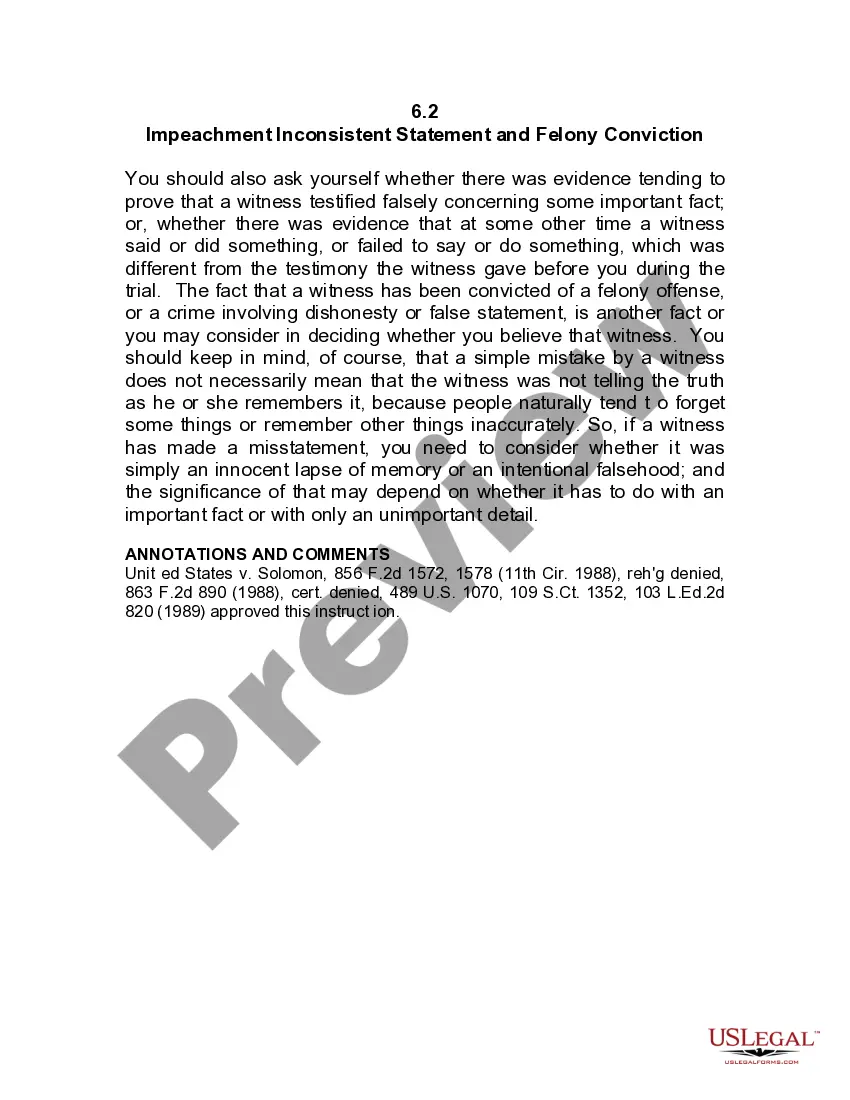
Jury Instruction - Impeachment - Inconsistent Statement - Defendant Testifies With No Felony Conviction
Understanding this form
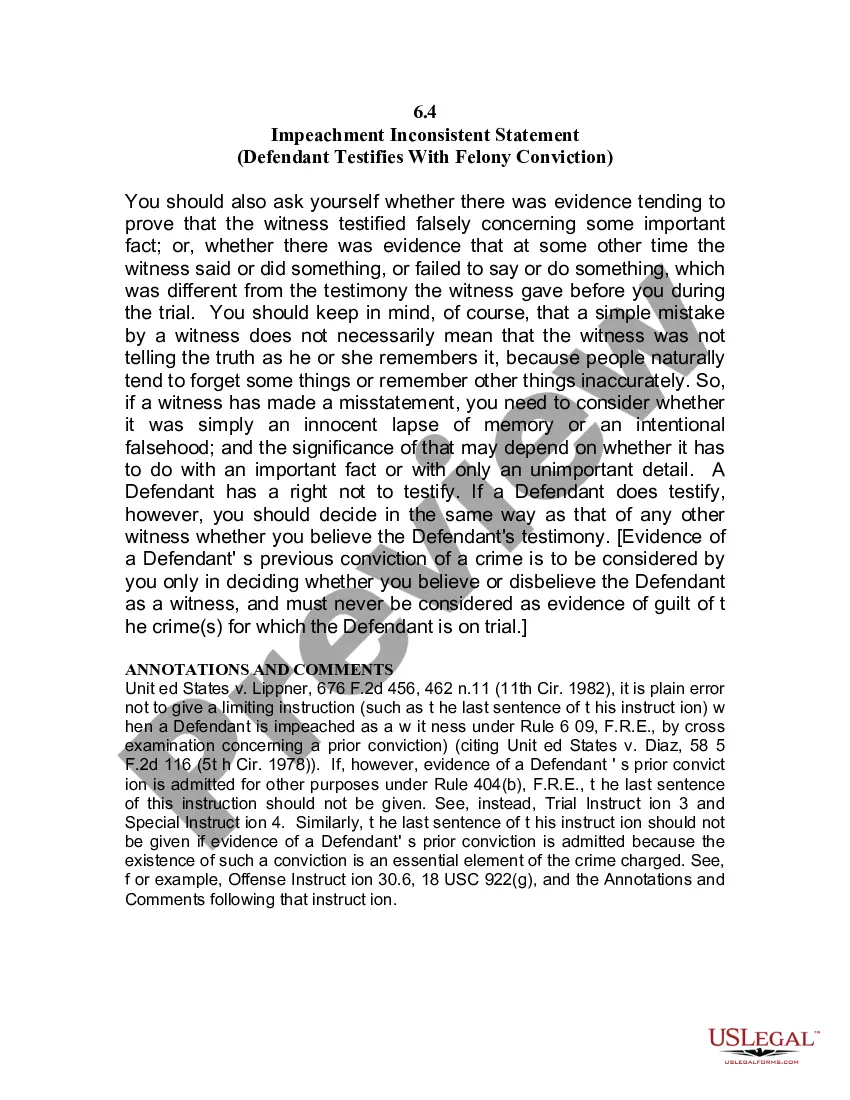
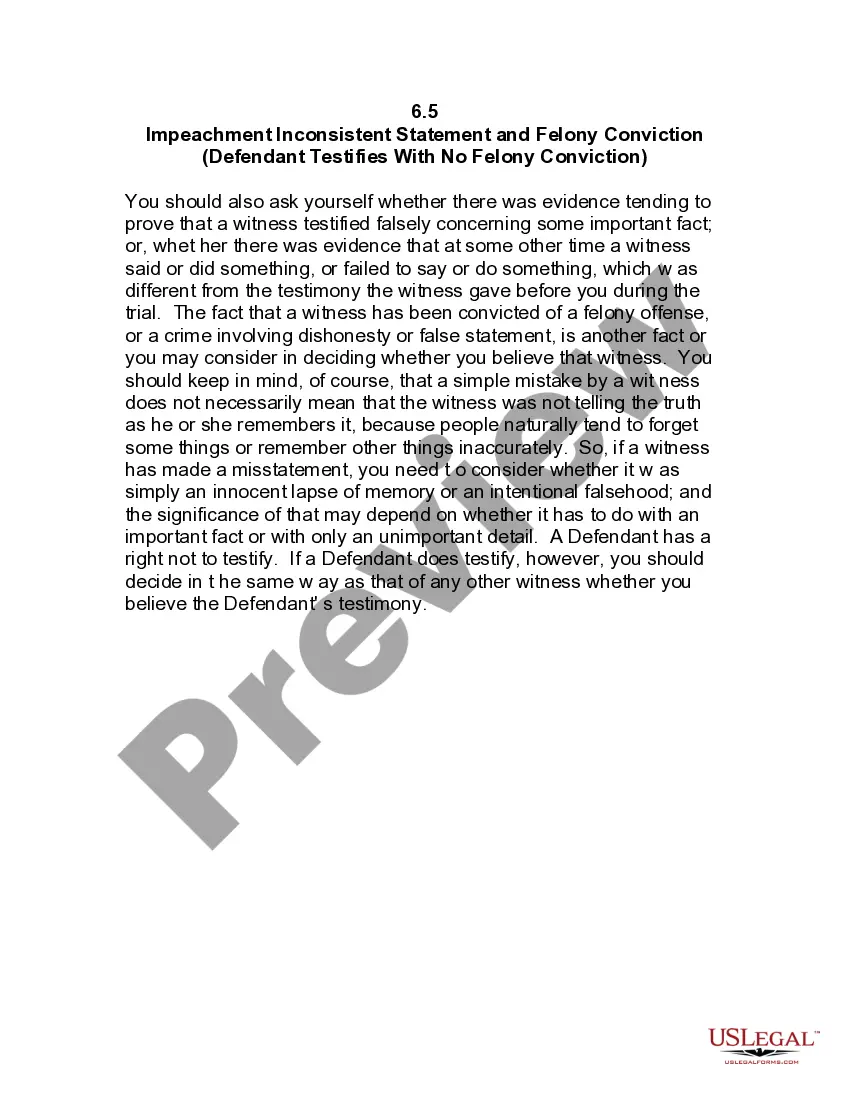
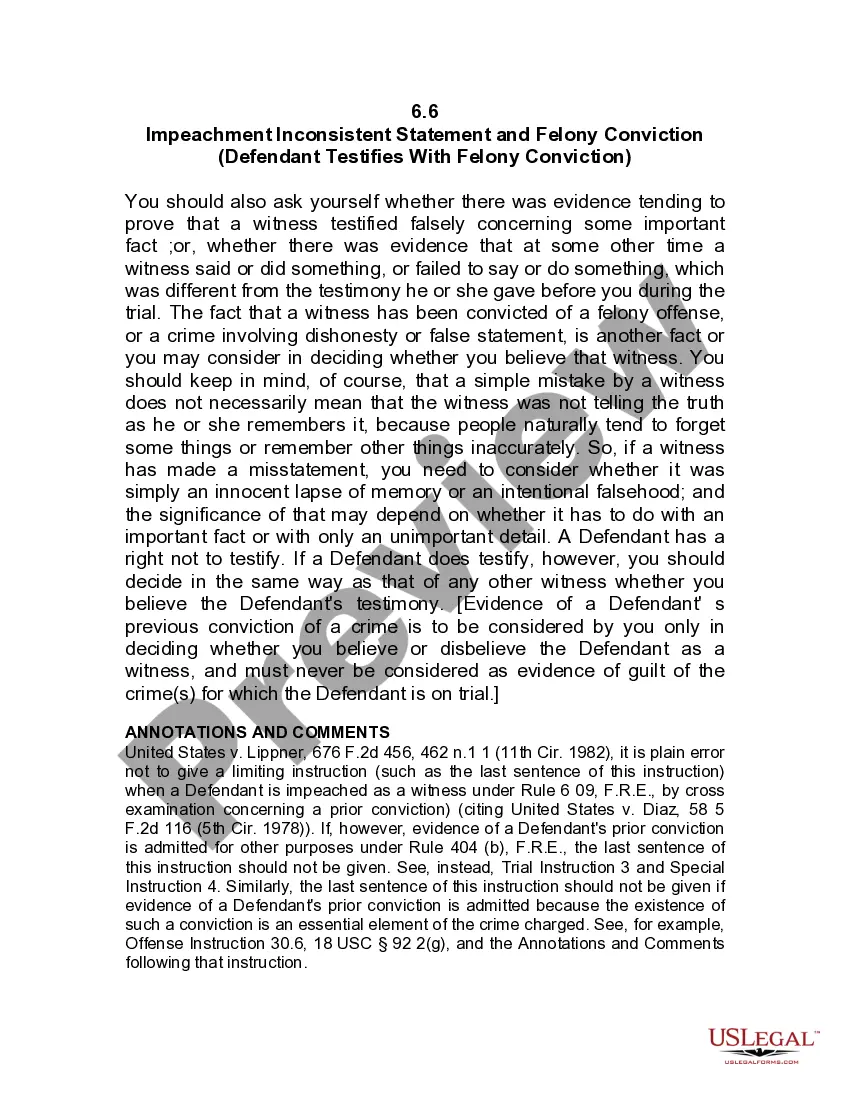
This form is a Jury Instruction on impeachment related to inconsistent statements made by a defendant who has no felony convictions. It provides guidelines for jurors to assess the credibility of witness testimony, including the defendant's, during a trial. This form helps ensure that jurors understand their responsibility to evaluate inconsistencies in testimony without jumping to conclusions about a witness's honesty based solely on minor errors or lapses of memory. The purpose of this instruction is to differentiate between innocent inaccuracies and deliberate falsehoods in witness statements, which is a crucial aspect of fair legal proceedings.
Form components explained
- Overview of impeachment and its implications for witness credibility.
- Guidance on assessing evidence of false testimony.
- Consideration of simple mistakes versus intentional misleading statements.
- Rights of the defendant regarding their choice to testify.
- Criteria for evaluating the significance of misstatements in testimony.
When to use this form
This form is used during trial proceedings when a defendant chooses to testify, and there are concerns about the credibility of their statements. It is pertinent when there are alleged inconsistencies in a witness's or the defendant's testimony that need to be clarified to the jury. The instruction can also be useful in cases where the jurors may need to determine whether to discount a witness's credibility based on discrepancies.
Who should use this form
- Judges who need to instruct jurors on evaluating witness credibility.
- Attorneys representing defendants in trials where witness testimony is critical.
- Legal professionals preparing for cases that involve testimonial inconsistencies.
- Court officials involved in the administration of trial procedures.
Instructions for completing this form
- Review the guidelines on impeachment presented in the form.
- Determine the relevant inconsistencies in witness testimony relevant to the case.
- Consider contextual factors influencing a witness's statements.
- Evaluate the importance of any discrepancies against the overall testimony.
- Ensure that jurors have a clear understanding of the distinction between honest mistakes and deceitful statements before deliberation.
Notarization requirements for this form
This form does not typically require notarization to be legally valid. However, some jurisdictions or document types may still require it. US Legal Forms provides secure online notarization powered by Notarize, available 24/7 for added convenience.
Get your form ready online
Our built-in tools help you complete, sign, share, and store your documents in one place.
Make edits, fill in missing information, and update formatting in US Legal Forms—just like you would in MS Word.
Download a copy, print it, send it by email, or mail it via USPS—whatever works best for your next step.
Sign and collect signatures with our SignNow integration. Send to multiple recipients, set reminders, and more. Go Premium to unlock E-Sign.
If this form requires notarization, complete it online through a secure video call—no need to meet a notary in person or wait for an appointment.
We protect your documents and personal data by following strict security and privacy standards.

Make edits, fill in missing information, and update formatting in US Legal Forms—just like you would in MS Word.

Download a copy, print it, send it by email, or mail it via USPS—whatever works best for your next step.

Sign and collect signatures with our SignNow integration. Send to multiple recipients, set reminders, and more. Go Premium to unlock E-Sign.

If this form requires notarization, complete it online through a secure video call—no need to meet a notary in person or wait for an appointment.

We protect your documents and personal data by following strict security and privacy standards.
Mistakes to watch out for
- Overlooking the context of a witness's statements when evaluating credibility.
- Failing to distinguish between minor errors and significant inconsistencies.
- Assuming all misstatements are deliberate falsehoods without adequate evidence.
- Neglecting to adequately explain the importance of a defendant's right not to testify.
Advantages of online completion
- Instant access to professionally drafted jury instructions.
- Convenient downloading for quick review and use in legal proceedings.
- Editable templates that allow for customization according to specific case needs.
- Reliable resources that comply with legal standards across jurisdictions.
Looking for another form?


Form popularity
FAQ
In the US, a party has the option of discrediting a witness through impeachment by cross-examining the witness about facts that reflect poorly on the witness's credibility or, in some cases, by introducing extrinsic evidence that reflects negatively on the witness's truthfulness or knowledge.
Rule 609(c) as submitted by the Court provided in part that evidence of a witness' prior conviction is not admissible to attack his credibility if the conviction was the subject of a pardon, annulment, or other equivalent procedure, based on a showing of rehabilitation, and the witness has not been convicted of a
First, the most basic step, is to have the witness repeat the testimony from today's hearing that you want to impeach. You cannot effectively impeach unless the witness repeats a fact they said during the current hearing that clearly contradicts a prior statement.
Rule 609 provides that, with certain restrictions, a witness may be impeached witrh evidence of two kids of criminal convictions: (1) felonies, regardless of their nature; and (2) misdemeanors involving crimes of dishonesty and false statement, such as check deception and perjury.
Under common law, a witness may be impeached by proof the witness has contradicted him- or herself through evidence of prior acts or statements that are inconsistent with testimony given on direct examination.
In the US, a party has the option of discrediting a witness through impeachment by cross-examining the witness about facts that reflect poorly on the witness's credibility or, in some cases, by introducing extrinsic evidence that reflects negatively on the witness's truthfulness or knowledge.
Repeat. First, the most basic step, is to have the witness repeat the testimony from today's hearing that you want to impeach. Build Up. Impeach.
The five basic methods are: use of contradiction, proof of bad character, proof of inconsistency, proof of bias, or proof of diminished capacity.