Agreement that Statement of Account is True, Correct and Settled
What is this form?
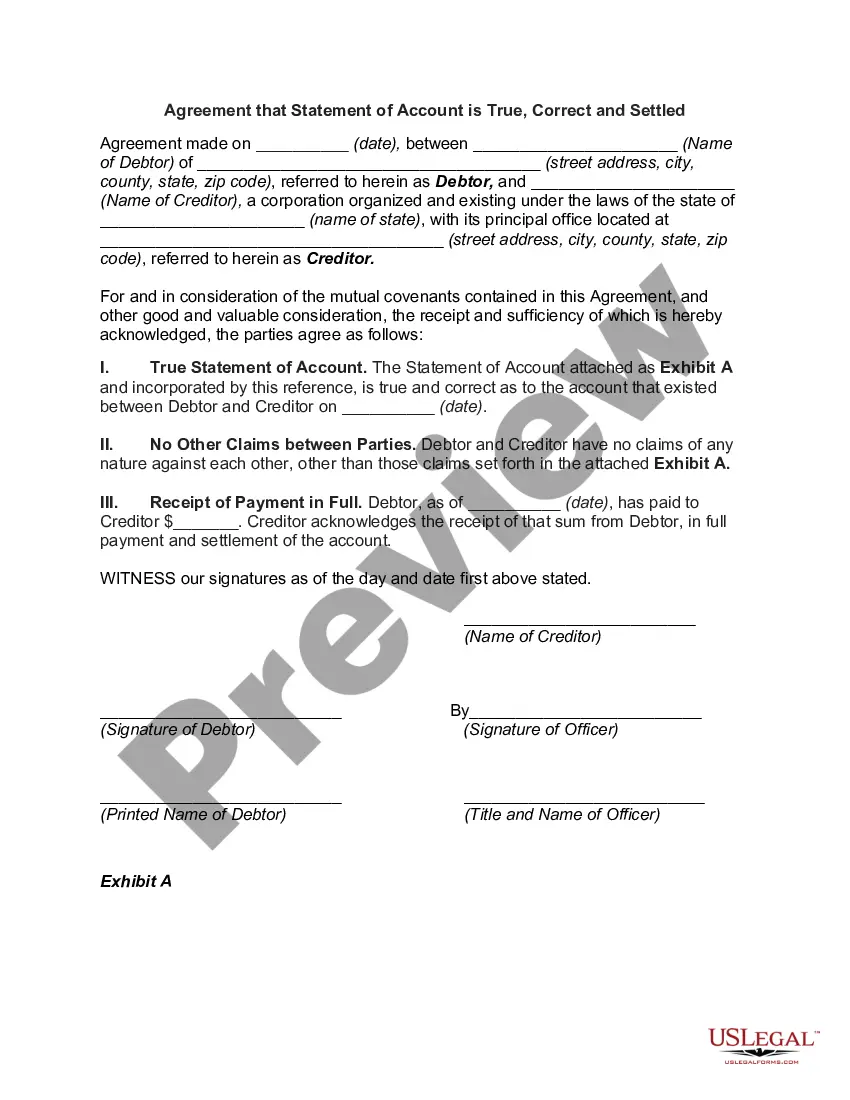
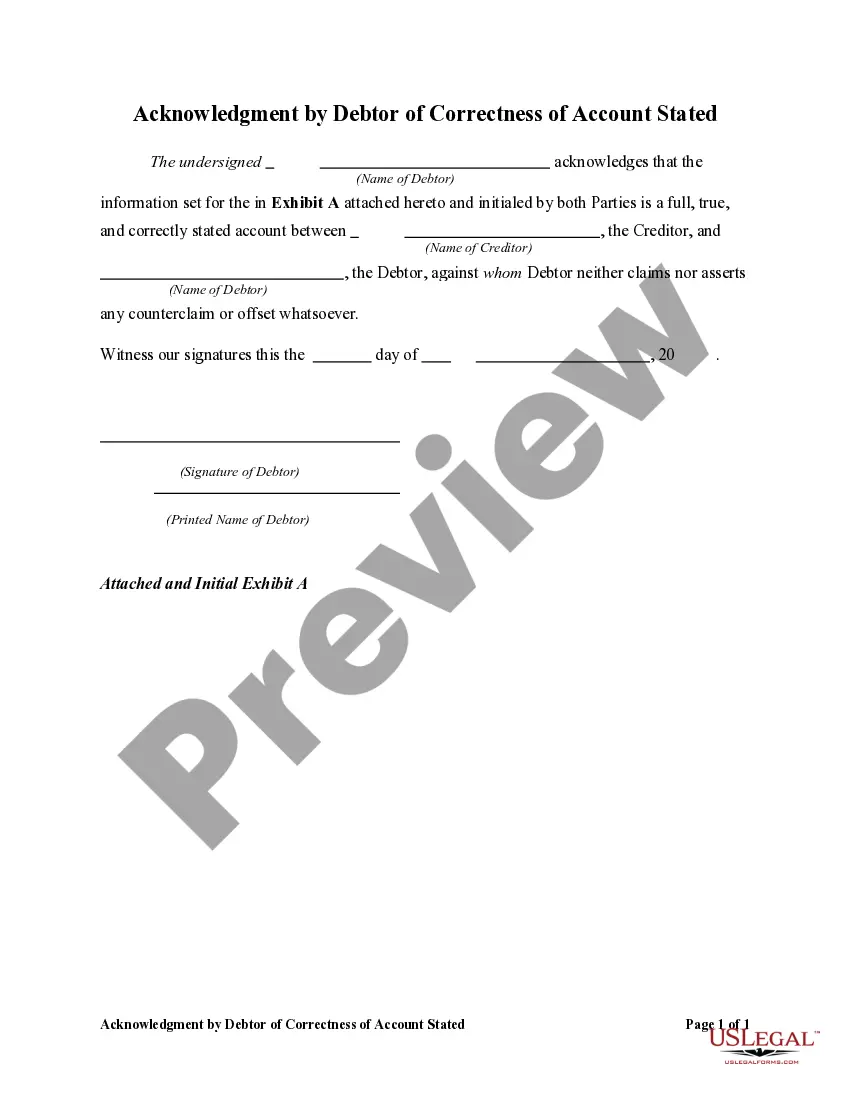
The Agreement that Statement of Account is True, Correct and Settled is a legal document used to confirm the accuracy of an account balance between a debtor and a creditor. This form clarifies that all financial obligations have been satisfied, ensuring that neither party has any further claims against each other regarding the account in question. This form is distinct from other debt settlement agreements as it emphasizes the acceptance of the statement of account as final and conclusive upon both parties.
Form components explained
- Identification of the Debtor and Creditor, including their contact information.
- A statement confirming that the attached Statement of Account is accurate as of a specific date.
- A declaration that no other claims exist between the parties outside of what is detailed in the attached statement.
- Acknowledgment of full payment by the Debtor, including the amount and date of payment.
- Signatures of both the Debtor and an authorized officer from the Creditor's organization.
When this form is needed
This form is appropriate to use when a debtor has made a payment to a creditor and both parties wish to officially confirm and settle the account. It is commonly utilized in scenarios where disagreements may arise regarding outstanding debts, ensuring a clear record that all obligations have been met. This form can also be useful in closing business transactions or financial accounts between entities.
Intended users of this form
This form is intended for:
- Debtors who wish to have a formal declaration that they have settled their account with a creditor.
- Creditors looking to confirm that the debtor has fulfilled their financial obligations and to release any further claims.
- Businesses or individuals engaged in financial transactions that require clear documentation of an account settlement.
How to complete this form
- Identify the debtor and creditor by entering their names and contact information.
- Specify the date of the agreement.
- Attach the Statement of Account as Exhibit A and ensure it's complete and accurate.
- Enter the amount paid by the debtor and the date of that payment.
- Ensure that both parties sign and date the agreement to formalize their acceptance.
Is notarization required?
This form does not typically require notarization unless specified by local law. It's important to verify local regulations to ensure compliance for your specific situation.
Get your form ready online
Our built-in tools help you complete, sign, share, and store your documents in one place.
Make edits, fill in missing information, and update formatting in US Legal Forms—just like you would in MS Word.
Download a copy, print it, send it by email, or mail it via USPS—whatever works best for your next step.
Sign and collect signatures with our SignNow integration. Send to multiple recipients, set reminders, and more. Go Premium to unlock E-Sign.
If this form requires notarization, complete it online through a secure video call—no need to meet a notary in person or wait for an appointment.
We protect your documents and personal data by following strict security and privacy standards.

Make edits, fill in missing information, and update formatting in US Legal Forms—just like you would in MS Word.

Download a copy, print it, send it by email, or mail it via USPS—whatever works best for your next step.

Sign and collect signatures with our SignNow integration. Send to multiple recipients, set reminders, and more. Go Premium to unlock E-Sign.

If this form requires notarization, complete it online through a secure video call—no need to meet a notary in person or wait for an appointment.

We protect your documents and personal data by following strict security and privacy standards.
Typical mistakes to avoid
- Failing to include all required information such as contact details or payment amounts.
- Not attaching the Statement of Account when mentioned in the agreement.
- Omitting signatures from either party, which could render the document invalid.
- Using incorrect dates which can lead to disputes over the timeline of the agreement.
Benefits of using this form online
- Convenience of accessing, downloading, and filling out the form from anywhere.
- Editability allows you to customize the form according to your specific needs.
- Reliability of forms drafted by licensed attorneys who ensure legal compliance.
Looking for another form?
Form popularity
FAQ
As of October 3, 2015, the Closing Disclosure form replaced the HUD-1 form for most real estate transactions. However, if you applied for a mortgage on or before October 3, 2015, you received a HUD-1.
A HUD-1 or HUD-1A Settlement Statement is prepared by a creditor or, more typically, by the settlement agent who conducts the closing on the creditor's behalf.
Completing Part B of HUD-1Fill in the property location and the name and address for the borrower, seller and lender. The settlement agent, date and location also are needed. Fill in the appropriate lines in sections J and K, which are summaries of the borrower's and seller's transactions, respectively.
A settlement statement is also known as a HUD-1 form or a closing statement. Until 2015, when the rules changed, this form was provided twice. First, within three business days of applying for a mortgage loan, the borrower receives one in the mail with the person's estimated closing costs.
A closing agent prepares the closing statement, which is settlement sheet. It's a comprehensive list of every expense that the buyer and seller must pay to complete the real estate transaction. Fees listed on this sheet include commissions, mortgage insurance, and property tax deposits.
File No./Escrow No. Think of the escrow number like your bank account numberit's a series of digits specific to a single transaction between a buyer and seller. Date & Time: Officer/Escrow Officer: Settlement Location: Property Address: Buyer: Seller: Lender:
The HUD-1 form is used in purchase transactions, and it includes lines for both borrower charges/fees and seller charges/fees.The HUD-1A is an option, instead of using the HUD-1, for loan transactions that do not include a seller (refinance). The HUD-1 is three pages, while the HUD-1A is only two pages.
The HUD-1 Settlement Statement is a standard government real estate form that was once used by settlement agents, also called closing agents, to itemize all charges imposed upon a borrower and seller for a real estate transaction. The statement is no longer used, with one exceptionreverse mortgages.
A HUD-1 or HUD-1A Settlement Statement is prepared by a creditor or, more typically, by the settlement agent who conducts the closing on the creditor's behalf.