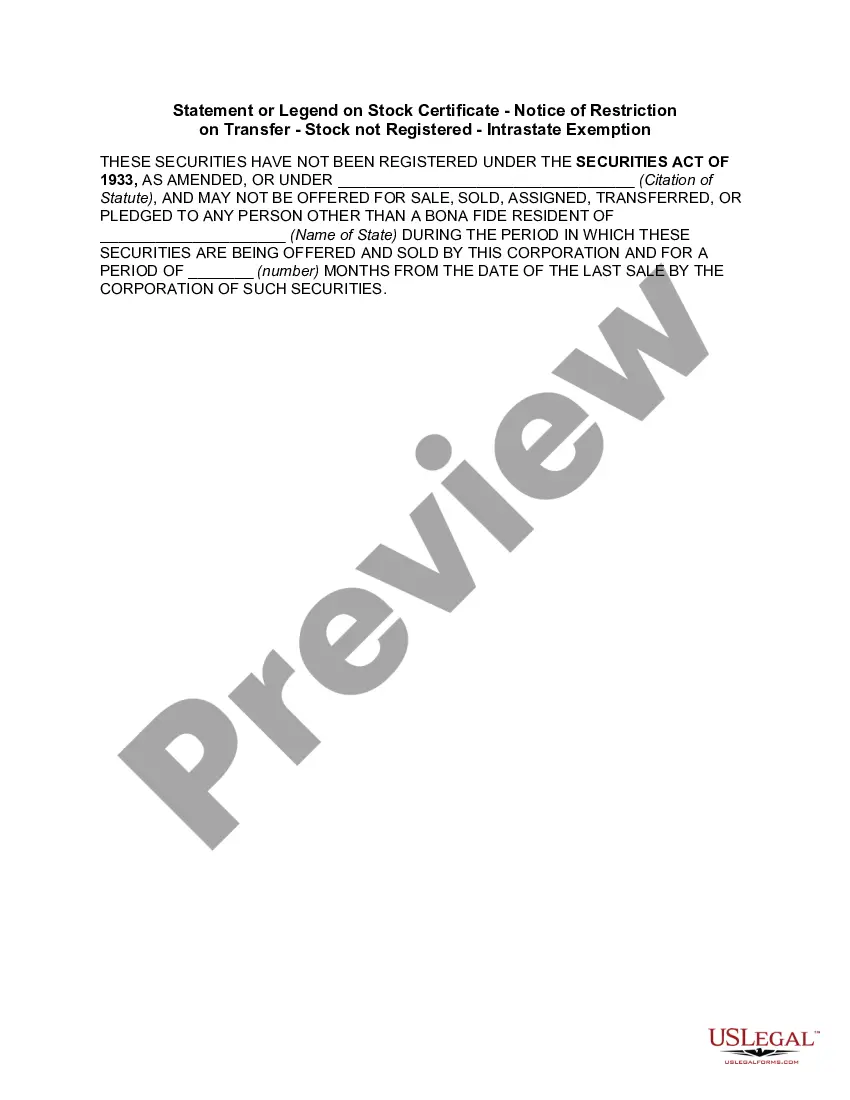
Statement or Legend on Stock Certificate - Notice of Restriction on Transfer - Stock not Registered - Intrastate Exemption
What this document covers
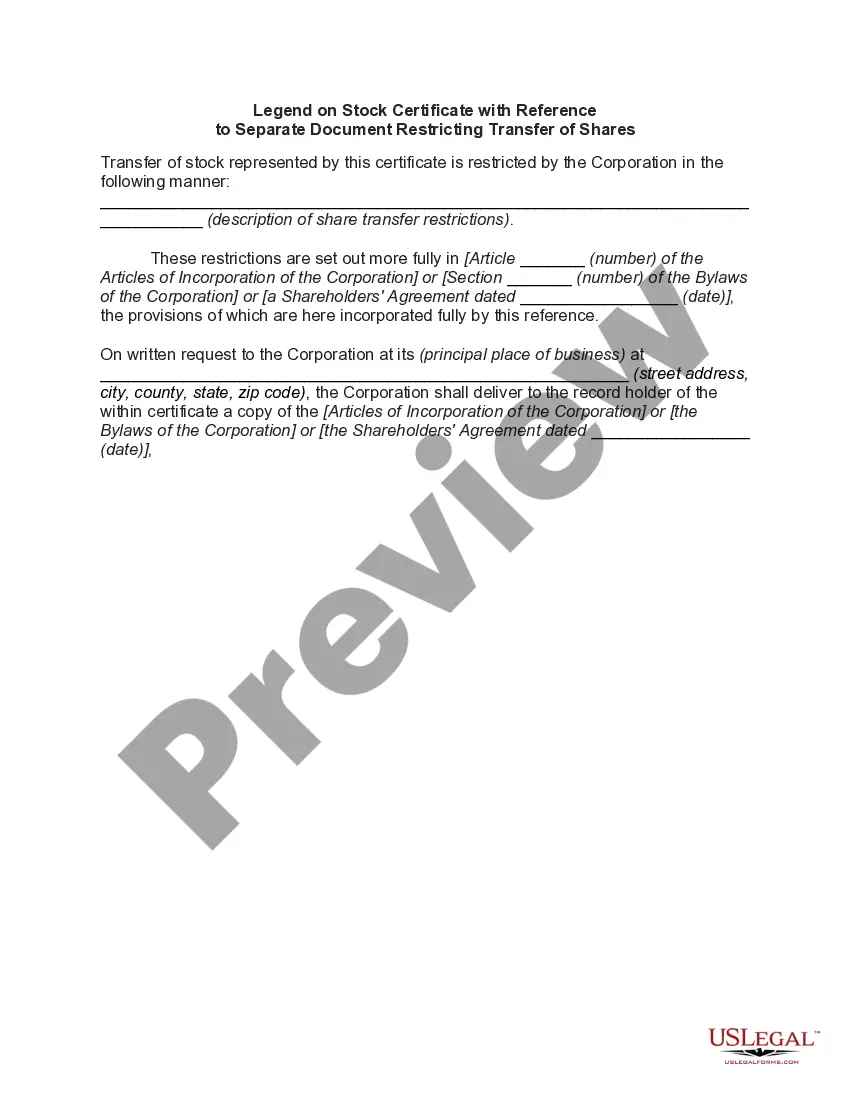
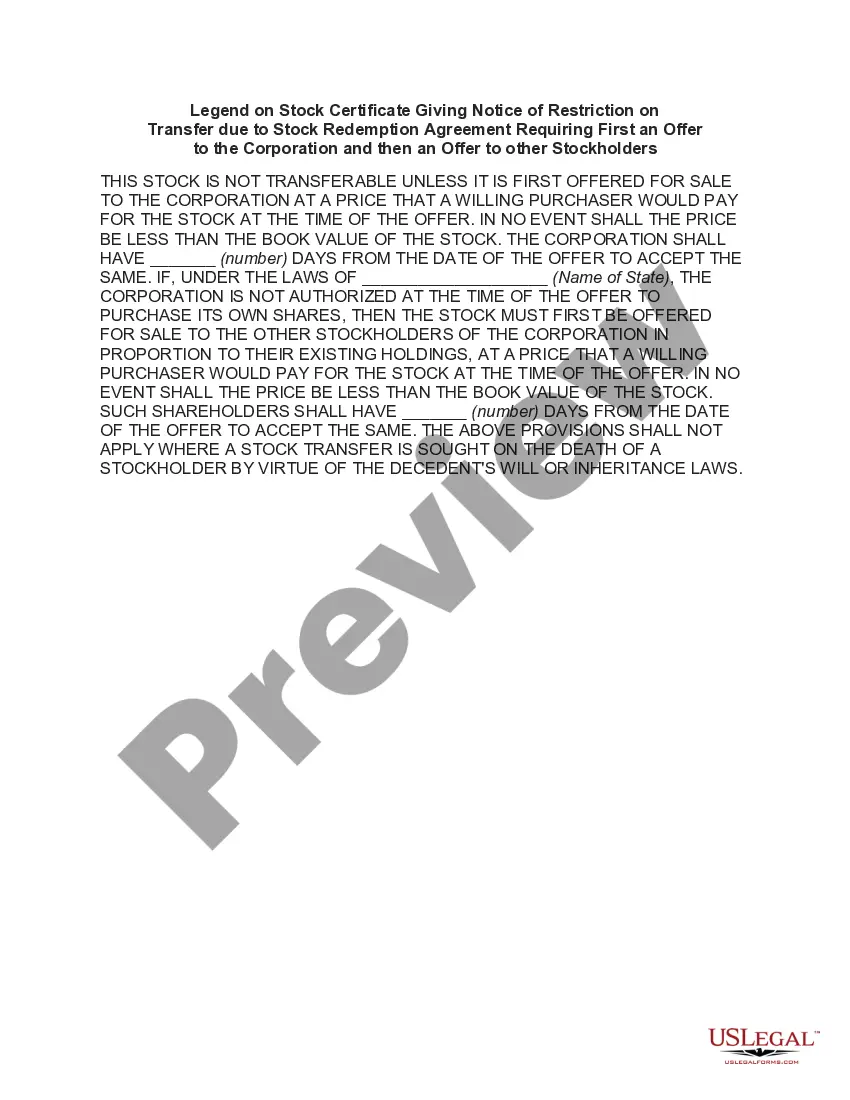
The Statement or Legend on Stock Certificate is a crucial document that provides notice of restrictions on the transfer of stock, particularly for unregistered securities. This form is used to comply with the Securities Act of 1933, which regulates the sale of securities to the public. By incorporating this legend, companies can inform shareholders about transfer restrictions, especially in intrastate offerings where both the issuer and investors are from the same state. This form differs from other stock certificate forms by explicitly detailing the exempt status of certain securities and the obligations of both the issuer and the investors regarding residency and transfer limitations.
What’s included in this form
- The legend statement indicating that the securities are unregistered.
- Notation of the applicable state citation for the exemption.
- Specification of residency requirements for investors.
- Details regarding the time period during which stock can only be sold to state residents.
When to use this document
This form is necessary when a corporation issues stock that is not registered with the SEC and falls under the intrastate exemption. It should be used when the corporation is planning to sell shares to investors who are residents of the same state. The legend is important for ensuring compliance with regulations concerning unregistered securities and protecting both the issuer and investors from potential legal issues that could arise from unauthorized transfers.
Who can use this document
- Corporations issuing unregistered securities under the intrastate exemption.
- Shareholders or investors obtaining stock in the corporation within the same state.
- Corporate legal counsel or compliance officers ensuring regulatory adherence.
How to complete this form
- Identify the state where the stock offering is taking place.
- Insert the appropriate citation of state law regarding securities regulation.
- Specify the duration in months for transfer restrictions applicable after the last sale.
- Complete the legend statement with the name of the state and any relevant details.
- Ensure all parties have a clear understanding of residency and transfer limitations before issuing the stock.
Does this form need to be notarized?
This form does not typically require notarization unless specified by local law. Users should verify specific state requirements to ensure compliance.
Get your form ready online
Our built-in tools help you complete, sign, share, and store your documents in one place.
Make edits, fill in missing information, and update formatting in US Legal Forms—just like you would in MS Word.
Download a copy, print it, send it by email, or mail it via USPS—whatever works best for your next step.
Sign and collect signatures with our SignNow integration. Send to multiple recipients, set reminders, and more. Go Premium to unlock E-Sign.
If this form requires notarization, complete it online through a secure video call—no need to meet a notary in person or wait for an appointment.
We protect your documents and personal data by following strict security and privacy standards.

Make edits, fill in missing information, and update formatting in US Legal Forms—just like you would in MS Word.

Download a copy, print it, send it by email, or mail it via USPS—whatever works best for your next step.

Sign and collect signatures with our SignNow integration. Send to multiple recipients, set reminders, and more. Go Premium to unlock E-Sign.

If this form requires notarization, complete it online through a secure video call—no need to meet a notary in person or wait for an appointment.

We protect your documents and personal data by following strict security and privacy standards.
Typical mistakes to avoid
- Failing to accurately cite the applicable state securities statute.
- Not specifying the duration of the transfer restriction appropriately.
- Overlooking the residency requirements for investors.
- Leaving out the proper legend statement on the stock certificate.
Benefits of completing this form online
- Easy access to legal forms drafted by licensed attorneys, ensuring compliance.
- Convenient download options for immediate use.
- Editable templates that allow customization for specific state requirements.
- Secure storage and management of legal documents.
Looking for another form?

Form popularity
FAQ
Rule 144 is a set of SEC guidelines outlining the sale of restricted or unregistered securities. In order to be freely transacted, Rule 144 mandates that 5 conditions must be satisfied, including a minimum holding period, quantity restrictions, and disclosure of the transaction.
An old stock or bond certificate may still be valuable even if it no longer trades under the name printed on the certificate. The company may have merged with another company or simply changed its name.
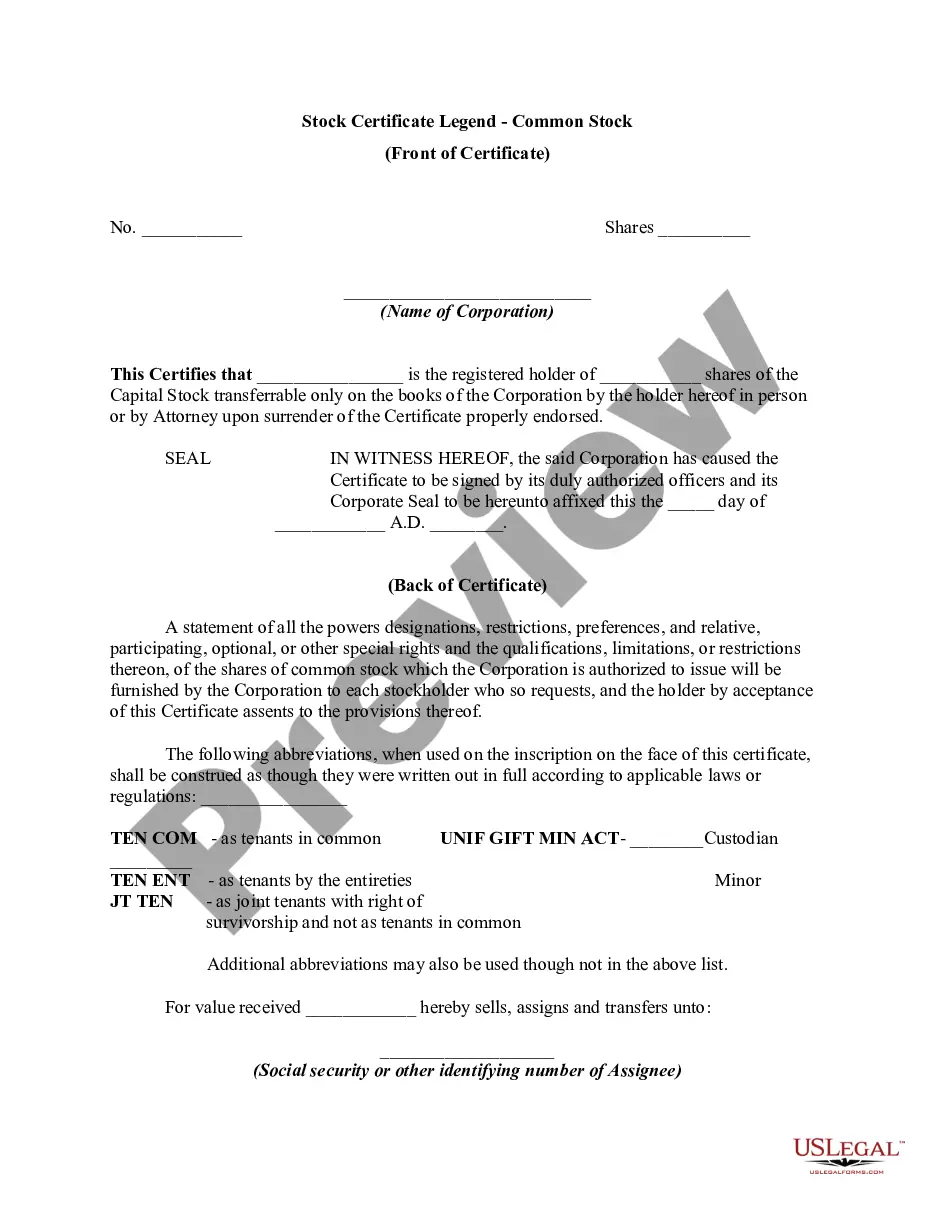
A legend is a statement on a stock certificate noting restrictions on the transfer of the stock. A stock legend is typically put in place due to the requirements established by the Securities and Exchange Commission (SEC) for unregistered securities.
Rule 144 regulates transactions dealing with restricted, unregistered, and control securities. These type of securities are typically acquired over-the-counter (OTC), through private sales, or constitute a controlling stake in an issuing company.
Form 144, required under Rule 144, is filed by a person who intends to sell either restricted securities or control securities (i.e., securities held by affiliates. Form 144 is notification to the SEC of this intention to sell and must take place at the time the sell order is placed with the broker-dealer.
Only a transfer agent can remove a restrictive legend. But the transfer agent won't remove the legend unless the issuer consentsusually in the form of an opinion letter from the issuer's counsel to the transfer agent.
Restrictive legends are stamped or printed on the certificate or instrument, face or reverse, of restricted securities and usually begin with These securities are not registered . . . . Restricted securities that are not represented by a certificate (generally referred to as book entry) will have a notation of
Restrictive legends are stamped or printed on the certificate or instrument, face or reverse, of restricted securities and usually begin with These securities are not registered . . . . Restricted securities that are not represented by a certificate (generally referred to as book entry) will have a notation of
Applicable Law: In the first lines, you have to write the name of the state where the company was incorporated. Company Identification: Then, you have to write the name of the corporation and its legal address. Name of the shareholder: The next line is meant for the shareholder's name.