Legend on Stock Certificate with Reference to Separate Document Restricting Transfer of Shares
What is this form?
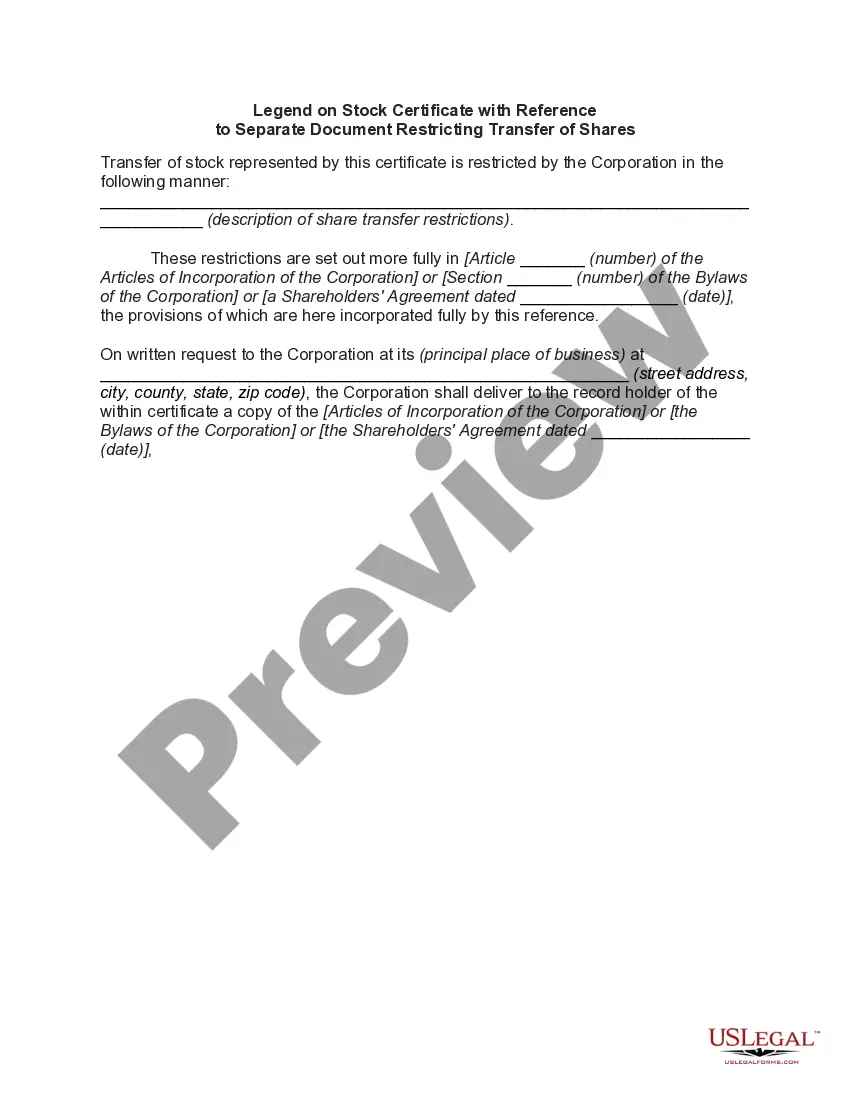
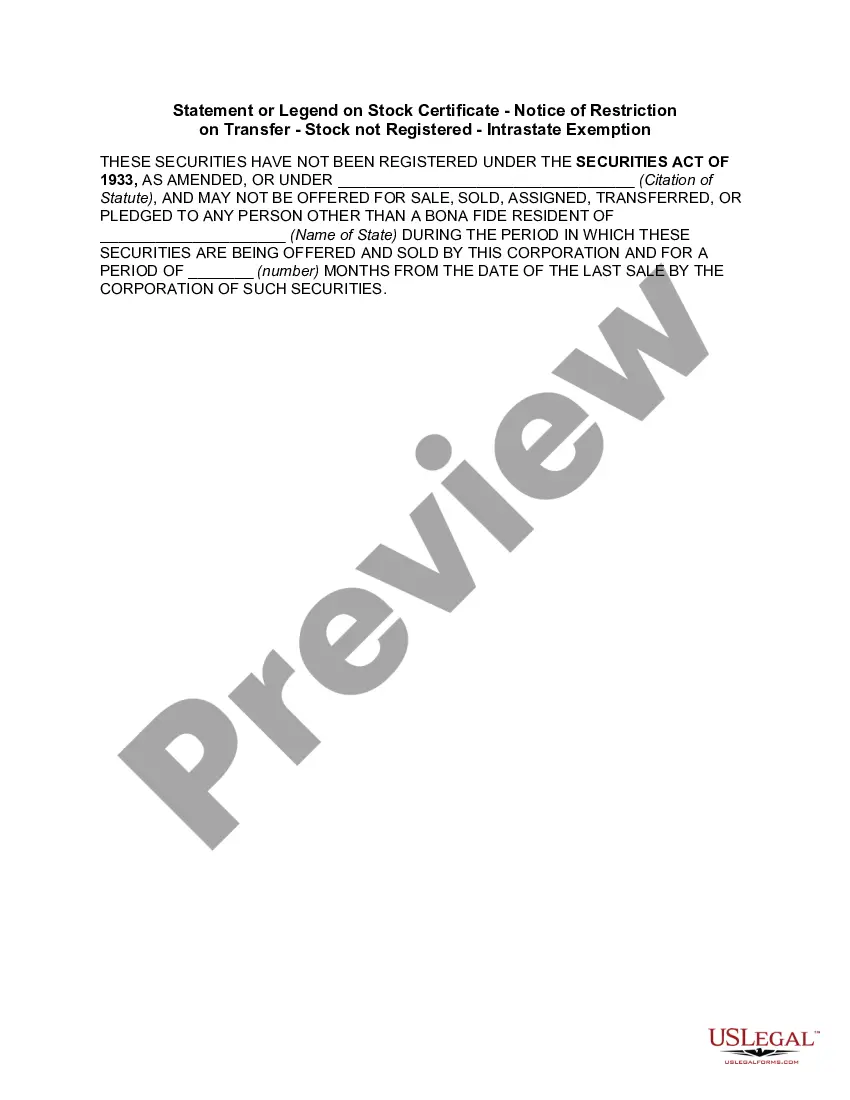
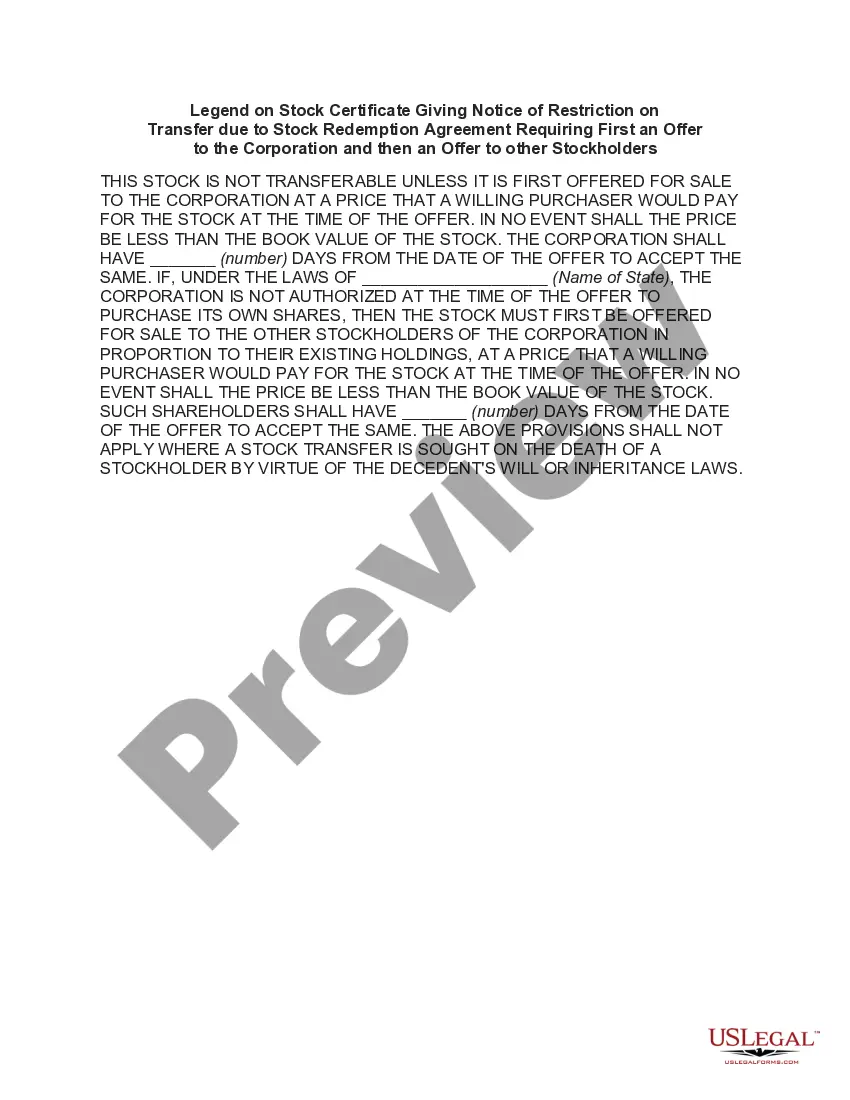
The Legend on Stock Certificate with Reference to Separate Document Restricting Transfer of Shares is a legal statement placed on a stock certificate. Its primary purpose is to note restrictions on the transfer of shares, often necessary to comply with government regulations for unregistered securities. This form is integral for companies issuing stock under specific conditions, distinguishing it from standard stock certificates by including essential legal references and compliance measures.
What’s included in this form
- Transfer restrictions: Detailed description of how the transfer of shares is limited.
- Reference articles: Provisions referencing the Articles of Incorporation, Bylaws, or Shareholders' Agreement.
- Contact information: The corporation's principal place of business where requests can be made for document copies.
When to use this form
This form should be used when a corporation issues stock that has specific restrictions on transferability. It is particularly relevant for private companies or those dealing with unregistered securities, ensuring that stockholders are aware of these restrictions in legal contexts involving share transactions.
Intended users of this form
- Corporations issuing stock with transfer restrictions.
- Shareholders required to comply with specific transfer provisions.
- Legal professionals drafting or reviewing stock certificates for compliance purposes.
Instructions for completing this form
- Identify the specific transfer restrictions and describe them clearly.
- Fill in the applicable articles or sections that outline the restrictions in your corporate documents.
- Complete the date of the Shareholders' Agreement if referenced.
- Provide the corporation's principal place of business for document requests.
Notarization requirements for this form
This form does not typically require notarization unless specified by local law. However, confirming the requirements in your jurisdiction is advisable.
Get your form ready online
Our built-in tools help you complete, sign, share, and store your documents in one place.
Make edits, fill in missing information, and update formatting in US Legal Forms—just like you would in MS Word.
Download a copy, print it, send it by email, or mail it via USPS—whatever works best for your next step.
Sign and collect signatures with our SignNow integration. Send to multiple recipients, set reminders, and more. Go Premium to unlock E-Sign.
If this form requires notarization, complete it online through a secure video call—no need to meet a notary in person or wait for an appointment.
We protect your documents and personal data by following strict security and privacy standards.

Make edits, fill in missing information, and update formatting in US Legal Forms—just like you would in MS Word.

Download a copy, print it, send it by email, or mail it via USPS—whatever works best for your next step.

Sign and collect signatures with our SignNow integration. Send to multiple recipients, set reminders, and more. Go Premium to unlock E-Sign.

If this form requires notarization, complete it online through a secure video call—no need to meet a notary in person or wait for an appointment.

We protect your documents and personal data by following strict security and privacy standards.
Common mistakes to avoid
- Failing to include a clear description of transfer restrictions.
- Incorrectly referencing Articles of Incorporation or Bylaws.
- Not updating the form if there are changes in the companyâs structure or regulations.
Why complete this form online
- Convenient access and instant downloading of the form from anywhere.
- Editable fields to customize the form for specific corporate requirements.
- Reliable templates drafted by licensed attorneys, ensuring legal compliance.
Looking for another form?
Form popularity
FAQ
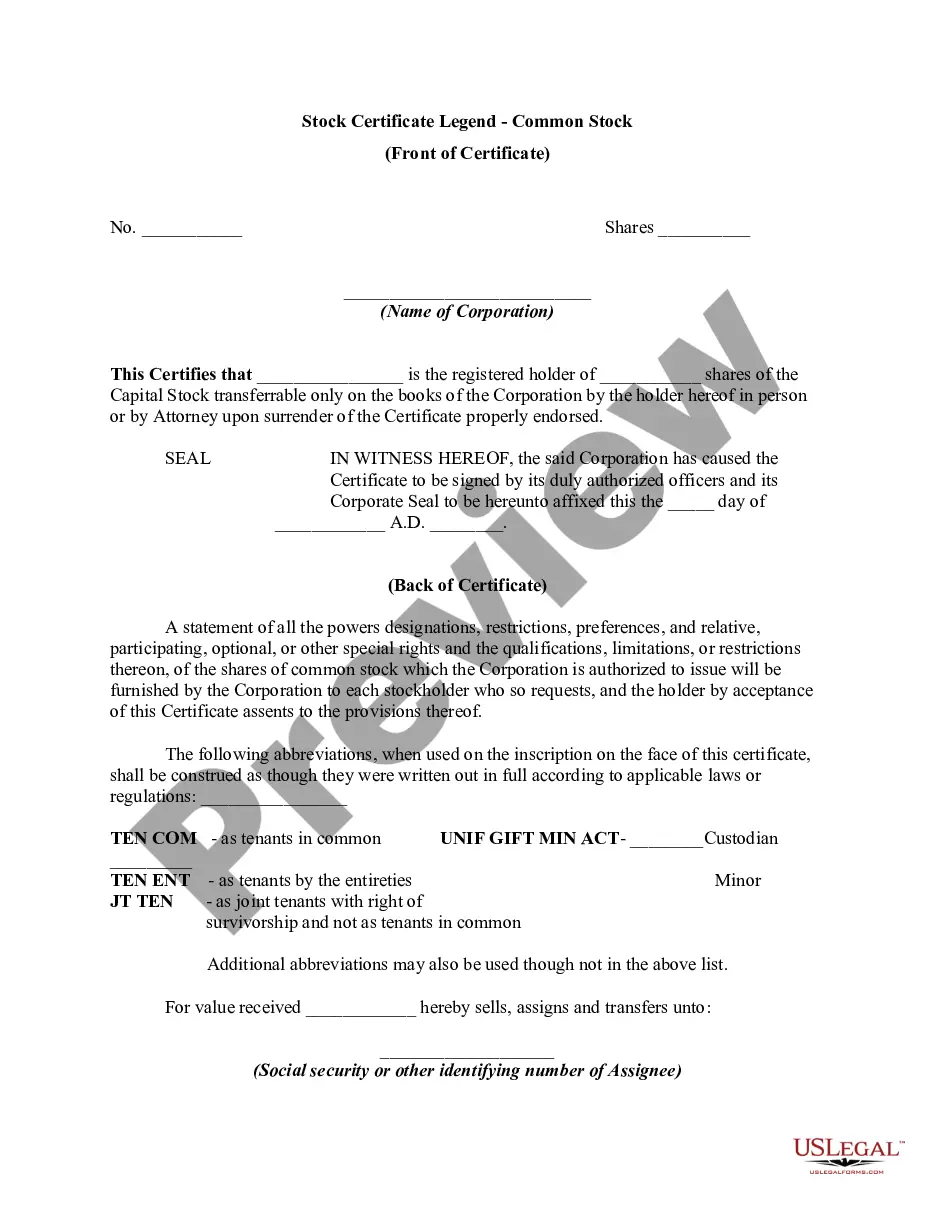
A legend is a statement on a stock certificate noting restrictions on the transfer of the stock. A stock legend is typically put in place due to the requirements established by the Securities and Exchange Commission (SEC) for unregistered securities.
Rule 144 is a set of SEC guidelines outlining the sale of restricted or unregistered securities. In order to be freely transacted, Rule 144 mandates that 5 conditions must be satisfied, including a minimum holding period, quantity restrictions, and disclosure of the transaction.
Only a transfer agent can remove a restrictive legend. But the transfer agent won't remove the legend unless the issuer consentsusually in the form of an opinion letter from the issuer's counsel to the transfer agent.
Restrictive legends are stamped or printed on the certificate or instrument, face or reverse, of restricted securities and usually begin with These securities are not registered . . . . Restricted securities that are not represented by a certificate (generally referred to as book entry) will have a notation of
When you acquire restricted securities or hold control securities, you must find an exemption from the SEC's registration requirements to sell them in a public marketplace. Rule 144 allows public resale of restricted and control securities if a number of conditions are met.
In order to have the legend on a stock certificate removed, investors should contact the company's shareholder relations department to find out the details of the removal process. Following that, the company will send a confirmation authorizing its transfer agent to remove the legend.
Restricted securities are securities acquired in an unregistered, private sale from the issuing company or from an affiliate of the issuer.Even if you've met all the conditions of Rule 144, you still cannot sell your restricted securities to the public until you've had the legend removed from the certificate.