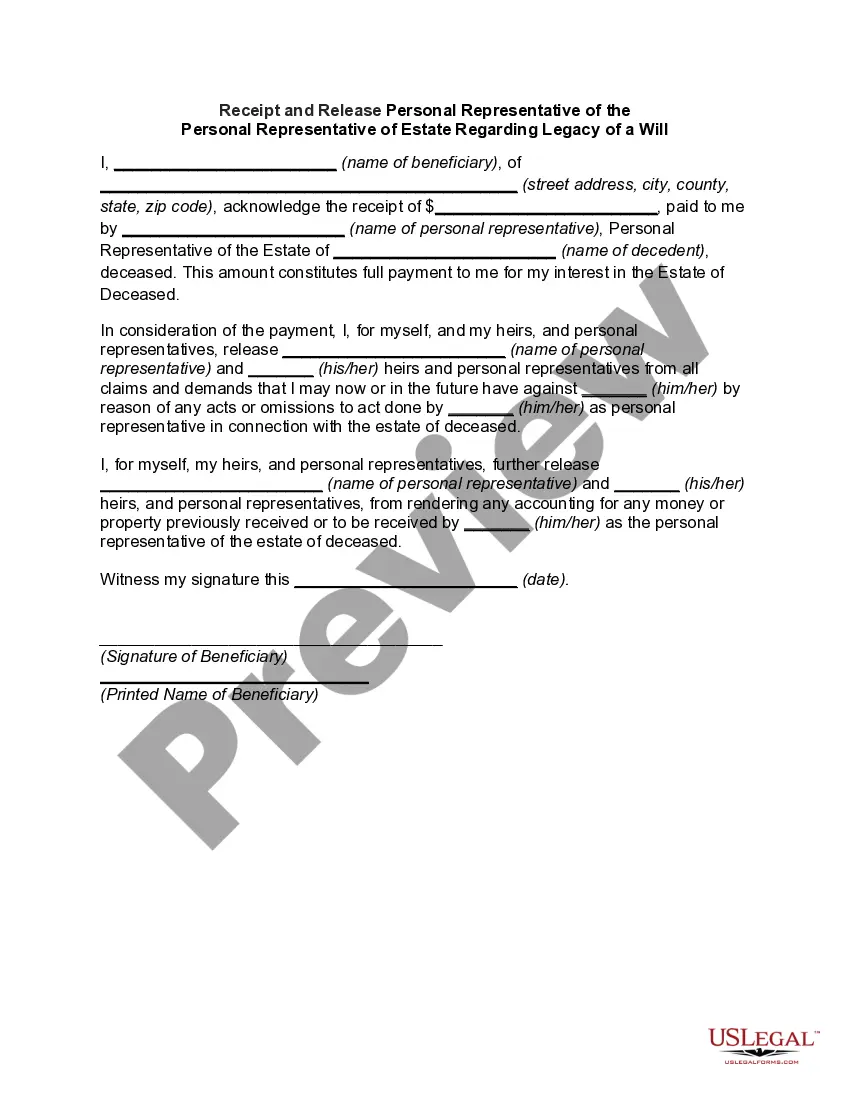
Receipt and Release Personal Representative of Estate Regarding Legacy of a Will
What this document covers
The Receipt and Release Personal Representative of Estate Regarding Legacy of a Will is a legal document that beneficiaries use to acknowledge receipt of their inheritance and to release the personal representative from future claims. This form safeguards the personal representative by serving as proof that all distributions have been made fully and satisfactorily. It differs from other estate forms by specifically focusing on the release of liability for actions taken by the personal representative in managing the estate.
Key parts of this document
- Name and address of the beneficiary
- Amount received from the personal representative
- Name of the personal representative and the decedent
- Release of all claims against the personal representative
- Date and signature of the beneficiary

Situations where this form applies
This form is used when a beneficiary has received their share from an estate and wishes to formally acknowledge this receipt while simultaneously releasing the personal representative from any further liability related to estate administration. It is especially useful when closing an estate, ensuring that no future disputes arise regarding the distribution of assets.
Who can use this document
- Beneficiaries or legatees who have received an inheritance
- Personal representatives managing the estate
- Heirs looking to provide formal acknowledgment of payment received from the estate
Steps to complete this form
- Enter the beneficiary's full name and address in the designated fields.
- Specify the amount received from the personal representative.
- Fill in the personal representative's name and the name of the deceased individual.
- Read through the release clause and confirm understanding before signing.
- Sign and date the form to validate the acknowledgment and release.
Notarization requirements for this form
In most cases, this form does not require notarization. However, some jurisdictions or signing circumstances might. US Legal Forms offers online notarization powered by Notarize, accessible 24/7 for a quick, remote process.
Get your form ready online
Our built-in tools help you complete, sign, share, and store your documents in one place.
Make edits, fill in missing information, and update formatting in US Legal Forms—just like you would in MS Word.
Download a copy, print it, send it by email, or mail it via USPS—whatever works best for your next step.
Sign and collect signatures with our SignNow integration. Send to multiple recipients, set reminders, and more. Go Premium to unlock E-Sign.
If this form requires notarization, complete it online through a secure video call—no need to meet a notary in person or wait for an appointment.
We protect your documents and personal data by following strict security and privacy standards.

Make edits, fill in missing information, and update formatting in US Legal Forms—just like you would in MS Word.

Download a copy, print it, send it by email, or mail it via USPS—whatever works best for your next step.

Sign and collect signatures with our SignNow integration. Send to multiple recipients, set reminders, and more. Go Premium to unlock E-Sign.

If this form requires notarization, complete it online through a secure video call—no need to meet a notary in person or wait for an appointment.

We protect your documents and personal data by following strict security and privacy standards.
Typical mistakes to avoid
- Failing to include all necessary names and addresses.
- Signing the document without understanding the release implications.
- Not dating the form, which can lead to disputes regarding the time of acknowledgment.
Advantages of online completion
- Convenient access to legally vetted documents from anywhere.
- Editable templates allow users to fill in their specific information easily.
- Secure storage of documents for easy retrieval when needed.
Looking for another form?

Form popularity
FAQ
Q: How Long Does an Executor Have to Distribute Assets From a Will? A: Dear Waiting: In most states, a will must be executed within three years of a person's death.
Beneficiaries are entitled to receive a financial accounting of the trust, including bank statements, regularly. When statements are not received as requested, a beneficiary must submit a written demand to the trustee.The court will review the trust account for any discrepancies or irregular activity.
This four-month period must pass before the estate can be closed. Even under the best of circumstances, a simple estate will usually take at least six months to close.
All taxes and liabilities paid from the estate, including medical expenses, attorney fees, burial or cremation expenses, estate sale costs, appraisal expenses, and more. The executor should keep all receipts for any services or transactions needed to liquidate the assets of the deceased.
Beneficiaries often must sign off on the inheritance they receive to acknowledge receipt of the distribution. For example, if you inherit a portion of real estate from the decedent, you must sign a deed accepting that real estate.
A Receipt, Release, Refunding and Indemnification Agreement is a probate tool that allows the executor to distribute estate funds to a beneficiary with the promise from the beneficiary to return the funds if it later turns out they were distributed in error.
A Receipt and Release Agreement is the means by which a beneficiary of an estate may acknowledge receipt of the property to which he is entitled, and agree to release the executor from any further liability with respect thereto.
Length and Commitment of Process. A person can expect for the probate process in Virginia to take anywhere from six months up to a year or more. Generally, there is a creditor period, so an estate cannot be completely distributed and closed prior to the expiration of the six-month period.
Before distributing assets to beneficiaries, the executor must pay valid debts and expenses, subject to any exclusions provided under state probate laws.The executor must maintain receipts and related documents and provide a detailed accounting to estate beneficiaries.