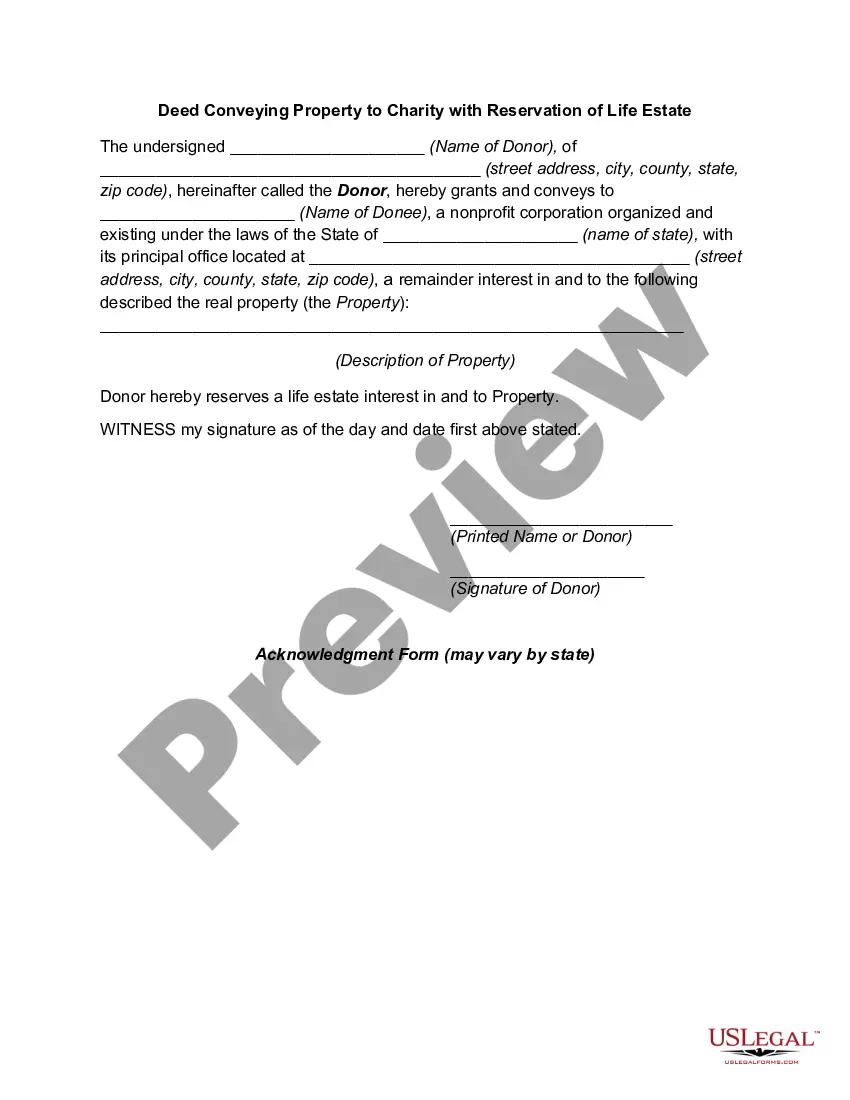
Deed Conveying Property to Charity with Reservation of Life Estate
About this form
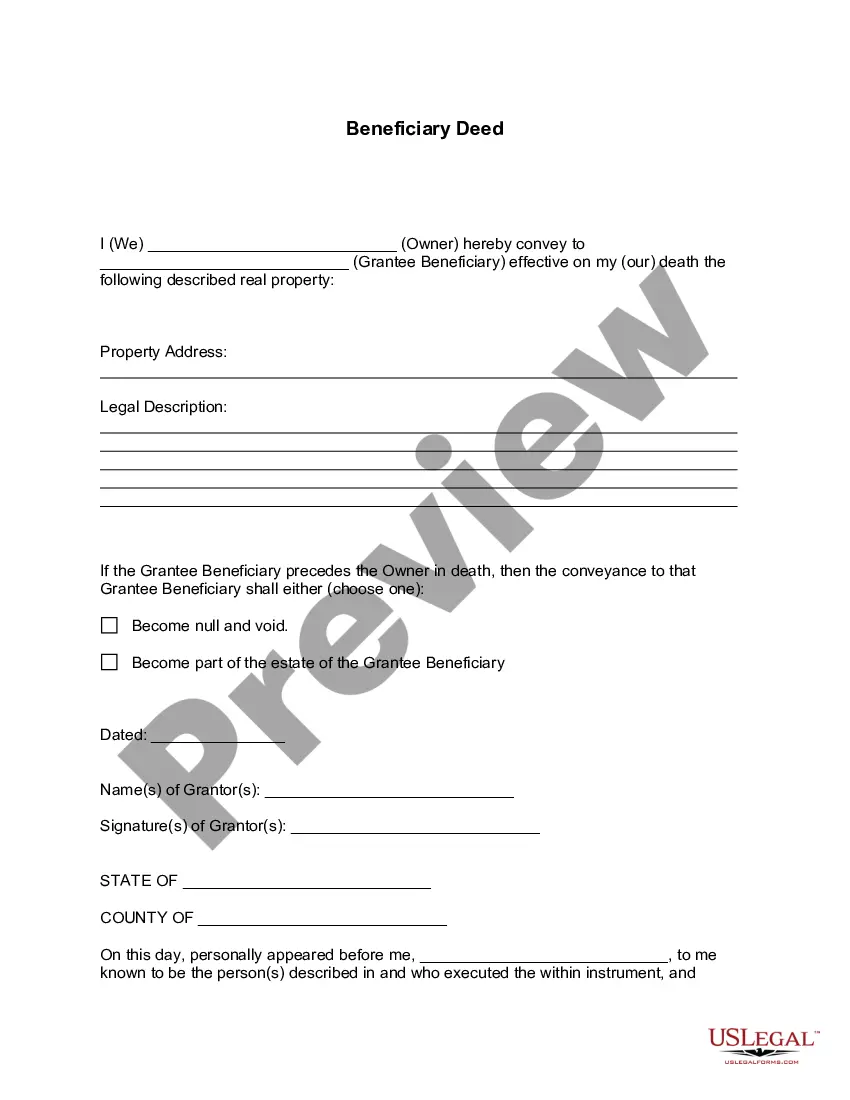
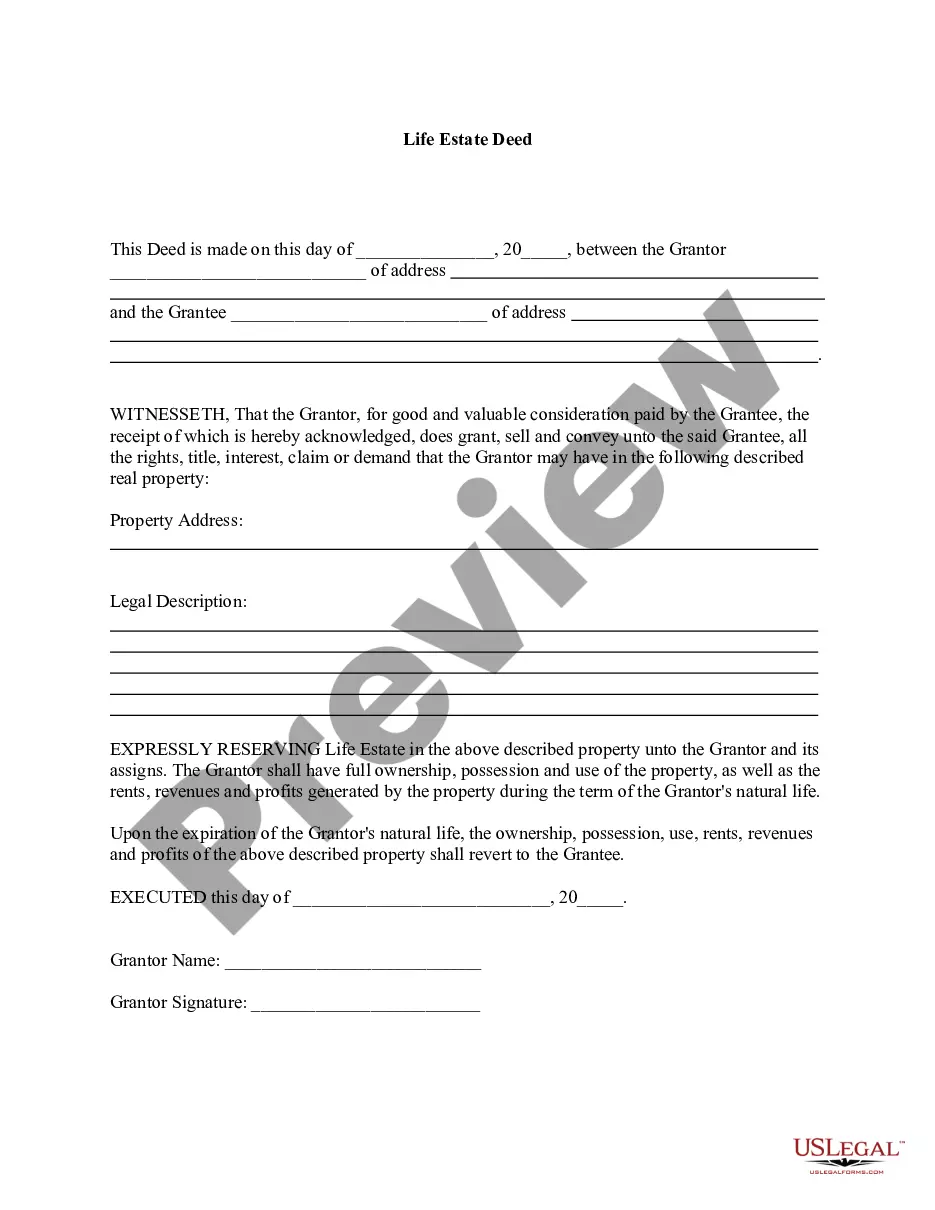
The Deed Conveying Property to Charity with Reservation of Life Estate is a legal document that allows a property owner, also known as the donor, to transfer ownership of real estate to a charity while retaining the right to live in or otherwise use the property for the duration of their life. This form creates a life estate, which terminates upon the donor's death, after which the property passes to the designated charity. This form is distinct from other property transfer documents as it specifically incorporates both the elements of a charitable conveyance and a life estate reservation.
Key components of this form
- Name and address of the donor (property owner)
- Name and address of the donee (charity)
- Description of the property being conveyed
- Signature of the donor
- Acknowledgment section (may vary by state)

When to use this form
This form is useful when a property owner wishes to donate real estate to a charitable organization but still wants to retain the right to live in the property for their lifetime. It is particularly applicable for those who wish to make a significant impact through philanthropy while ensuring their living situation remains stable. This form can also benefit those looking to reduce their taxable estate by transferring property to a charity.
Who needs this form
- Individuals wishing to donate property to a charitable organization
- Property owners who want to retain living rights in the donated property
- Those seeking to achieve tax benefits through charitable donations
- Anyone who has a clear understanding of their estate planning goals
Instructions for completing this form
- Identify the parties involved, including the donor and donee.
- Provide the full description of the property being conveyed.
- Clearly state the reservation of life estate clause.
- Include the donor's signature and printed name.
- If necessary, complete the acknowledgment section according to state requirements.
Does this form need to be notarized?
To make this form legally binding, it must be notarized. Our online notarization service, powered by Notarize, lets you verify and sign documents remotely through an encrypted video session.
Get your form ready online
Our built-in tools help you complete, sign, share, and store your documents in one place.
Make edits, fill in missing information, and update formatting in US Legal Forms—just like you would in MS Word.
Download a copy, print it, send it by email, or mail it via USPS—whatever works best for your next step.
Sign and collect signatures with our SignNow integration. Send to multiple recipients, set reminders, and more. Go Premium to unlock E-Sign.
If this form requires notarization, complete it online through a secure video call—no need to meet a notary in person or wait for an appointment.
We protect your documents and personal data by following strict security and privacy standards.

Make edits, fill in missing information, and update formatting in US Legal Forms—just like you would in MS Word.

Download a copy, print it, send it by email, or mail it via USPS—whatever works best for your next step.

Sign and collect signatures with our SignNow integration. Send to multiple recipients, set reminders, and more. Go Premium to unlock E-Sign.

If this form requires notarization, complete it online through a secure video call—no need to meet a notary in person or wait for an appointment.

We protect your documents and personal data by following strict security and privacy standards.
Common mistakes
- Failing to provide a clear and complete property description.
- Omitting the donor's signature or not having it witnessed.
- Not understanding the implications of a life estate.
- Using outdated language or not following state-specific guidelines.
Benefits of completing this form online
- Convenient access to legally drafted forms at any time.
- Easy to customize for your unique needs and circumstances.
- Reliable forms that comply with current legal standards.
- Immediate downloadable access after completion.
Quick recap
- The deed allows for property to be conveyed to a charity while the donor retains use for life.
- Properly filling out this form ensures clear legal rights and responsibilities.
- Consult local regulations for any specific requirements related to property deeds and life estates.
Looking for another form?
Form popularity
FAQ
Generally, the writing takes the form of the following language: I, Smith, convey my real property to Jones for life. The writing, whose exact language requirements may differ between states, is typically contained in a deed or a will.
A deed is a legal document.There are several categories of deeds, some of which might surprise youbut keep in mind that a deed is a document conveying a title. A conveyance is the transfer of real property (real estate).
Conveyance means to transfer, it is the legal transfer of property from one name to another, either as ownership or lease.
The person conveying the property is known as the grantor and the person receiving the property is the grantee. The grantor may convey the entirety of the parcel without any reservations through a transfer otherwise known as a transfer in fee simple.
A Conveyance (or Deed of Conveyance) is the document by which the sale of a parcel of unregistered land is effected.Indenture of Conveyance is effectively just an old fashioned alternative name for a conveyance. A Transfer Deed is the document by which the sale of a parcel of registered land is effected.