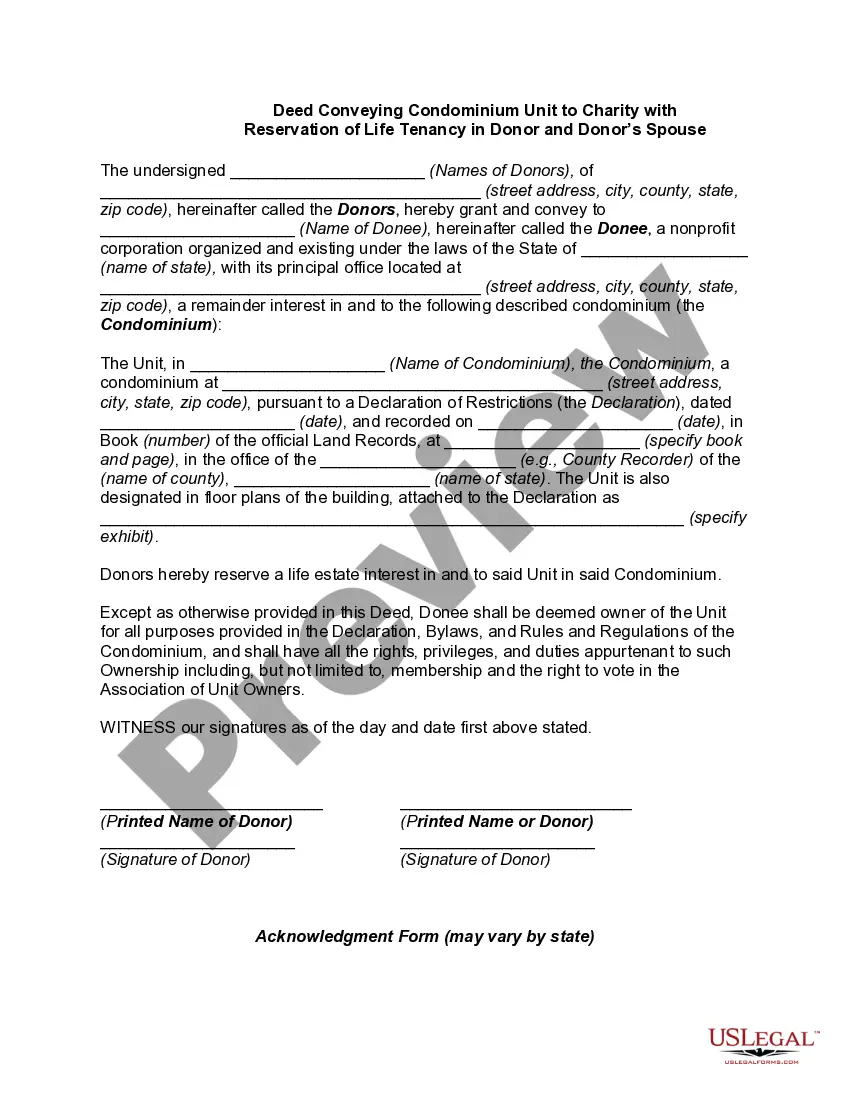
Deed Conveying Condominium Unit to Charity with Reservation of Life Tenancy in Donor and Donor's Spouse
Overview of this form
The Deed Conveying Condominium Unit to Charity with Reservation of Life Tenancy in Donor and Donor's Spouse is a legal document that allows donors to transfer ownership of a condominium unit to a charitable organization while retaining the right to live there for the duration of their lives. This form is particularly useful for individuals wishing to support a charity while ensuring they maintain a comfortable living situation for themselves and their spouse. Unlike other property transfer forms, this deed specifically accommodates the reservation of life tenancy, making it unique in its protections and benefits for the donors.
Main sections of this form
- Names and addresses of the donors
- Name and details of the charitable organization (donee)
- Description of the condominium unit being conveyed
- Reservation of life tenancy for the donors
- Legal acknowledgment requirements
- Signatures of the donors


When to use this document
This form should be used when a donor wishes to make a charitable contribution of a condominium unit while maintaining the right to live in that unit until their death. It is ideal for individuals who want to provide support to a nonprofit organization while still enjoying the benefits of their property during their lifetime.
Who this form is for
- Individuals wishing to donate real estate to a charitable organization
- Donors who want to retain the right to occupy the property for their lifetime
- Couples looking to provide for a charity while ensuring housing security
Steps to complete this form
- Identify the parties involved by entering the full names and addresses of the donors.
- Specify the name and address of the charitable organization receiving the condominium.
- Provide a detailed description of the condominium unit, including its designation and location.
- Clearly state the life tenancy reserve for the donors in the document.
- Ensure all signatures are obtained and that the form is acknowledged if required by state law.
Notarization guidance
This form must be notarized to be legally valid. US Legal Forms provides secure online notarization powered by Notarize, allowing you to complete the process through a verified video call.
Get your form ready online
Our built-in tools help you complete, sign, share, and store your documents in one place.
Make edits, fill in missing information, and update formatting in US Legal Forms—just like you would in MS Word.
Download a copy, print it, send it by email, or mail it via USPS—whatever works best for your next step.
Sign and collect signatures with our SignNow integration. Send to multiple recipients, set reminders, and more. Go Premium to unlock E-Sign.
If this form requires notarization, complete it online through a secure video call—no need to meet a notary in person or wait for an appointment.
We protect your documents and personal data by following strict security and privacy standards.

Make edits, fill in missing information, and update formatting in US Legal Forms—just like you would in MS Word.

Download a copy, print it, send it by email, or mail it via USPS—whatever works best for your next step.

Sign and collect signatures with our SignNow integration. Send to multiple recipients, set reminders, and more. Go Premium to unlock E-Sign.

If this form requires notarization, complete it online through a secure video call—no need to meet a notary in person or wait for an appointment.

We protect your documents and personal data by following strict security and privacy standards.
Avoid these common issues
- Failing to accurately describe the property being conveyed.
- Not including the name of the charitable organization correctly.
- Missing signatures from both donors.
- Neglecting to check state-specific requirements for conveyance.
Why use this form online
- Convenience of downloading the form at your own pace and completing it when ready.
- Editable fields allow for customization to fit your specific needs.
- Access to forms drafted by licensed attorneys ensures legal reliability.
What to keep in mind
- The form allows for property transfer to a charity while reserving life tenancy for the donors.
- Using this form can provide both charitable benefits and security in housing.
- Accurate completion and adherence to state laws are essential to the validity of this deed.
Looking for another form?
Form popularity
FAQ
Pursuant to ' 2036(a) of the IRC, the transfer of a residence with a retained life estate permits the transferee of the residence to receive a full step up in his or her cost basis in the premises upon the death of the transferor, to its fair market value on the transferor's date of death.
The cost basis, because it was a gift (not inherited after death) is the same cost basis as it was for your mother. $30,000, plus any capital improvements after her purchase and before it was transferred to you.
When a person (the beneficiary) receives an asset from a giver (the benefactor) after the benefactor dies, the asset often receives a stepped-up basis, which is its market value at the time the benefactor dies (Internal Revenue Code § 1014(a)).
Generally, the writing takes the form of the following language: I, Smith, convey my real property to Jones for life. The writing, whose exact language requirements may differ between states, is typically contained in a deed or a will.
There is a value to a life estate. Upon sale, the life tenant is entitled to compensation for the sale of their interest. Life estates are valued using the age of the life tenant and the present fair market value of the property.
Assets That May Not Be Eligible for a Step-Up in Basis 401(k) accounts. Pensions. Tax deferred annuities. Certificates of deposit.
A life estate is usually property that has been acquired during the lifetime of a person with his or her ownership only lasting through the time he or she lives.This also means he or she cannot sell it, rent it or alter it until the life tenant passes on or leaves permanently.
Remainderman Rights and Life Estates Typically, the deed will state that the occupant of property is allowed to use it for the duration of their life. Almost all deeds creating a life estate will also name a remaindermanthe person or persons who get the property when the life tenant dies.
A person owns property in a life estate only throughout their lifetime. Beneficiaries cannot sell property in a life estate before the beneficiary's death. One benefit of a life estate is that property can pass when the life tenant dies without being part of the tenant's estate.