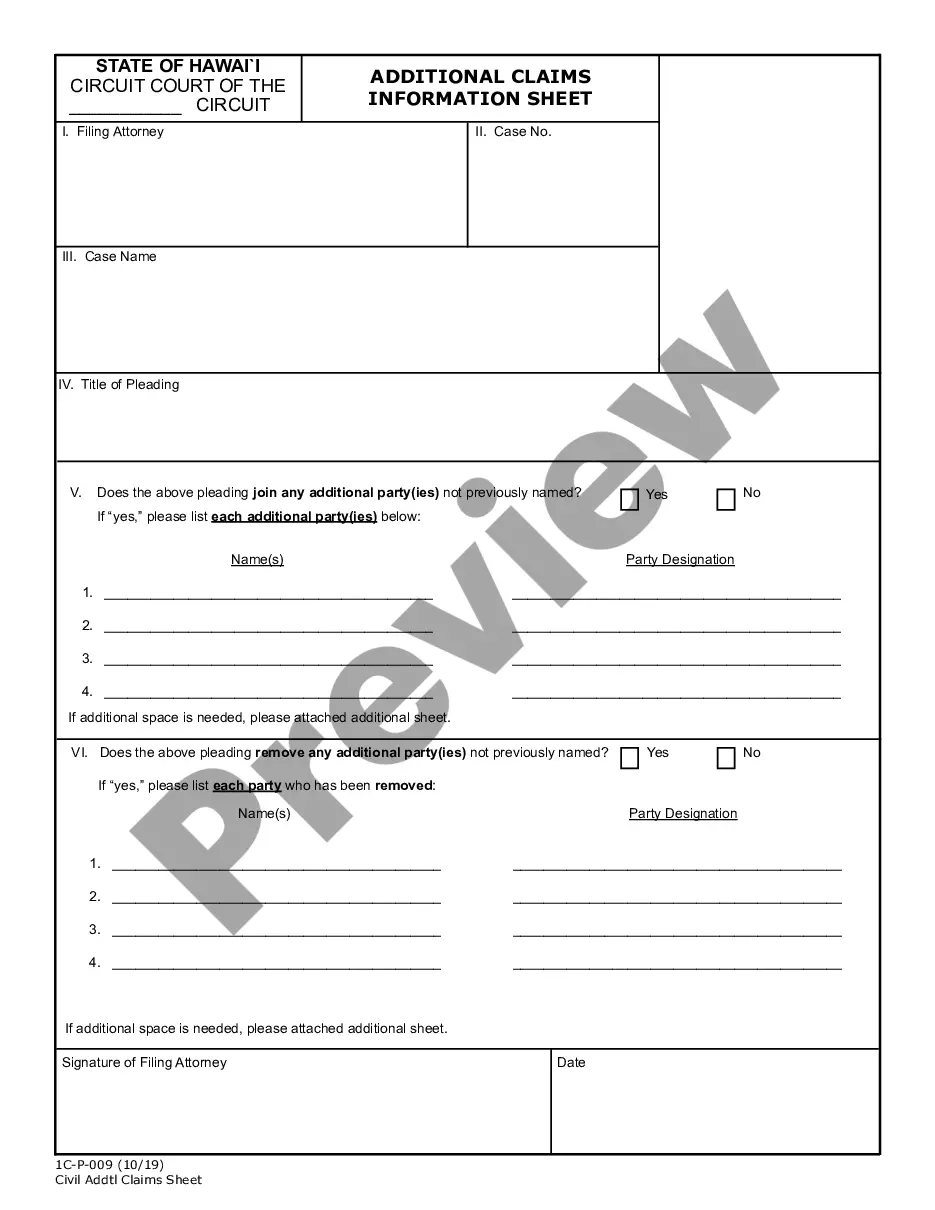
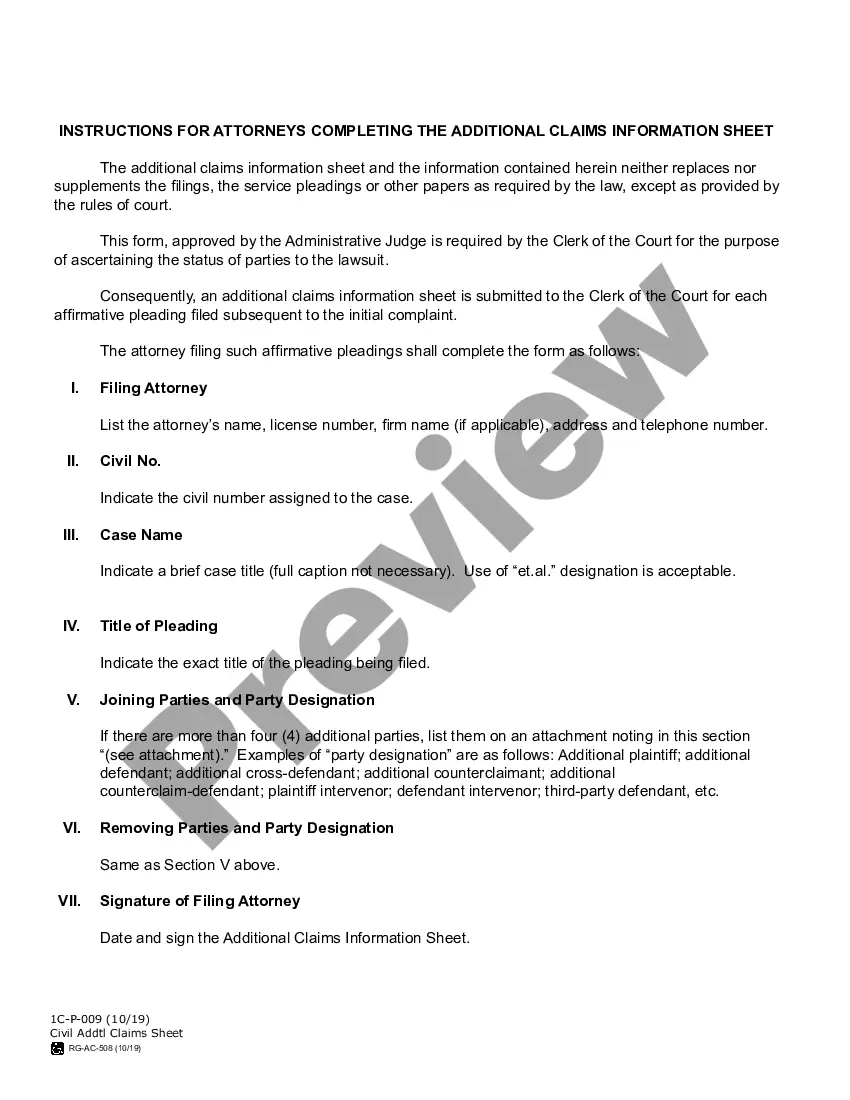
Hawaii Additional Claims Information Sheet
Notarization guidance
This form does not typically require notarization to be legally valid. However, some jurisdictions or document types may still require it. US Legal Forms provides secure online notarization powered by Notarize, available 24/7 for added convenience.
Get your form ready online
Our built-in tools help you complete, sign, share, and store your documents in one place.
Make edits, fill in missing information, and update formatting in US Legal Forms—just like you would in MS Word.
Download a copy, print it, send it by email, or mail it via USPS—whatever works best for your next step.
Sign and collect signatures with our SignNow integration. Send to multiple recipients, set reminders, and more. Go Premium to unlock E-Sign.
If this form requires notarization, complete it online through a secure video call—no need to meet a notary in person or wait for an appointment.
We protect your documents and personal data by following strict security and privacy standards.

Make edits, fill in missing information, and update formatting in US Legal Forms—just like you would in MS Word.

Download a copy, print it, send it by email, or mail it via USPS—whatever works best for your next step.

Sign and collect signatures with our SignNow integration. Send to multiple recipients, set reminders, and more. Go Premium to unlock E-Sign.

If this form requires notarization, complete it online through a secure video call—no need to meet a notary in person or wait for an appointment.

We protect your documents and personal data by following strict security and privacy standards.
Looking for another form?
Form popularity
FAQ
You generally have a specific period, usually two years, to file a lawsuit in Hawaii, depending on the nature of your claim. Missing this timeframe can forfeit your right to pursue legal action. The Hawaii Additional Claims Information Sheet can assist you in tracking crucial deadlines and organizing all necessary claims, so you never miss an opportunity.
Rule 52 of the Civil Procedure governs the judge's requirement to provide findings of fact and conclusions of law in civil cases. This rule promotes transparency and accountability in the judiciary. When working on your case, the Hawaii Additional Claims Information Sheet can serve as a valuable resource to summarize your claims effectively based on this rule.
Rule 4 in Hawaii Family Court outlines the procedures for serving legal documents to involved parties. This rule is crucial as it ensures all concerned individuals receive proper notification, fostering fairness in the legal process. By leveraging the Hawaii Additional Claims Information Sheet, you can better understand how to navigate these procedural requirements.
Rule 52 of the Hawaii Rules of Civil Procedure pertains to the findings of fact and conclusions of law that a judge must make in a court decision. This rule ensures that the reasoning behind a court's decision is clear and transparent. It is advisable to refer to the Hawaii Additional Claims Information Sheet to help formulate your legal strategy under this rule.
In Hawaii, the statute of limitations varies based on the type of civil lawsuit you are filing. Generally, you have two years from the date of the incident to initiate your claims. Utilizing the Hawaii Additional Claims Information Sheet can help you organize your information and stay within the required time frame.
A Rule 52b motion allows a party to ask the court to amend its findings and conclusions after a trial. This motion is essential when you believe the court made an error in its final ruling. By using the Hawaii Additional Claims Information Sheet, you can effectively prepare your motion, ensuring all relevant claims are addressed.
An example of a statement of claim might include an individual outlining their grievance following a contract breach. The claim would detail the contract's specifics, the breach's nature, and the resulting damages incurred. Using actual examples can help clarify the process. The Hawaii Additional Claims Information Sheet contains samples and outlines to help you craft your own statement successfully.
Formatting a statement of claims involves presenting your information in a clear and organized manner. Start with a title, followed by numbered paragraphs that convey each claim and its supporting facts. Consistent formatting enhances readability and professionalism. For further guidance, consult the Hawaii Additional Claims Information Sheet.
When filling out a health insurance claim form, provide complete and accurate information about the medical services received. Include relevant dates, descriptions of services, and personal information as required. Be sure to keep copies of all documentation submitted. For additional insights, the Hawaii Additional Claims Information Sheet can serve as a useful resource.
To fill out a statement in support of your claim, clearly summarize the reasons for the claim while including pertinent evidence. Ensure that you present facts succinctly and logically, emphasizing how they substantiate your position. Taking the time to review the Hawaii Additional Claims Information Sheet can greatly assist you in structuring your statement effectively.