Letter to Community Residents from Association Board regarding COVID-19 coronavirus implications
What this document covers
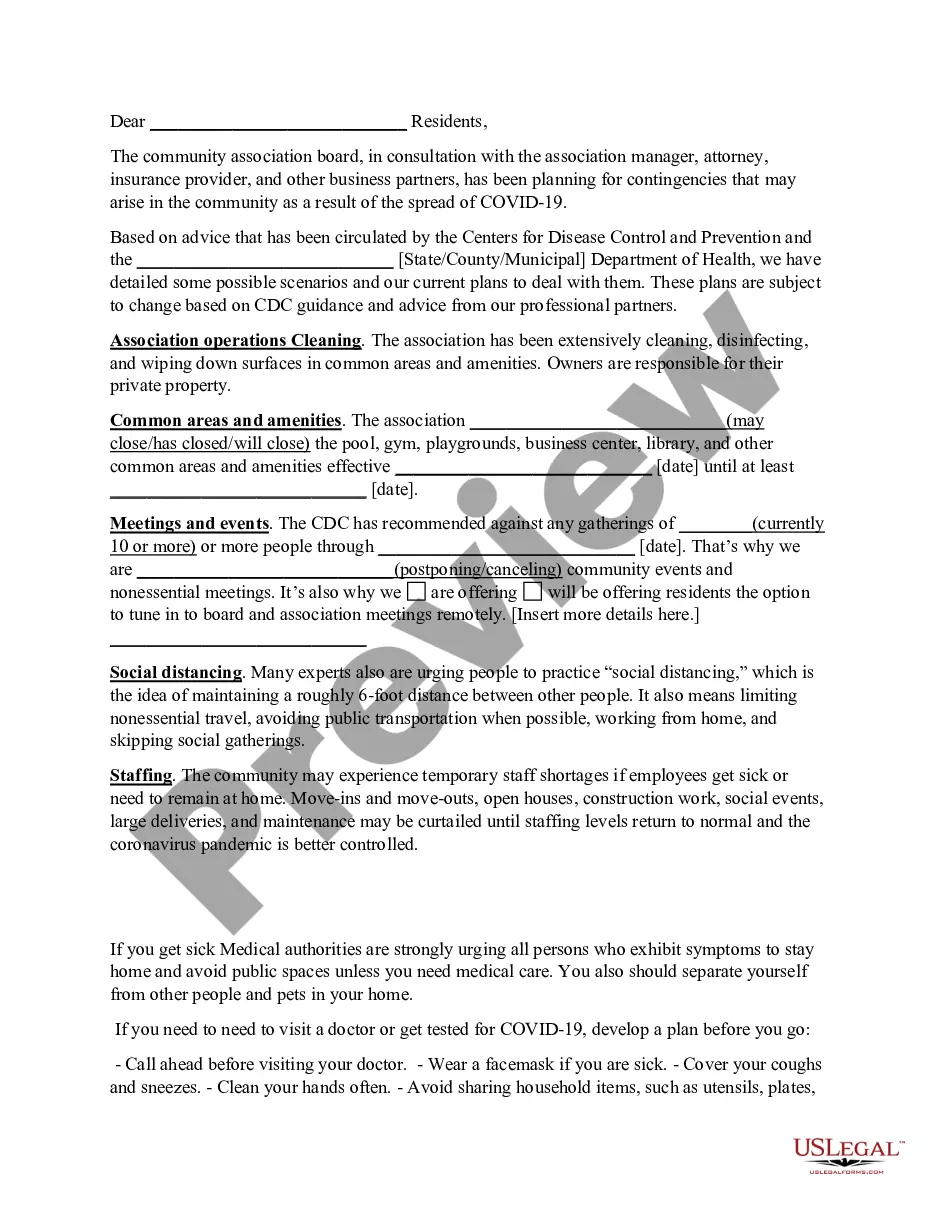
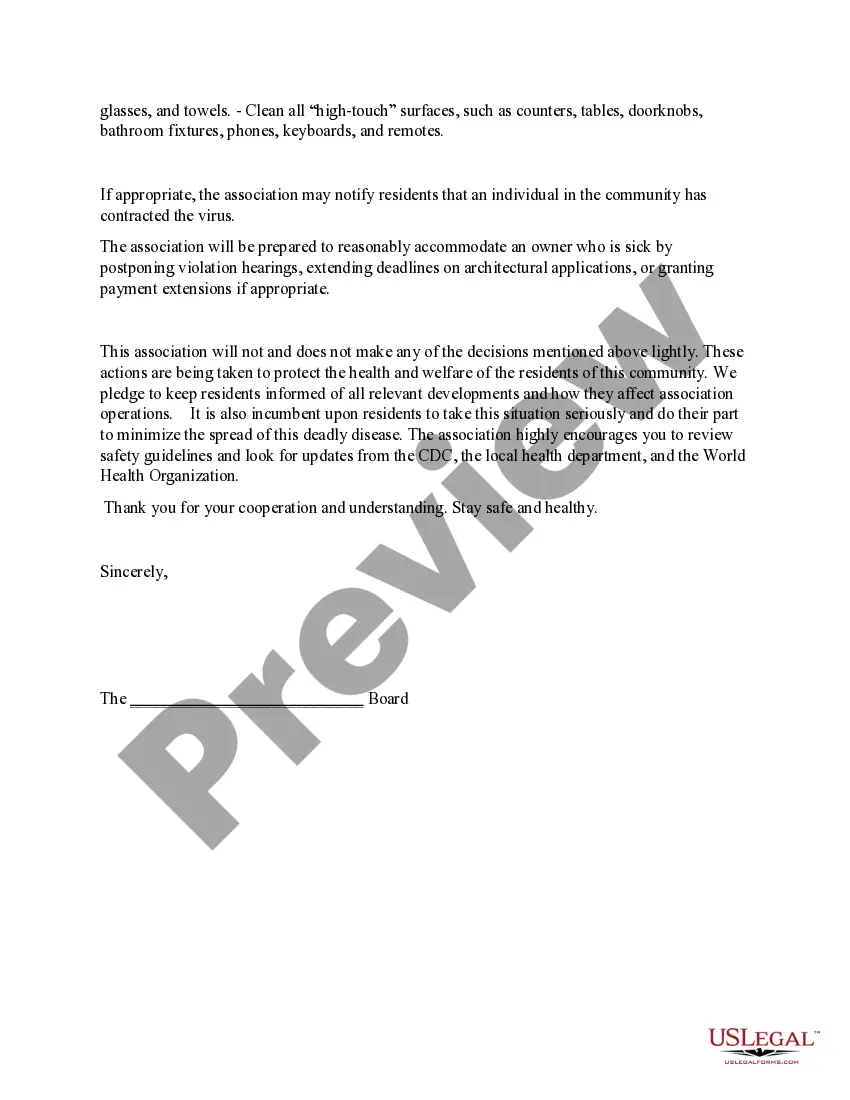
This form is a Letter to Community Residents from the Association Board regarding COVID-19 coronavirus implications. It provides community residents with important updates on the association's response to the pandemic, including adjustments in policies and operational changes. This letter is essential for keeping residents informed and ensuring health and safety during an unprecedented time.
Form components explained
- Greeting section to address community residents.
- Details on cleaning and disinfection efforts in common areas.
- Information about the status of amenities and facilities.
- Updates on community meetings and events in light of public health recommendations.
- Guidance on social distancing and safety measures.
- Suggestions for residents experiencing illness and how to protect themselves.
- Commitment from the association to keep residents informed.
When to use this form
This form should be used when a community association needs to communicate with its residents about changes due to the COVID-19 pandemic. It is essential for outlining new policies, safety measures, and updates regarding the operations of shared facilities. The letter clarifies the association's commitment to resident health and directs them on protocols to follow during this public health crisis.
Who should use this form
- Community association boards looking to inform residents about COVID-19 related updates.
- Property managers responsible for maintaining communication with resident communities.
- Homeowners associations (HOAs) facing operational changes due to the pandemic.
Completing this form step by step
- Address the letter to âResidentsâ and include the community name.
- Consult with professionals, such as legal advisors and health department officials, to gather pertinent information.
- Fill in details regarding cleaning protocols and status of common areas.
- Specify dates related to the closure or postponement of community events.
- Provide guidance on health and safety measures for residents.
- Close the letter with a reassuring message from the board and include a signature area.
Does this document require notarization?
This form does not typically require notarization unless specified by local law. It is designed for ease of use and compliance within community associations.
Get your form ready online
Our built-in tools help you complete, sign, share, and store your documents in one place.
Make edits, fill in missing information, and update formatting in US Legal Forms—just like you would in MS Word.
Download a copy, print it, send it by email, or mail it via USPS—whatever works best for your next step.
Sign and collect signatures with our SignNow integration. Send to multiple recipients, set reminders, and more. Go Premium to unlock E-Sign.
If this form requires notarization, complete it online through a secure video call—no need to meet a notary in person or wait for an appointment.
We protect your documents and personal data by following strict security and privacy standards.

Make edits, fill in missing information, and update formatting in US Legal Forms—just like you would in MS Word.

Download a copy, print it, send it by email, or mail it via USPS—whatever works best for your next step.

Sign and collect signatures with our SignNow integration. Send to multiple recipients, set reminders, and more. Go Premium to unlock E-Sign.

If this form requires notarization, complete it online through a secure video call—no need to meet a notary in person or wait for an appointment.

We protect your documents and personal data by following strict security and privacy standards.
Mistakes to watch out for
- Failing to consult with legal and health professionals leads to inaccurate or outdated information.
- Not personalizing the letter for the specific community can reduce its effectiveness.
- Neglecting to update the document as circumstances change can create confusion.
Advantages of online completion
- Easy to download and customize for your specific community needs.
- Can be updated quickly to reflect changing guidelines or circumstances.
- Reliably drafted by legal professionals, ensuring compliance and accuracy in communication.
Legal use & context
- This letter serves to inform and protect the health of community residents during a public health crisis.
- It is a formal communication that clarifies the associationâs roles and responsibilities.
- Residents are expected to adhere to guidelines mentioned to minimize the spread of illness.
Key takeaways
- The letter outlines essential updates related to COVID-19 for community residents.
- It emphasizes the importance of safety measures and compliance with health guidelines.
- Regular communication from the association is crucial for maintaining resident trust and health.
Looking for another form?
Form popularity
FAQ
Someone who was within 6 feet of an infected person for a cumulative total of 15 minutes or more over a 24-hour period starting from 2 days before illness onset (or, for asymptomatic patients, 2 days prior to test specimen collection) until the time the patient is isolated.
Stay at least 6 feet (about 2 arms' length) from other people. Keeping distance from others is especially important for people who are at higher risk of getting very sick.
The virus that causes COVID-19 most commonly spreads from person to person by respiratory droplets during close physical contact (within 6 feet). The virus can sometimes spread from person to person by small droplets or virus particles that linger in the air for minutes to hours. This can happen in enclosed spaces with inadequate ventilation. In general, being outdoors and in spaces with good ventilation reduces the risk of exposure to infectious respiratory droplets.
For COVID-19, a close contact is anyone who was within 6 feet of an infected person for a total of 15 minutes or more. An infected person can spread COVID-19 starting from 48 hours (or 2 days) before the person has any symptoms or tests positive for COVID-19.
Community spread means spread of an illness for which the source of infection is unknown. It's also possible, however, that the patient may have been exposed to a returned traveler who was infected.
Anyone who has had close contact with someone with COVID-19 should stay home for 14 days after their last exposure to that person.
People may spread COVID-19 as soon as two to three days before developing symptoms which occur on average 5 to 7 days after exposure, with some cases lasting as long as 14 days. If you live with or care for people who are at risk for severe illness from COVID-19, consider self-quarantining for the full 14 days.
Being around large groups of people increases the likelihood of spreading the virus. This is why it's recommended that you avoid social gatherings. It's not just coughing or sneezing that produces respiratory droplets, however. Things like talking, laughing, or singing can also send these droplets into the air