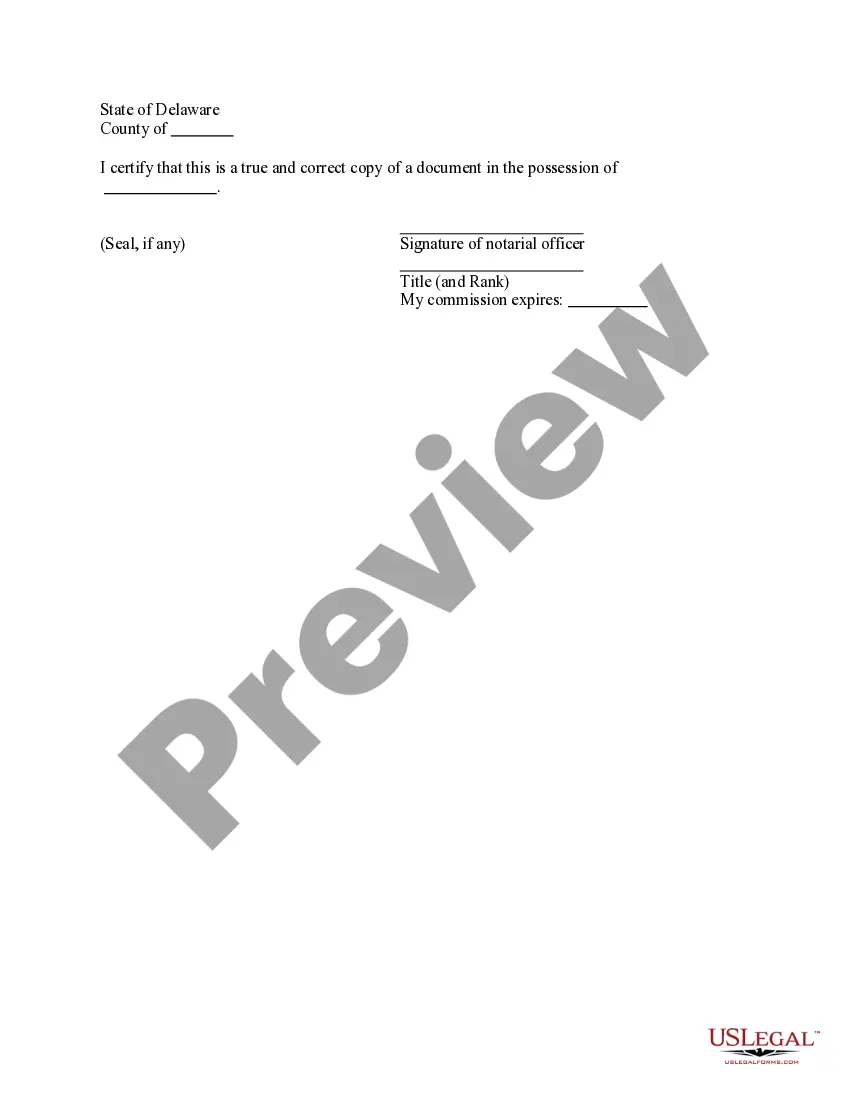
Release Constituting Accord and Satisfaction between Employer and Executive Employee Pursuant to Severance Agreement
About this form
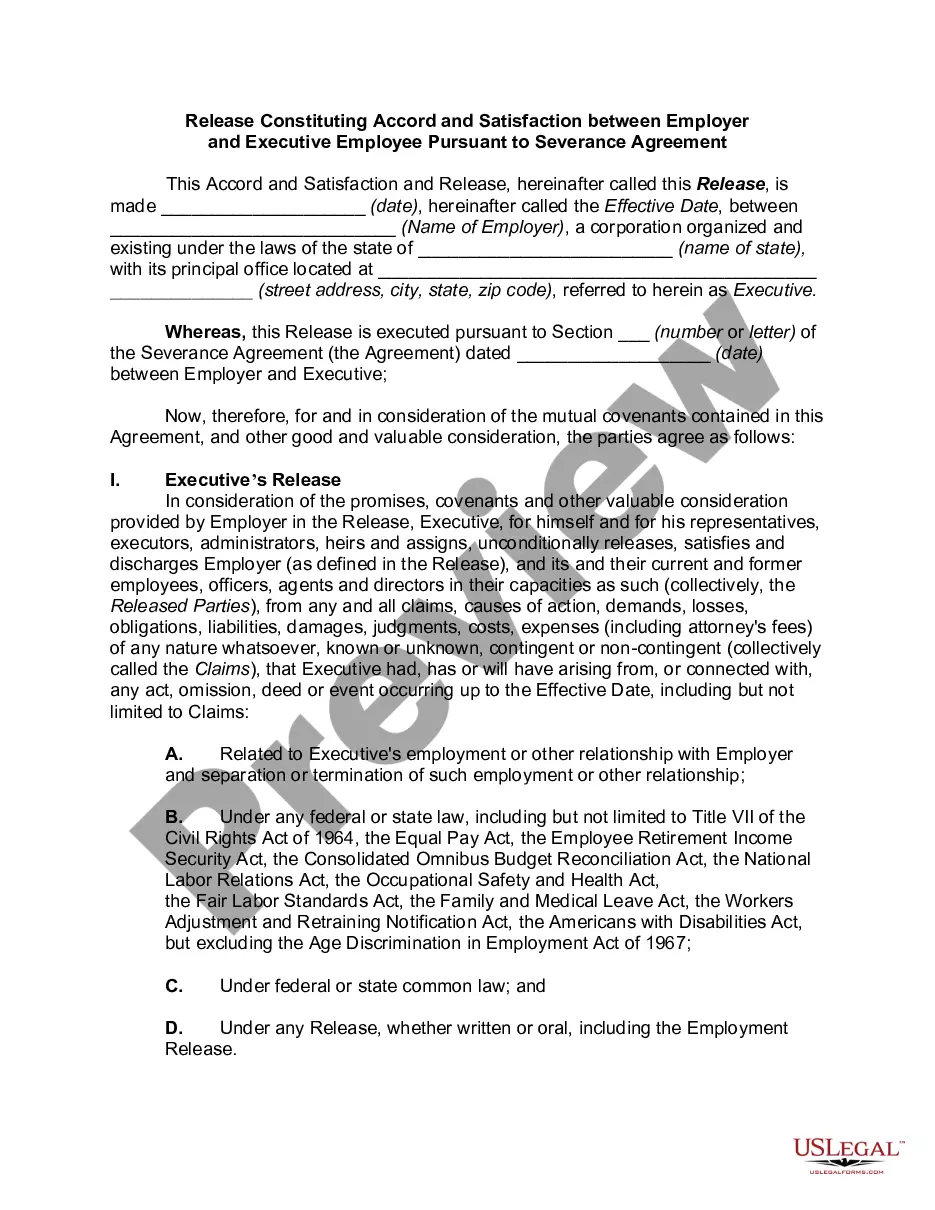
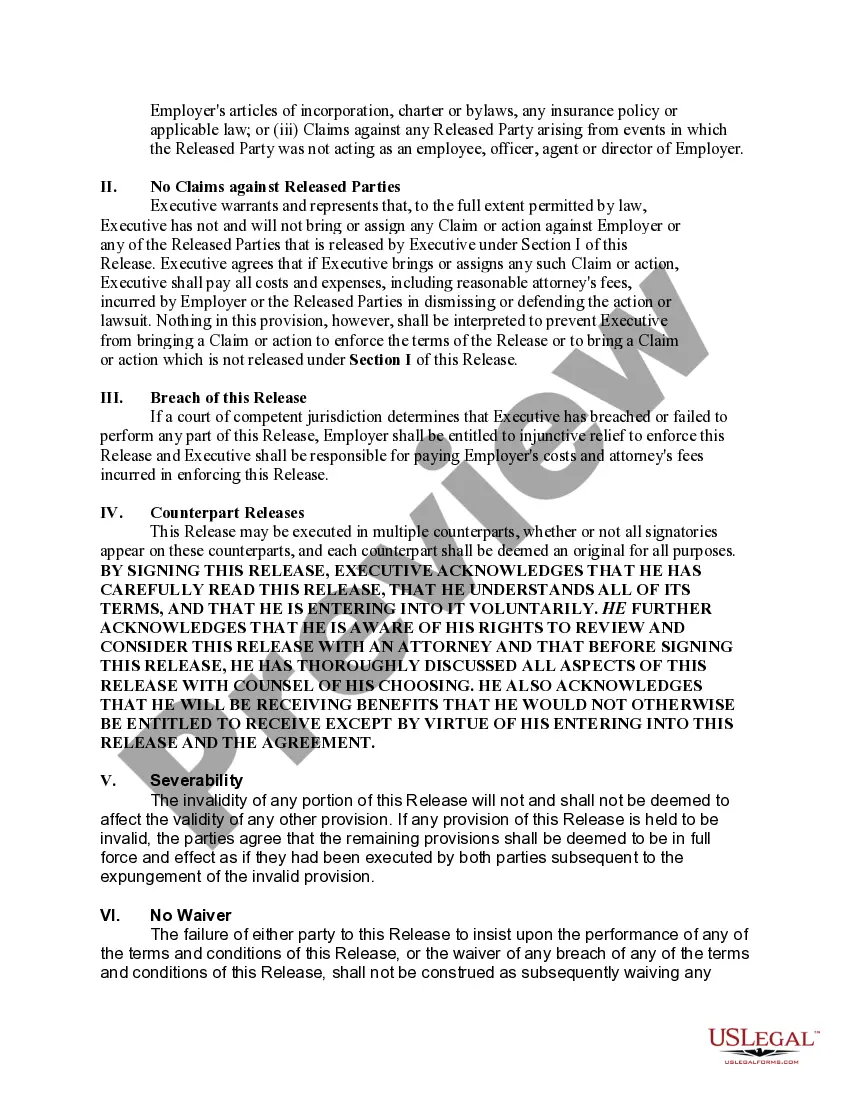
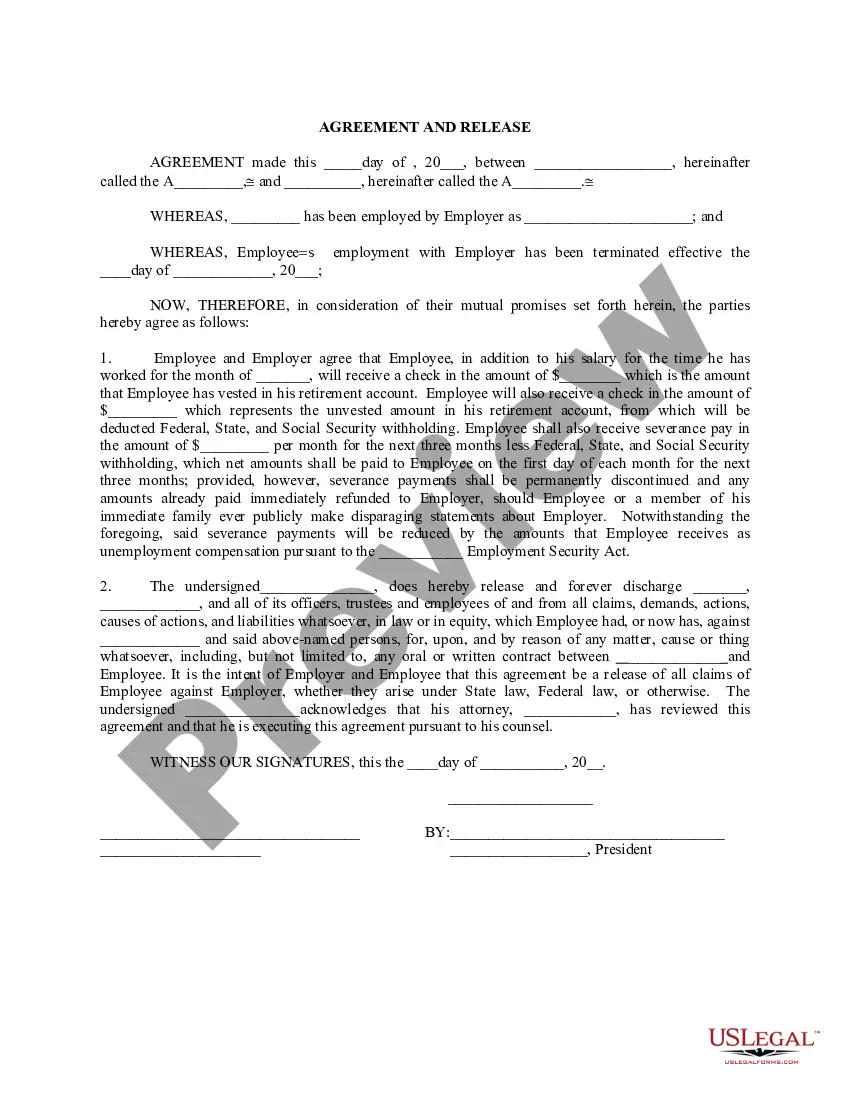
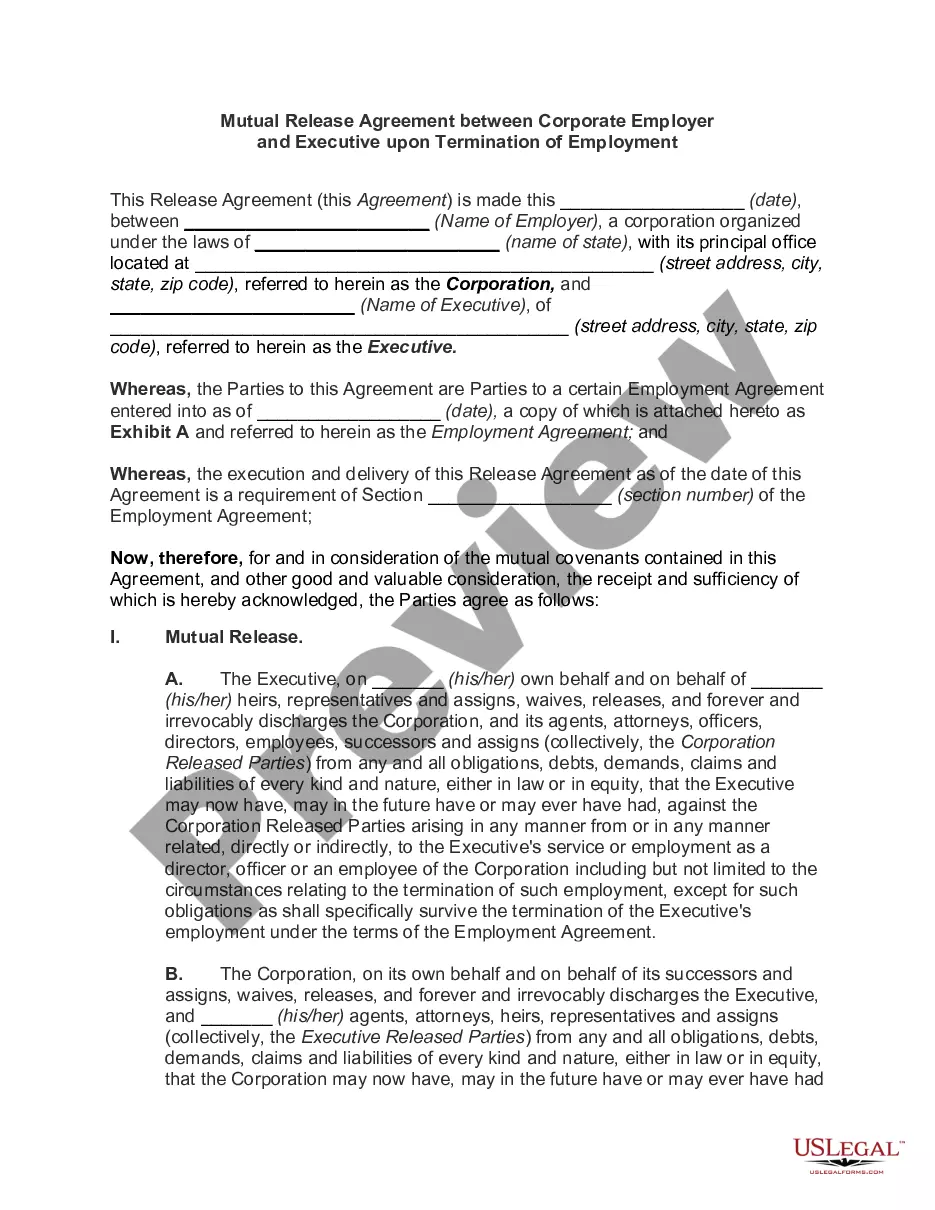
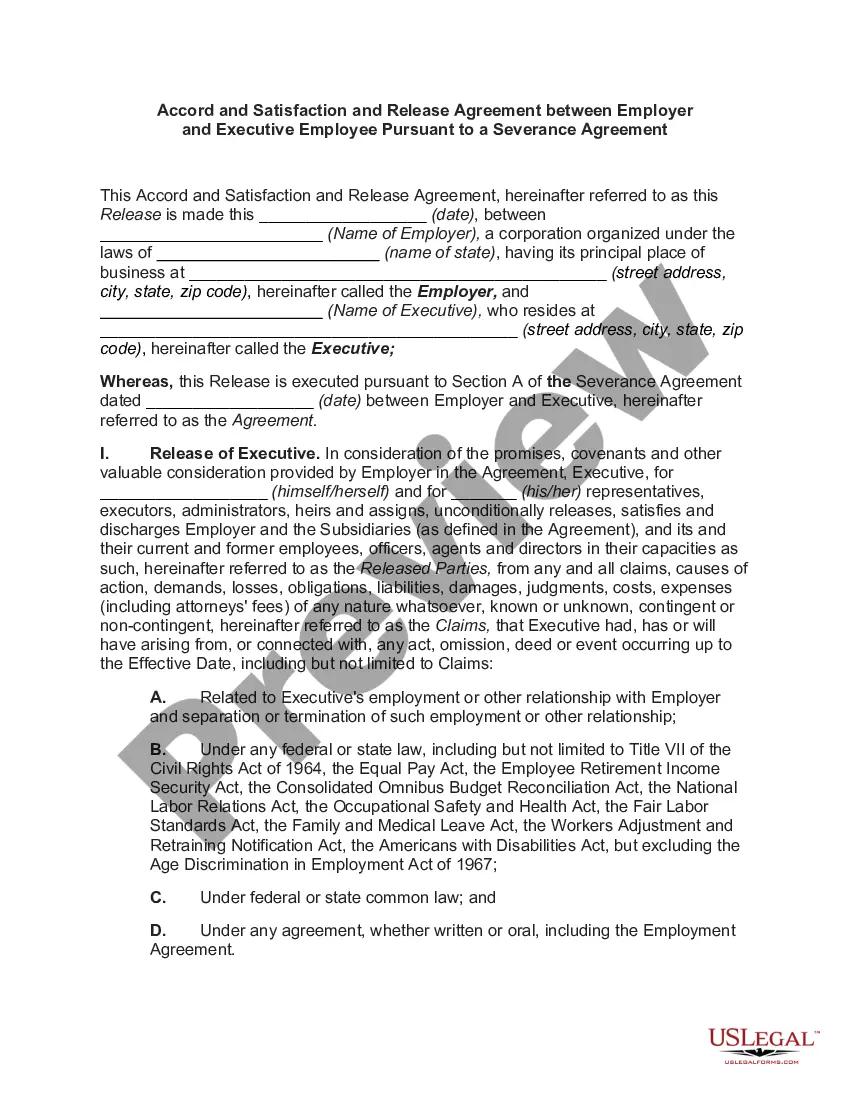
This form is a Release Constituting Accord and Satisfaction between an Employer and an Executive Employee, created pursuant to a Severance Agreement. Its primary purpose is to formally discharge any claims the Executive may have against the Employer, ensuring both parties are clear on their obligations and rights post-termination. This release serves to finalize the executive's separation from the company and is unique from general contract terminations by explicitly addressing the mutual agreements reached under the severance context.
What’s included in this form
- Date of the agreement and effective date.
- Name and details of the Employer and Executive.
- Release of claims against the Employer, including specific federal and state laws.
- No claims provision preventing future lawsuits related to the released claims.
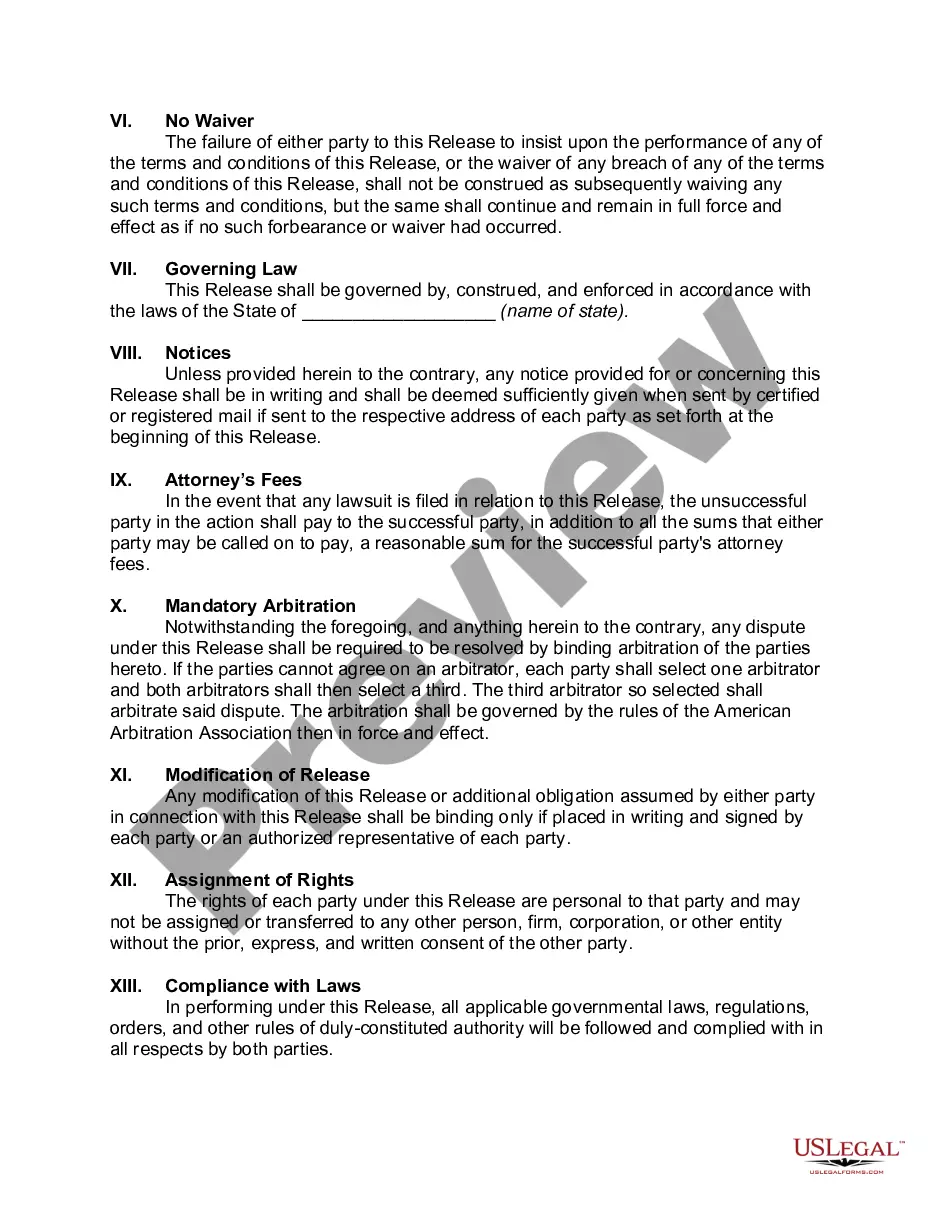
- Governing law clause indicating which state laws will apply.
- Mandatory arbitration requirement for disputes arising from the release.


When this form is needed
This form should be used when an Executive and an Employer reach a mutual agreement regarding the terms of separation upon termination of employment. Situations include layoffs, voluntary resignations under specific conditions, or after exiting negotiations wherein the Executive agrees to release any potential claims in exchange for severance benefits. Utilizing this form ensures that both parties have a clear understanding and legal standing moving forward.
Who needs this form
This form is intended for:
- Employers seeking to confirm a complete and mutual understanding when parting ways with an Executive.
- Executive Employees who wish to formally release their claims against their previous employer as part of their severance negotiation.
- Legal representatives of either party who are involved in drafting or reviewing employment separation agreements.
Steps to complete this form
- Identify the date, names, and contact information for both the Employer and Executive.
- Fill in the effective date for when the agreement starts.
- Clearly state any claims being released by the Executive, ensuring alignment with severance conditions.
- Include provisions for governing law and mandatory arbitration, as necessary.
- Each party must sign the document, acknowledging their understanding and agreement to its terms.
Notarization guidance
This form does not typically require notarization to be legally valid. However, some jurisdictions or document types may still require it. US Legal Forms provides secure online notarization powered by Notarize, available 24/7 for added convenience.
Get your form ready online
Our built-in tools help you complete, sign, share, and store your documents in one place.
Make edits, fill in missing information, and update formatting in US Legal Forms—just like you would in MS Word.
Download a copy, print it, send it by email, or mail it via USPS—whatever works best for your next step.
Sign and collect signatures with our SignNow integration. Send to multiple recipients, set reminders, and more. Go Premium to unlock E-Sign.
If this form requires notarization, complete it online through a secure video call—no need to meet a notary in person or wait for an appointment.
We protect your documents and personal data by following strict security and privacy standards.

Make edits, fill in missing information, and update formatting in US Legal Forms—just like you would in MS Word.

Download a copy, print it, send it by email, or mail it via USPS—whatever works best for your next step.

Sign and collect signatures with our SignNow integration. Send to multiple recipients, set reminders, and more. Go Premium to unlock E-Sign.

If this form requires notarization, complete it online through a secure video call—no need to meet a notary in person or wait for an appointment.

We protect your documents and personal data by following strict security and privacy standards.
Common mistakes to avoid
- Failing to include the effective date of the agreement.
- Leaving out required signatures from either party.
- Not specifying all claims being released, leading to ambiguity.
- Neglecting to review the form with legal counsel before signing.
Why use this form online
- Convenient access from anywhere, allowing quick download and completion.
- Editable templates that can be tailored to meet specific needs.
- Reliable legal validity as forms are drafted by licensed attorneys.
- Time-saving features for easy completion and printing.
Legal use & context
- Enforceability: Properly executed releases can protect employers from future claims by former employees.
- Limitations: Certain claims may not be waivable, such as those protected by federal law or specific state statutes.
- Due consideration must be given for the agreement to be valid; both parties should receive benefits in exchange for the release.
Key takeaways
- The release form serves to formalize the conclusion of an employment relationship under specific terms.
- Both parties must understand and agree on the release of claims to avoid potential future disputes.
- Reviewing this form with legal counsel is advisable to ensure compliance with state-specific laws.
Looking for another form?
Form popularity
FAQ
An ACORD certificate is proof that you have the amount and kind of liability insurance the client requires for the project. An ACORD certificate may also be requested by a bank or mortgage company for a property they hold the mortgage on, or by an equipment leasing company when they lease equipment for a project.
There is an important distinction between this form and ACORD 27 Evidence of Property Insurance or ACORD 28 Evidence of Commercial Property Insurance.When the property is insured under a large limit commercial lines policy and the lender requires specific detailed coverage information, use form 28.
ACORD 28, Evidence of Commercial Property Insurance, provides a coverage statement for mortgagees, additional insureds and loss payees who provide mortgages or loans on real property or business personal property insured under a Commercial Lines policy, and are named in the policy.
The Acord 25 form, also known as a certificate of insurance (COI), is a type of liability insurance certificate that represents the contractual agreements between the insured clients and the insurance agencies.
The one-page ACORD certificate of insurance summarizes essential information about your insurance policy, such as coverage types, policy numbers, insurance limits, and effective and expiration dates. As a small business owner, your clients may ask you to provide an ACORD certificate of insurance, or COI.
The one-page ACORD certificate of insurance summarizes essential information about your insurance policy, such as coverage types, policy numbers, insurance limits, and effective and expiration dates. As a small business owner, your clients may ask you to provide an ACORD certificate of insurance, or COI.
ACORD 25, Certificate ofLiability Insurance, is issued as a matter of information only, and confers no rights upon the certificate holder.If the receiver of the form wants to verify that liability coverage exists on a policy and has no direct interest in the policy, use the certificate of insurance.
ACORD 23, Vehicle or Equipment Certificate of Insurance, is issued as a matter of information ony and confers no rights upon the certificate holder.Vehicle(s) may be defined as motor-vehicle, highway vehicles, non-highway vehicles, on-road vehicles, and/or off-road vehicles.
ACORD 24, Certificate of Property Insurance.When the property is insured under a Commercial Lines policy with a large limit and the lender requires specific detailed coverage information, use ACORD 28, Evidence of Commercial Property Insurance.