Sample Letter for Parent Teacher Conference - Disruptive Child
Understanding this form
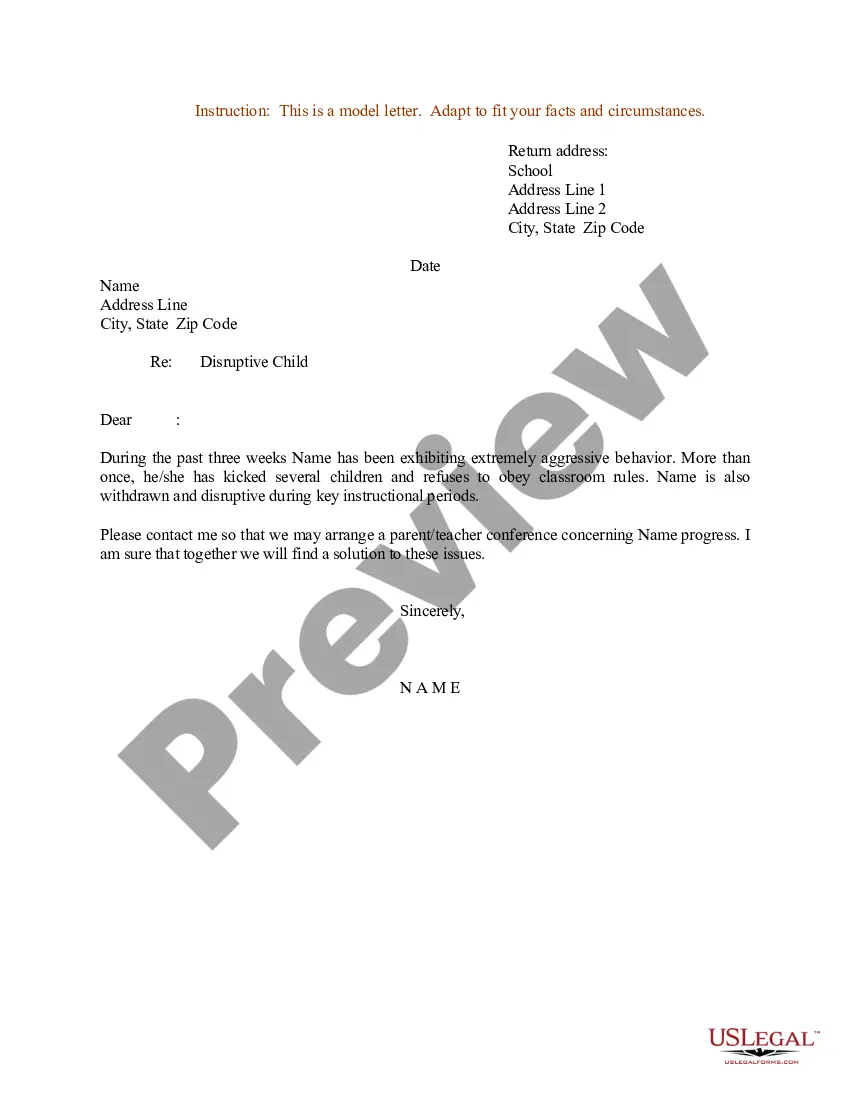
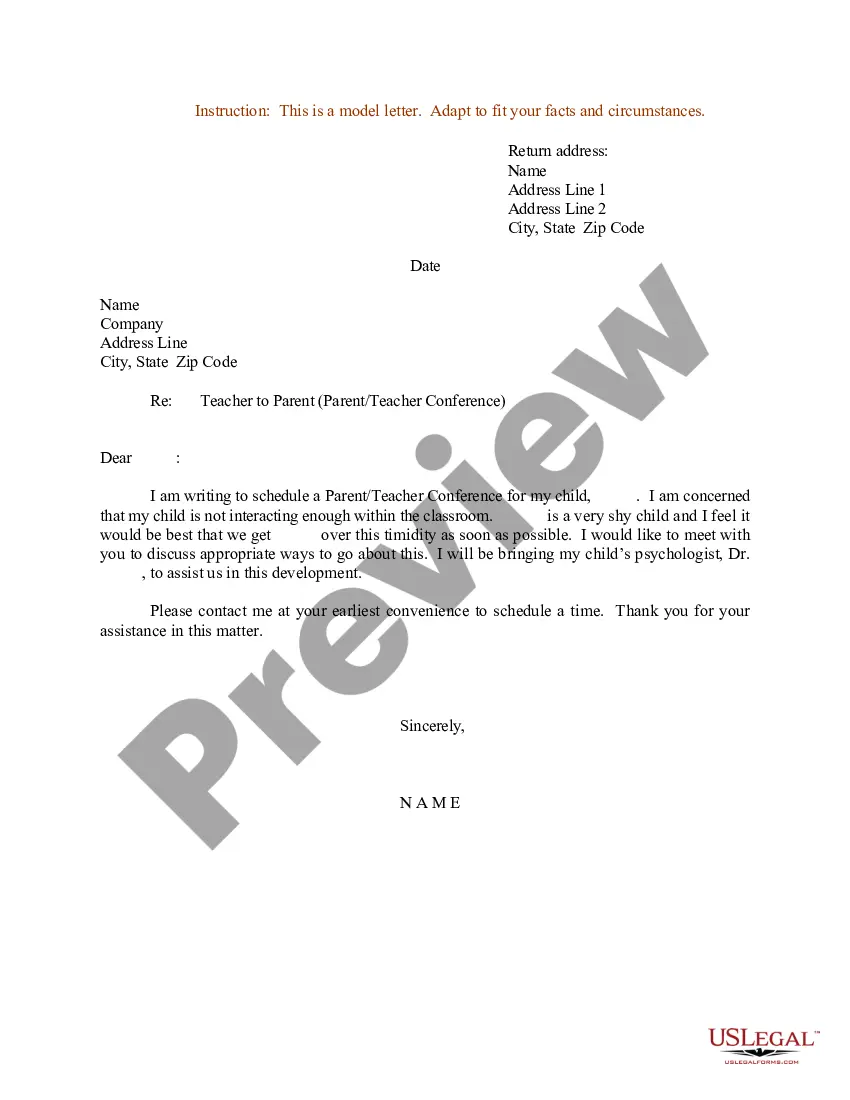
This Sample Letter for Parent Teacher Conference regarding a disruptive child is a template designed to help parents communicate with teachers. Its primary purpose is to request a meeting to discuss a child's behavioral challenges and academic progress. This form simplifies the process of addressing concerns in a constructive manner, promoting collaboration between parents and teachers to find solutions.
Form components explained
- Return address: Includes the school and parent's address for easy correspondence.
- Date: Indicates when the letter is sent.
- Subject line: Clearly states the focus on a disruptive child.
- Request for contact: Invites the teacher to arrange a parent/teacher conference.
- Closing: Provides space for the parentâs signature and name.
Situations where this form applies
This form is useful when a parent notices disruptive behavior from their child at school that may be affecting their academic performance. Parents should consider using this letter to request a meeting with the teacher to better understand the situation and work collaboratively towards solutions.
Intended users of this form
- Parents or guardians of children who display disruptive behavior in a school setting.
- Individuals seeking to engage with teachers about their child's progress.
- Anyone wishing to establish a constructive dialogue between home and school.
How to prepare this document
- Identify the return addresses: Fill in the schoolâs and your address at the top of the letter.
- Enter the date: Write the date when you are sending the letter.
- Specify the subject: Mention the focus on the disruptive behavior of your child.
- Request a conference: Politely ask the teacher to arrange a meeting to discuss your child's progress.
- Sign the letter: Include your name at the bottom to personalize the letter.
Does this form need to be notarized?
This form does not typically require notarization unless specified by local law.
Get your form ready online
Our built-in tools help you complete, sign, share, and store your documents in one place.
Make edits, fill in missing information, and update formatting in US Legal Forms—just like you would in MS Word.
Download a copy, print it, send it by email, or mail it via USPS—whatever works best for your next step.
Sign and collect signatures with our SignNow integration. Send to multiple recipients, set reminders, and more. Go Premium to unlock E-Sign.
If this form requires notarization, complete it online through a secure video call—no need to meet a notary in person or wait for an appointment.
We protect your documents and personal data by following strict security and privacy standards.

Make edits, fill in missing information, and update formatting in US Legal Forms—just like you would in MS Word.

Download a copy, print it, send it by email, or mail it via USPS—whatever works best for your next step.

Sign and collect signatures with our SignNow integration. Send to multiple recipients, set reminders, and more. Go Premium to unlock E-Sign.

If this form requires notarization, complete it online through a secure video call—no need to meet a notary in person or wait for an appointment.

We protect your documents and personal data by following strict security and privacy standards.
Mistakes to watch out for
- Failing to include both addresses, which may delay communication.
- Not specifying the child's name in the subject line, leading to confusion.
- Forgetting to sign the letter before sending it.
Why complete this form online
- Convenience: Download and edit the template easily from home.
- Time-saving: Quickly customize the letter to your needs.
- Reliable format: Ensure professional presentation with a clear structure.
Legal use & context
- This letter serves as an official request for a school meeting, fostering parental involvement in education.
- While not legally binding, it establishes a written record of concerns, which can be important for future discussions.
Key takeaways
- The Sample Letter for Parent Teacher Conference - Disruptive Child is a valuable tool for parents to address behavioral issues.
- Clear communication is vital in a child's educational journey.
- Using this form can aid in fostering collaboration between parents and teachers for effective problem-solving.
Looking for another form?


Form popularity
FAQ
Have realistic behavior expectations and ideally before school starts, at an open house or parent meeting share those expectations with the parents. Create a relationship with parents based on teamwork from day one. Lead with love.
Tell them they can use it as a resource to build on the strengths the child already has, he said. Considering the emotion surrounding the topic, and to avoid alienating parents or heightening their anxiety, Fitton, Rispoli and Snyder advise approaching the undertaking with sensitivity.
1 List Specific Behaviors. A letter to parents should describe the specific behaviors in a factual and objective way. 2 Explain Next Steps. The parents will want to know how the problem was dealt with and what you plan to do next. 3 Call to Action. 4 Share Positives.
Stick to the facts. Present a we're on the same side approach by focusing on a shared commitment to children's safety, and emphasizing that you want what is safest for all children. Share your feelings. Include the positive. Be prepared to provide the parent with resources for help and information.
When planning what to say at parent teacher conferences, prepare a way to end on a positive note. You could tell why you love having the child in your class, highlight an overall strength, or a special connection you have with the child. Here's what it might sound like: It's so fun having Toby in my class!
Parents are largely responsible for their children's behaviour.It is more helpful to encourage parents to identify areas in which they are struggling to manage their children's behaviour and motivate them to set appropriate boundaries.
Use I messages. They will help you speak honestly about your feelings without placing blame on the parent. Use examples from observations during the day. Ask if there have been any recent changes at home. Emphasize the positive.
Put the date on your letter. Give your child's full name and the name of your child's main teacher or current class placement. Say what you want, rather than what you don't want. Give your address and a daytime phone number where you can be reached.