Sample Letter for Teacher to Parent - Parent Teacher Conference
About this form
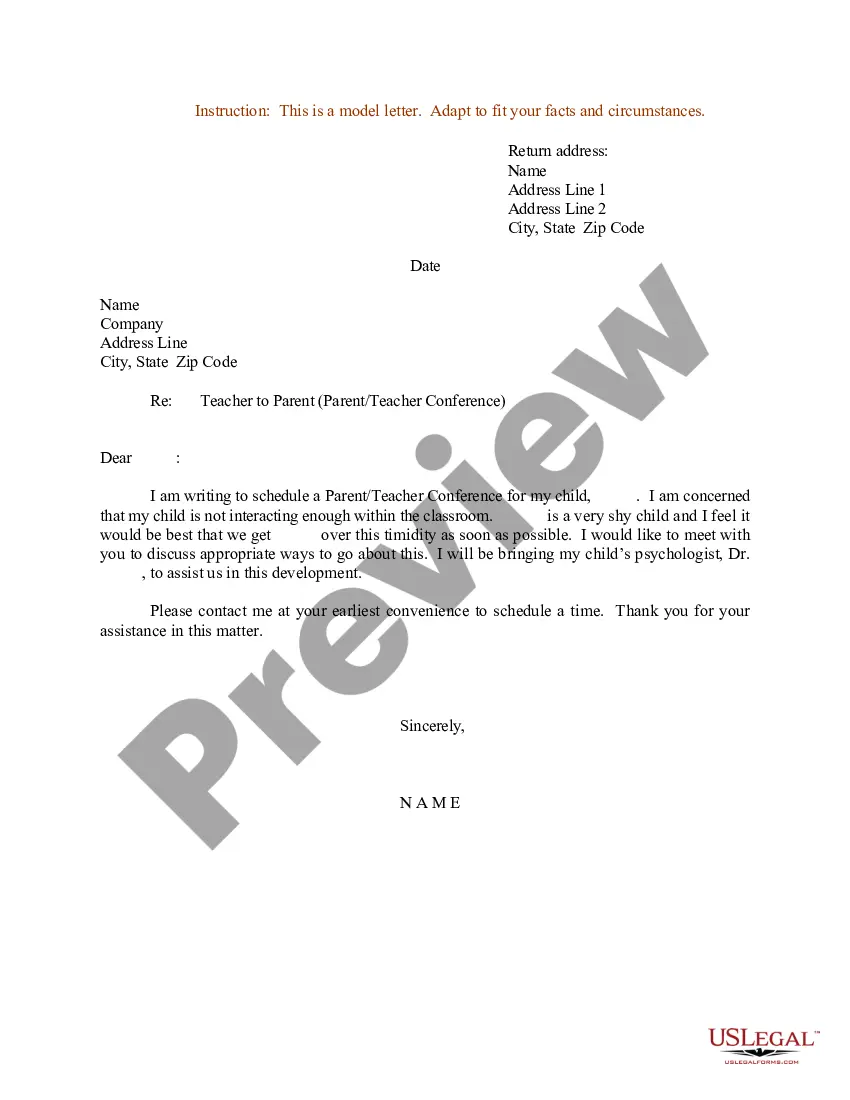
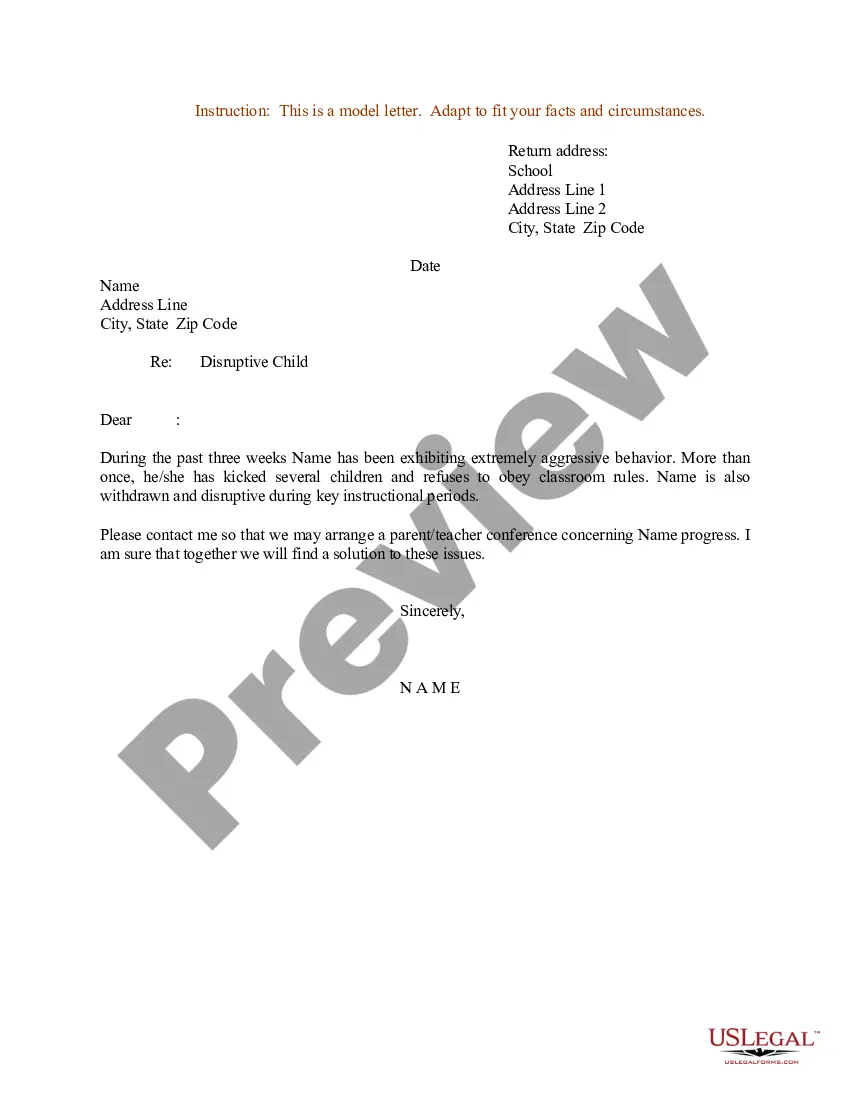
This Sample Letter for Teacher to Parent - Parent Teacher Conference is a template designed to facilitate communication between teachers and parents regarding student progress. Unlike general communication forms, this specific letter helps outline key details about the parent-teacher conference, providing clarity and organization for both parties involved.
Key components of this form
- Return address: Includes the teacherâs address for formal communication.
- Date: The date the letter is prepared for documentation purposes.
- Recipient details: The parent's name and address for targeted delivery.
- Subject line: Clearly states the purpose of the letter regarding the parent-teacher conference.
When this form is needed
This form is useful when a teacher needs to notify a parent about an upcoming parent-teacher conference. It can be used to discuss a studentâs academic progress, behavior, or to address any other concerns that may be important for the parent to know.
Who should use this form
- Teachers seeking to communicate with parents effectively.
- School administrators who wish to standardize communication methods.
- Parents wanting clarification on topics to be discussed at the conference.
How to prepare this document
- Fill in the return address at the top of the letter.
- Add the current date to document when the letter is sent.
- Enter the recipient's name and address to ensure it reaches the right person.
- Craft the body of the letter discussing the purpose of the parent-teacher conference.
- Sign the letter to finalize it before sending.
Does this form need to be notarized?
This form does not typically require notarization unless specified by local law.
Get your form ready online
Our built-in tools help you complete, sign, share, and store your documents in one place.
Make edits, fill in missing information, and update formatting in US Legal Forms—just like you would in MS Word.
Download a copy, print it, send it by email, or mail it via USPS—whatever works best for your next step.
Sign and collect signatures with our SignNow integration. Send to multiple recipients, set reminders, and more. Go Premium to unlock E-Sign.
If this form requires notarization, complete it online through a secure video call—no need to meet a notary in person or wait for an appointment.
We protect your documents and personal data by following strict security and privacy standards.

Make edits, fill in missing information, and update formatting in US Legal Forms—just like you would in MS Word.

Download a copy, print it, send it by email, or mail it via USPS—whatever works best for your next step.

Sign and collect signatures with our SignNow integration. Send to multiple recipients, set reminders, and more. Go Premium to unlock E-Sign.

If this form requires notarization, complete it online through a secure video call—no need to meet a notary in person or wait for an appointment.

We protect your documents and personal data by following strict security and privacy standards.
Avoid these common issues
- Failing to include the correct date or return address.
- Not personalizing the letter by omitting the parent's name.
- Leaving out important details regarding the discussion topics.
Benefits of using this form online
- Convenience of downloading and printing at your own pace.
- Easily editable to customize according to specific student needs.
- Reliability of using a template prepared by legal professionals.
Legal use & context
- This sample letter is not a legally binding document but serves as a formal communication tool.
- It helps document the intent to meet and discuss important educational matters.
Main things to remember
- This sample letter is an essential tool for effective communication between teachers and parents.
- Personalization of the letter can enhance parent engagement.
- It is available in a convenient format that allows for easy editing and use in any state.
Looking for another form?
Form popularity
FAQ
Use a Personalized Greeting This would look like: Dear Ms. Ciccarelli, instead of Dear Parents. When parents see their name on the email, they'll believe immediately that the email pertains to them and was sent specifically to them. This is another great way to grab your parents' attention.
1st paragraph - Teacher introduces him or herself (write about your expertise and/or longevity in the field). 2nd paragraph - Describe what your goal is as an educator (let the parent see that you are concerned for their child's education and behavioral growth).
Parent Teacher Meeting will be held on Friday, 14th May'10. All Parents are requested to come and meet the Teachers of their wards and discuss about their progress. Timings are from am to am and no children are allowed to come along with the parents..
Most formal letters will start with 'Dear' before the name of the person that you are writing to: 'Dear Ms Brown,' or 'Dear Brian Smith,' You can choose to use first name and surname, or title and surname. 'Dear Sir/Madam,' Remember to add the comma.
Your child's teacher will probably show you some samples of your child's work, and may discuss your child's progress, grades, homework, and behavior. The teacher may also ask you about any concerns that she has about your child, as well as questions about his study habits.
Be caring, but make sure they got the communication. Remember, your goal is to work together to help their child succeed. Sign the letter with a simple "Sincerely" and your name. Consider mailing the letter to the parent, rather than sending it home with the student.
Put the date on your letter. Give your child's full name and the name of your child's main teacher or current class placement. Say what you want, rather than what you don't want. Give your address and a daytime phone number where you can be reached.
Do start with a positive about their child. Even if he/she is one of your most challenging students behaviorally or academically, begin with a positive anecdote, trait, or simply, 'I'm so happy ____ is in my class. ' It comforts parents, shows you care and lets them know you notice their child.
Put the date on your letter. Give your child's full name and the name of your child's main teacher or current class placement. Say what you want, rather than what you don't want. Give your address and a daytime phone number where you can be reached.