Twelve Month Sales Forecast
Understanding this form
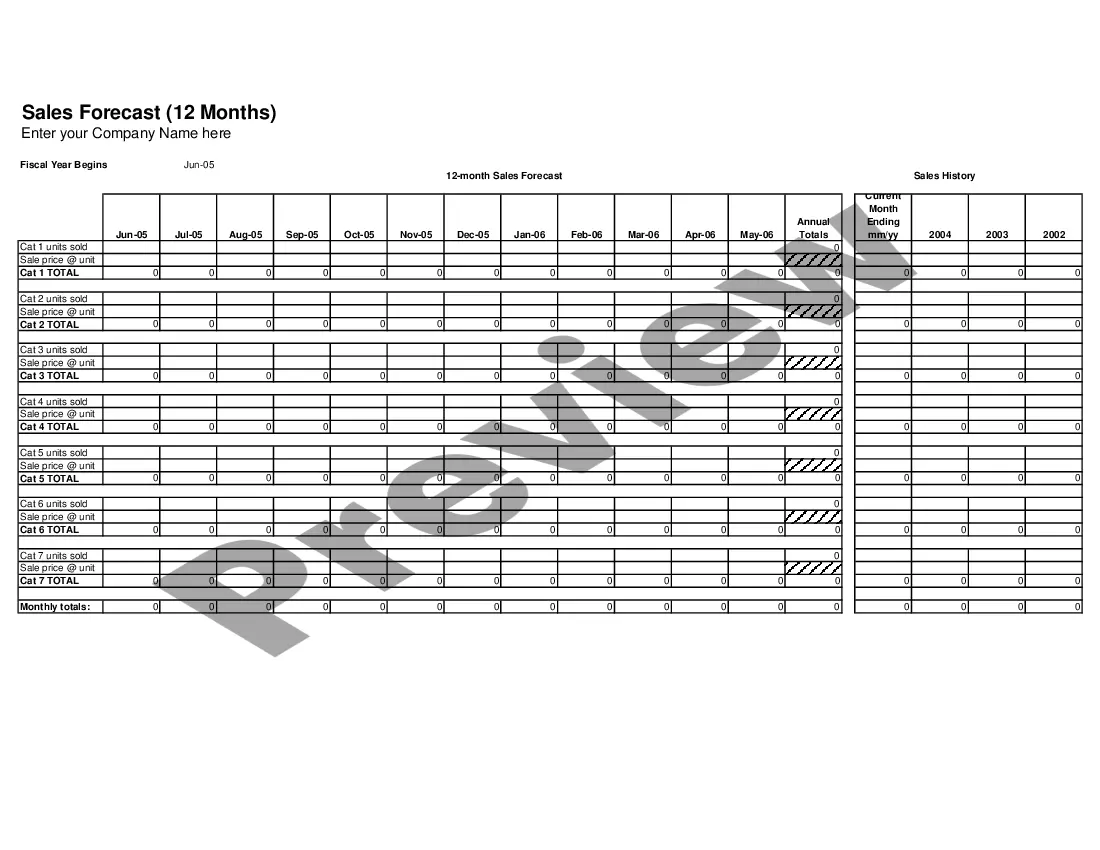
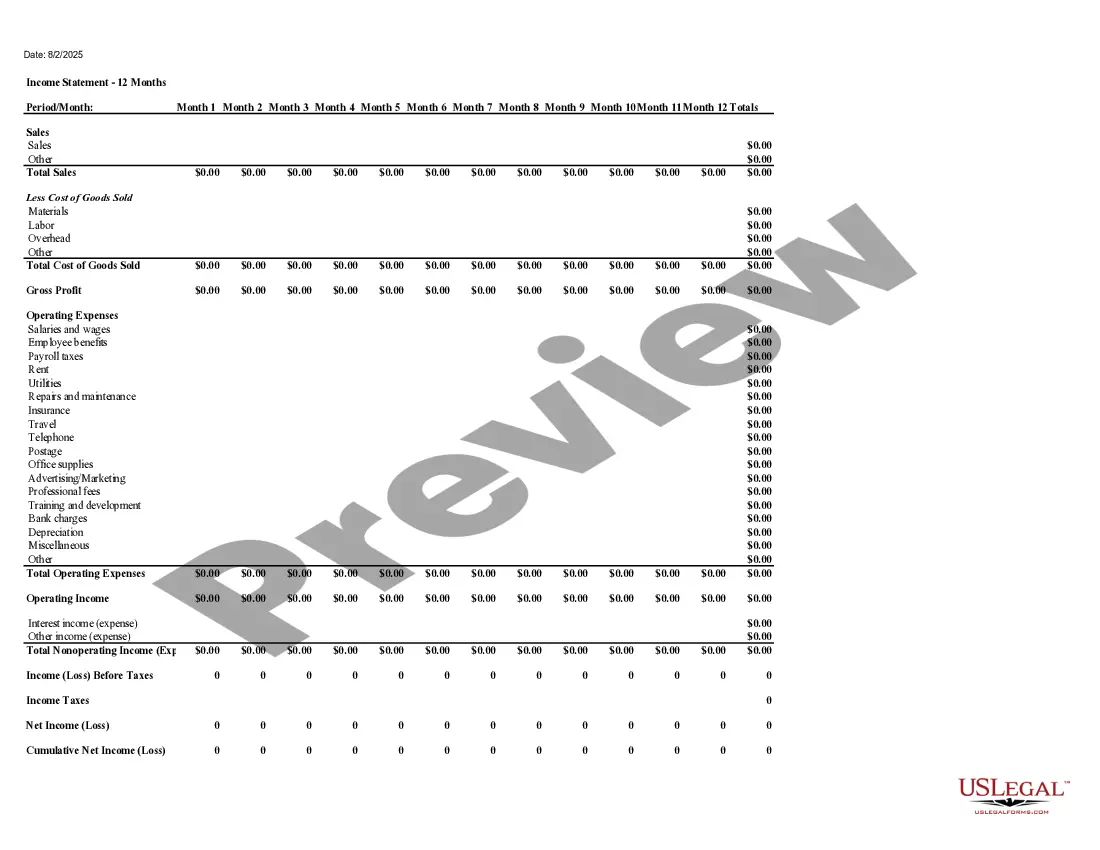
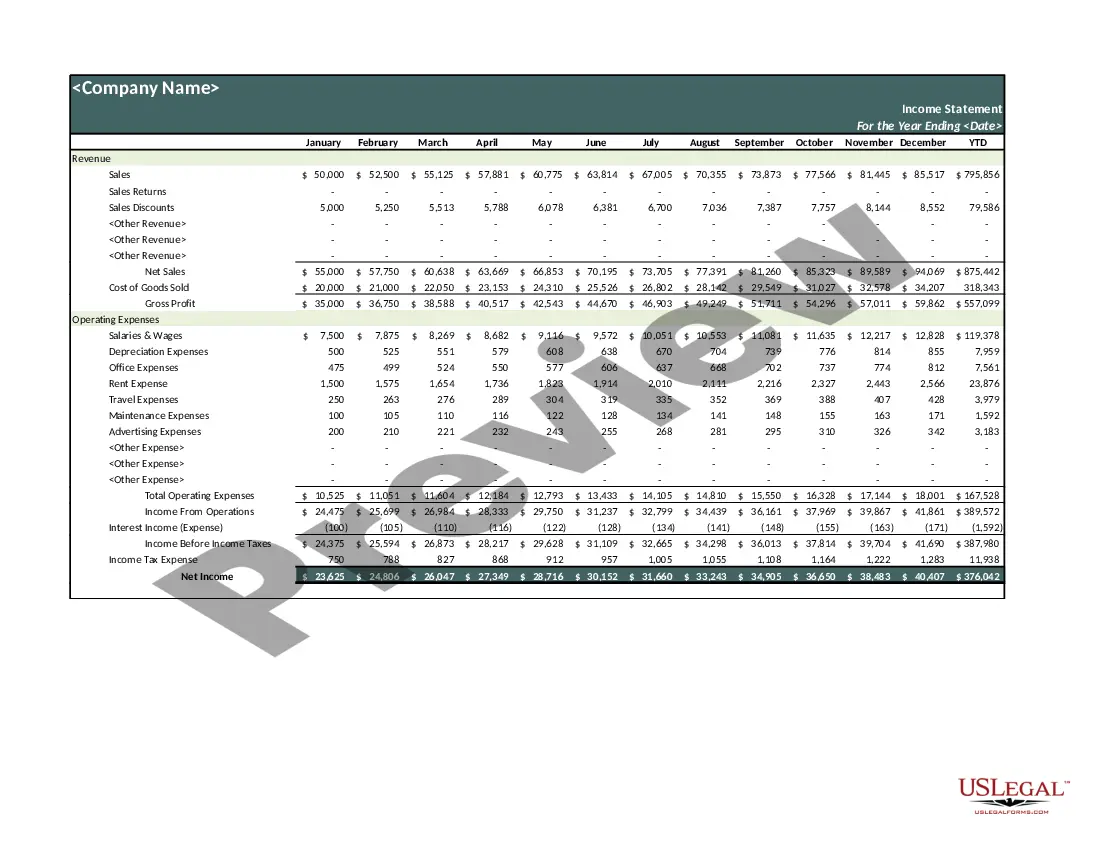
The Twelve Month Sales Forecast is a strategic tool designed for businesses to project sales over a one-year period. It helps organizations organize their sales targets by month, enabling effective financial planning and resource allocation. Unlike simple sales reports, this forecast allows you to visualize future sales trends based on past performance and anticipated market changes.
Key components of this form
- Company name: where you enter your business name.
- Fiscal year begins: indicates when the sales forecast period starts.
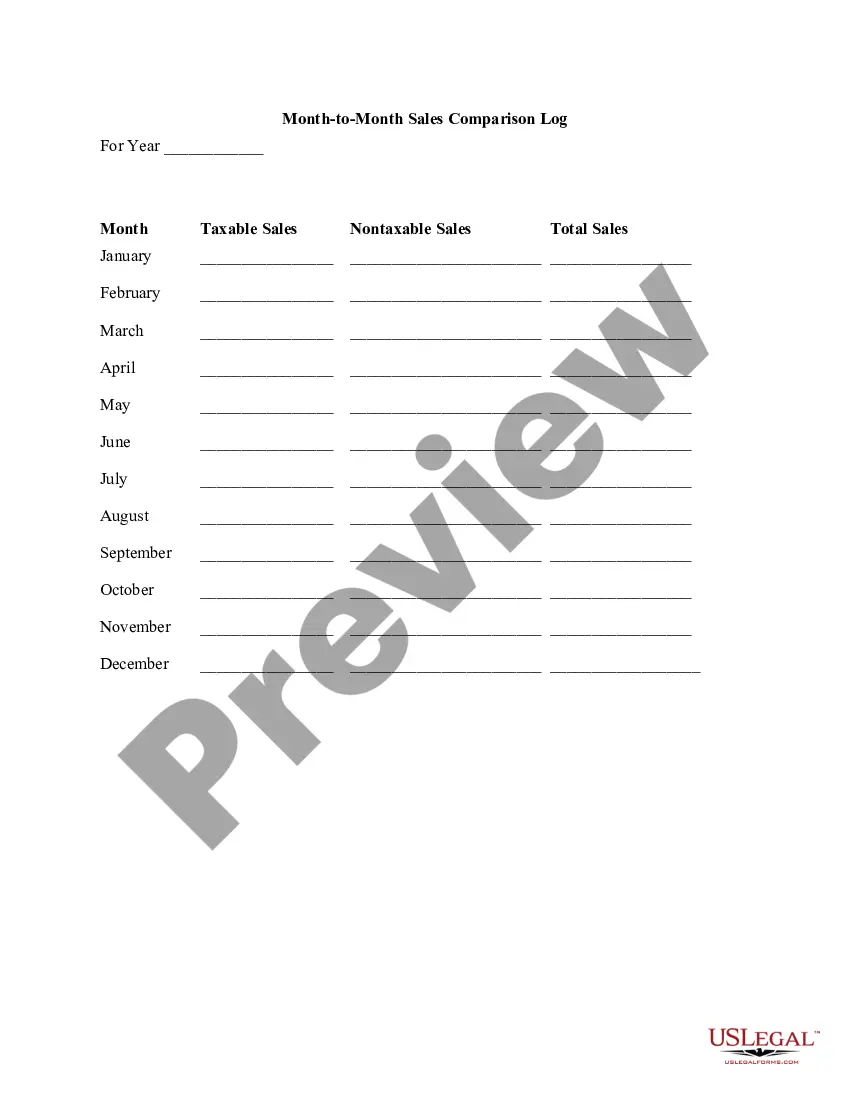
- Monthly sales forecast: tracks anticipated sales for each month across various product categories.
- Sales history: allows for comparison with past yearsâ sales data.
- Unit sales and sale price fields: facilitate detailed input on units sold and their prices.
- Annual totals: summarizes total sales for the year, enhancing overall sales visibility.
When this form is needed
This Twelve Month Sales Forecast form is essential for businesses looking to plan their sales strategy effectively. Use it when launching new products, setting annual sales objectives, or reviewing past sales performance. It is also useful during budget planning sessions and for securing investments or loans by demonstrating potential revenue.
Who needs this form
- Business owners and managers focused on growth and expansion.
- Sales teams needing to set monthly sales targets.
- Financial planners and analysts preparing budgets.
- Entrepreneurs assessing market opportunities.
How to prepare this document
- Enter your company name in the designated field.
- Specify the starting month for your fiscal year.
- For each product category, input the expected units sold and sale price per unit.
- Use the sales history section to input past sales data for comparison.
- Review all entries for accuracy and completeness before finalizing.
- Summarize annual totals to get a clear view of projected revenue.
Is notarization required?
This form does not typically require notarization unless specified by local law. Check with your legal advisor if you need to notarize any documents related to your sales forecast or financial planning.
Get your form ready online
Our built-in tools help you complete, sign, share, and store your documents in one place.
Make edits, fill in missing information, and update formatting in US Legal Forms—just like you would in MS Word.
Download a copy, print it, send it by email, or mail it via USPS—whatever works best for your next step.
Sign and collect signatures with our SignNow integration. Send to multiple recipients, set reminders, and more. Go Premium to unlock E-Sign.
If this form requires notarization, complete it online through a secure video call—no need to meet a notary in person or wait for an appointment.
We protect your documents and personal data by following strict security and privacy standards.

Make edits, fill in missing information, and update formatting in US Legal Forms—just like you would in MS Word.

Download a copy, print it, send it by email, or mail it via USPS—whatever works best for your next step.

Sign and collect signatures with our SignNow integration. Send to multiple recipients, set reminders, and more. Go Premium to unlock E-Sign.

If this form requires notarization, complete it online through a secure video call—no need to meet a notary in person or wait for an appointment.

We protect your documents and personal data by following strict security and privacy standards.
Common mistakes
- Failing to update sales history data, which can skew projections.
- Overlooking seasonal variations that affect sales numbers.
- Not adjusting sales forecasts based on market trends or economic changes.
- Forgetting to include all product categories in the forecast.
Benefits of completing this form online
- Convenience of downloading and editing at your own pace.
- Easy accessibility from any device, making it portable for business meetings.
- Reliable templates drafted by licensed attorneys ensure compliance and completeness.
Looking for another form?



Form popularity
FAQ
Find your business's cash for the beginning of the period. Estimate incoming cash for next period. Estimate expenses for next period. Subtract estimated expenses from income. Add cash flow to opening balance.
Step 1: Define the Terms. Step 2: Clarify and Communicate Your Sales Stages. Step 3: Make Sure CRM is THE Only Source for the Forecast. Step 4: Go Beyond Pipeline and Bookings.
In a worksheet, enter two data series that correspond to each other: Select both data series. On the Data tab, in the Forecast group, click Forecast Sheet. In the Create Forecast Worksheet box, pick either a line chart or a column chart for the visual representation of the forecast.
In its simplest form, a financial projection is a forecast of future revenues and expenses. Typically the projection will account for internal or historical data and will include a prediction of external market factors. In general, you will need to develop both short- and mid-term financial projections.
A cash flow projection estimates the money you expect to flow in and out of your business, including all of your income and expenses. Typically, most businesses' cash flow projections cover a 12-month period.
Examples of quantitative forecasting methods are last period demand, simple and weighted N-Period moving averages, simple exponential smoothing, poisson process model based forecasting and multiplicative seasonal indexes.
To forecast by units, you predict how many units you're going to sell each monthusing the bottom-up method of course. Then, you figure out what the average price is going to be for each unit. Multiply those two numbers together and you have the total sales you plan on making each month.
Map Your Sales Process and Pipeline. Separate Individual Lines of Sale. Draw from Past Data. Create a Unit Sales Projection. Project Prices and Calculate Sales. Calculate Average Unit Costs. Crunch the Numbers. Expect Ongoing Adjustment.
Start with the goals of your forecast. Understand your average sales cycle. Get buy-in is critical to your forecast. Formalize your sales process. Look at historical data. Establish seasonality. Determine your sales forecast maturity.