Sample Letter to Opposing Counsel concerning Settlement of Litigation
What is this form?
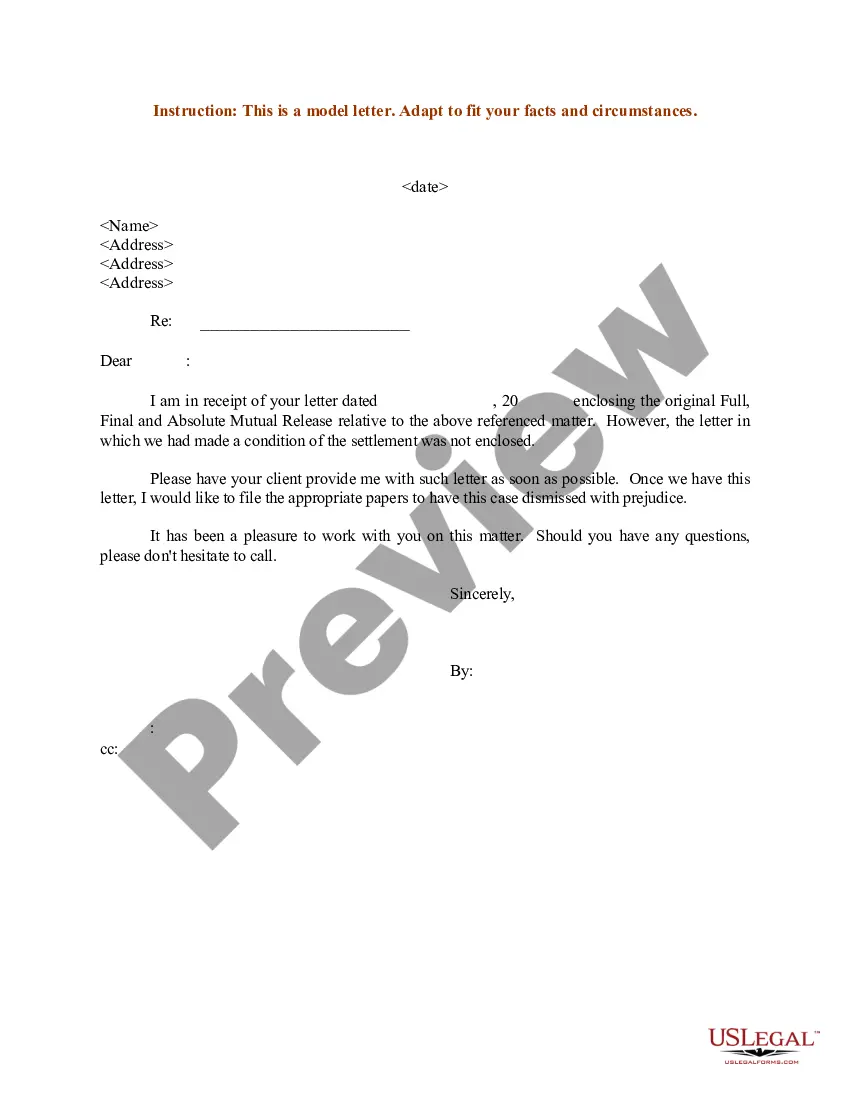
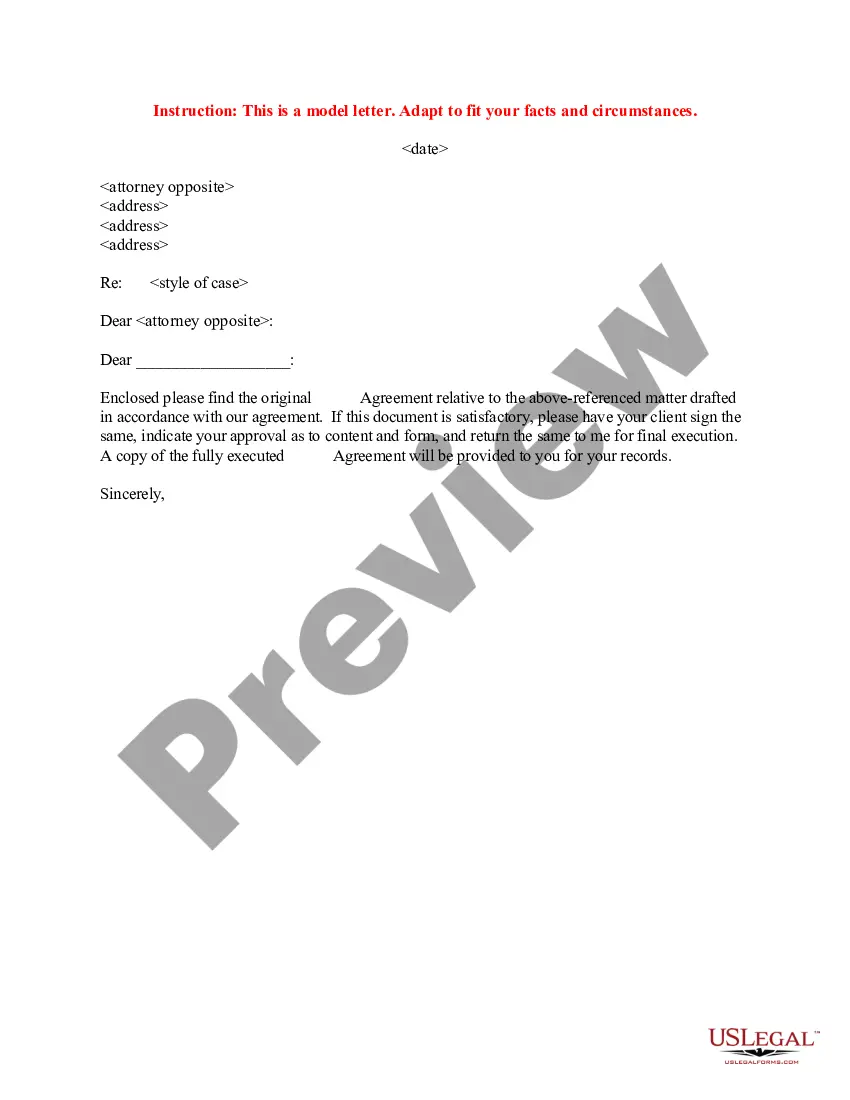
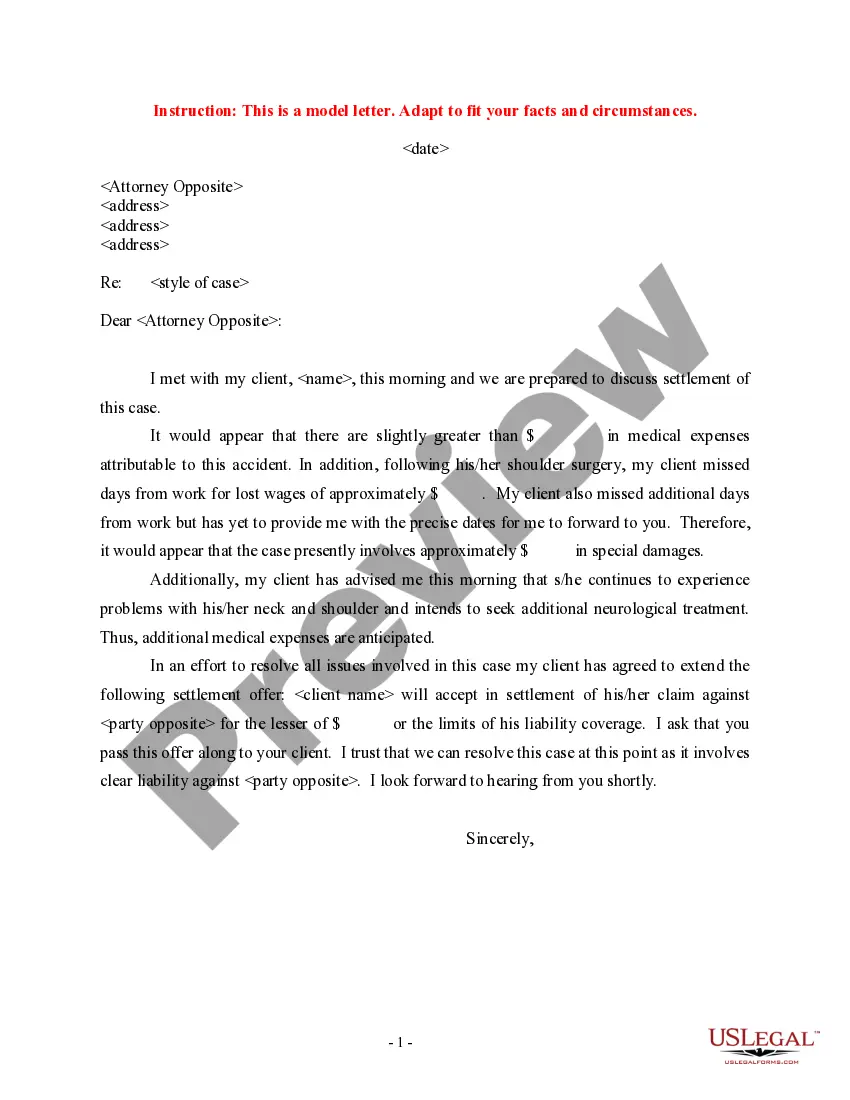
This Sample Letter to Opposing Counsel concerning Settlement of Litigation serves as a template for drafting formal communications directed toward an opposing attorney. Its primary purpose is to facilitate discussions regarding the settlement of a legal dispute, providing a structured format that ensures clarity and professionalism. Unlike other legal documents, this form is specifically tailored for correspondence, making it distinct from procedural or contractual forms.
Key components of this form
- Date of the letter
- Name and address of the sender
- Name and address of the opposing counsel
- Subject line regarding the settlement
- Body of the letter detailing the settlement proposal
- Signature block for the sender


Common use cases
This letter should be used when parties are negotiating a settlement in a legal dispute and need to communicate formally with opposing counsel. It's suitable for scenarios where the terms of the settlement are being discussed or proposed, providing a clear medium for conveying critical information and intentions.
Intended users of this form
This form is intended for:
- Attorneys representing clients in litigation
- Individuals involved in a legal dispute seeking to initiate settlement talks
- Business owners engaged in contractual disagreements
- Parties interested in resolving disputes without the need for trial
Instructions for completing this form
- Identify the date the letter is being sent.
- Input the sender's name and address at the top of the letter.
- Fill in the opposing counsel's name and address in the designated section.
- Write a clear subject line addressing the settlement issue.
- Draft the body of the letter, outlining the proposal and any relevant details.
- Sign the letter and include any necessary contact information.
Is notarization required?
Notarization is generally not required for this form. However, certain states or situations might demand it. You can complete notarization online through US Legal Forms, powered by Notarize, using a verified video call available anytime.
Get your form ready online
Our built-in tools help you complete, sign, share, and store your documents in one place.
Make edits, fill in missing information, and update formatting in US Legal Forms—just like you would in MS Word.
Download a copy, print it, send it by email, or mail it via USPS—whatever works best for your next step.
Sign and collect signatures with our SignNow integration. Send to multiple recipients, set reminders, and more. Go Premium to unlock E-Sign.
If this form requires notarization, complete it online through a secure video call—no need to meet a notary in person or wait for an appointment.
We protect your documents and personal data by following strict security and privacy standards.

Make edits, fill in missing information, and update formatting in US Legal Forms—just like you would in MS Word.

Download a copy, print it, send it by email, or mail it via USPS—whatever works best for your next step.

Sign and collect signatures with our SignNow integration. Send to multiple recipients, set reminders, and more. Go Premium to unlock E-Sign.

If this form requires notarization, complete it online through a secure video call—no need to meet a notary in person or wait for an appointment.

We protect your documents and personal data by following strict security and privacy standards.
Avoid these common issues
- Failing to include a clear date on the letter.
- Not addressing the letter properly to the opposing counsel.
- Making vague or unclear proposals in the settlement discussion.
- Omitting relevant contact information for follow-up.
Benefits of completing this form online
- Convenient access for quick drafting and editing.
- Reliable format that ensures compliance with common legal standards.
- Customizable to fit specific settlement discussions.
- Ability to download and save for future use or reference.
Legal use & context
An effective letter to opposing counsel can play a crucial role in the negotiation process. It serves as formal documentation of the intent to settle, which may be significant if the matter escalates to litigation. Ensure that all proposals are clear and reasonable, as this can impact the proceedings moving forward.
Key takeaways
- This form is specifically designed for settlement discussions in litigation.
- Use it to clearly communicate settlement terms to the opposing counsel.
- No notarization is typically required, but local laws should be checked.
Looking for another form?

Form popularity
FAQ
A settlement demand letter is used to ask for a settlement. The demand letter indicates that you are willing and ready to settle your claim related to your slip and fall accident, car crash, construction accident, or other injury.
Write the term clearly at the top of any written correspondence; or. state it at the start of any oral communication.
Outline The Incident. You will need to start by outlining the details of the accident. Detail Your Injuries. The next section you will want to talk about the resulting injuries. Explain All Of Your Damages. Calculate Your Settlement Demand. Attach Relevant Documents. Get Help From An Attorney.
A lawyer is not prohibited from calling another party's attorney or another member of the party's attorney's firm as a witness, either in discovery or at trial, where such attorney may have unprivileged knowledge relevant to the case or unprivileged knowledge reasonably calculated to lead to the discovery of admissible
Never Refer To Counsel In Argument Resist the impulse in Court to address opposing counsel directly always address through the Court. It will keep you more civil and calmer (and it's what the Court wants anyway).
Opposing counsel call each other 'friend' in increasingly popular SCOTUS lingo. The Supreme Court under the leadership of Chief Justice John G. Roberts Jr. is increasingly using the word friend to refer to opposing counsel in oral arguments, a term also picked up by the lawyers appearing before the court.
But by default, communications to the other side are addressed to the designated attorney-in-charge/top-named lawyer, with cc's to everyone else. In a rare situation where you are sending a letter specifically to multiple attorneys as opposed to the other side as a whole, it's Dear Messrs. Smith and Jones, Dear Ms.
Never Refer To Counsel In Argument Resist the impulse in Court to address opposing counsel directly always address through the Court. It will keep you more civil and calmer (and it's what the Court wants anyway).
2714 Retain relevant documents. 2714 Decide whether (and when) to make offer. 2714 Evaluate the reasons for settling. 2714 Assess motivating factors to settle. 2714 Confirm client's ability to settle. 2714 List all covered parties. 2714 List all legal issues to be settled.