Pool Services Agreement - Self-Employed
About this form
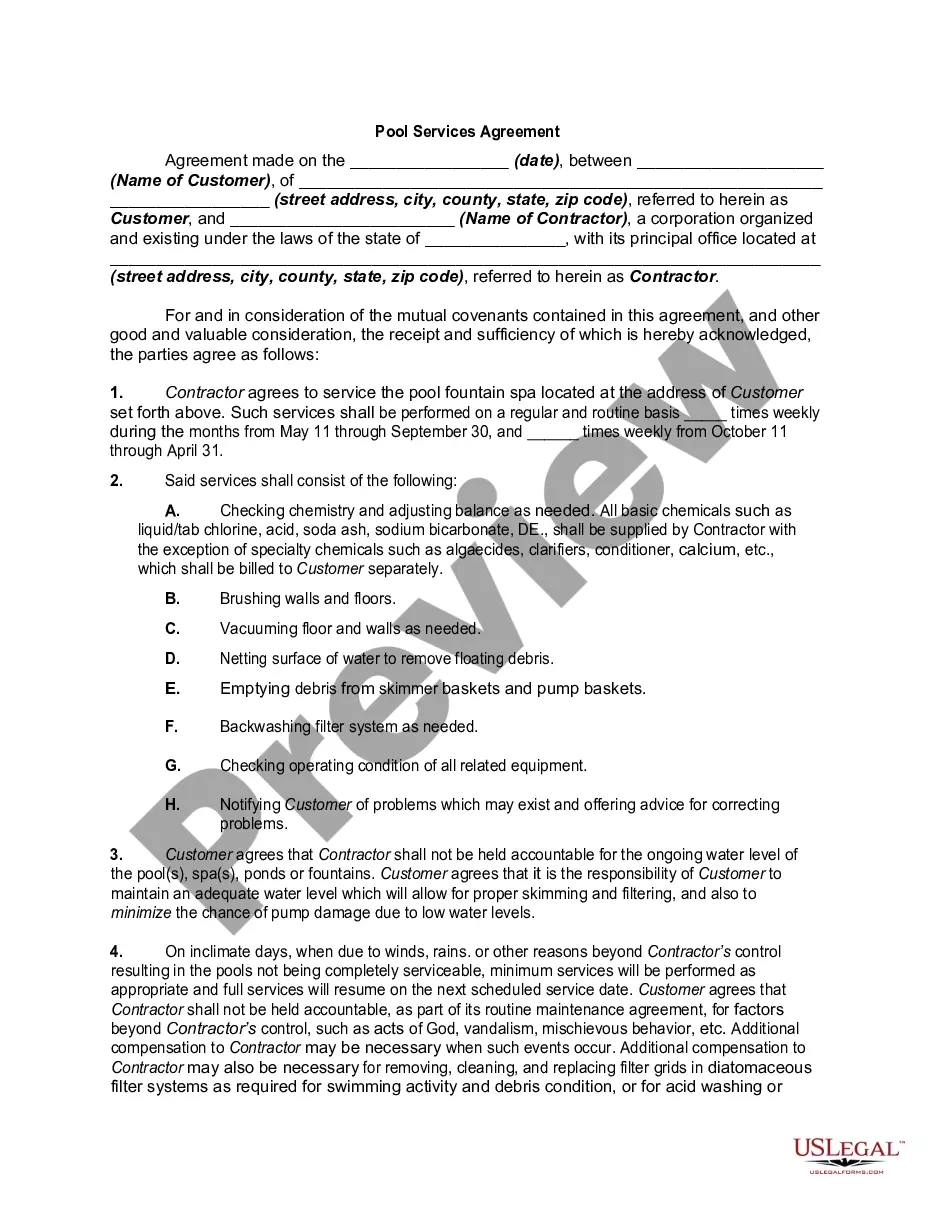
The Pool Services Agreement - Self-Employed is a legal document that outlines the terms between a customer and a contractor providing pool maintenance services. This contract specifies the services to be performed, the payment structure, and the responsibilities of both parties. Unlike other maintenance agreements, this form addresses specifics for self-employed contractors, ensuring clarity on services, payment schedules, and liability, making it essential for both contractors and customers involved in pool care.
Main sections of this form
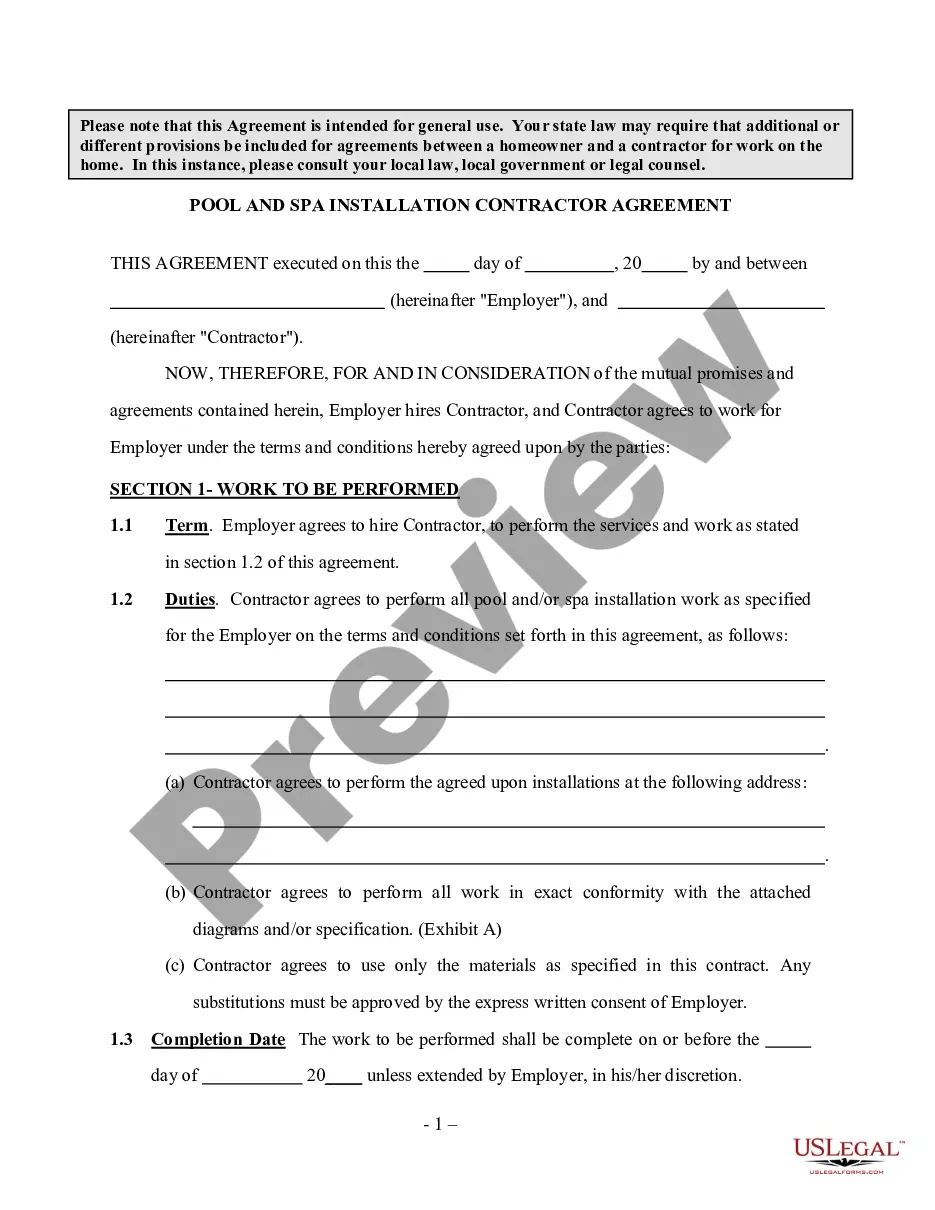
- Identification of the parties involved, including the customer and contractor.
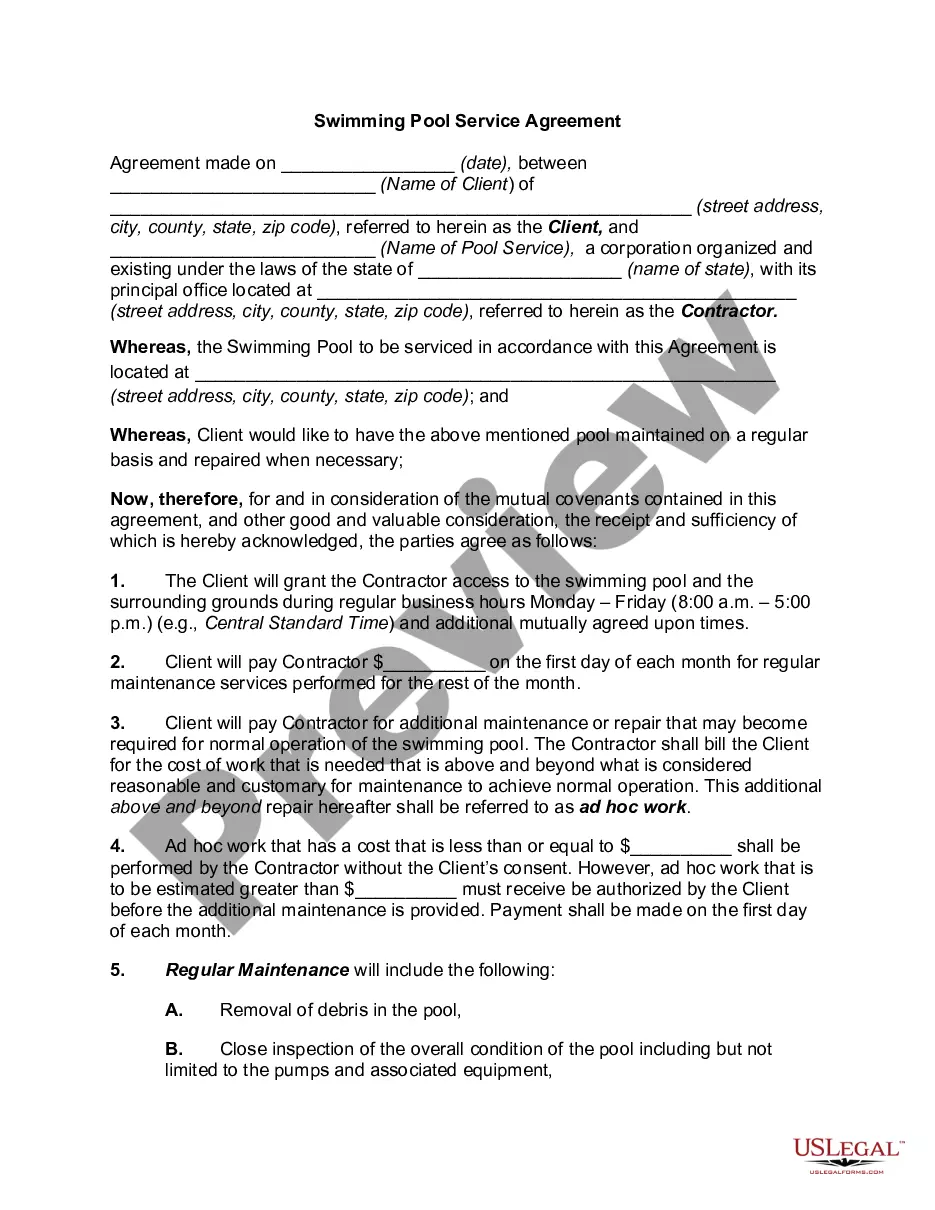
- Details of the services to be provided, such as pool cleaning, chemical balancing, and equipment checks.
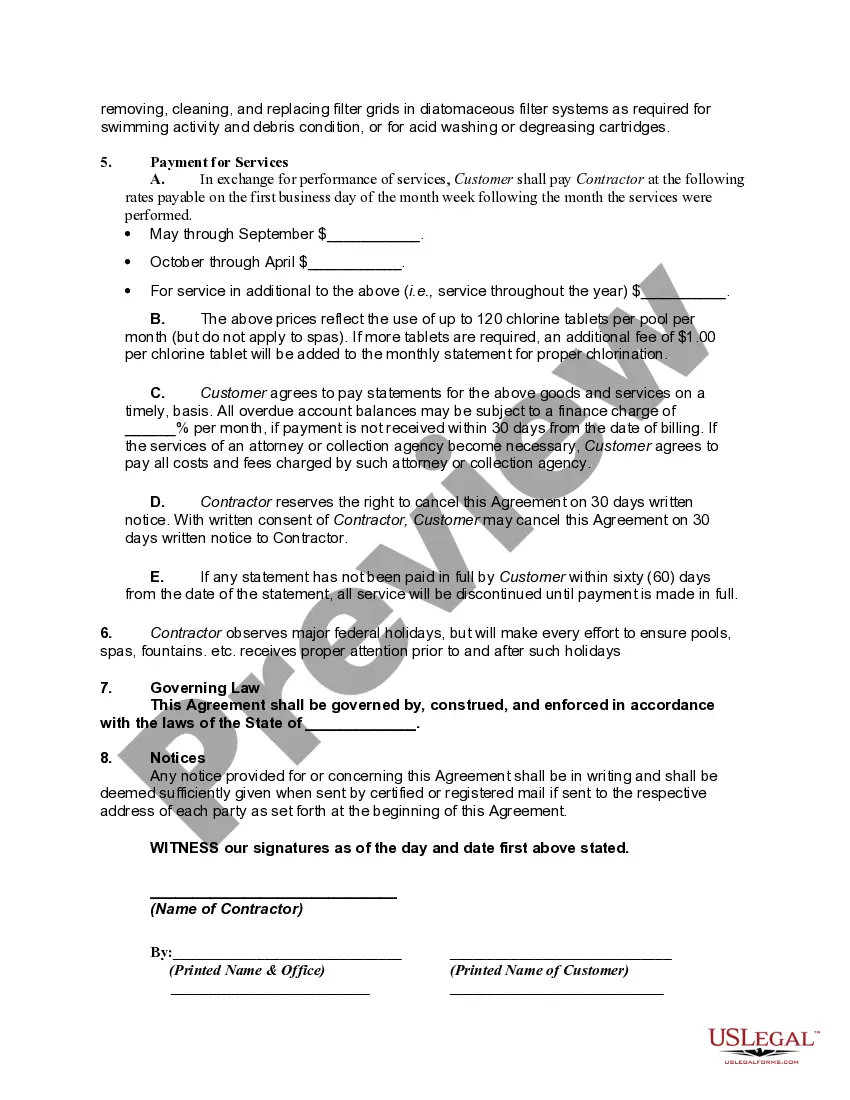
- Payment terms including monthly rates and fees for additional services or missed payments.
- Responsibilities regarding pool water levels and weather-related service adjustments.
- Governing law provision, clarifying which state laws apply.
- Cancellation terms and notice requirements for both parties.

When this form is needed
This form is useful when a self-employed contractor is hired to maintain a pool or spa. It is ideal for defining the scope of work, establishing payment terms, and protecting both parties against misunderstandings. Use this agreement when initiating a seasonal or year-round maintenance relationship to ensure clear expectations about services and payments.
Who needs this form
- Pool contractors who operate as self-employed individuals needing a contractual framework.
- Homeowners or property managers looking for reliable pool maintenance services.
- Individuals or businesses seeking to formalize the service agreement and protect their interests.
Steps to complete this form
- Identify all parties involved by entering the customer's name and address and the contractor's name and business address.
- Specify the date the agreement is made at the top of the document.
- Detail the frequency of services, indicating how many times per week services will be performed during different months.
- Enter the payment rates for services and any penalties for late payments, if applicable.
- Fill out any provisions regarding service limitations due to weather or other issues.
- Ensure both parties sign and print their names at the conclusion of the form.
Is notarization required?
This form usually doesn’t need to be notarized. However, local laws or specific transactions may require it. Our online notarization service, powered by Notarize, lets you complete it remotely through a secure video session, available 24/7.
Get your form ready online
Our built-in tools help you complete, sign, share, and store your documents in one place.
Make edits, fill in missing information, and update formatting in US Legal Forms—just like you would in MS Word.
Download a copy, print it, send it by email, or mail it via USPS—whatever works best for your next step.
Sign and collect signatures with our SignNow integration. Send to multiple recipients, set reminders, and more. Go Premium to unlock E-Sign.
If this form requires notarization, complete it online through a secure video call—no need to meet a notary in person or wait for an appointment.
We protect your documents and personal data by following strict security and privacy standards.

Make edits, fill in missing information, and update formatting in US Legal Forms—just like you would in MS Word.

Download a copy, print it, send it by email, or mail it via USPS—whatever works best for your next step.

Sign and collect signatures with our SignNow integration. Send to multiple recipients, set reminders, and more. Go Premium to unlock E-Sign.

If this form requires notarization, complete it online through a secure video call—no need to meet a notary in person or wait for an appointment.

We protect your documents and personal data by following strict security and privacy standards.
Typical mistakes to avoid
- Failing to specify the frequency of service, which could lead to misunderstandings.
- Not entering the correct payment details or forgetting to include potential additional charges.
- Ignoring local laws that may require specific terms or disclosures in the agreement.
- Not having both parties sign the document, which is essential for enforceability.
Why use this form online
- Convenience of downloading the template anytime, ensuring immediate access to necessary documentation.
- Editability, allowing users to customize the form according to their specific service arrangement.
- Reliability, since the form is drafted by licensed attorneys and complies with legal standards.
Looking for another form?


Form popularity
FAQ
A shareholders' agreement includes a date; often the number of shares issued; a capitalization table that outlines shareholders and their percentage ownership; any restrictions on transferring shares; pre-emptive rights for current shareholders to purchase shares to maintain ownership percentages (for example, in the
Pooling. Pooling is a resource management term that refers to the grouping together of resources for the purposes of maximizing advantage and/or minimizing risk to the users. The term is used in many disciplines.
The act of sharing or combining two or more things: the pooling of resources.
A shareholders' agreement is a legally binding contract among the shareholders that sets out their rights and obligations, maps out how the company should be managed, establishes share ownership and share transfer rules all in order to provide clear solutions to contentious scenarios that may arise in the future.
In resource management, pooling is the grouping together of resources (assets, equipment, personnel, effort, etc.) for the purposes of maximizing advantage or minimizing risk to the users. The term is used in finance, computing and equipment management.
To share something such as money, ideas, equipment etc with a group of people, especially so that they can work more effectively together.
(p016bl), 1. A collection of blood or other fluid in any region of the body; pool of blood results from dilation and retardation of the circulation in the capillaries and veins of the region. 2. A combination of resources.
Does everyone have to sign a shareholders' agreement? A shareholder cannot be compelled to sign a shareholders' agreement i.e. each shareholder should enter into it voluntarily.
Introduction. Step 1: Decide on the issues the agreement should cover. Step 2: Identify the interests of shareholders. Step 3: Identify shareholder value. Step 4: Identify who will make decisions - shareholders or directors. Step 5: Decide how voting power of shareholders should add up. Further information and documents.