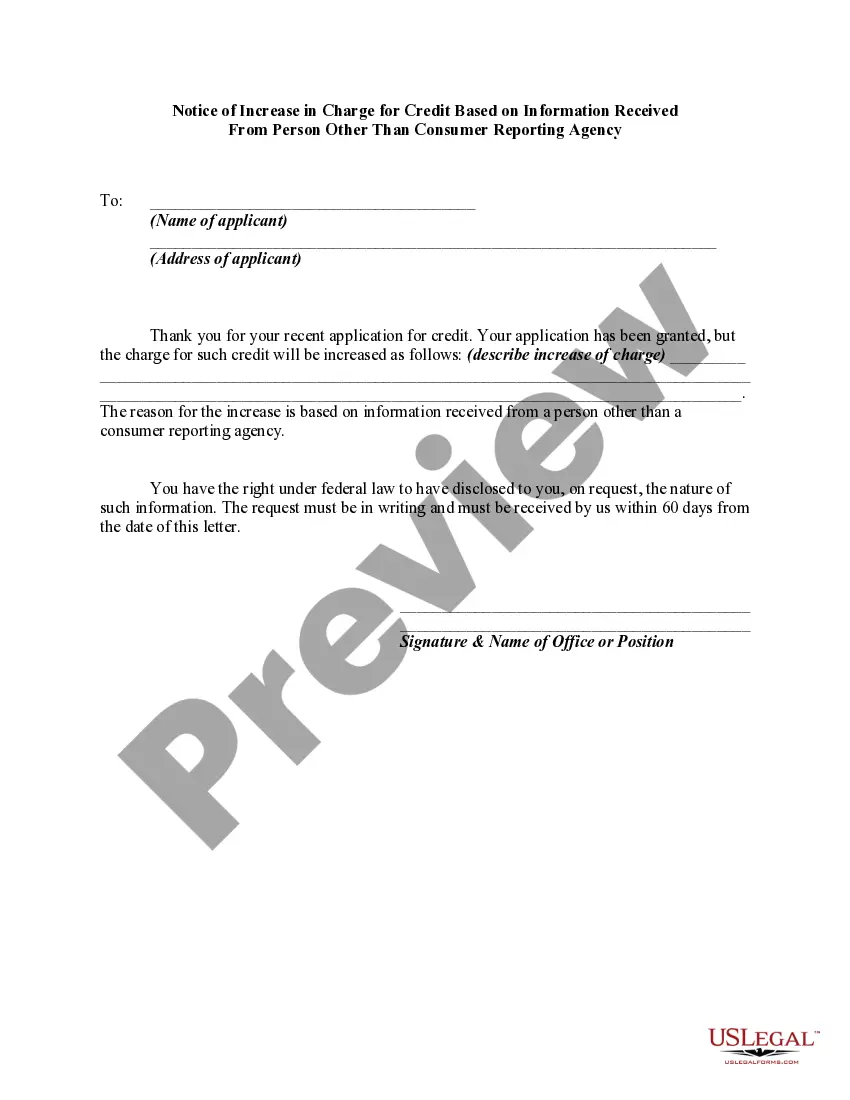
Notice of Increase in Charge for Credit Based on Information Received From Person Other Than Consumer Reporting Agency
About this form
The Notice of Increase in Charge for Credit Based on Information Received From Person Other Than Consumer Reporting Agency is a legal document required when a credit application is approved but the charge is increased due to information from a source other than a credit reporting agency. This form ensures that consumers are informed of their rights regarding the information that led to the charge increase, distinguishing it from other credit-related forms by emphasizing transparency in credit practices.
Key components of this form
- Name and address of the credit applicant.
- Thank you note for the credit application.
- Description of the increased charge and its reason.
- Disclosure of the consumerâs rights to request further information.
- Contact information for further inquiries or requests.
- Signature line for the issuerâs representative.
When to use this form
This form should be used when a consumer's application for credit is approved, but the terms of the credit are changed to include a higher charge based on information obtained from a source other than a consumer reporting agency. It is essential for maintaining compliance with federal regulations and for informing the consumer of their rights.
Who can use this document
- Lenders and financial institutions granting credit to consumers.
- Creditors requiring a formal process to communicate charge increases.
- Anyone involved in consumer credit management.
Steps to complete this form
- Enter the name and address of the credit applicant at the top of the form.
- Include a brief thank you note for their credit application.
- Describe the increase in charge and provide the reason for this change.
- Clearly state the consumer's right to request the nature of the information used in decision-making.
- Sign the form by including your name and title before sending it to the applicant.
Notarization requirements for this form
This form does not typically require notarization unless specified by local law. Users should check their jurisdiction's regulations to confirm.
Get your form ready online
Our built-in tools help you complete, sign, share, and store your documents in one place.
Make edits, fill in missing information, and update formatting in US Legal Forms—just like you would in MS Word.
Download a copy, print it, send it by email, or mail it via USPS—whatever works best for your next step.
Sign and collect signatures with our SignNow integration. Send to multiple recipients, set reminders, and more. Go Premium to unlock E-Sign.
If this form requires notarization, complete it online through a secure video call—no need to meet a notary in person or wait for an appointment.
We protect your documents and personal data by following strict security and privacy standards.

Make edits, fill in missing information, and update formatting in US Legal Forms—just like you would in MS Word.

Download a copy, print it, send it by email, or mail it via USPS—whatever works best for your next step.

Sign and collect signatures with our SignNow integration. Send to multiple recipients, set reminders, and more. Go Premium to unlock E-Sign.

If this form requires notarization, complete it online through a secure video call—no need to meet a notary in person or wait for an appointment.

We protect your documents and personal data by following strict security and privacy standards.
Common mistakes to avoid
- Failing to include all required applicant information.
- Not providing a clear explanation of the charge increase.
- Neglecting to inform the consumer about their rights.
- Sending the notice without a signature or proper authorization.
Why complete this form online
- Convenience of accessing and downloading the form from anywhere.
- Editable formats that allow for quick personalization.
- Reliability of using forms drafted by licensed attorneys.
- Instant updates to ensure compliance with legal changes.
Key takeaways
- The form notifies consumers of credit charge increases based on non-agency information.
- It is essential for creditors to comply with federal regulations protecting consumer rights.
- Properly completing this form is crucial to avoid legal pitfalls and ensure consumer awareness.
Looking for another form?
Form popularity
FAQ
In the credit score exception notices, creditors are required to disclose the distribution of credit scores among consumers who are scored under the same scoring model that is used to generate the consumer's credit score using the same scale as that of the credit score provided to the consumer.
Notice to Home Loan Applicant In short, this is a disclosures that includes things like the credit score of the applicant, the range of possible scores, key factors that adversely affected the credit score, the date of the score, and the name of the person or entity that provided the score.
The right to know what's in your credit file.The right to request a credit score (more on this in a minute)The right to an adverse action notice if a creditor denies you financing because of something on your credit file.The right to seek damages for violations.The Fair Credit Reporting Act Credit.com\nwww.credit.com > Credit Law Articles
An adverse action notice is to inform you that you have been denied credit, employment, insurance, or other benefits based on information in a credit report. The notice should indicate which credit reporting agency was used, and how to contact them.
A creditor must disclose a consumer's credit score and information relating to a credit score on a risk-based pricing notice when the score of the consumer to whom the creditor extends credit or whose extension of credit is under review is used in setting the material terms of credit.
The CSD discloses the credit score, the lender used in connection with the consumers' loan application and home loan, and the key factors affecting the credit score.It contains contact information for each credit reporting agency used, including the agency name, telephone number and website.
The statement that a dispute meets the requirements of the FCRA means both that the consumer filed a formal dispute, and that the CRA has issued a formal Notice of Results of Reinvestigation finding the asserted inaccuracy has been verified as accurate.
The FCRA limits the amount of time that adverse or negative information can be included in a consumer's credit report. Generally, a CRA is prohibited from reporting adverse information that is more than seven years old, or in the case of bankruptcies, more than ten years old.