General Consent Form for Drug Testing
What this document covers
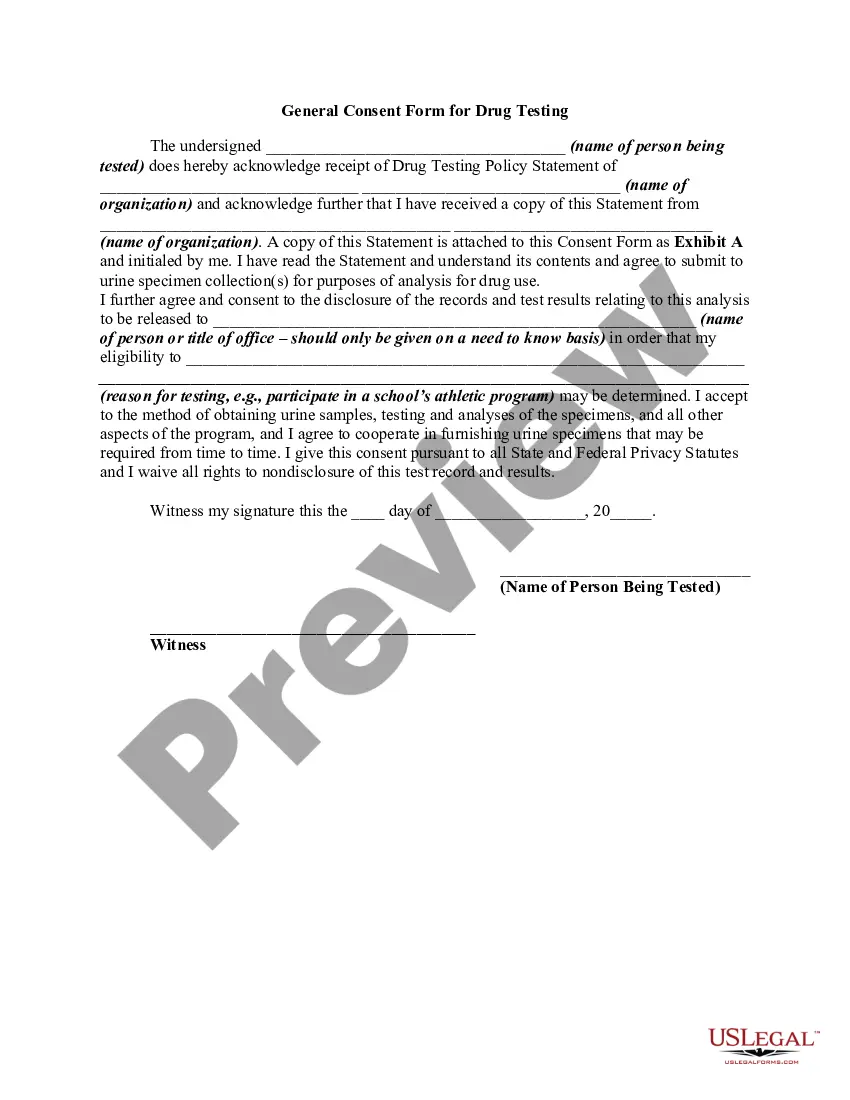
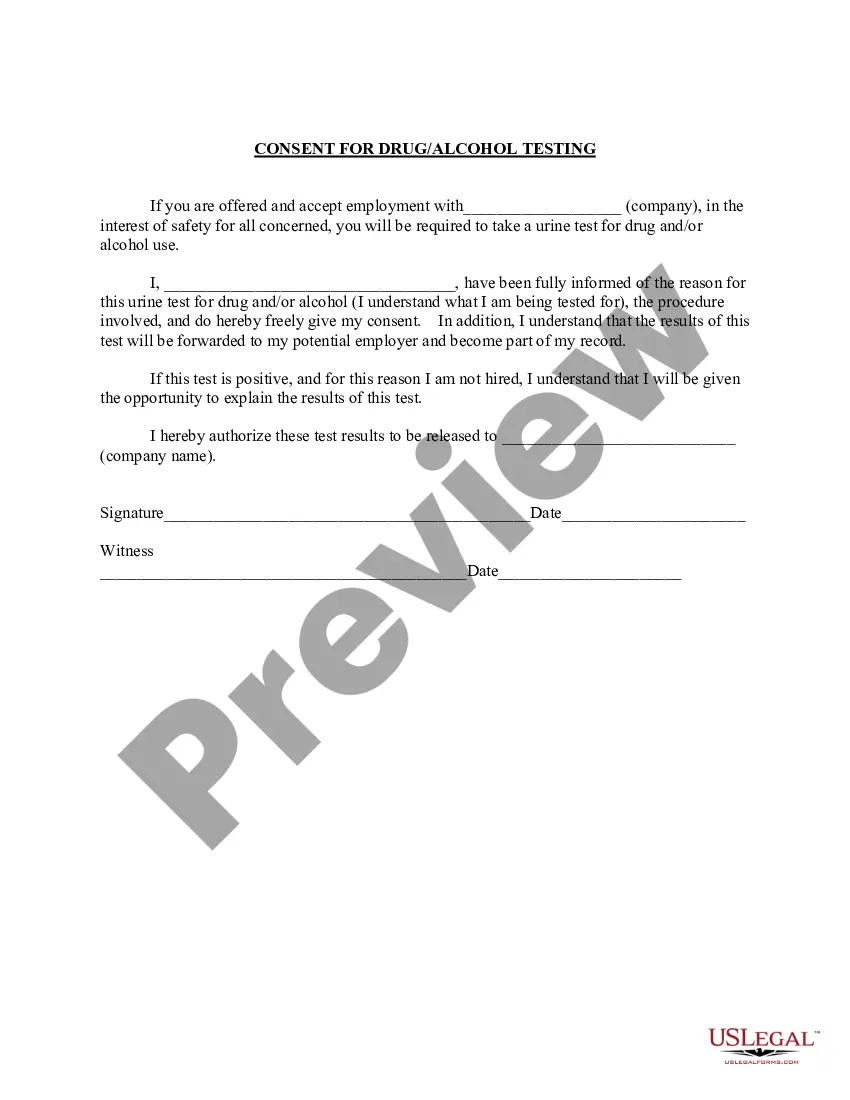
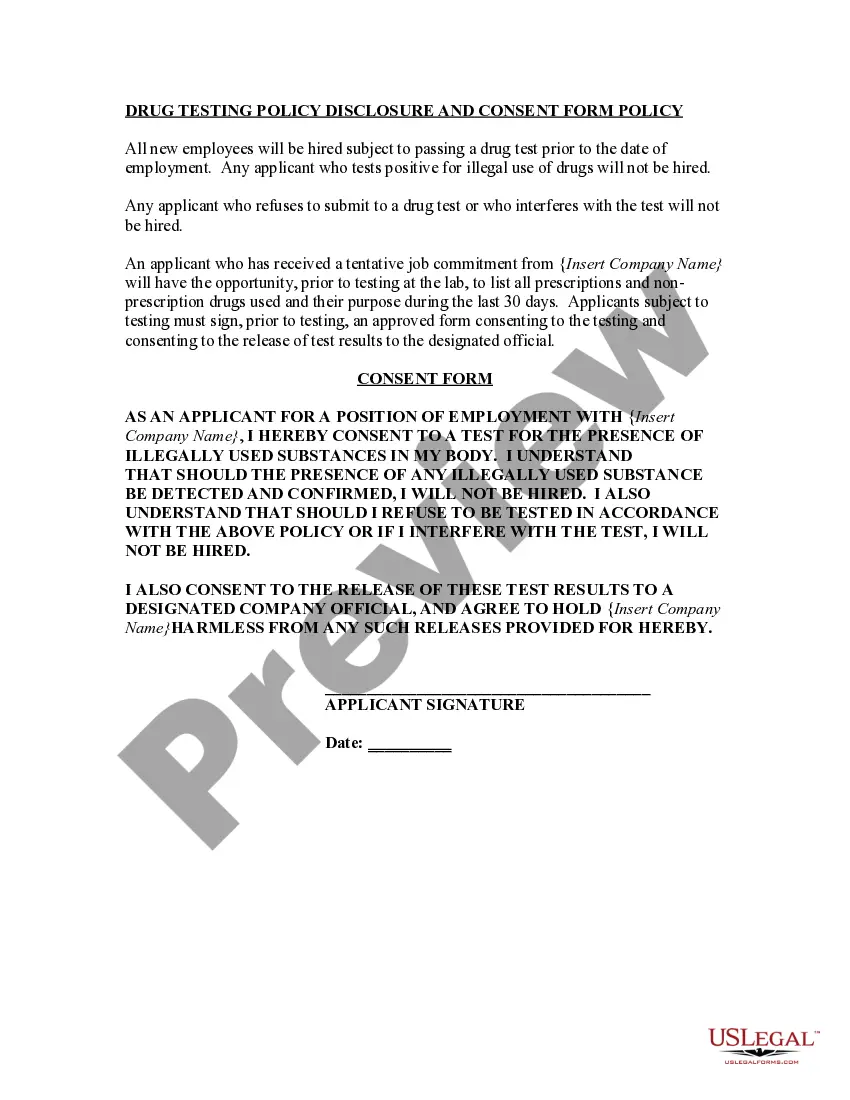
The General Consent Form for Drug Testing is a legal document that grants permission for an organization to conduct drug testing on an individual. This form ensures that the person being tested understands the drug testing policy and consents to provide urine samples for analysis. Unlike other consent forms, this document specifically addresses drug testing procedures, privacy rights, and the disclosure of test results to designated parties.
Main sections of this form
- Name of the individual being tested.
- Details of the organization administering the drug test.
- Acknowledgment of receipt of the Drug Testing Policy Statement.
- Agreement to submit to urine specimen collection for drug testing.
- Consent for disclosure of test results to specified persons or offices.
- Signature of the person being tested and a witness.
Situations where this form applies
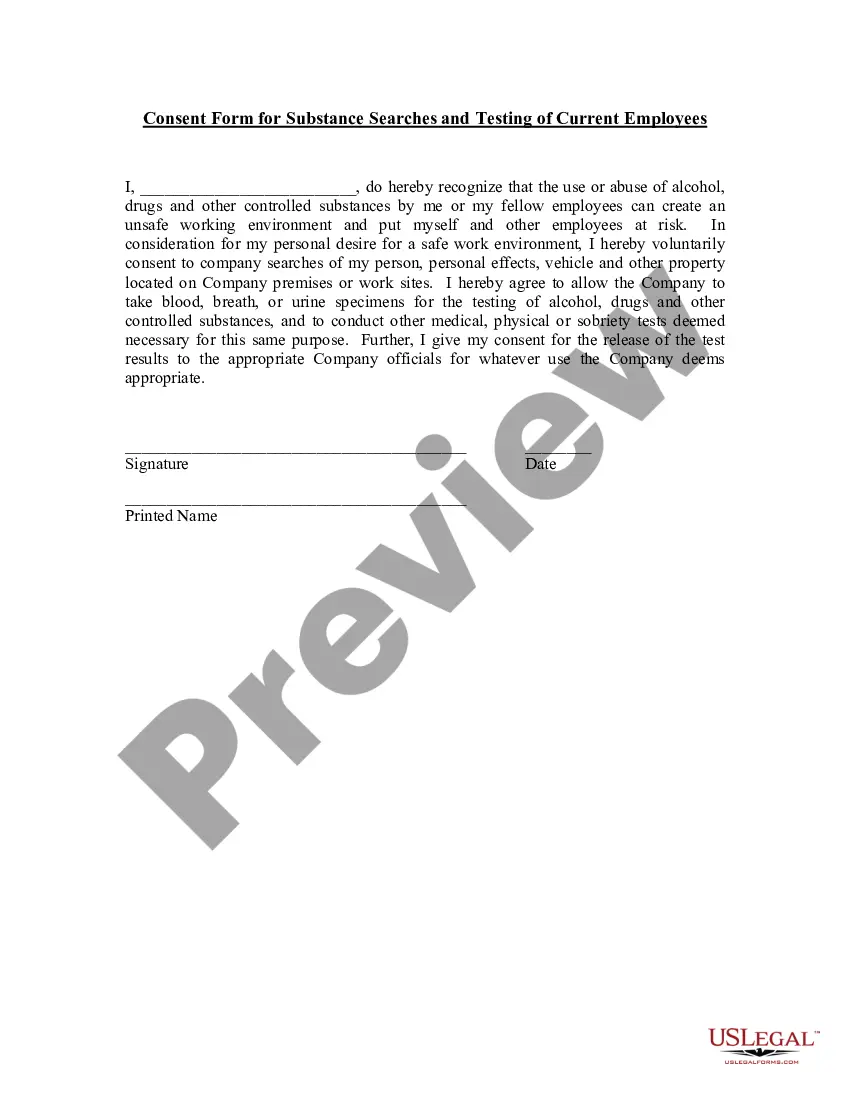
This form should be used when an organization requires individuals, such as employees or students, to undergo drug testing as part of their policies. It is essential when determining eligibility for certain programs, like participation in sports, employment opportunities, or maintaining safety regulations in the workplace. Having this form ensures that all parties are informed and legally protected during the testing process.
Who this form is for
This form is intended for use by:
- Organizations implementing drug testing policies for employees or students.
- Individuals required to consent to drug testing for employment or program participation.
- Legal representatives handling cases related to drug testing procedures.
Instructions for completing this form
- Identify and enter the name of the person being tested.
- Provide the name of the organization conducting the drug testing.
- Acknowledge receipt of the Drug Testing Policy Statement by signing where indicated.
- Designate who is authorized to receive the test results.
- Sign and date the form, and have a witness sign as well.
Notarization requirements for this form
This form does not typically require notarization unless specified by local law. However, it is advisable to check state requirements for additional verification processes.
Get your form ready online
Our built-in tools help you complete, sign, share, and store your documents in one place.
Make edits, fill in missing information, and update formatting in US Legal Forms—just like you would in MS Word.
Download a copy, print it, send it by email, or mail it via USPS—whatever works best for your next step.
Sign and collect signatures with our SignNow integration. Send to multiple recipients, set reminders, and more. Go Premium to unlock E-Sign.
If this form requires notarization, complete it online through a secure video call—no need to meet a notary in person or wait for an appointment.
We protect your documents and personal data by following strict security and privacy standards.

Make edits, fill in missing information, and update formatting in US Legal Forms—just like you would in MS Word.

Download a copy, print it, send it by email, or mail it via USPS—whatever works best for your next step.

Sign and collect signatures with our SignNow integration. Send to multiple recipients, set reminders, and more. Go Premium to unlock E-Sign.

If this form requires notarization, complete it online through a secure video call—no need to meet a notary in person or wait for an appointment.

We protect your documents and personal data by following strict security and privacy standards.
Common mistakes to avoid
- Failing to read the Drug Testing Policy Statement before signing the consent form.
- Not providing accurate information regarding the organization or testing reason.
- Overlooking the need for a witness signature.
Advantages of online completion
- Convenience of accessing and completing the form from anywhere.
- Editable templates allow for easy customization to meet specific needs.
- Reliable access to attorney-drafted legal forms ensures accuracy.
Legal use & context
- Helps establish clear consent regarding drug testing, protecting both parties.
- Ensures compliance with state and federal privacy laws related to drug testing.
- Offers a legal framework that can limit disputes over test results sharing.
Key takeaways
- The General Consent Form for Drug Testing protects both the individual and the organization.
- It is necessary for establishing a clear understanding of drug testing policies.
- Ensure that all sections of the form are accurately completed to prevent issues later.
Looking for another form?

Form popularity
FAQ
The drug and alcohol testing consent form is used by employers to screen applicants and employees for drug and/or alcohol use.Within the form, the employee gives the employer permission to test their urine, hair, blood, or any other physical sample for indicators of substance abuse.
Taking aspirin before the drug test is a common method of falsifying results. The chemical compounds of aspirin are known to have properties that can mask drugs within the urine, making this a popular method.
Invalid result: Refers to the result reported by a laboratory for a urine specimen that contains an unidentified adulterant, contains an unidentified interfering substance, has an abnormal physical characteristic, or has an endogenous substance at an abnormal concentration that prevents the laboratory from completing
If you fail or refuse a pre-employment DOT drug test, it will hinder your ability to get a safety-sensitive job. You will have to complete a Return-to-Duty program by a DOT-qualified Substance Abuse Professional (SAP) before applying for work.
The best way to contest false-positive results is to reach out to your pharmacist and ask if prescription drugs and OTC medications you take on a regular basis can cause a positive drug test result. Ask if the pharmacist can provide written documentation to this effect and bring a copy to the test site.
Even if drug testing is allowed, applicant privacy may be violated in the way the test is conducted. For example, requiring an applicant to take a urine test or disrobe in someone else's presence may well be a violation of privacy.
No matter what kind of job you have, the employer can make you take a drug or alcohol test, without prior notice, if: They have reason to think that you are under the influence of drugs or alcohol at work.
HIPAA stipulates that covered entities must provide HIPAA-compliant authorization before releasing drug and alcohol test results. Collection facilities or labs employed for the drug test will typically have an authorization form.
According to the Equal Employment Opportunity Commission (EEOC), "if the results of a drug test reveal the presence of a lawfully prescribed drug or other medical information, such information must be treated as a confidential medical record." As a best practice, all drug test results should be filed in a confidential