Growth Assumptions
What is this form?
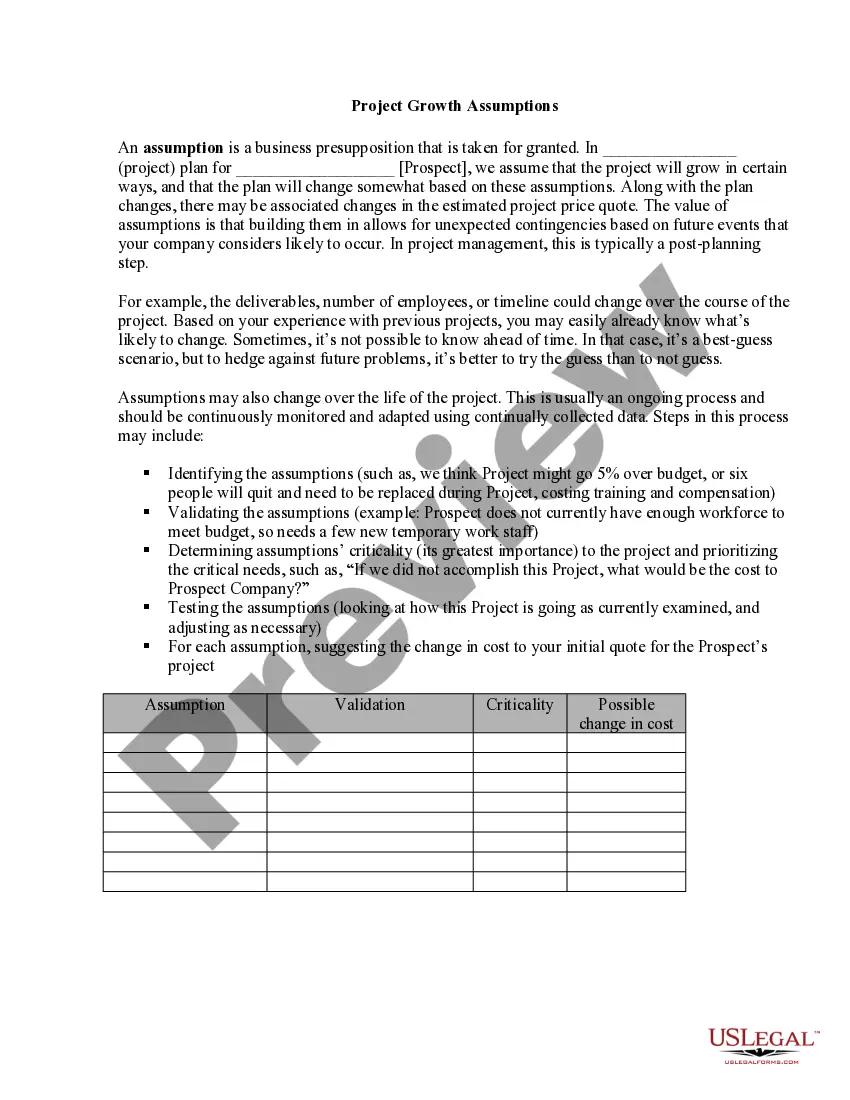
The Growth Assumptions form is a crucial tool for project managers and business planners. It outlines the key assumptions and projections regarding the growth of a project. By detailing how these assumptions may impact the project's plan and budget, it allows stakeholders to prepare for potential changes. This form is different from other project management forms as it specifically focuses on the variables that affect growth and forecasting, providing a structured approach to managing expectations and budgets.
Key parts of this document
- Project name and details
- Assumptions about growth and their implications
- Estimation of budget changes based on growth assumptions
- Validation of assumptions with supporting data
- Assessment of the criticality of each assumption
- Recommendations for adjustments to project quotes

When this form is needed
This form is essential when planning a new project or when there are significant developments in an ongoing project. Use it to outline anticipated changes in project scope, budget, or timelines. It is particularly useful when adjusting to unforeseen circumstances, such as changes in workforce availability or unexpected costs. By using the Growth Assumptions form, you can proactively address potential issues, ensuring better project management and stakeholder communication.
Intended users of this form
- Project managers overseeing development initiatives
- Business analysts involved in project planning
- Financial planners and budget analysts
- Stakeholders wanting to understand project forecast adjustments
- Consultants and advisors in management roles
Instructions for completing this form
- Enter the project's name and key details.
- List potential growth assumptions based on past project experiences.
- Validate each assumption with relevant data or projections.
- Assess the criticality of each assumption in relation to the project.
- Propose adjustments to the original project quote based on assumptions.
- Review and update the document periodically as project conditions change.
Notarization guidance
Notarization is not commonly needed for this form. However, certain documents or local rules may make it necessary. Our notarization service, powered by Notarize, allows you to finalize it securely online anytime, day or night.
Get your form ready online
Our built-in tools help you complete, sign, share, and store your documents in one place.
Make edits, fill in missing information, and update formatting in US Legal Forms—just like you would in MS Word.
Download a copy, print it, send it by email, or mail it via USPS—whatever works best for your next step.
Sign and collect signatures with our SignNow integration. Send to multiple recipients, set reminders, and more. Go Premium to unlock E-Sign.
If this form requires notarization, complete it online through a secure video call—no need to meet a notary in person or wait for an appointment.
We protect your documents and personal data by following strict security and privacy standards.

Make edits, fill in missing information, and update formatting in US Legal Forms—just like you would in MS Word.

Download a copy, print it, send it by email, or mail it via USPS—whatever works best for your next step.

Sign and collect signatures with our SignNow integration. Send to multiple recipients, set reminders, and more. Go Premium to unlock E-Sign.

If this form requires notarization, complete it online through a secure video call—no need to meet a notary in person or wait for an appointment.

We protect your documents and personal data by following strict security and privacy standards.
Typical mistakes to avoid
- Neglecting to validate assumptions with sufficient data.
- Overestimating growth without considering potential setbacks.
- Failing to update the form as project circumstances evolve.
- Underestimating the impact of resource changes on project budgets.
Benefits of completing this form online
- Convenient access to downloadable templates that are easy to fill out.
- Editability allows for ongoing adjustments as project assumptions change.
- Structured format ensures all critical aspects of project growth are captured.
- Reliability in legal language drafted by licensed attorneys.
Quick recap
- The Growth Assumptions form is vital for effective project management.
- Proactive identification and validation of assumptions can mitigate risks.
- Regular updates to the form are crucial as project dynamics change.
- This tool aids in communicating expectations to all stakeholders involved.
Looking for another form?




Form popularity
FAQ
Be able to explain how you make that assumption: Be quite critical of the assumptions you include in your forecast.Record every assumption which you use in your financials so you can easily refer back to them. Explain your premises thoroughly to others and yourself.Keep research work and reference data with you.
Your sales assumptions Every year is different so you need to list any changing circumstances that could significantly affect your sales. These factors - known as the sales forecast assumptions - form the basis of your forecast.
Here are some typical examples of assumptions: The market: The market you sell into will grow by 2%. Your market share will shrink by 2%, due to the success of a competitor.
If we see the historical sales going up by 5% in every historical period, we may assume that the future sales in the forecast period will also go up by 5%. If last year's sales were 100, forward sales would be 105. Our forecast assumption would be 5%.
Sales forecasting is the use of current information and conditions to estimate future sales.
Model Assumptions denotes the large collection of explicitly stated (or implicit premised), conventions, choices and other specifications on which any Risk Model is based. The suitability of those assumptions is a major factor behind the Model Risk associated with a given model.
Financial Projections ? Estimates of future financial results that are calculated from the assumptions factored into the financial model. The assumptions are your best guesses of what the future holds; the financial projections are numerical versions of those assumptions.