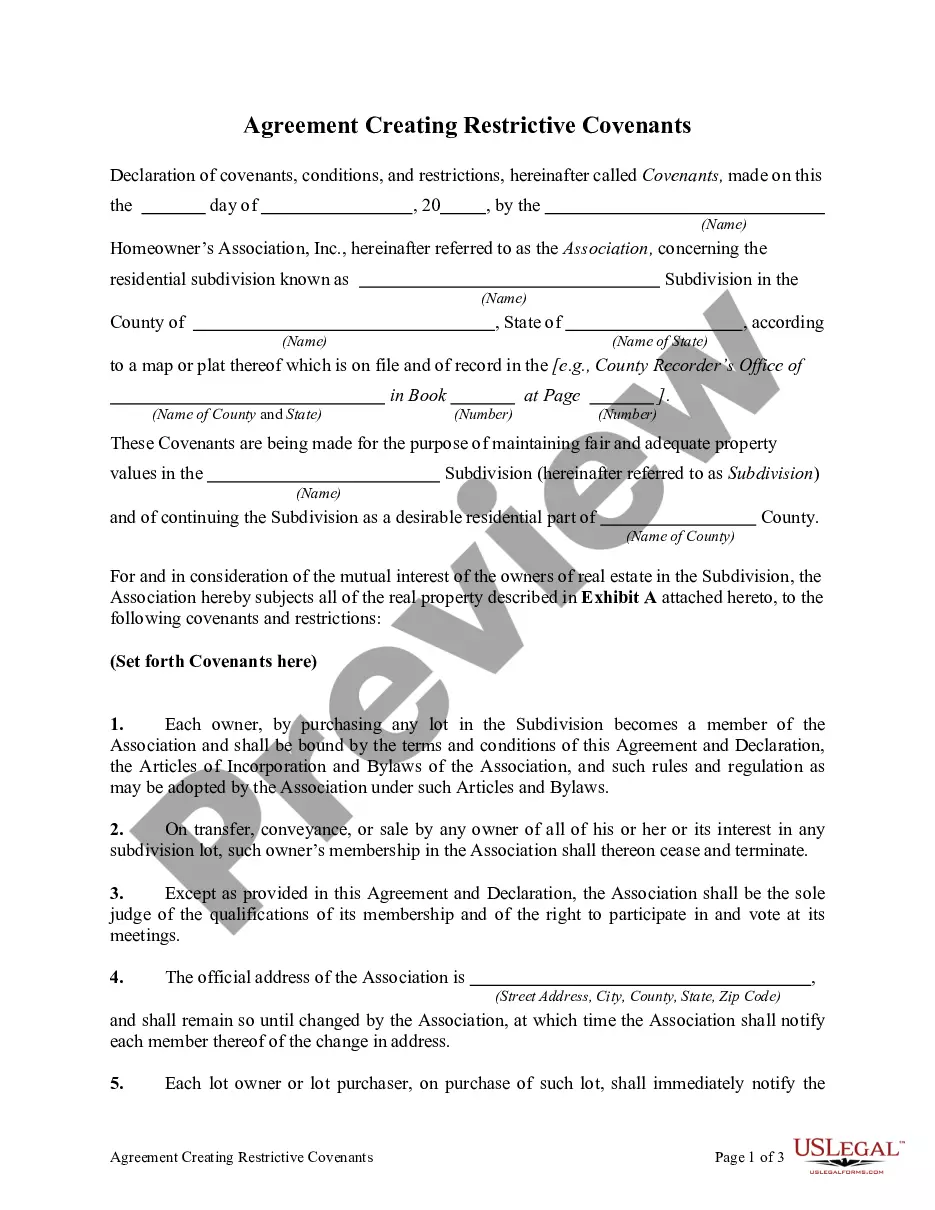
Agreement Creating Restrictive Covenants
What this document covers
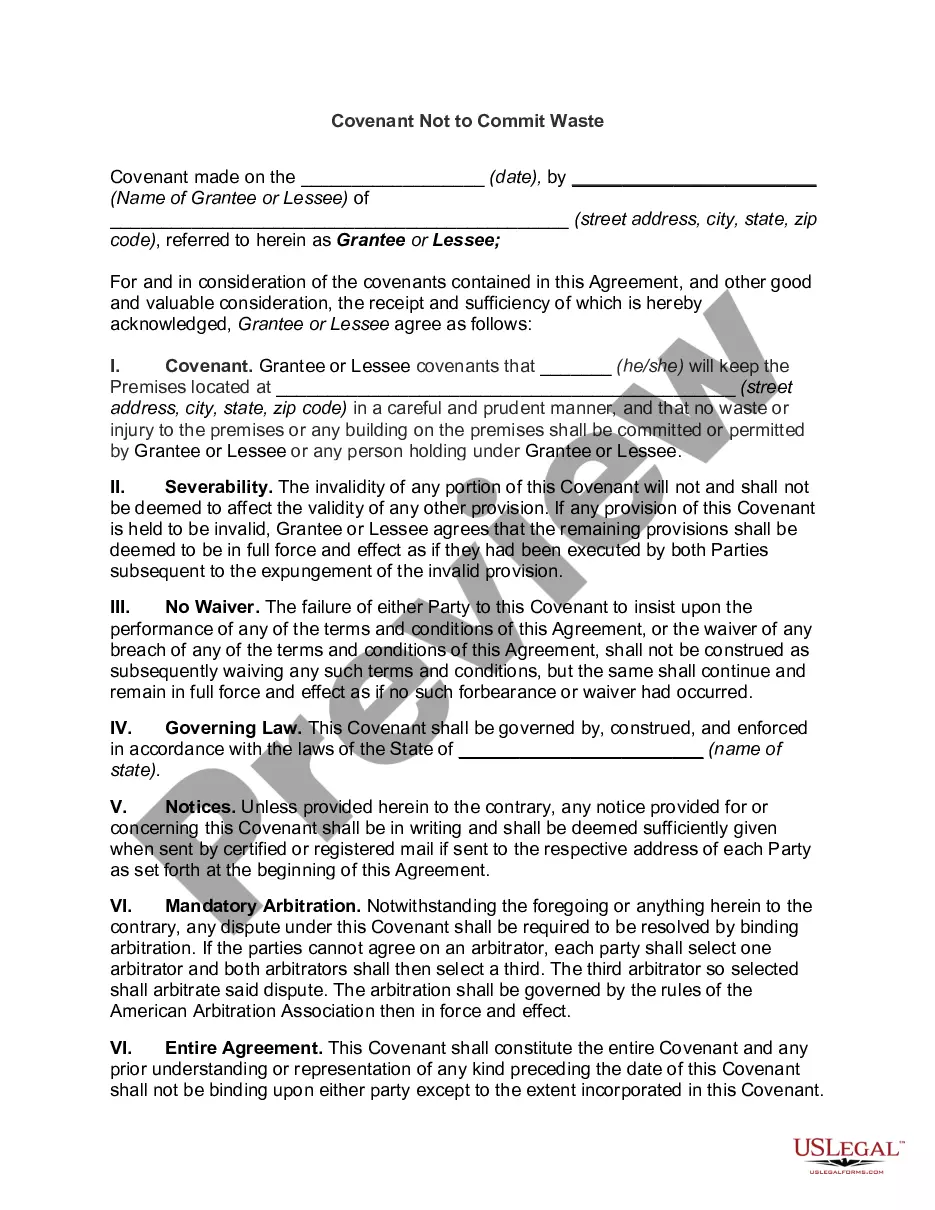
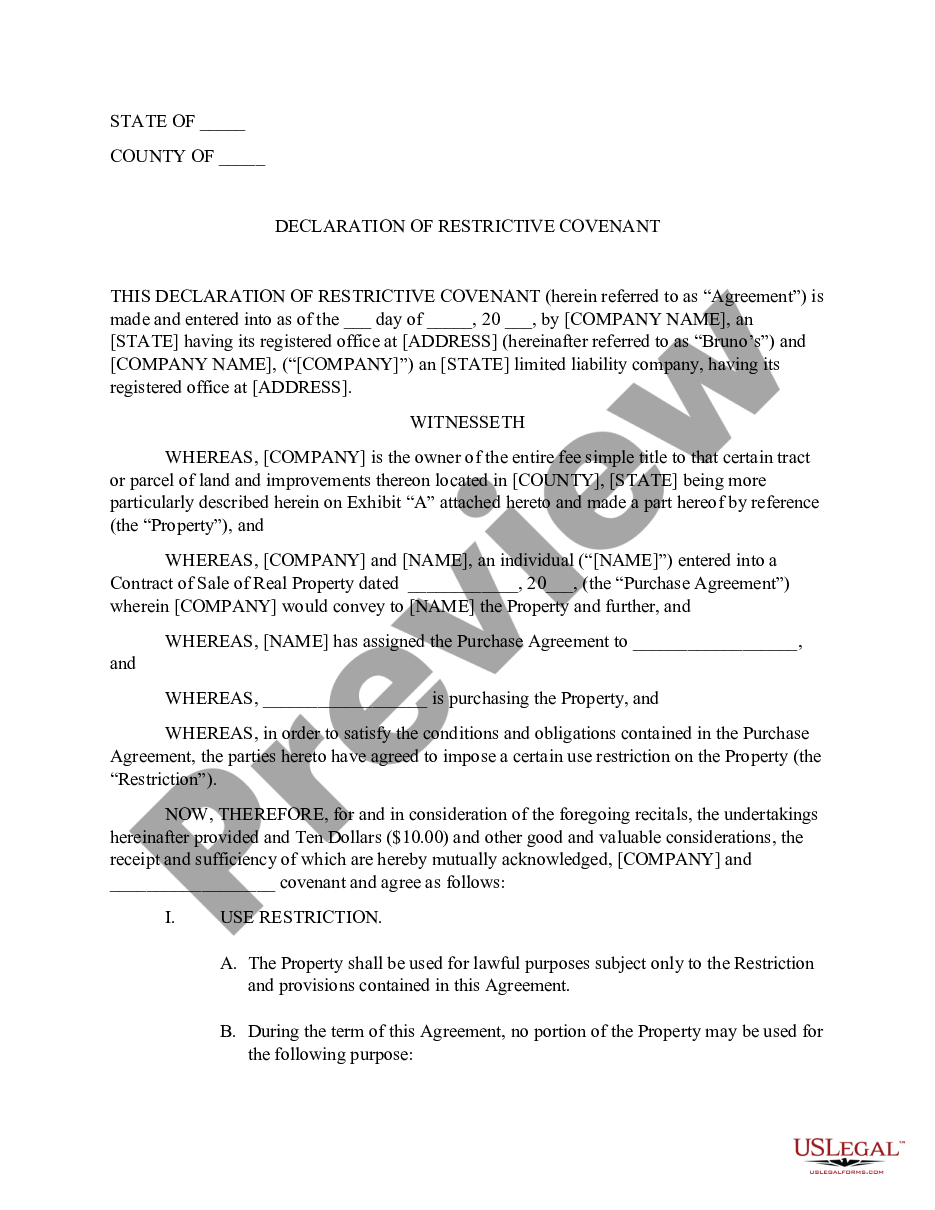
The Agreement Creating Restrictive Covenants is a legal document that establishes specific limitations on the use of real property. It may require property owners to comply with certain conditions, such as maintaining the property or restricting it to residential use. Unlike general property agreements, this form is binding not only between the original parties but also extends to future owners of the property, thereby running with the land. Itâs essential for ensuring that all property owners within a subdivision adhere to uniform standards and restrictions, thereby maintaining property values and neighborhood quality.
Form components explained
- Declaration of covenants and restrictions regarding property use.
- Identification of the Homeowners Association overseeing the subdivision.
- Details about the residential subdivision and its governing laws.
- Mutual interests and obligations of the property owners within the subdivision.
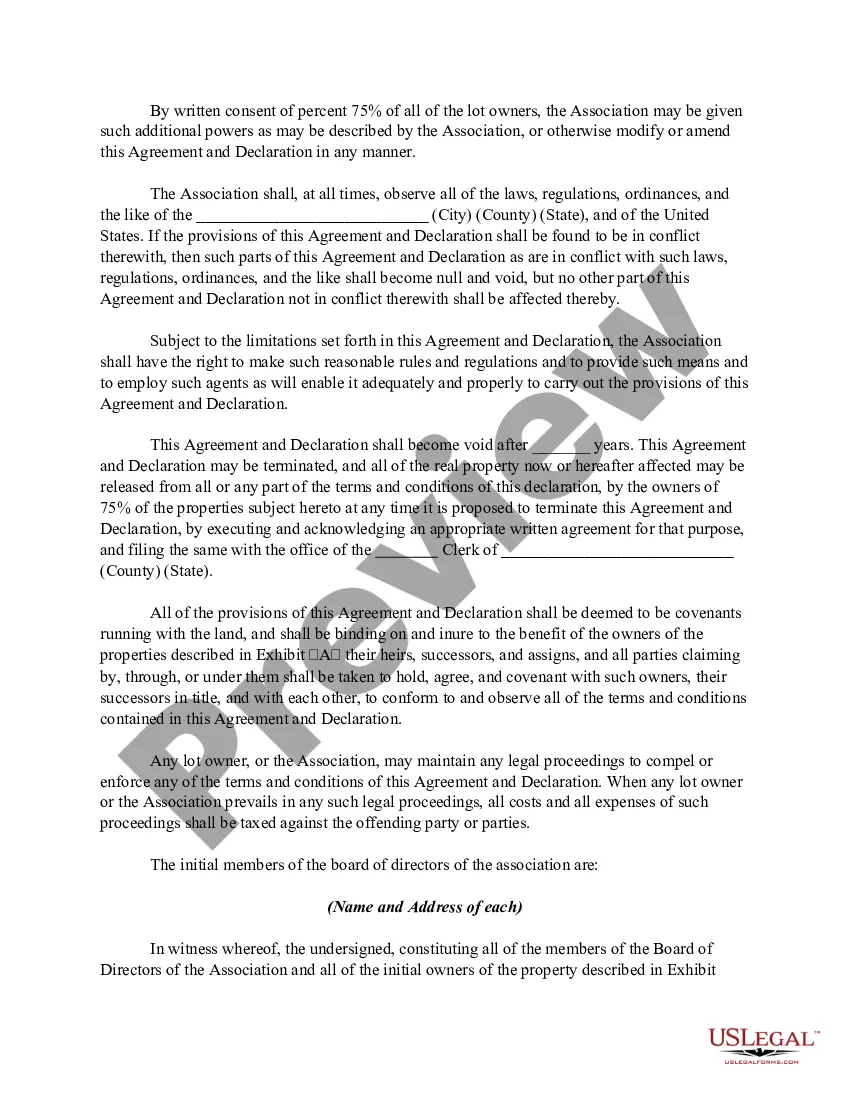
- Procedures for amending the agreement and the process for termination.

Situations where this form applies
This form should be used when developing a residential subdivision where common standards and restrictions are necessary. It is applicable when property developers want to ensure consistency in property use and maintenance, like prohibiting certain structures or uses of land, to maintain the community's appeal and property values. Use this agreement if you want to enforce rules among homeowners, such as limiting building sizes or types of allowable businesses.
Intended users of this form
- Property developers creating new residential subdivisions.
- Homeowners Associations seeking to implement or enforce property use restrictions.
- Current property owners within a subdivision wanting to establish or clarify use covenants.
- Real estate attorneys assisting clients with property management and subdivision development.
Instructions for completing this form
- Identify the parties involved, including the Homeowners Association and property owners.
- Describe the residential subdivision and include any relevant mapping references.
- Outline the specific covenants and restrictions that will apply to the property.
- Enter the effective date and duration of the agreement, noting any termination conditions.
- Ensure all members of the board of directors and property owners sign the document.
Does this document require notarization?
This form does not typically require notarization unless specified by local law. However, itâs advisable to check state-specific requirements to ensure compliance with any legal standards.
Get your form ready online
Our built-in tools help you complete, sign, share, and store your documents in one place.
Make edits, fill in missing information, and update formatting in US Legal Forms—just like you would in MS Word.
Download a copy, print it, send it by email, or mail it via USPS—whatever works best for your next step.
Sign and collect signatures with our SignNow integration. Send to multiple recipients, set reminders, and more. Go Premium to unlock E-Sign.
If this form requires notarization, complete it online through a secure video call—no need to meet a notary in person or wait for an appointment.
We protect your documents and personal data by following strict security and privacy standards.
Make edits, fill in missing information, and update formatting in US Legal Forms—just like you would in MS Word.
Download a copy, print it, send it by email, or mail it via USPS—whatever works best for your next step.
Sign and collect signatures with our SignNow integration. Send to multiple recipients, set reminders, and more. Go Premium to unlock E-Sign.

If this form requires notarization, complete it online through a secure video call—no need to meet a notary in person or wait for an appointment.
We protect your documents and personal data by following strict security and privacy standards.
Avoid these common issues
- Failing to properly identify all parties involved can lead to issues in enforcement.
- Not including detailed covenants can result in confusion about property use restrictions.
- Neglecting to follow local recording requirements may affect the validity of the agreement.
- Overlooking the need for all signatures, including from board members and property owners.
Benefits of using this form online
- Convenient access to ready-made templates drafted by licensed attorneys.
- Edit and customize the form to fit specific needs without legal jargon.
- Reliable and secure download options for immediate use.
- Time-saving compared to creating legal forms from scratch.
Looking for another form?




Form popularity
FAQ
If a neighbour threatens to breach a restrictive covenant binding on them you will probably want to obtain an injunction to prevent breach rather than simply claim monetary compensation.Generally only the owner of land which was, or was part of, the land intended to be benefited by the covenant, can enforce it.
In other words, you may be able to remove your restrictive covenant- but there are no guarantees.If you can agree to have the covenant removed, a 'Deed of Release of Restrictive Covenant' should be drawn up and signed by the dominant and servient owners.
Limitations On Home Color. Rent And Lease Restrictions. Restrictions On Business Usage. Limitations On Permissible Pets. Requirements For Exterior Maintenance. Restrictions On Exterior Constructions.
What Is A Restrictive Covenant? A restrictive covenant is a document registered at the Alberta Land Titles Office. Essentially, the document includes an agreement between the owners of two or more properties. In some instances, the same person or company owns all the pieces of land to which the restriction is applied.
Express release: It may be possible to negotiate the release or variation of a restrictive covenant. Indemnity insurance: It is possible to obtain indemnity insurance to protect against the risk of a person with the benefit of a restrictive covenant seeking to enforce it.
A restrictive covenant is an agreement that restricts a company or other party to a contract from engaging in certain actions. For example, a restrictive covenant entered into with a public company might limit the amount of dividends the firm can pay its shareholders.
A restrictive covenant creates a deed restricted community. It is an agreement that states what a homeowner can or cannot do with their house or land. They are binding legal obligations which sellers write into the deed or contract of the property, and they can have penalties against buyers who fail to follow them.
Certain restrictive covenants will be enforceable, if you are able to prove that they are: reasonable. necessary to protect legitimate business interests; and. of a duration no longer than is necessary to protect those interests.
A restrictive covenant is a clause in an employment contract or services agreement that works to prohibit an individual from (among other things) competing with his or her ex-employer for a certain period after he or she has left the business.
If the value or use of certain land is negatively impacted by a restrictive covenant, there are options to have the covenant removed by legal process, which include: Obtaining a written release or modification of the covenant from the party or parties who are entitled to enforce it.