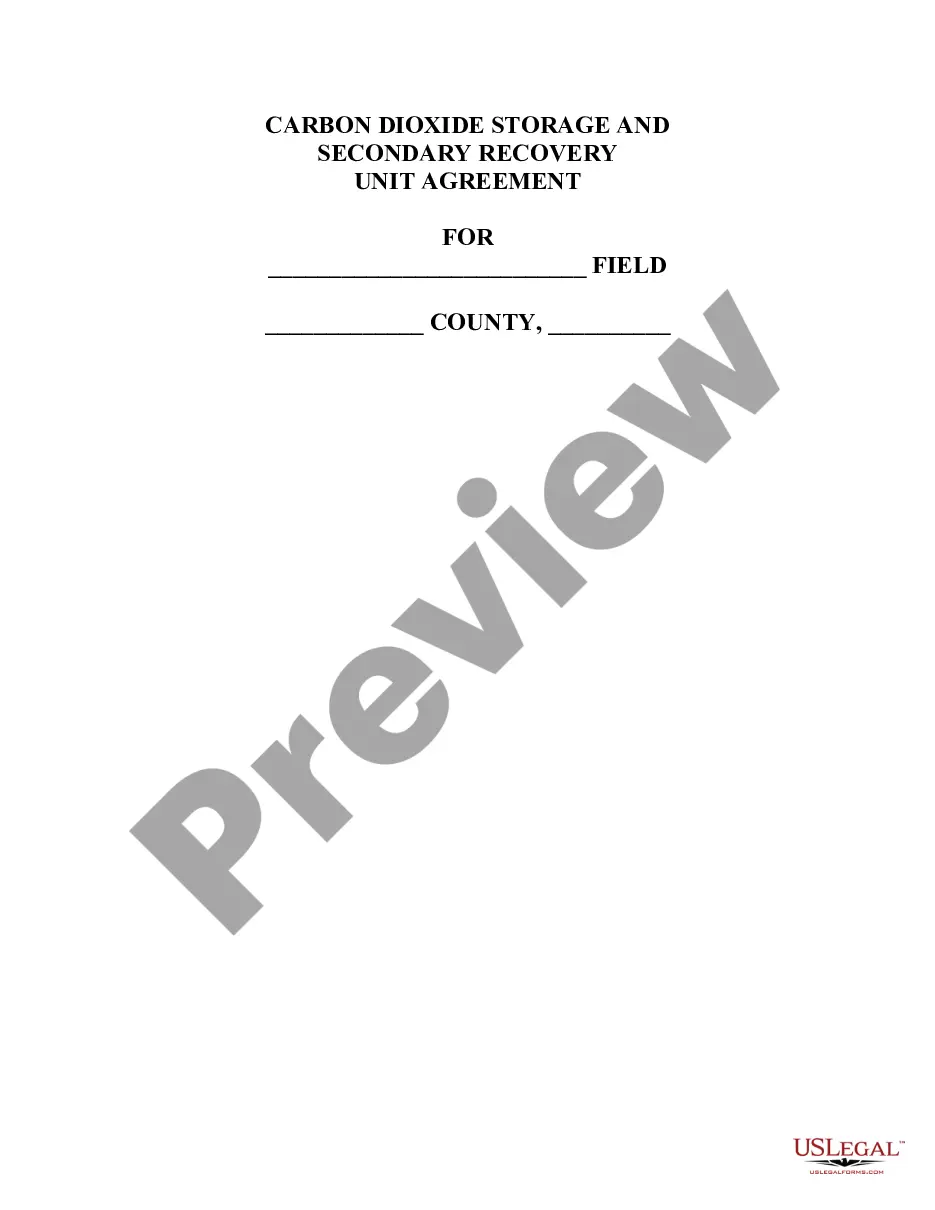
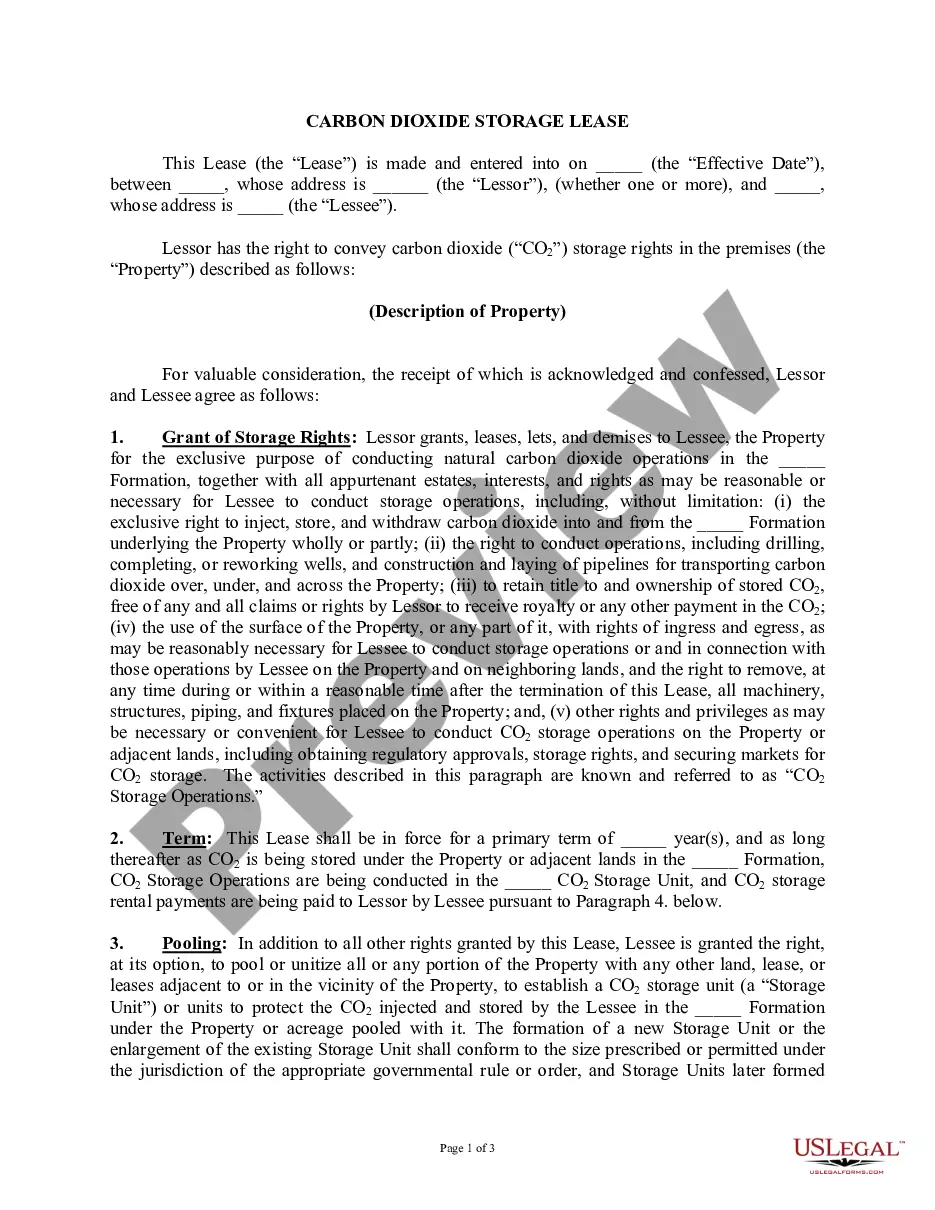
Texas Carbon Dioxide Storage Unit Agreement
Description

Get your form ready online
Our built-in tools help you complete, sign, share, and store your documents in one place.
Make edits, fill in missing information, and update formatting in US Legal Forms—just like you would in MS Word.
Download a copy, print it, send it by email, or mail it via USPS—whatever works best for your next step.
Sign and collect signatures with our SignNow integration. Send to multiple recipients, set reminders, and more. Go Premium to unlock E-Sign.
If this form requires notarization, complete it online through a secure video call—no need to meet a notary in person or wait for an appointment.
We protect your documents and personal data by following strict security and privacy standards.

Make edits, fill in missing information, and update formatting in US Legal Forms—just like you would in MS Word.

Download a copy, print it, send it by email, or mail it via USPS—whatever works best for your next step.

Sign and collect signatures with our SignNow integration. Send to multiple recipients, set reminders, and more. Go Premium to unlock E-Sign.

If this form requires notarization, complete it online through a secure video call—no need to meet a notary in person or wait for an appointment.

We protect your documents and personal data by following strict security and privacy standards.
Looking for another form?








How to fill out Carbon Dioxide Storage Unit Agreement?
Choosing the right legitimate papers format can be a battle. Naturally, there are tons of web templates available on the net, but how do you discover the legitimate type you need? Utilize the US Legal Forms site. The support offers a large number of web templates, like the Texas Carbon Dioxide Storage Unit Agreement, which you can use for enterprise and private demands. Every one of the types are checked out by pros and meet up with state and federal requirements.
If you are currently registered, log in for your account and click the Acquire key to obtain the Texas Carbon Dioxide Storage Unit Agreement. Use your account to search through the legitimate types you might have acquired formerly. Visit the My Forms tab of your own account and acquire yet another backup in the papers you need.
If you are a whole new customer of US Legal Forms, here are straightforward guidelines that you should comply with:
- Very first, be sure you have selected the right type for the area/county. You may check out the form making use of the Review key and study the form description to ensure it will be the right one for you.
- If the type does not meet up with your expectations, take advantage of the Seach area to discover the right type.
- Once you are certain that the form would work, go through the Get now key to obtain the type.
- Pick the pricing plan you would like and type in the required information. Create your account and purchase the transaction making use of your PayPal account or charge card.
- Pick the submit formatting and download the legitimate papers format for your device.
- Total, revise and printing and indication the acquired Texas Carbon Dioxide Storage Unit Agreement.
US Legal Forms will be the largest library of legitimate types in which you can discover numerous papers web templates. Utilize the company to download expertly-produced paperwork that comply with condition requirements.
Form popularity
FAQ
Class VI wells are wells used for injection of carbon dioxide (CO2) into underground subsurface rock formations for long-term storage, or geologic sequestration.
Class VI wells are used to inject carbon dioxide (CO2) into deep rock formations. This long-term underground storage is called geologic sequestration (GS).
Class II wells are used to inject fluids related to oil and gas production, including injection of CO2 for EOR. Class VI wells are used to inject CO2 for GS.
EPA aims to review complete Class VI applications and issue permits when appropriate within approximately 24 months. This timeframe is dependent on several factors, including the complexity of the project and the quality and completeness of the submitted application.
Class IV wells are shallow wells used to dispose hazardous or radioactive wastes into or above a geologic formation that contains an underground source of drinking water (USDW). In 1984, EPA banned the use of Class IV injection wells.
In Texas and most states, pore space belongs to the surface owner, absent an explicit severance. Some states are passing statutes prohibiting the severance of pore space as a separate estate, thereby securing ownership in the surface owners.
Class II wells are used only to inject fluids associated with oil and natural gas production. Class II fluids are primarily brines (salt water) that are brought to the surface while producing oil and gas. It is estimated that over 2 billion gallons of fluids are injected in the United States every day.