Texas Retainer Agreement
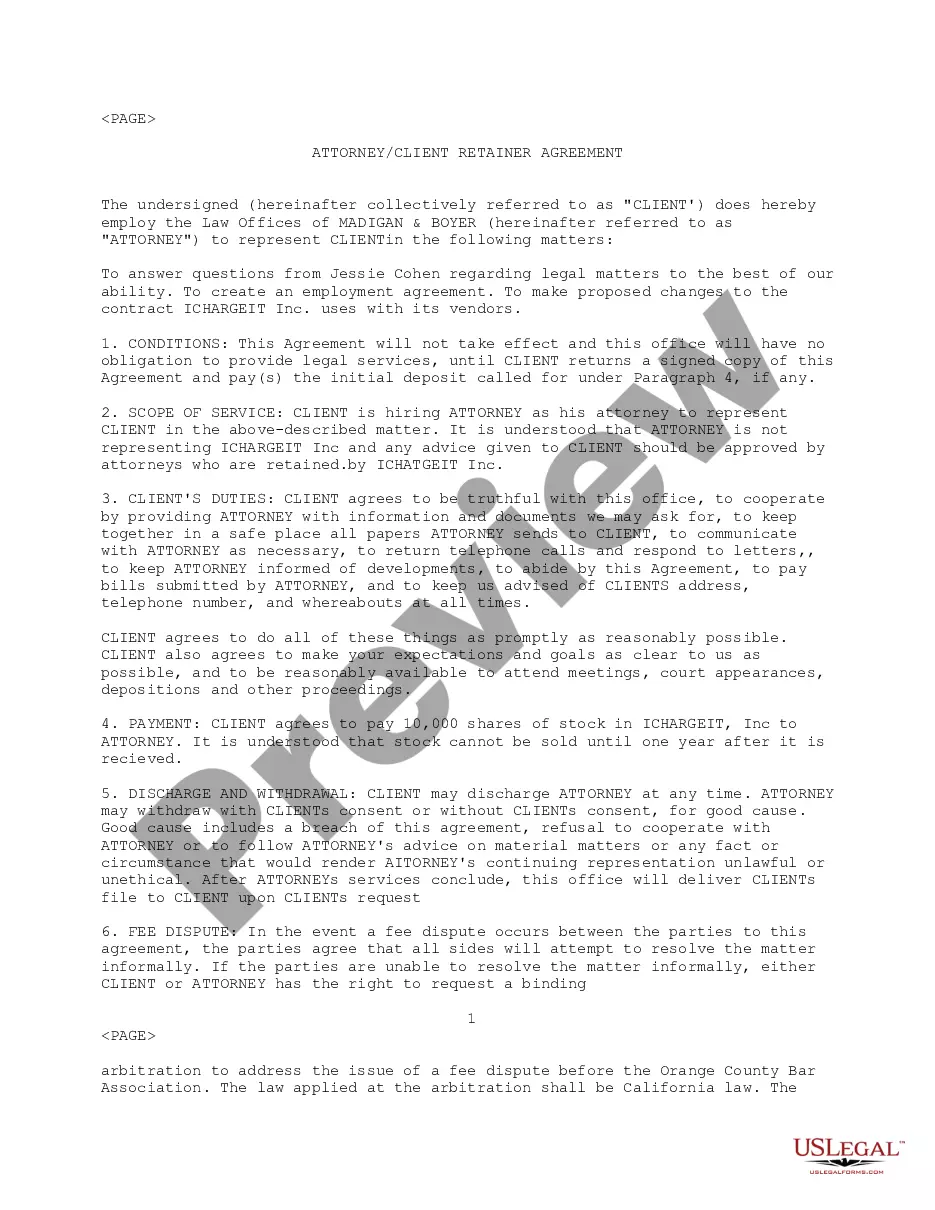
Description



Get your form ready online
Our built-in tools help you complete, sign, share, and store your documents in one place.
Make edits, fill in missing information, and update formatting in US Legal Forms—just like you would in MS Word.
Download a copy, print it, send it by email, or mail it via USPS—whatever works best for your next step.
Sign and collect signatures with our SignNow integration. Send to multiple recipients, set reminders, and more. Go Premium to unlock E-Sign.
If this form requires notarization, complete it online through a secure video call—no need to meet a notary in person or wait for an appointment.
We protect your documents and personal data by following strict security and privacy standards.

Make edits, fill in missing information, and update formatting in US Legal Forms—just like you would in MS Word.

Download a copy, print it, send it by email, or mail it via USPS—whatever works best for your next step.

Sign and collect signatures with our SignNow integration. Send to multiple recipients, set reminders, and more. Go Premium to unlock E-Sign.

If this form requires notarization, complete it online through a secure video call—no need to meet a notary in person or wait for an appointment.

We protect your documents and personal data by following strict security and privacy standards.
Looking for another form?




How to fill out Retainer Agreement?
You are able to devote time on-line attempting to find the lawful record format that meets the federal and state needs you require. US Legal Forms gives 1000s of lawful types which can be evaluated by specialists. It is simple to acquire or printing the Texas Retainer Agreement from your assistance.
If you currently have a US Legal Forms bank account, it is possible to log in and then click the Download option. Afterward, it is possible to complete, edit, printing, or sign the Texas Retainer Agreement. Each and every lawful record format you get is the one you have forever. To get one more version of the acquired type, visit the My Forms tab and then click the corresponding option.
Should you use the US Legal Forms website for the first time, adhere to the basic recommendations below:
- First, make certain you have chosen the proper record format for your county/metropolis that you pick. Read the type information to make sure you have selected the correct type. If readily available, utilize the Preview option to look throughout the record format also.
- If you wish to locate one more variation from the type, utilize the Lookup industry to get the format that meets your needs and needs.
- Once you have identified the format you would like, simply click Purchase now to proceed.
- Pick the rates plan you would like, type in your credentials, and register for an account on US Legal Forms.
- Complete the purchase. You can utilize your charge card or PayPal bank account to pay for the lawful type.
- Pick the structure from the record and acquire it in your gadget.
- Make changes in your record if required. You are able to complete, edit and sign and printing Texas Retainer Agreement.
Download and printing 1000s of record templates utilizing the US Legal Forms site, that offers the largest collection of lawful types. Use professional and status-specific templates to take on your organization or specific demands.
Form popularity
FAQ
A retainer is a fee paid up front by the client. A lawyer can use this fee as a down payment on expenses and fees. It is important to review your account from time to time to understand how your money is being spent.
Perhaps the most apparent benefit of establishing a retainer agreement with an attorney is having the comfort of immediate legal advice at your fingertips. If you deal with legal issues frequently, a retainer agreement keeps a close line between you and your attorney if questions arise that require immediate attention.
Retainers can be anywhere from $2,500-$15,000, and having this money on hand allows your attorney to pay for litigation costs when needed, without having to notify you of every single filing fee that might come up.
The amount serves as a guarantee by the client to pay the attorney upon completion of the agreed work. The attorney cannot claim the retainer fee until he has completed the work and invoiced the client. Any remaining retainer fee after paying the hourly attorney fees should be returned to the client.
The essential parts of the agreement include: Scope and nature of the work. What is the attorney expected to do for the client? ... Retainer fee. The retainer fee is the amount charged to the client. ... Client expenses. The client typically pays for some expenses, especially filing-related expenses, and travel costs.
A retainer is a fee paid to a lawyer or law firm in advance of services being rendered, and the law firm should hold it in a trust account until the services are provided. It gets booked to the balance sheet as a prepaid expense (which is an asset).
This agreement should cover elements like the services you'll provide, how long the working relationship will last, fees, pricing, confidentiality, and more. This sounds like a lot, but it's important to create a comprehensive agreement that protects your agency should anything go wrong.
In Texas, a retainer fee is paid to an attorney to compensate them for their commitment to providing services. Retainer fees can potentially be refundable or non-refundable. If the attorney requests a non-refundable retainer, it must meet specific legal requirements.