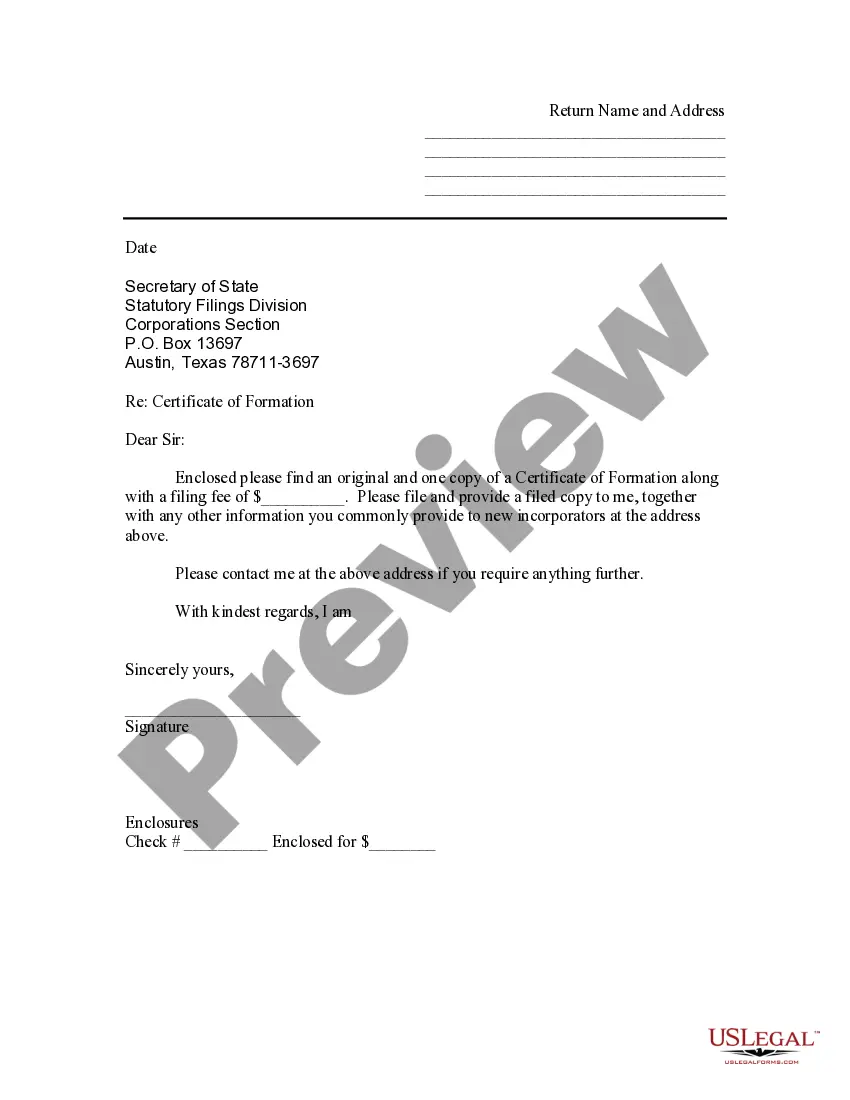
Texas Sample Transmittal Letter
About this form
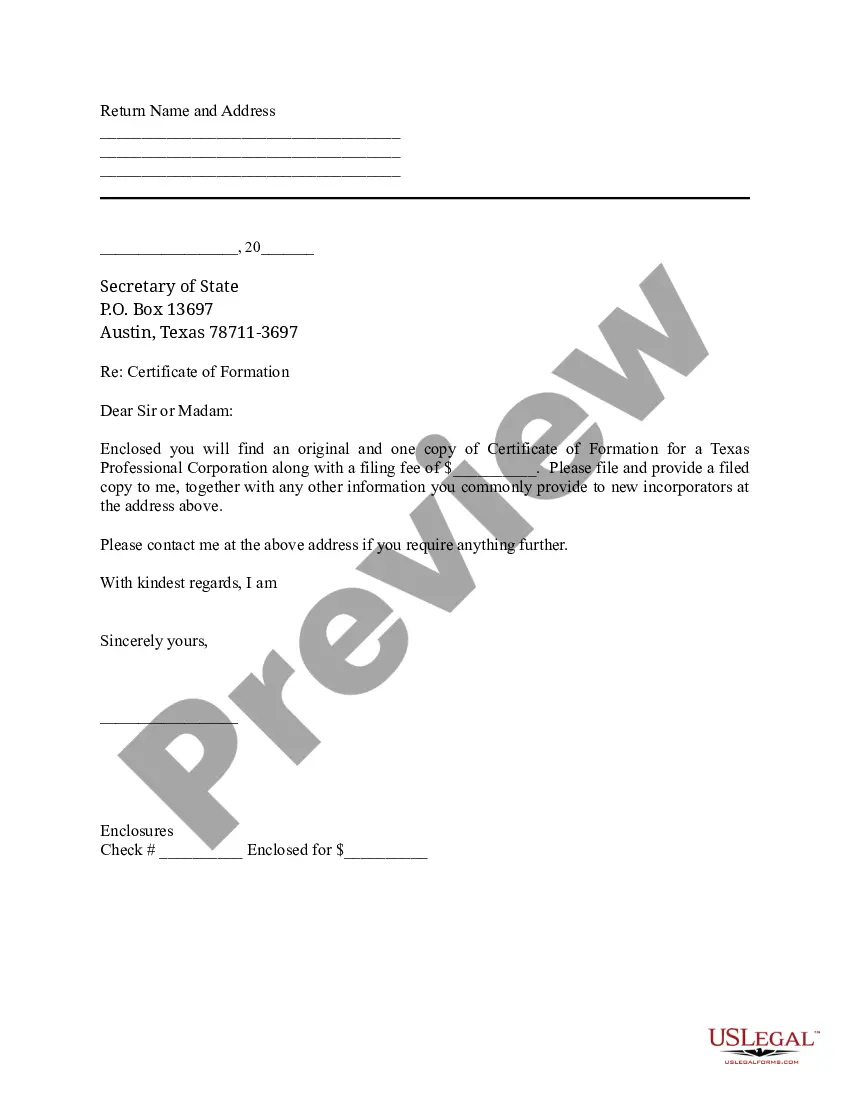
A Sample Transmittal Letter is a formal document used to accompany the Articles of Organization and any required filings sent to the Secretary of State for legal registration of an organization. This form is essential for ensuring that all necessary documents are submitted together, clearly stating the contents and any associated fees.
Main sections of this form
- Date: The date the letter is prepared.
- Recipient Information: Address of the Secretary of State's office.
- Subject: Indication of what the letter pertains to, such as âCertificate of Formation.â
- Enclosures: Details of the documents included with the letter.
- Signature: A space for the sender's signature to validate the document.
When to use this document
This form should be used when submitting the Articles of Organization, along with any other required forms and fees, to the Secretary of State. It is particularly important for individuals starting a business or forming a corporation, as it establishes the official communication for the incorporation process.
Intended users of this form
- Business owners and entrepreneurs looking to legally form a corporation or organization.
- Anyone filing Articles of Organization with the Secretary of State.
- Individuals seeking to ensure proper documentation is submitted for approval.
Instructions for completing this form
- Enter the date on which the letter is prepared.
- Fill in the recipientâs address, specifically the Secretary of State's Statutory Filings Division.
- State the subject as âCertificate of Formationâ to clarify the purpose.
- List any documents enclosed, including the Certificate of Formation, and the total filing fee.
- Sign the letter and include your printed name for authenticity.
Does this form need to be notarized?
This form does not typically require notarization unless specified by local law. You can submit the transmittal letter as is, but ensure all information is accurate and complete to avoid any issues during processing.
Get your form ready online
Our built-in tools help you complete, sign, share, and store your documents in one place.
Make edits, fill in missing information, and update formatting in US Legal Forms—just like you would in MS Word.
Download a copy, print it, send it by email, or mail it via USPS—whatever works best for your next step.
Sign and collect signatures with our SignNow integration. Send to multiple recipients, set reminders, and more. Go Premium to unlock E-Sign.
If this form requires notarization, complete it online through a secure video call—no need to meet a notary in person or wait for an appointment.
We protect your documents and personal data by following strict security and privacy standards.

Make edits, fill in missing information, and update formatting in US Legal Forms—just like you would in MS Word.

Download a copy, print it, send it by email, or mail it via USPS—whatever works best for your next step.

Sign and collect signatures with our SignNow integration. Send to multiple recipients, set reminders, and more. Go Premium to unlock E-Sign.

If this form requires notarization, complete it online through a secure video call—no need to meet a notary in person or wait for an appointment.

We protect your documents and personal data by following strict security and privacy standards.
Common mistakes to avoid
- Omitting the required filing fee amount.
- Failing to sign the letter, which can delay processing.
- Not double-checking the recipient's address, leading to misdelivery.
- Neglecting to include all necessary enclosures, such as copies of documents.
Why complete this form online
- Convenient access to legal templates that save time.
- Edit and customize documents to suit specific needs.
- Reliable forms drafted by licensed attorneys, ensuring legal accuracy.
What to keep in mind
- The Sample Transmittal Letter is essential for submitting Articles of Organization in Texas.
- Ensure all necessary documents and fees are included with your application.
- Double-check recipient information to avoid delays in processing.
Looking for another form?


Form popularity
FAQ
A Transmittal Letter is a business letter and is formatted accordingly, it should include the recipient's address, sender's address, distribution list, a salutation and closing. It typically includes why it should receive the reader's consideration, and what the reader should do with it.
Include heading with the date and recipient's address. Include a heading with your full name and company address, located in the top left corner of the page. Greet the recipient appropriately. Write the letter body. Include a short closing paragraph.
A Transmittal Letter is a business letter and is formatted accordingly, it should include the recipient's address, sender's address, distribution list, a salutation and closing. It typically includes why it should receive the reader's consideration, and what the reader should do with it.
A letter or memo of transmittal conveys the report to the person requesting it, or the primary audience for the report. It provides a context for reading the report. Unlike the report proper, a letter of transmittal may use I and be less formal in tone than the rest of the report.
Letter of Transmittal A report usually includes a covering letter or message to the person who requested it. Basically, the writer says, Please find attached the report you requested. This covering letter or message should be written as a brief formal letter.
A letter of transmittal is a type of short cover letter or business letter that accompanies a document to explain the purpose or importance of it. This letter clarifies correspondence by putting the documents sent into context, to keep confusion at a minimum.
The main purpose of a transmittal is to document the sending of documents, files, or samples.
A transmittal letter is a brief business letter sent along with another type of communication, such as a longer document like a proposal, a response to an inquiry or a payment. It provides a way to let the recipient understands what is being sent, why they received it, and who it is from.