Texas Division Orders
Overview of this form
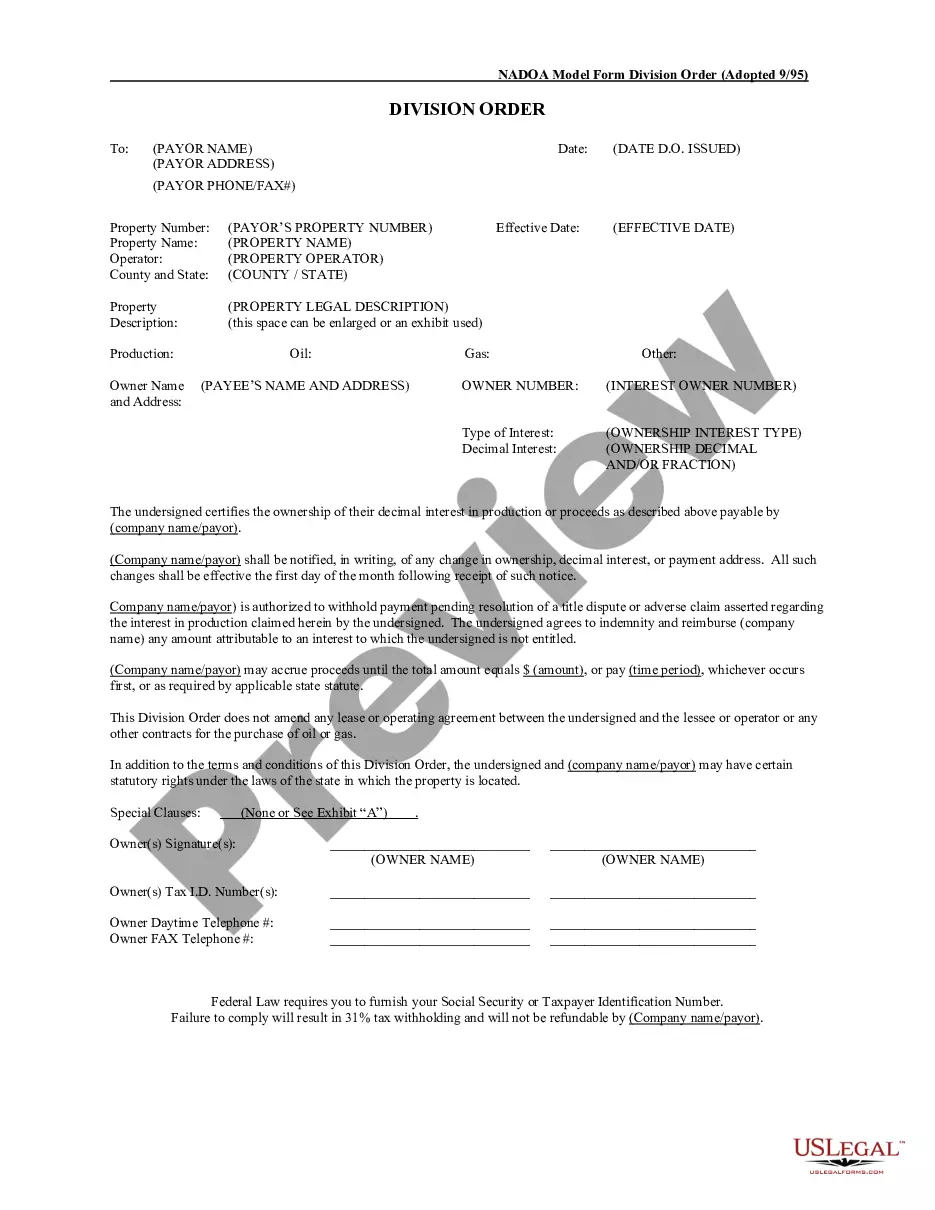
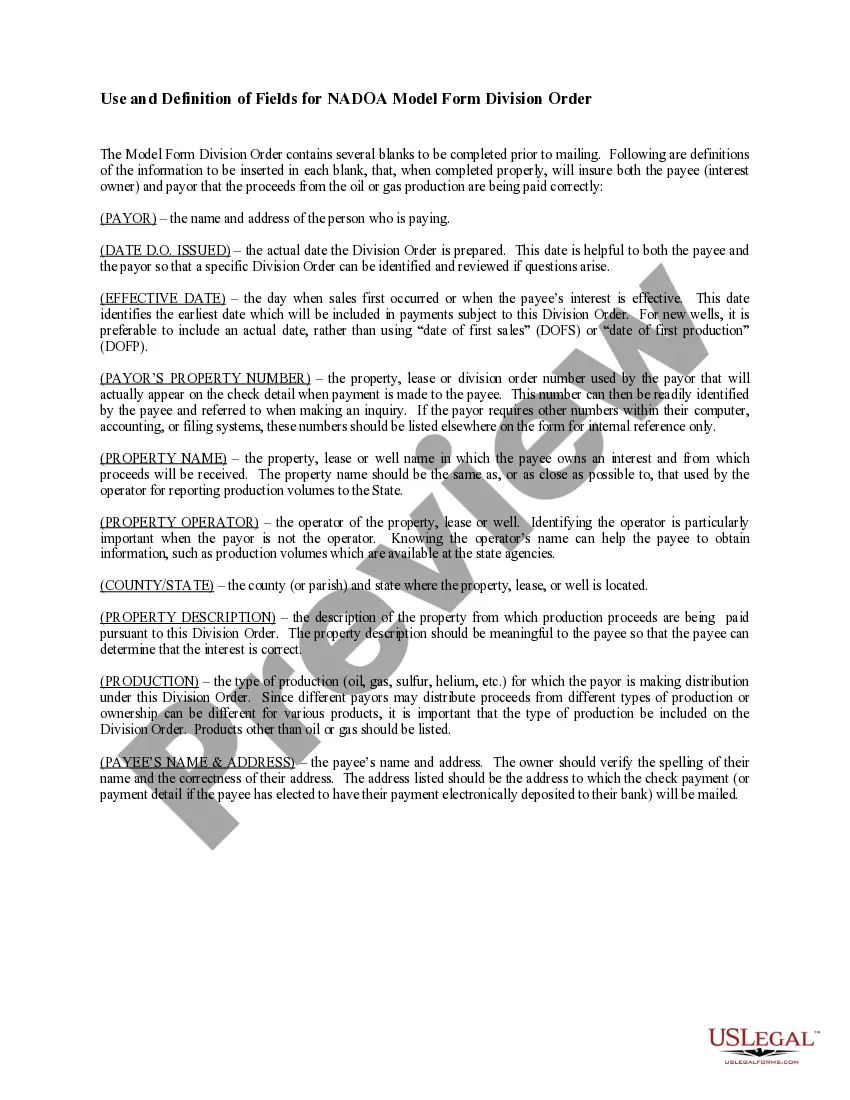
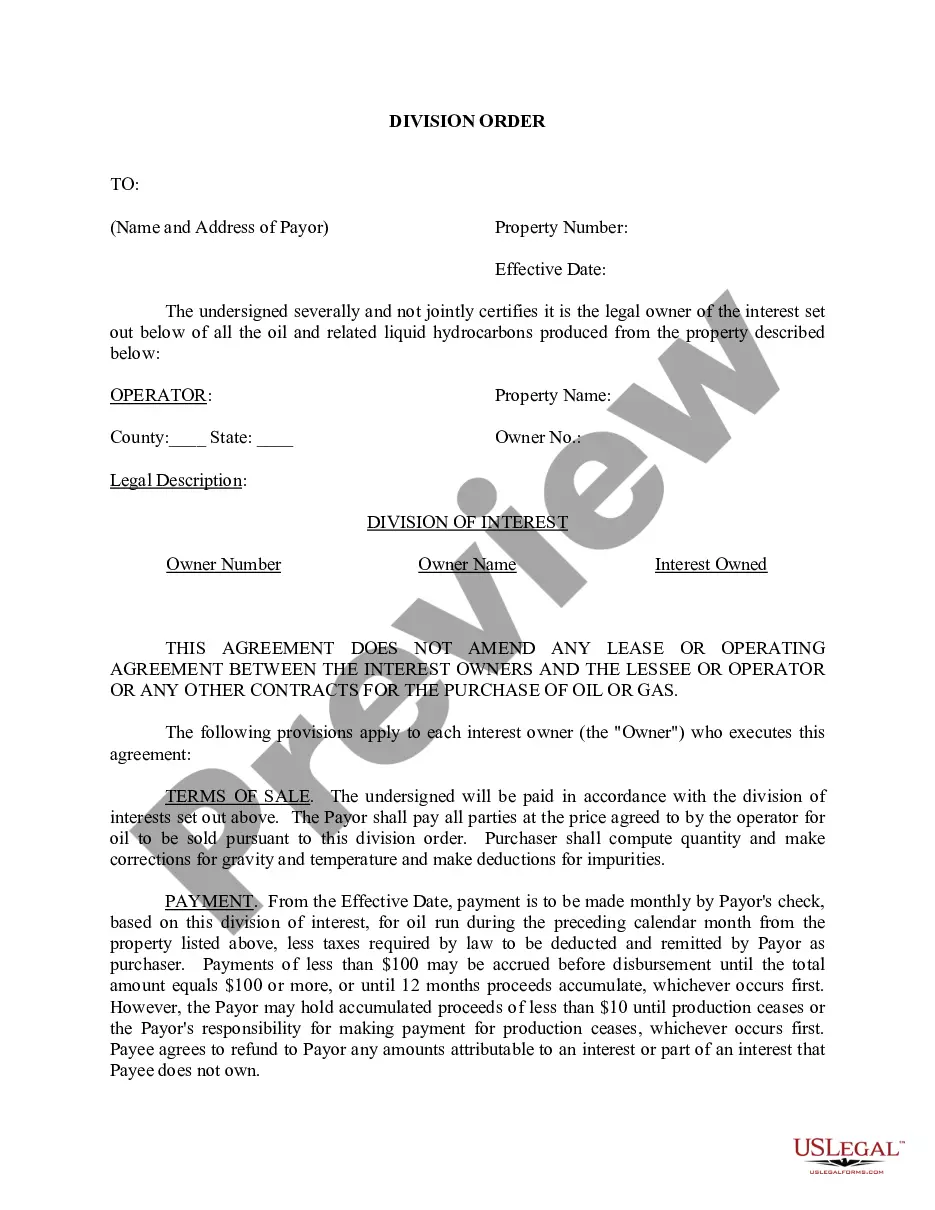
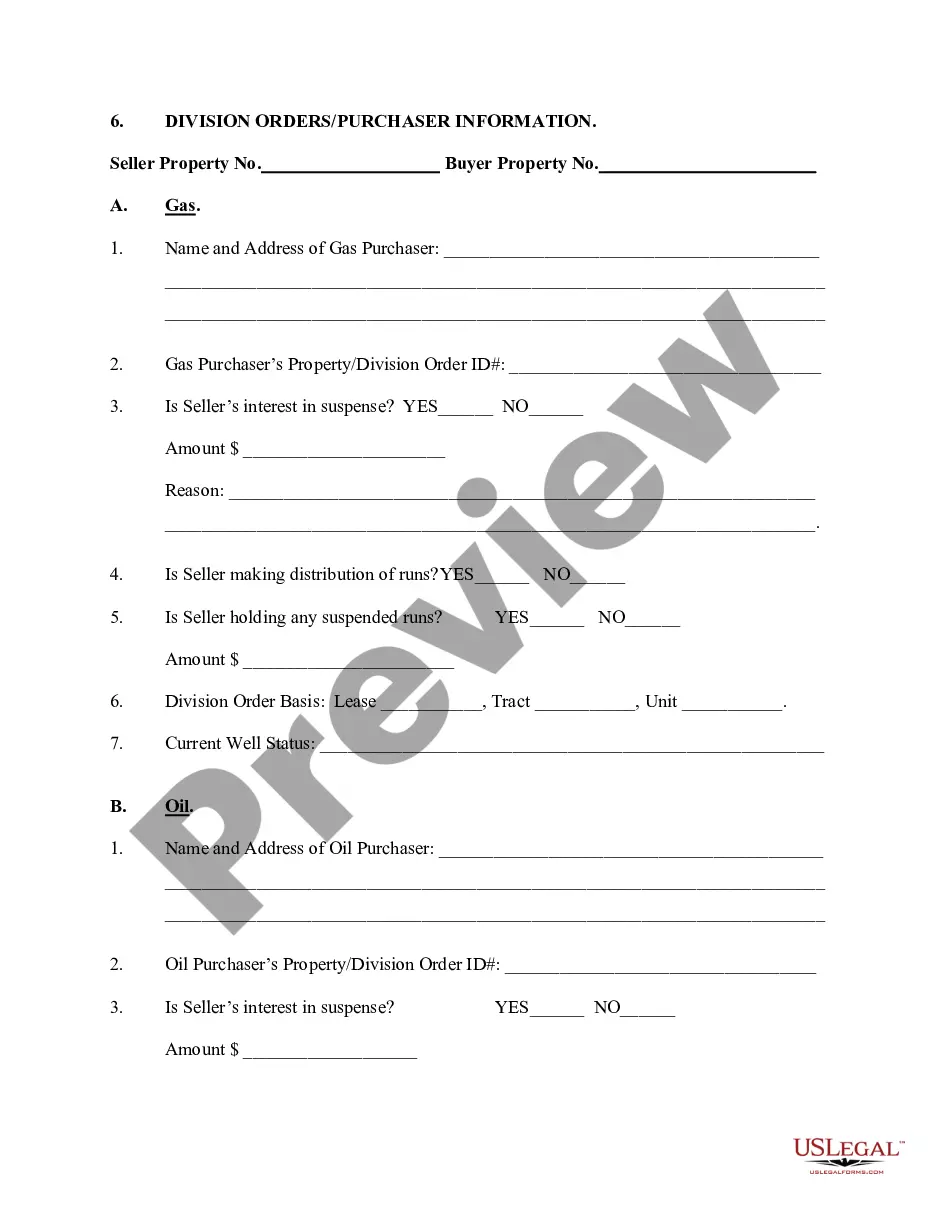
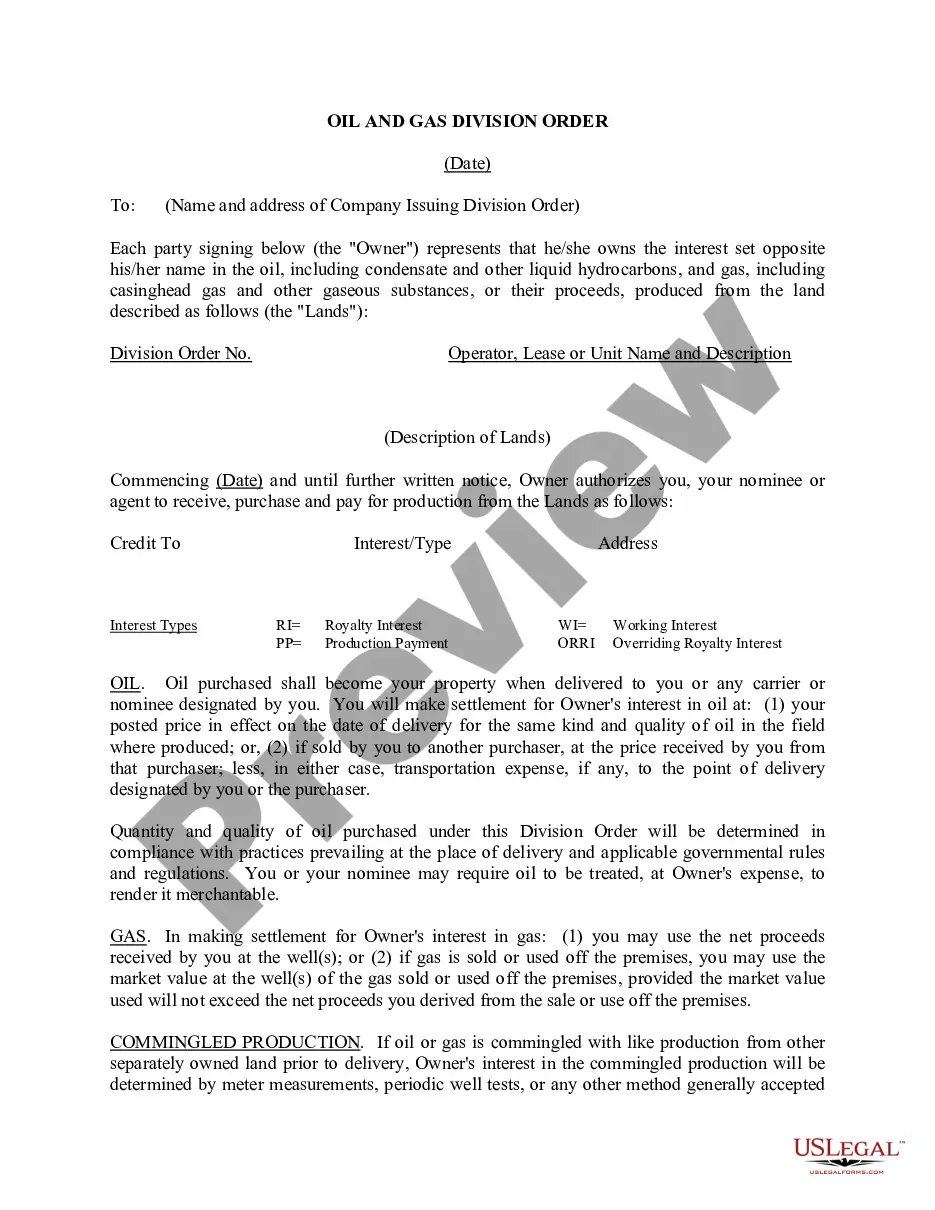
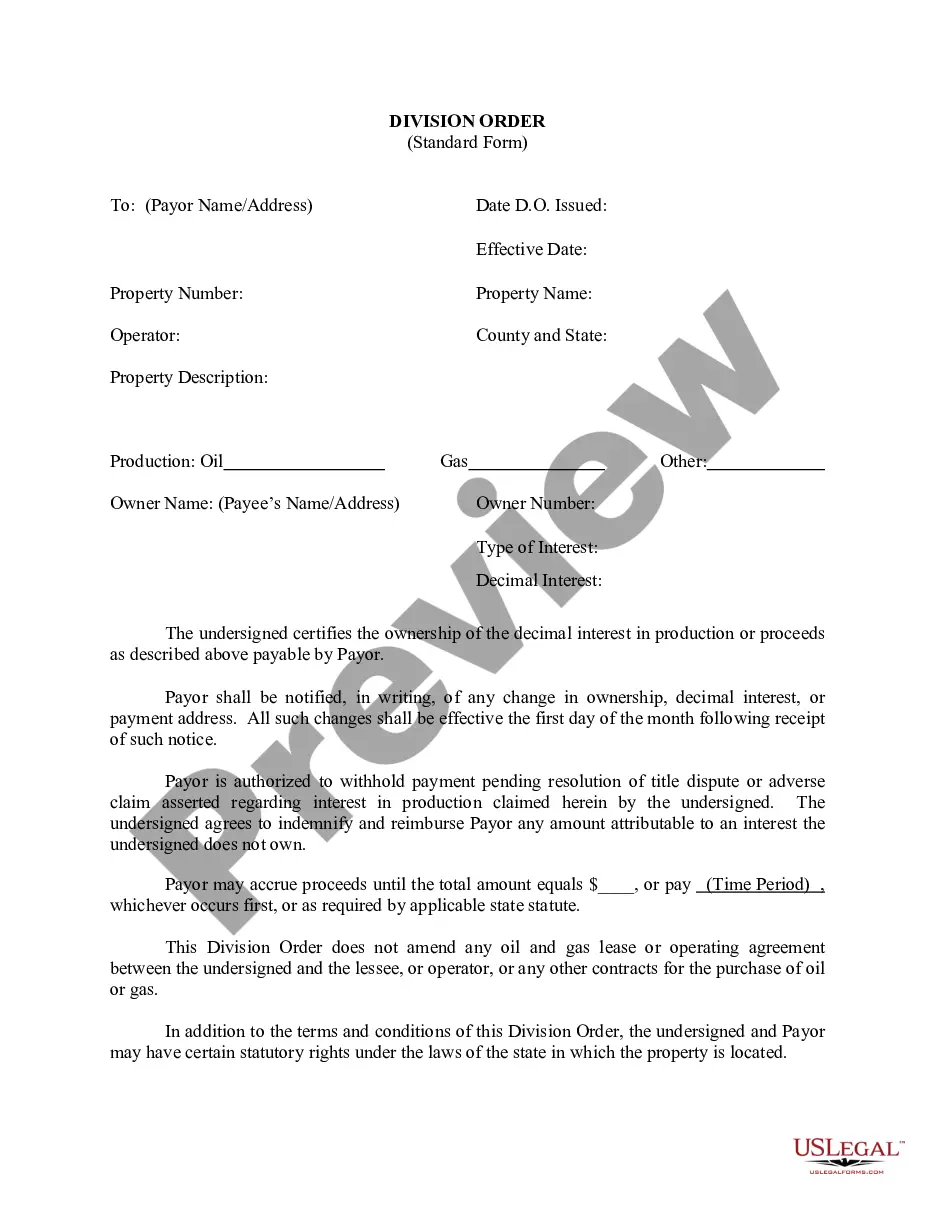
The Division Order is a legal document used in the petroleum and natural gas industries, ensuring that payments for production are accurately distributed to the rightful owners of mineral interests. This form is specifically intended to formalize the agreement between the owner of the interest and the payor, clarifying the ownership and the details regarding payments for production proceeds. Unlike other contracts, the Division Order does not alter the original lease terms but acts as a verification tool for how funds are allocated based on ownership percentages.
Key parts of this document
- Payor Information: Name and contact details of the entity responsible for payments.
- Effective Date: The date when the owner's interest in production officially begins.
- Property Details: Includes property name, operator, county, state, and a legal description.
- Production Type: Specifies whether the production is oil, gas, or other materials.
- Owner Information: Details of the interest owners, including names, addresses, ownership percentages, and necessary identification numbers.
- Signature Requirements: Signatures from all owners declaring their interest in the production proceeds.
When to use this document
This form should be used when an entity like an oil or gas company requests that the owners of mineral interests agree to the terms of payment related to production proceeds. This includes scenarios such as establishing payment obligations for new drilling operations, updating ownership details due to transfers, or resolving any disputes regarding title claims. It is crucial whenever changes occur in ownership or when first production from a well begins.
Intended users of this form
- Mineral interest owners who hold claims to production proceeds from oil or gas wells.
- Oil and gas companies requiring formal documentation to comply with payment obligations.
- Estate executors or administrators handling mineral interests for heirs.
- Landowners involved in leasing land for oil and gas extraction.
How to prepare this document
- Identify the parties involved by filling out the payor and owner details accurately.
- Specify the property information, including legal descriptions and property details relevant to the production.
- Enter critical dates such as the date of issuance and the effective date for the owner's interest.
- Clearly state the type of production (oil, gas, etc.) and list all relevant ownership percentages.
- Ensure all owners sign the document and provide their identification and contact information.
Does this document require notarization?
This form usually doesn’t need to be notarized. However, local laws or specific transactions may require it. Our online notarization service, powered by Notarize, lets you complete it remotely through a secure video session, available 24/7.
Get your form ready online
Our built-in tools help you complete, sign, share, and store your documents in one place.
Make edits, fill in missing information, and update formatting in US Legal Forms—just like you would in MS Word.
Download a copy, print it, send it by email, or mail it via USPS—whatever works best for your next step.
Sign and collect signatures with our SignNow integration. Send to multiple recipients, set reminders, and more. Go Premium to unlock E-Sign.
If this form requires notarization, complete it online through a secure video call—no need to meet a notary in person or wait for an appointment.
We protect your documents and personal data by following strict security and privacy standards.

Make edits, fill in missing information, and update formatting in US Legal Forms—just like you would in MS Word.

Download a copy, print it, send it by email, or mail it via USPS—whatever works best for your next step.

Sign and collect signatures with our SignNow integration. Send to multiple recipients, set reminders, and more. Go Premium to unlock E-Sign.

If this form requires notarization, complete it online through a secure video call—no need to meet a notary in person or wait for an appointment.

We protect your documents and personal data by following strict security and privacy standards.
Common mistakes to avoid
- Failing to provide accurate owner names or addresses, leading to payment issues.
- Missing signatures from all interest owners, which could invalidate the order.
- Entering incorrect effective dates that do not align with production timelines.
- Omitting the type of production, creating confusion over payment obligations.
Advantages of online completion
- Convenient access to downloadable and editable formats without the need for physical paperwork.
- Secure and reliable services that ensure legal compliance with state regulations.
- Ease of tracking changes and updates to ownership details over time.
Looking for another form?
Form popularity
FAQ
The percentage each lease tract contributes to the overall PA (or Communitized Area) is referred to as the Tract Participation Factor (TPF). percentage of unit revenue was multiplied by the Royalty (or ORRI) burden, to determine the royalty burden for each tract.
Royalty Interest an ownership in production that bears no cost in production. Royalty interest owners receive their share of production revenue before the working interest owners. Working Interest an ownership in a well that bears 100% of the cost of production.
A division order is a record of your interest in a specific well. It contains your decimal interest, interest type, well number and well name. Division orders are issued to all that own an interest in a specific well after that well has achieved first sales of either oil or gas.
Net revenue is the amount that is shared among the property owners. To determine net revenue interest, multiply the royalty interest by the owner's shared interest. For example, if you have a 5/16 royalty, your net royalty interest would be 25% multiplied by 5/16, which equals 7.8125% calculated to four decimal places.
Your decimal interest is calculated based on your royalty interest in the tract or unit on which the well is drilled.Or, you might own a non-participating royalty equal to 1/16 of the royalty reserved in any lease of the lands in the unit (a fraction of the royalty).
A Division Order (DO's), also known as a Division of Interest (DOI), is the instrument which details the proportional ownership of produced minerals, including oil, liquids, natural gas, etc., in a well or unitized area of production.
Use this formula to calculate your decimal share of royalties from the producing well: (Mineral Interest Share) times (Royalty Rate) = (Royalty Share Decimal). Example 1: (1/3 x 100% mineral interest) times (1/8 Royalty Rate) = 1/3 x 1/8 = 1/24 = 0.04166667 RI.
A Division Order is an instrument which sets forth the proportional ownership in produced hydrocarbons, including crude oil, natural gas, and NGL's. Sometimes the Division Order is referred to as a division of interest. More often than not, a single well or lease will have multiple owners.
Royalty interest in the oil and gas industry refers to ownership of a portion of a resource or the revenue it produces. A company or person that owns a royalty interest does not bear any operational costs needed to produce the resource, yet they still own a portion of the resource or revenue it produces.