Tennessee Motion to Dissolve Temporary Restraining Order
What is this form?
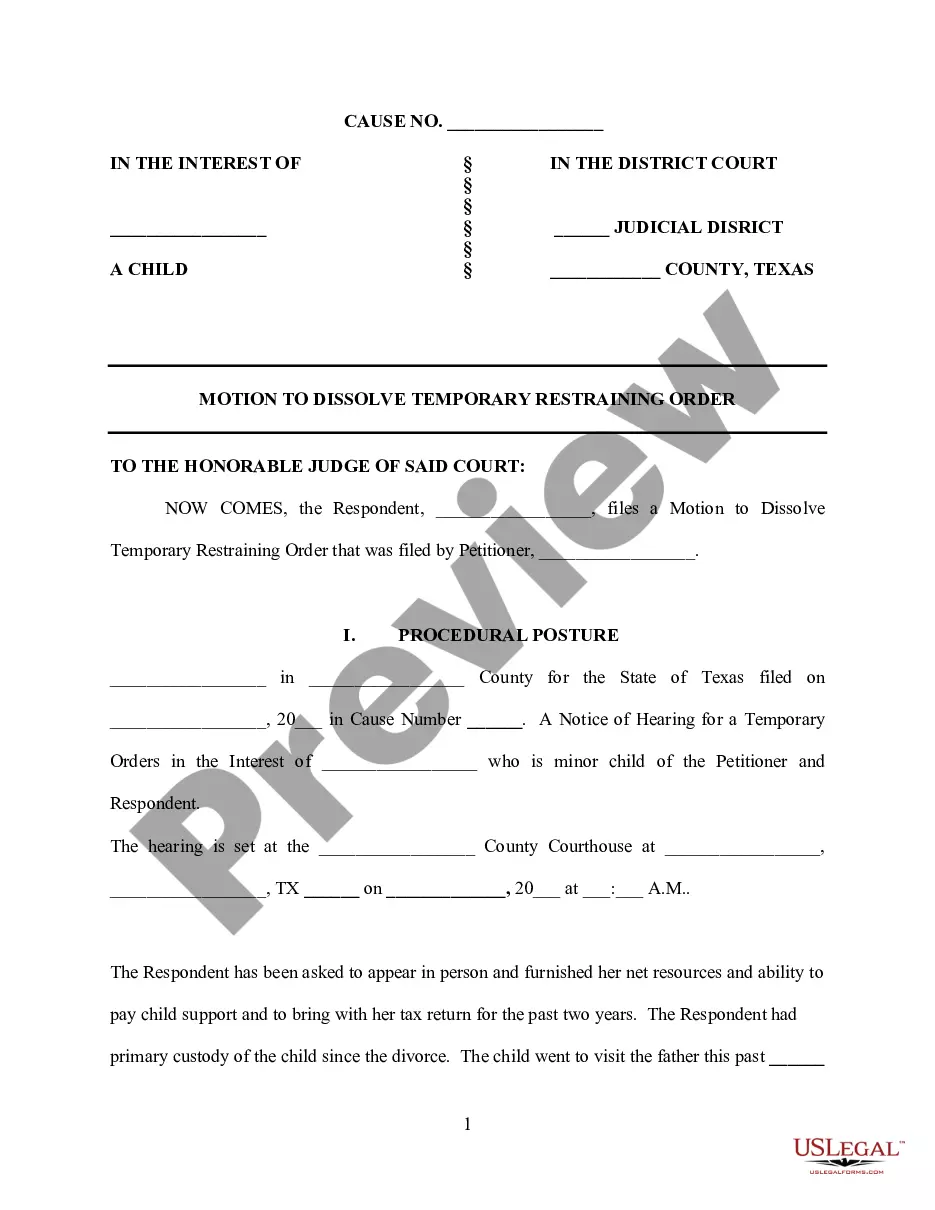
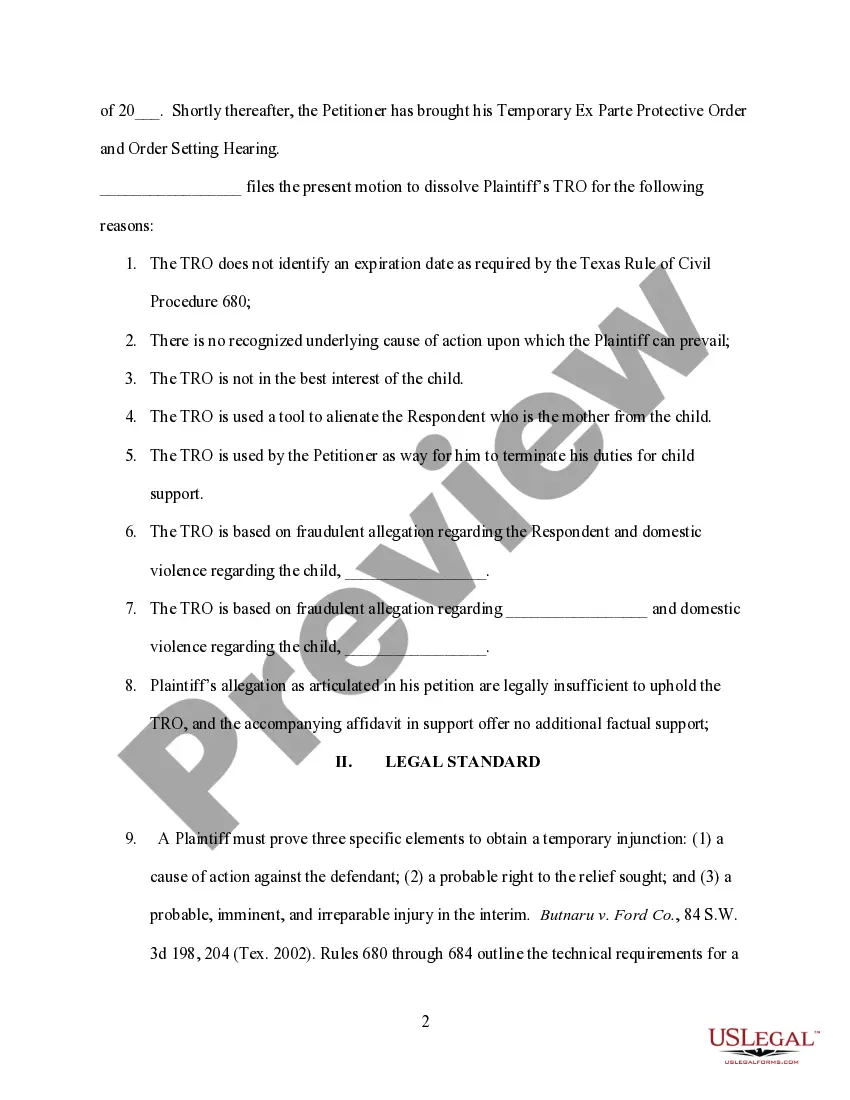
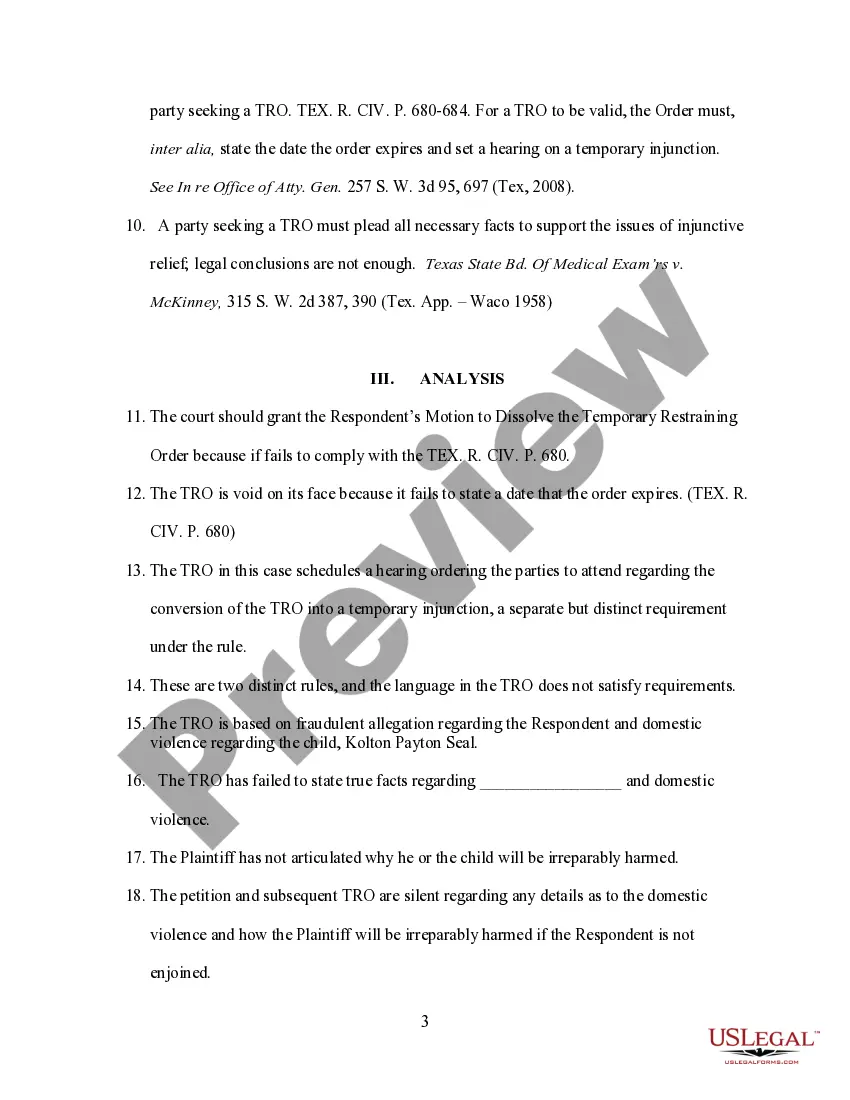
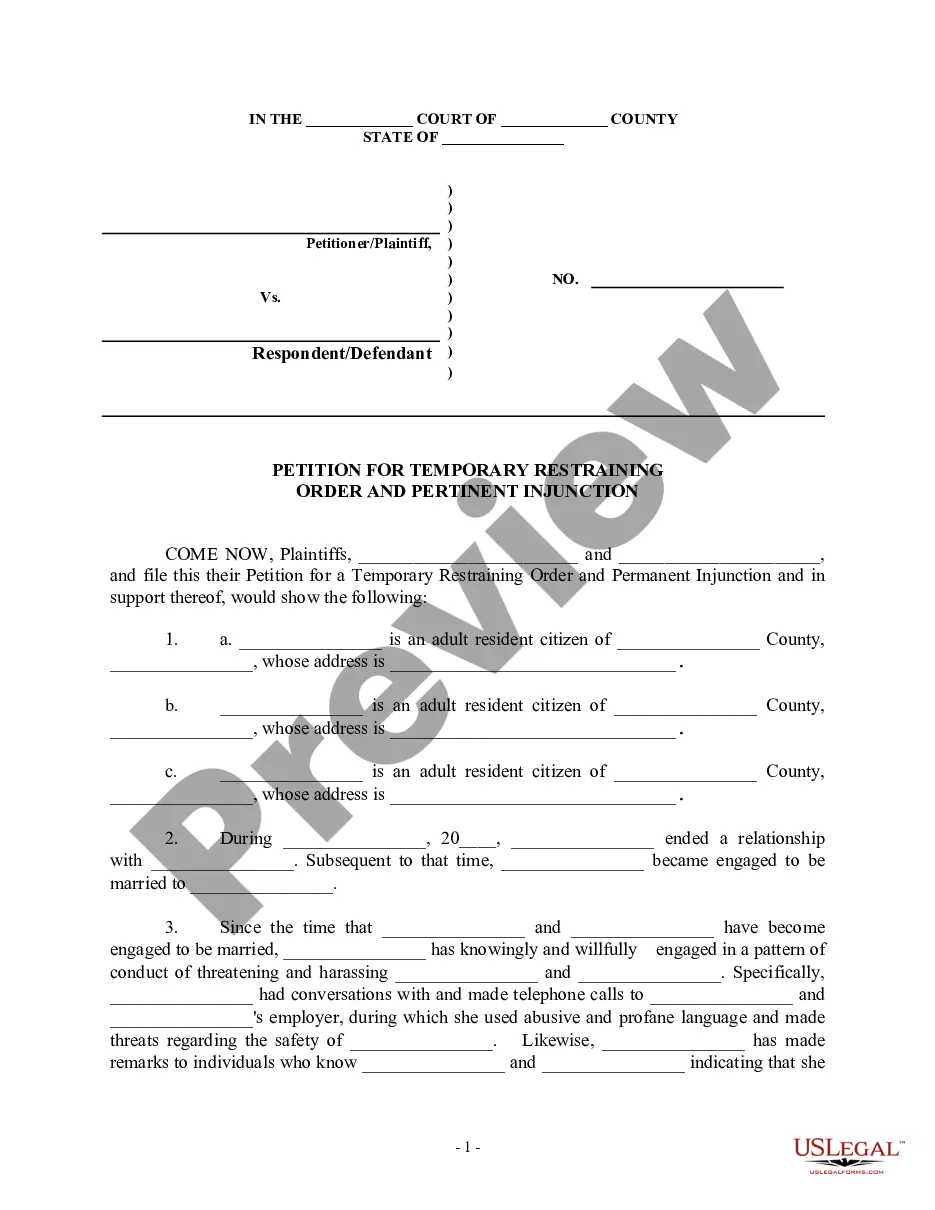
The Motion to Dissolve Temporary Restraining Order is a legal document used by a respondent to request the annulment of a temporary restraining order (TRO) issued against them. This form serves to challenge the legality of the TRO on various grounds, including the absence of an expiration date, lack of a valid legal basis, and detrimental effects on a child involved. It is distinct from other pleadings as it focuses specifically on contesting a TRO set forth in family law cases.
Key parts of this document
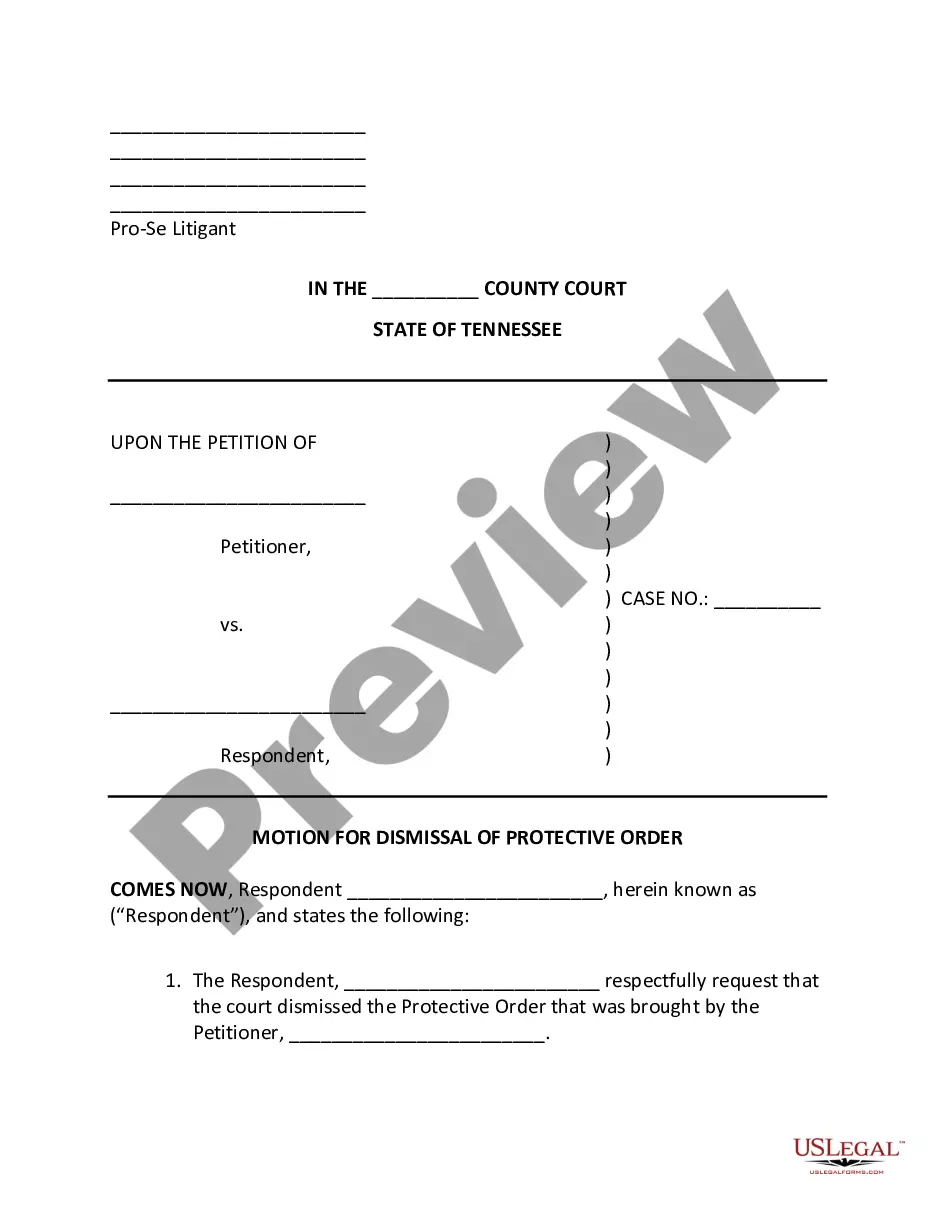
- Case information, including cause number and court details.
- Parties involved: identifies the respondent and petitioner.
- Procedural posture summarizing previous court actions related to the TRO.
- Legal reasons for dissolving the TRO, including failure to state an expiration date and lack of underlying cause.
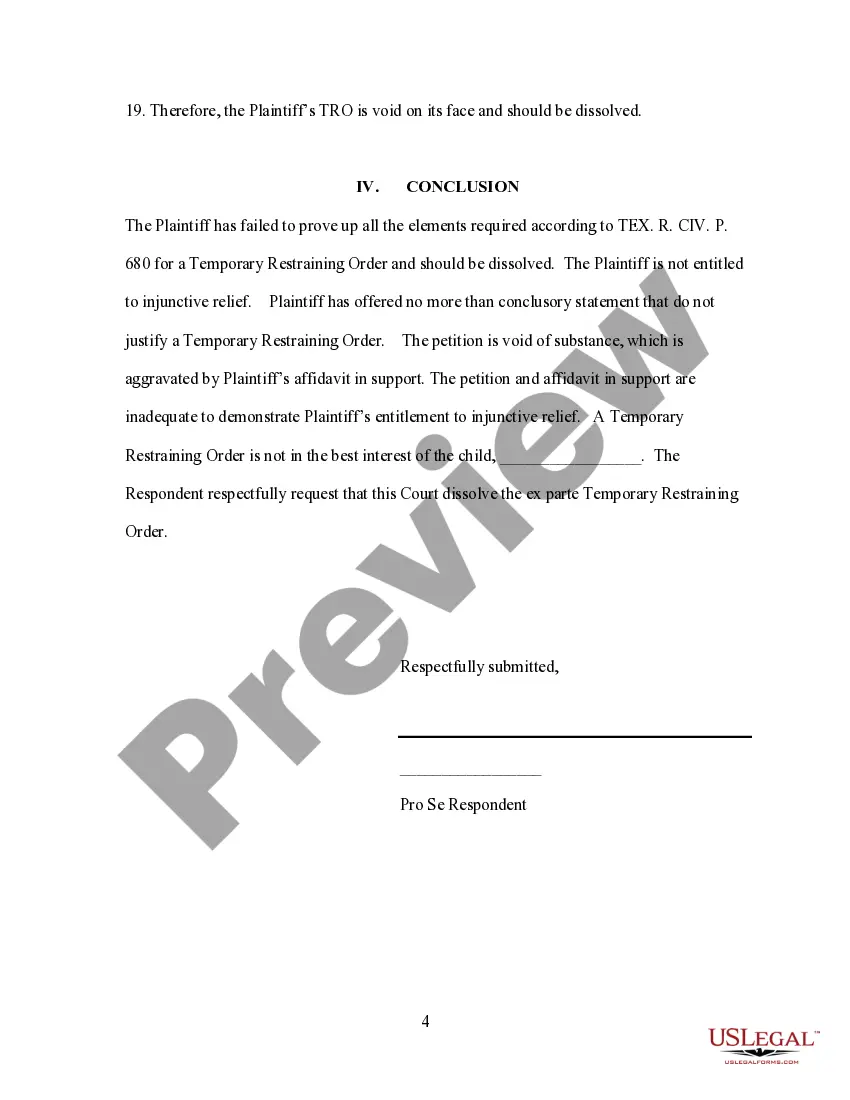
- Conclusion calling for the court to dissolve the TRO based on legal insufficiencies.
- Certificate of service to ensure all parties have been notified of the motion.

Common use cases
This form is necessary when a respondent wants to contest an existing temporary restraining order that they believe is unjustified. Common scenarios include instances where the TRO does not have a specified expiration date or is filed without valid cause. A parent who has been awarded child custody may need to use this motion if they feel the TRO undermines their relationship with their child or is based on false allegations.
Who should use this form
- Individuals who have been issued a temporary restraining order in a family law case.
- Respondents aiming to dissolve a TRO that they believe is not in the best interest of the child involved.
- Individuals who feel the TRO lacks legal support or fails to comply with Texas law requirements.
Steps to complete this form
- Fill in the case information, including the cause number and court details.
- Identify the parties involved, listing the respondent and petitioner clearly.
- Detail the procedural history, including the date the TRO was filed.
- Specify the reasons for dissolving the TRO, citing any legal grounds applicable.
- Conclude with a request for the court to dissolve the TRO and explain briefly why it is not in the childâs best interest.
- Sign the certificate of service to notify the involved parties of the motion.
Notarization requirements for this form
This form does not typically require notarization unless specified by local law. It is crucial to check specific court requirements where the motion is filed to confirm if notarization is necessary.
Get your form ready online
Our built-in tools help you complete, sign, share, and store your documents in one place.
Make edits, fill in missing information, and update formatting in US Legal Forms—just like you would in MS Word.
Download a copy, print it, send it by email, or mail it via USPS—whatever works best for your next step.
Sign and collect signatures with our SignNow integration. Send to multiple recipients, set reminders, and more. Go Premium to unlock E-Sign.
If this form requires notarization, complete it online through a secure video call—no need to meet a notary in person or wait for an appointment.
We protect your documents and personal data by following strict security and privacy standards.

Make edits, fill in missing information, and update formatting in US Legal Forms—just like you would in MS Word.

Download a copy, print it, send it by email, or mail it via USPS—whatever works best for your next step.

Sign and collect signatures with our SignNow integration. Send to multiple recipients, set reminders, and more. Go Premium to unlock E-Sign.

If this form requires notarization, complete it online through a secure video call—no need to meet a notary in person or wait for an appointment.

We protect your documents and personal data by following strict security and privacy standards.
Avoid these common issues
- Failing to include relevant case information such as case number or parties' names.
- Not providing sufficient legal grounds for the motion to dissolve the TRO.
- Leaving out the certificate of service, which can delay the process.
- Overlooking the requirement to specify a hearing date for the TRO dissolution.
Benefits of using this form online
- Immediate access to a professionally drafted legal form, ensuring compliance with legal standards.
- Convenient download options allow for easy editing and customization.
- Ensures that all necessary components are included, reducing the chance of errors.
- Cost-effective solution compared to hiring an attorney for simple motions.
Looking for another form?
Form popularity
FAQ
An injunction or temporary restraining order is an order from the court prohibiting a party from performing or ordering a specified act, either temporarily or permanently.
A temporary protection order lasts 15 days, or until the full hearing for your extended protection order. Extended protection orders are issued after a full court hearing where both sides have the opportunity to appear in court.
An injunction is a court order requiring a person to do or cease doing a specific action. There are three types of injunctions: Permanent injunctions, Temporary restraining orders and preliminary injunctions. Temporary restraining orders (TRO) and preliminary injunctions are equitable in nature.
What is a preliminary injunction? A preliminary injunction is temporary relief that preserves the status quo until the courts decide on the merits of the case. The relief sought often involves asking a court to prevent an opposing party from taking specific action or continuing a current course of action.
Specifically, Rule 69.04 of the Tennessee Rules of Civil Procedure provides that: Within ten years from the entry of a judgment, the creditor whose judgment remains unsatisfied may file a motion to extend the judgment for another ten years.
How do I drop an Order of Protection? Once filed, an Order of Protection can ONLY be dropped after the Respondent is served. You will need to go the Order of Protection office to file a Request to Cancel. You will be given a court date and you must both go to court.
RULE 65. Injunctive relief may be obtained by (1) restraining order, (2) temporary injunction, or (3) permanent injunction in a final judgment. A restraining order shall only restrict the doing of an act. An injunction may restrict or mandatorily direct the doing of an act.
A temporary injunction may be granted during the pendency of an action if it is clearly shown by verified complaint, affidavit or other evidence that the movant's rights are being or will be violated by an adverse party and the movant will suffer immediate and irreparable injury, loss or damage pending a final judgment