South Carolina Receipt and Release with Waiver
What is this form?
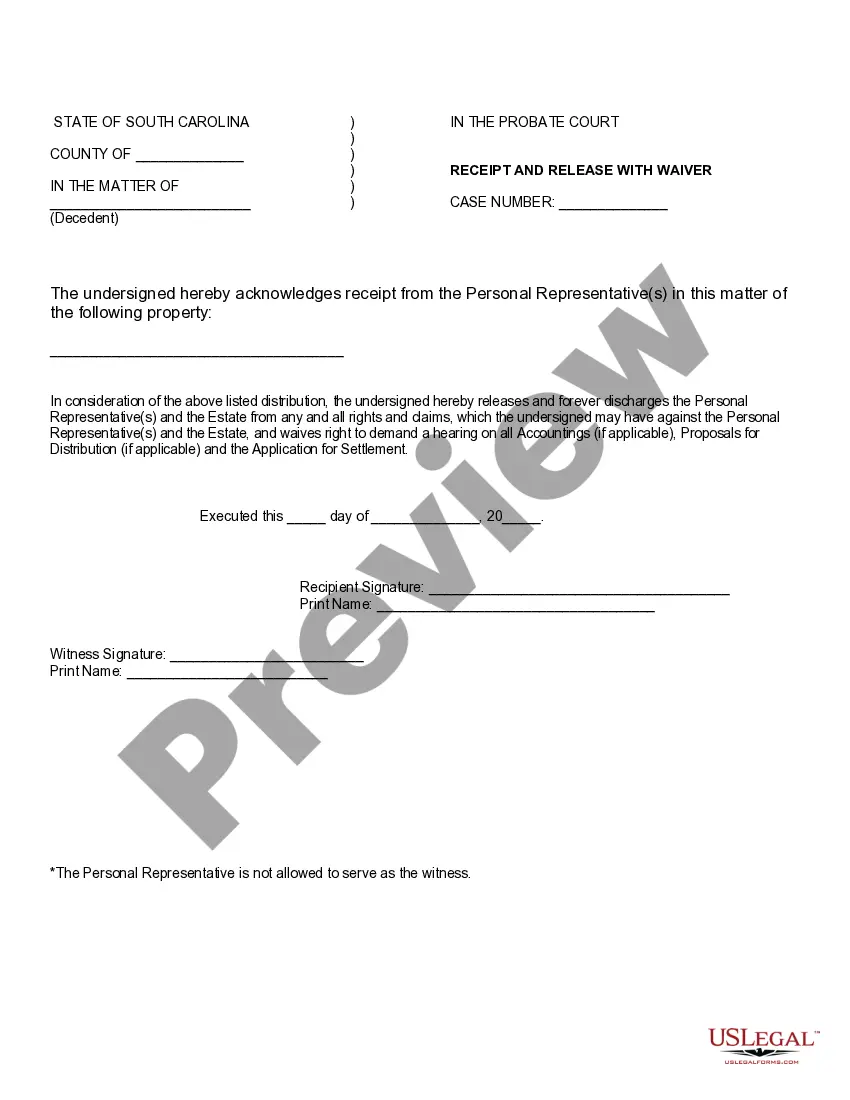
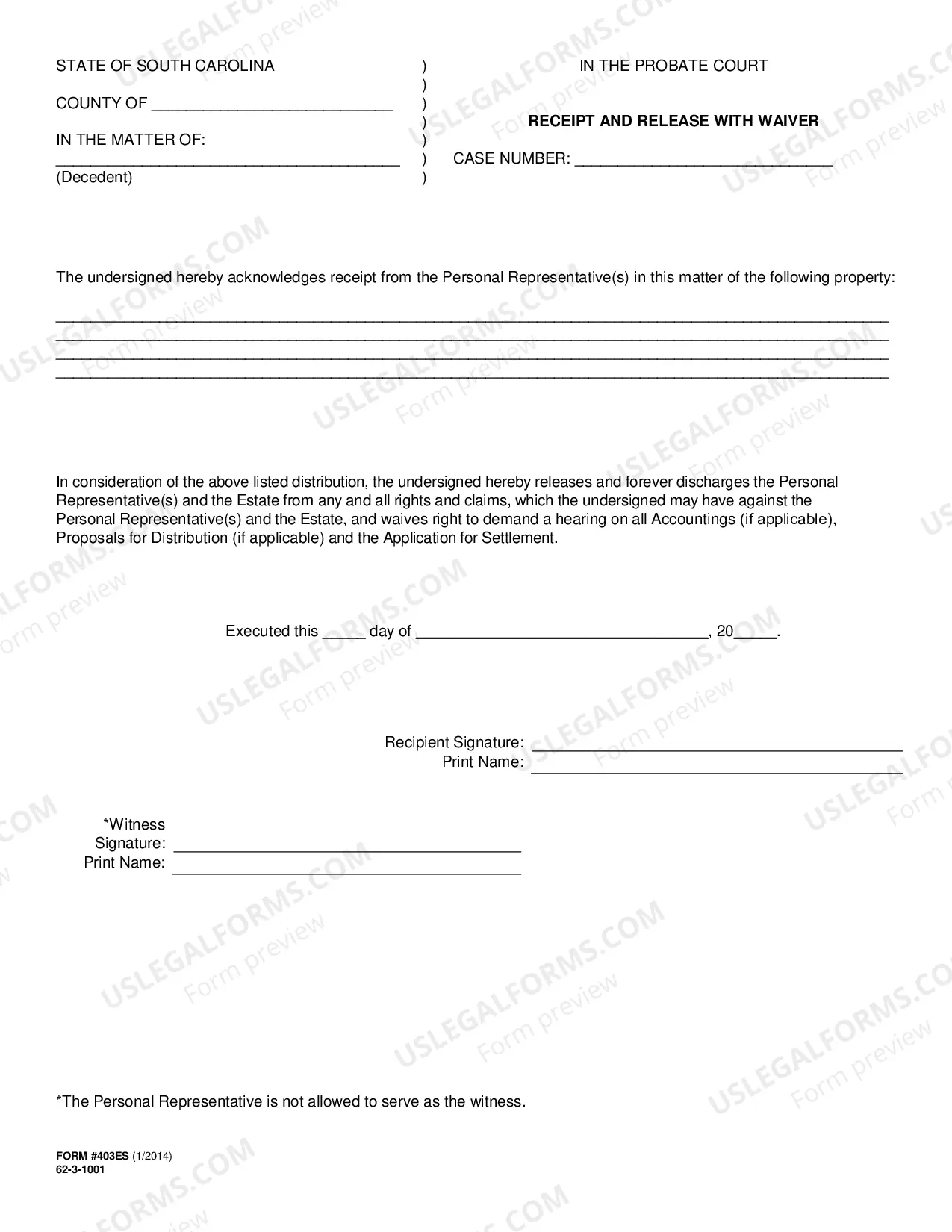
The Receipt and Release with Waiver is a legal document that serves to confirm the recipient's acknowledgement of receiving property from an estate. This form is significant as it not only recognizes the transfer of property but also includes a waiver of rights to demand further hearings regarding the estateâs accounting. This form is crucial for finalizing distributions of estate property and ensures that the Personal Representative and estate are protected from future claims related to the acknowledged property transfer.
Key components of this form
- State identification for proper legal context.
- Decedent's information included for clarity on the estate involved.
- Description of the property being acknowledged.
- Recipient's acknowledgment of receipt and waiver of any claims.
- Signatures of the recipient and witnesses for validity.

When to use this form
This form should be used when an individual receives property as part of an estate distribution. It is applicable in situations where the recipient wishes to formally acknowledge the receipt of property and agree to waive any rights to challenge the accounting of the estate or to demand further hearings. This is particularly important in settling the estate in a smooth manner, without further disputes over property distributions.
Who needs this form
- Individuals receiving property from a deceased person's estate.
- Personal Representatives managing the estate distribution.
- Beneficiaries of an estate who wish to finalize their property claims.
Completing this form step by step
- Identify the state and county where the probate court is located.
- Fill in the decedent's name and the case number related to the estate.
- Clearly describe the property you are acknowledging receipt of.
- Have the recipient sign the form and include their printed name.
- Obtain a signature from a witness who is not the Personal Representative.
Does this form need to be notarized?
This form does not typically require notarization unless specified by local law. It is advisable to check local probate court regulations to ensure compliance.
Get your form ready online
Our built-in tools help you complete, sign, share, and store your documents in one place.
Make edits, fill in missing information, and update formatting in US Legal Forms—just like you would in MS Word.
Download a copy, print it, send it by email, or mail it via USPS—whatever works best for your next step.
Sign and collect signatures with our SignNow integration. Send to multiple recipients, set reminders, and more. Go Premium to unlock E-Sign.
If this form requires notarization, complete it online through a secure video call—no need to meet a notary in person or wait for an appointment.
We protect your documents and personal data by following strict security and privacy standards.

Make edits, fill in missing information, and update formatting in US Legal Forms—just like you would in MS Word.

Download a copy, print it, send it by email, or mail it via USPS—whatever works best for your next step.

Sign and collect signatures with our SignNow integration. Send to multiple recipients, set reminders, and more. Go Premium to unlock E-Sign.

If this form requires notarization, complete it online through a secure video call—no need to meet a notary in person or wait for an appointment.

We protect your documents and personal data by following strict security and privacy standards.
Mistakes to watch out for
- Failing to provide a clear description of the property being received.
- Not including necessary signatures, such as that of a witness.
- Inaccurate completion of state and county information, which can affect the form's validity.
Benefits of using this form online
- Easy access to downloadable and customizable templates.
- Time efficiency in filling out and finalizing legal documents.
- Reliability in having forms created by licensed attorneys to meet legal standards.
Looking for another form?
Form popularity
FAQ
The appointment of a witness, a witness's spouse, or a witness's issue is valid, if otherwise so, and the individual so appointed, in such case, is entitled by law to take or receive any commissions or other compensation on account thereof.
In South Carolina, you can make a living trust to avoid probate for virtually any asset you own?real estate, bank accounts, vehicles, and so on. You need to create a trust document (it's similar to a will), naming someone to take over as trustee after your death (called a successor trustee).
Current through 2023 Act No. 5. Section 62-2-202 - Probate estate (a) For purposes of this Part, probate estate means the decedent's property passing under the decedent's will plus the decedent's property passing by intestacy, reduced by funeral and administration expenses and enforceable claims.
Any executor, devisee, legatee, guardian, attorney, or other person who fails to deliver to the judge of the probate court having jurisdiction to admit it to probate any last will and testament, including any codicil or codicils thereto, upon conviction must be punished as for a misdemeanor.
SECTION 62-2-101. Intestate estate. Any part of the estate of a decedent not effectively disposed of by his will passes to his heirs as prescribed in the following sections of this Code.
In most cases, probate is a legal responsibility in South Carolina. However, probate can be avoided if the decedent's assets were placed in a living trust before they died with beneficiaries designated to inherit the estate.
Exempt property. The surviving spouse of a decedent who was domiciled in this State is entitled from the estate to a value not exceeding twenty-five thousand dollars in excess of any security interests therein in household furniture, automobiles, furnishings, appliances, and personal effects.
Waiver of statutory filing requirements: If filed by all of the necessary parties, the estate can be administered without the need for a Final Accounting, Proposal for Distribution, or Notice of Right to Demand Hearing.