South Carolina MAILING THREATENING COMMUNICATIONS
What is this form?
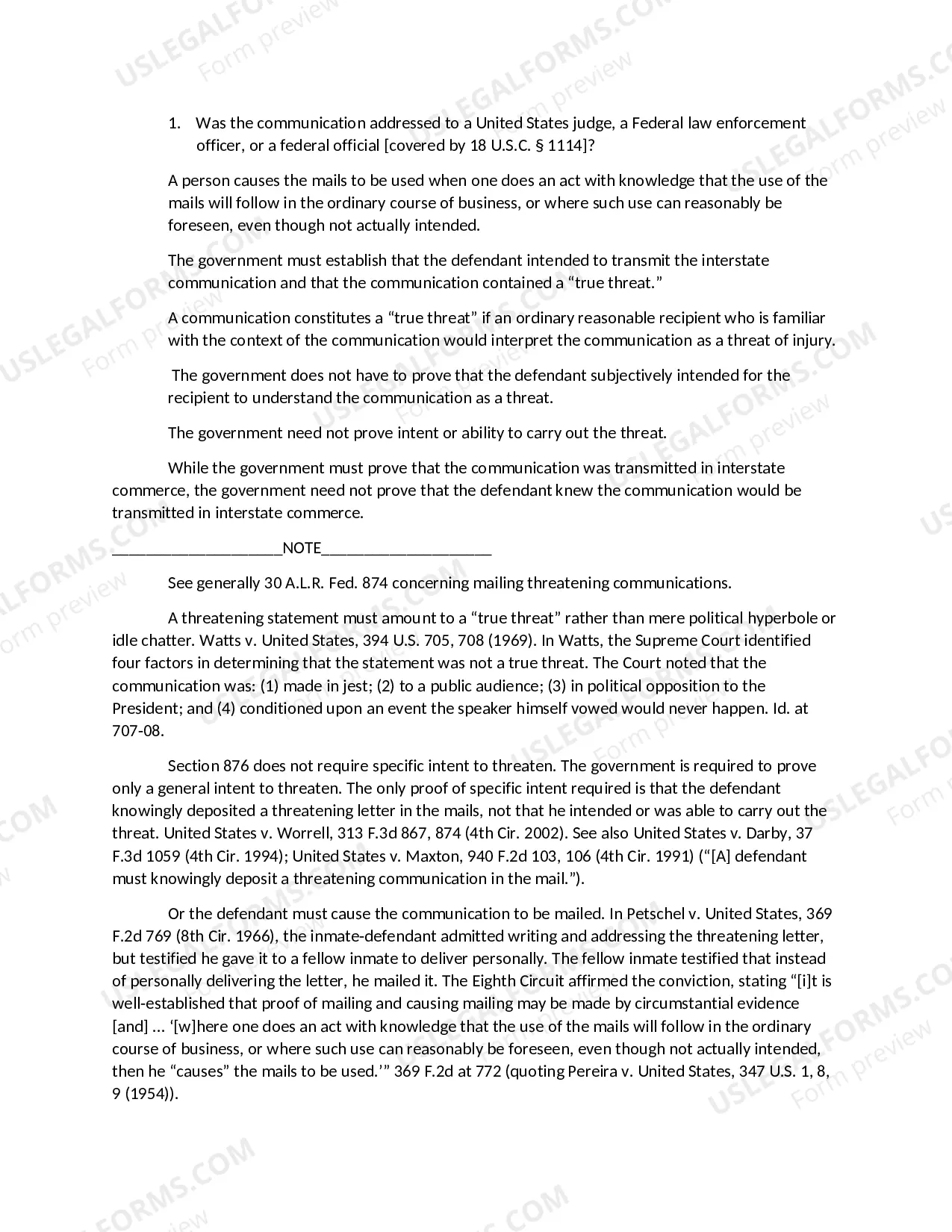
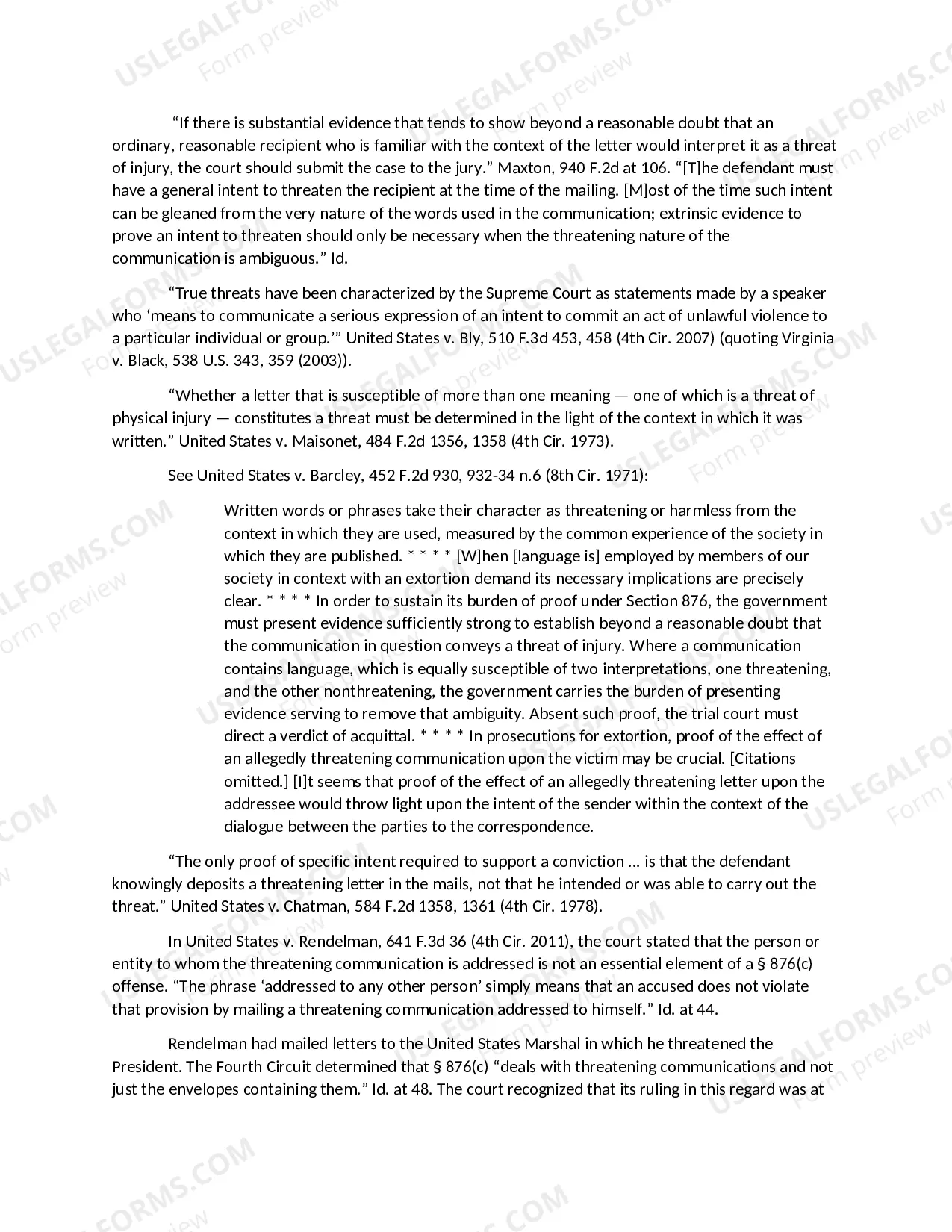
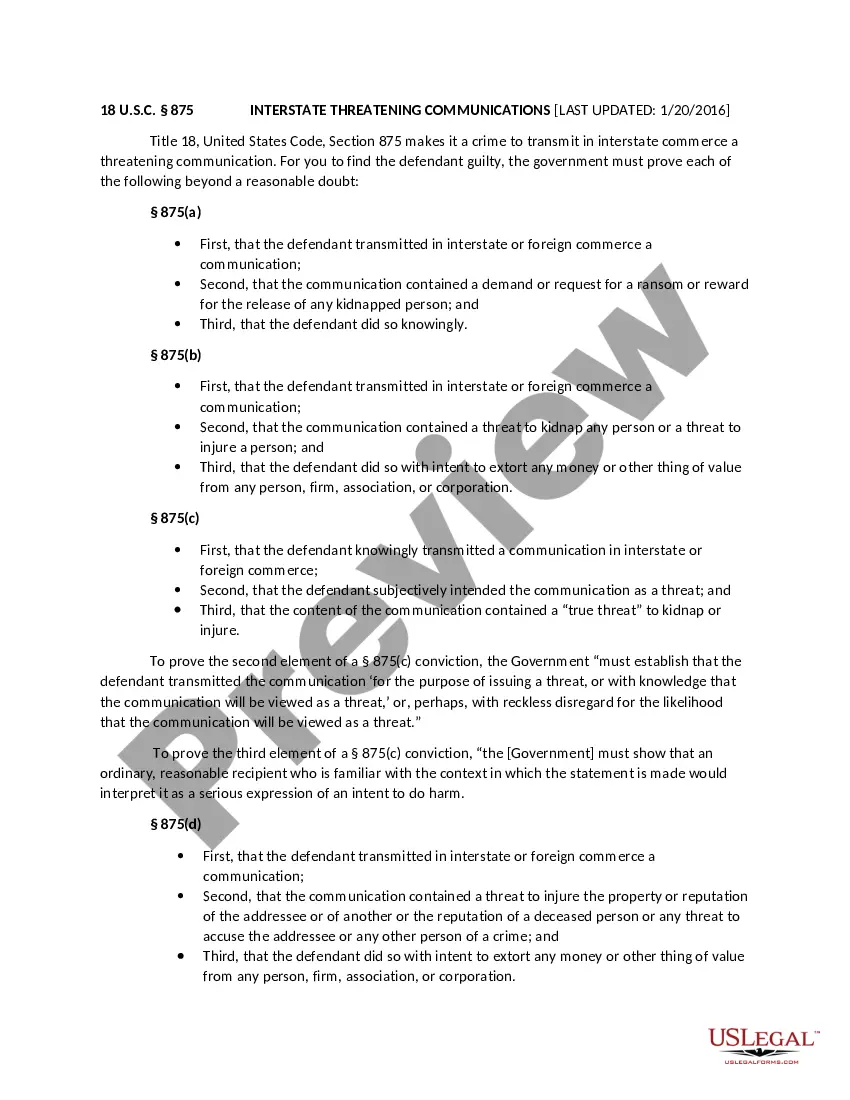
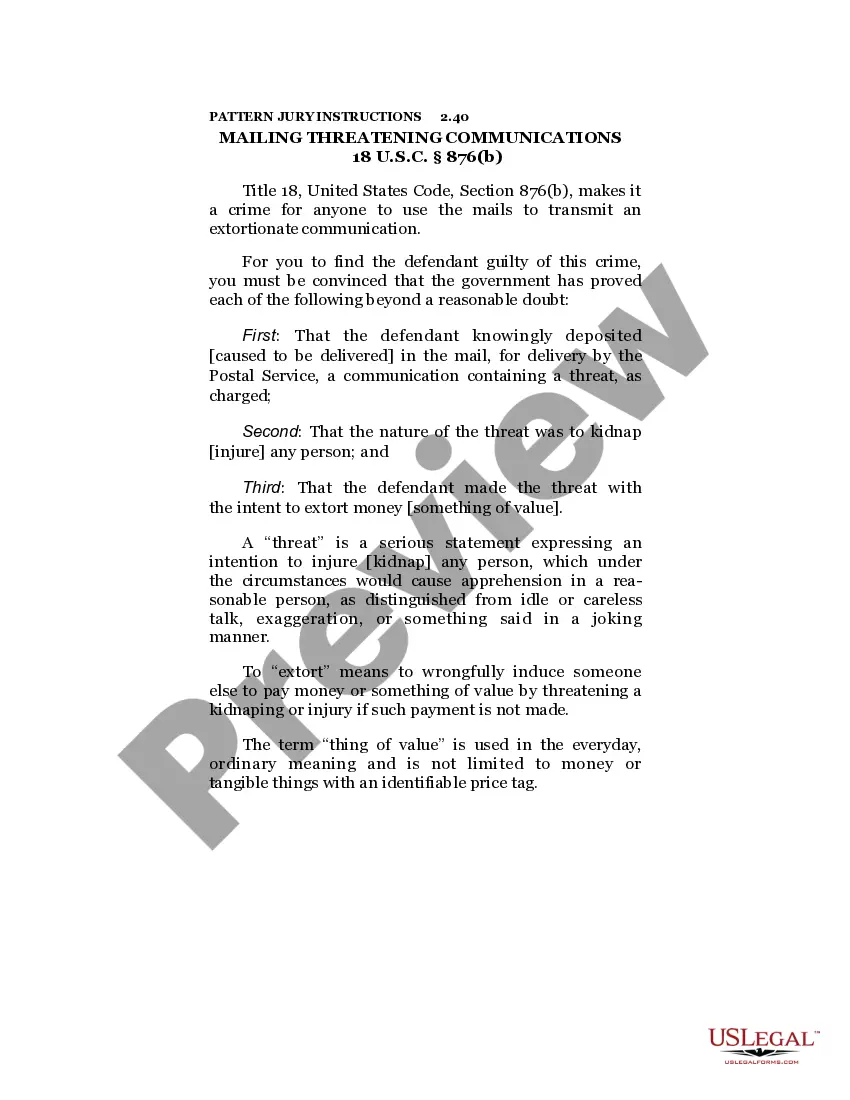
The Mailing Threatening Communications form is a legal document used to outline the parameters of criminal liability under Title 18, United States Code, Section 876. This form serves to guide the prosecution in cases where threatening communications are sent via mail. It is essential for understanding how such communications are identified as criminal threats, including the specific elements that must be proven for a conviction. This form is distinct from other legal documents as it focuses specifically on the legal definitions, elements of proof, and relevant case law regarding mailed threats.
Key parts of this document
- Definition and elements of mailing a threatening communication.
- Criteria for establishing that a communication is a true threat.
- Details on specific intent vs. general intent in threatening cases.
- Guidelines about aggravated penalties applicable in certain scenarios.
- Legal context for understanding the implications of threatening communications.

When to use this form
This form is used in legal proceedings where an individual is accused of mailing threats, including demands for ransom or threats of injury. It is applicable when determining the legal standards for prosecution in cases where threats have been communicated through postal services. If you are involved in a criminal case regarding threatening communications, this form will assist in understanding the charges and defense strategies.
Who can use this document
- Prosecutors involved in cases of mailed threats.
- Defense attorneys representing individuals accused of making threatening communications.
- Judges and jurors for comprehension of the legal standards in relevant cases.
- Legal scholars or students studying criminal law related to threats and extortion.
Steps to complete this form
- Review the legal definitions and elements of proof that apply to the case.
- Identify the specific threats made in the communication.
- Gather evidence that supports the claim of a true threat.
- Detail the circumstances surrounding the mailing of the communication.
- Incorporate relevant case law and precedents to support the legal argument.
Is notarization required?
This form usually doesn’t need to be notarized. However, local laws or specific transactions may require it. Our online notarization service, powered by Notarize, lets you complete it remotely through a secure video session, available 24/7.
Get your form ready online
Our built-in tools help you complete, sign, share, and store your documents in one place.
Make edits, fill in missing information, and update formatting in US Legal Forms—just like you would in MS Word.
Download a copy, print it, send it by email, or mail it via USPS—whatever works best for your next step.
Sign and collect signatures with our SignNow integration. Send to multiple recipients, set reminders, and more. Go Premium to unlock E-Sign.
If this form requires notarization, complete it online through a secure video call—no need to meet a notary in person or wait for an appointment.
We protect your documents and personal data by following strict security and privacy standards.

Make edits, fill in missing information, and update formatting in US Legal Forms—just like you would in MS Word.

Download a copy, print it, send it by email, or mail it via USPS—whatever works best for your next step.

Sign and collect signatures with our SignNow integration. Send to multiple recipients, set reminders, and more. Go Premium to unlock E-Sign.

If this form requires notarization, complete it online through a secure video call—no need to meet a notary in person or wait for an appointment.

We protect your documents and personal data by following strict security and privacy standards.
Mistakes to watch out for
- Failing to establish the context in which the communication was made.
- Not differentiating between a general intent to threaten and a specific intent.
- Overlooking the requirement for the communication to qualify as a true threat.
- Neglecting to provide sufficient evidence to prove the elements of a crime.
Advantages of online completion
- Easy access to downloadable legal templates drafted by licensed attorneys.
- Editable formats allow customization to specific case needs.
- Convenient and timely access to forms, enhancing legal preparedness.
- Reliable content that adheres to legal standards and requirements.
Legal use & context
- The form outlines the legal criteria necessary for prosecuting mailed threats under federal law.
- It emphasizes the importance of context in determining whether a communication is a true threat.
- Understanding this form can aid in ensuring compliance with legal standards during criminal trials.
Looking for another form?

Form popularity
FAQ
The penalties vary widely depending on the severity of the crime and the intention of the person charged. If someone threatens to physically hurt another person but does not actually hurt that individual, the penalty can be up a $500 fine and up to 30 days in jail for third-degree assault and battery.
Section 16-17-735 - Persons impersonating officials or law enforcement officers; persons falsely asserting authority of law; offenses; punishment. (2) denies or impedes another in the exercise or enjoyment of any right, privilege, power, or immunity.
(6) knowingly permit a telephone under his control to be used for any purpose prohibited by this section.
SECTION 16-17-425. Student threats. (A) It is unlawful for a student of a school or college in this State to make threats to take the life of or to inflict bodily harm upon another by using any form of communication whatsoever.
(A) The Attorney General or any solicitor may make application to a judge of competent jurisdiction for an order authorizing or approving the installation and use of a mobile tracking device by the South Carolina Law Enforcement Division or any law enforcement entity of a political subdivision of this State.
Threatening illegal acts A threat is a threat?even when delivered electronically. If your intent is to coerce, harass or intimidate someone, and you pick up your phone and follow through with a threat of illegal activity, you may face an unlawful communication charge.
Threatening a public official, teacher, principal or one of their family members is a felony charge. If you're convicted, your punishment will be: A fine of up to $5,000. A jail sentence of up to five years.