South Carolina INTERSTATE THREATENING COMMUNICATIONS
What is this form?
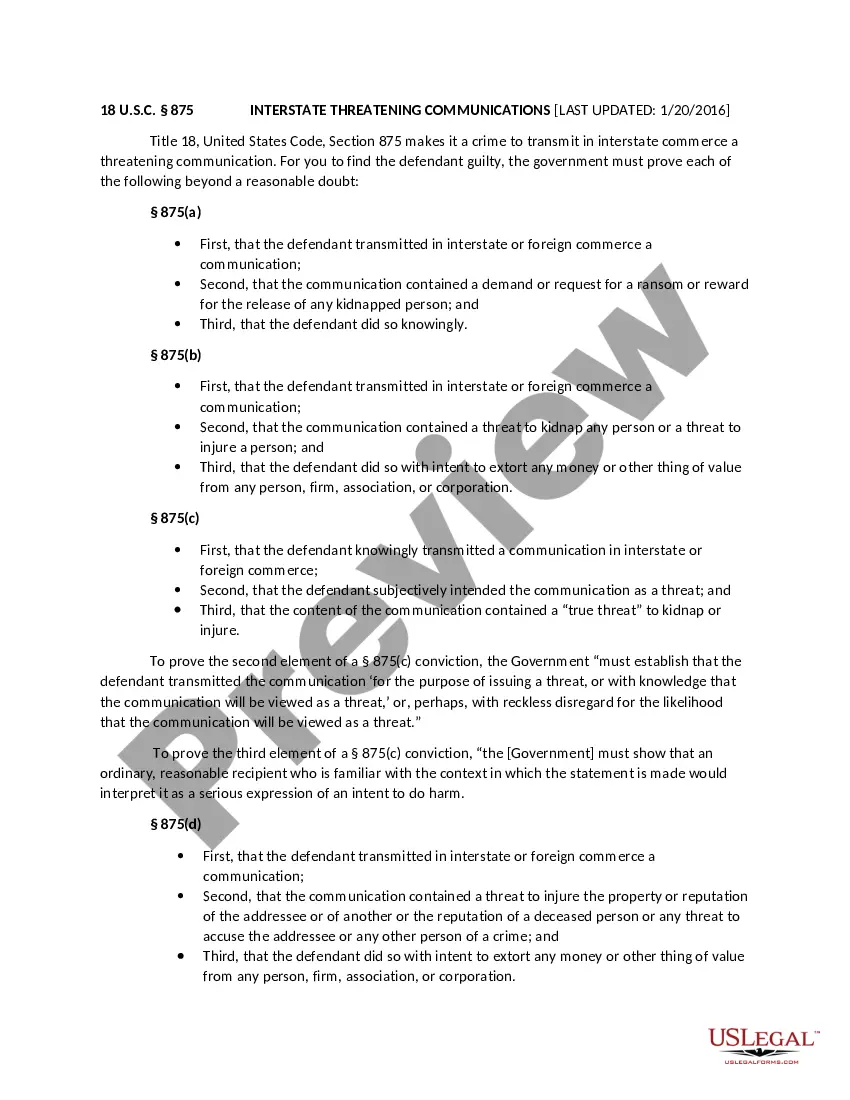
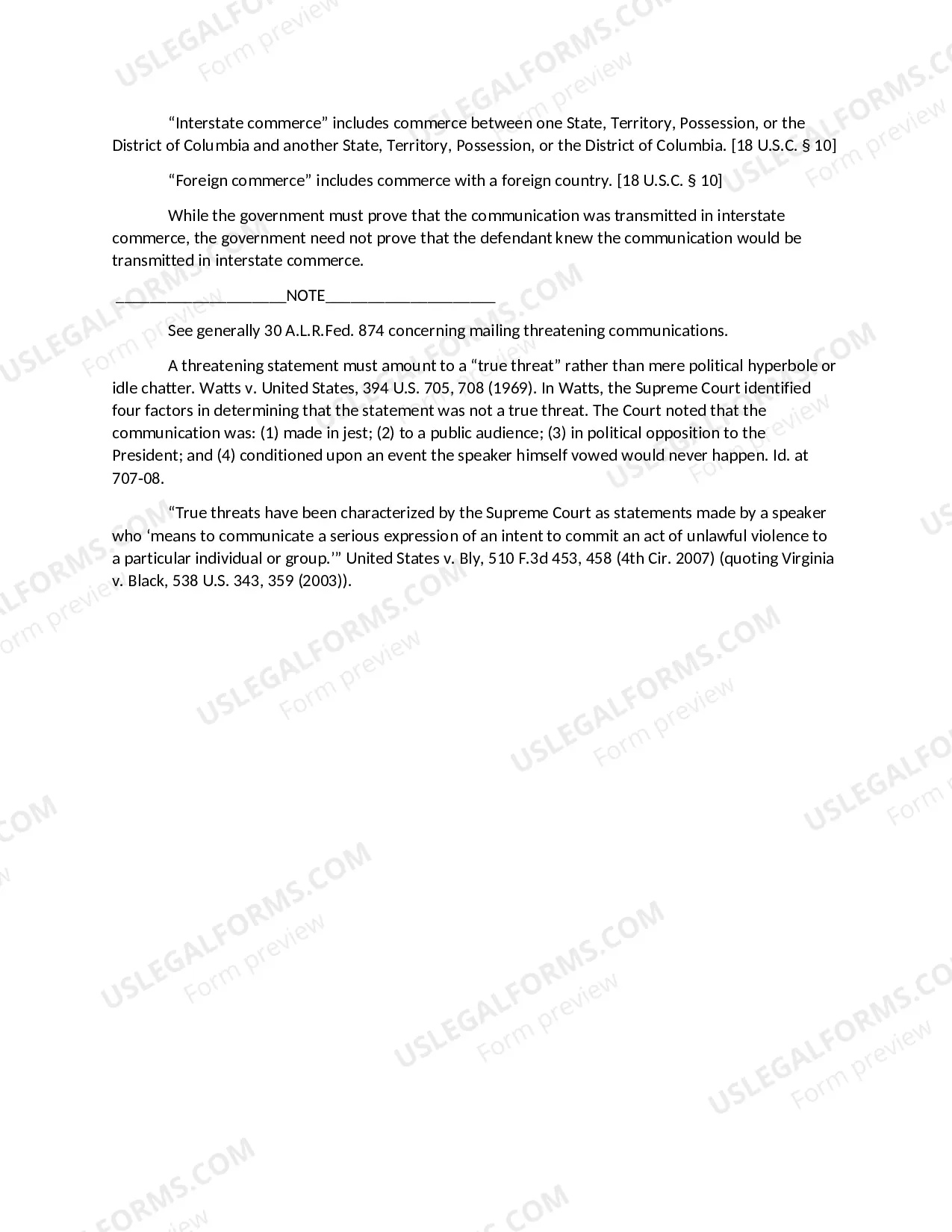
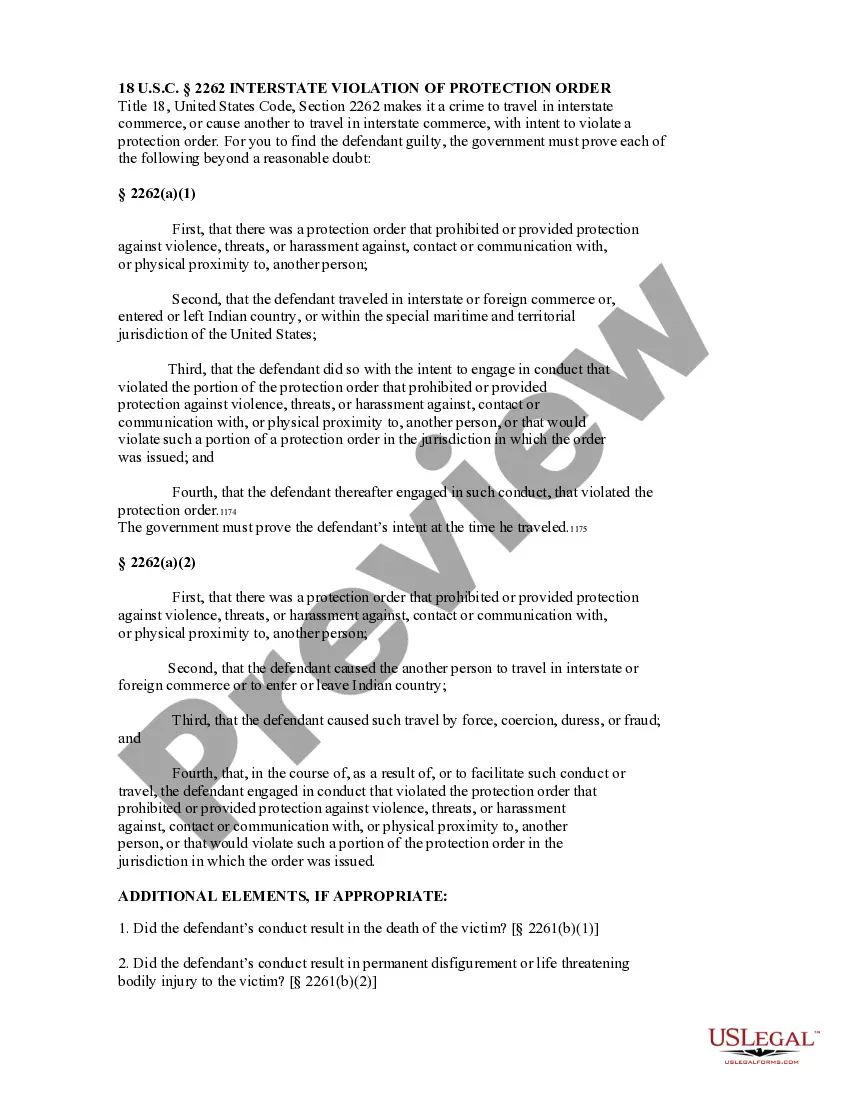
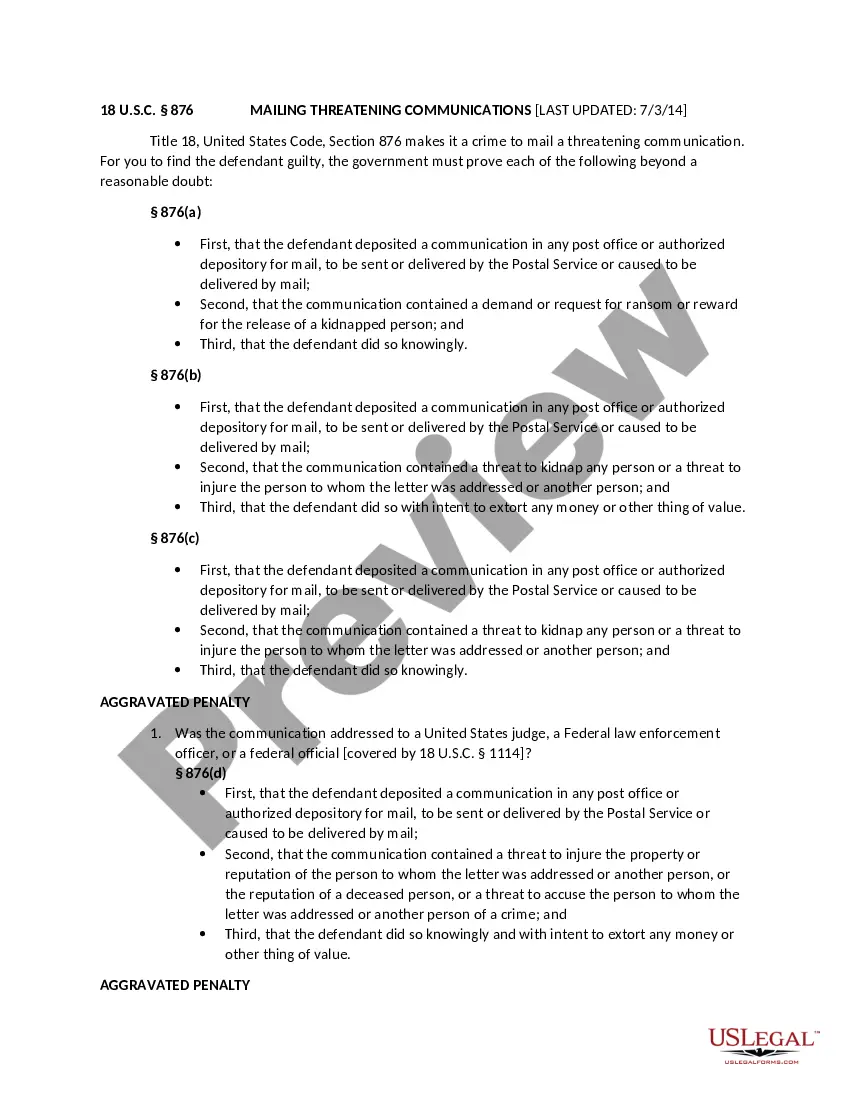
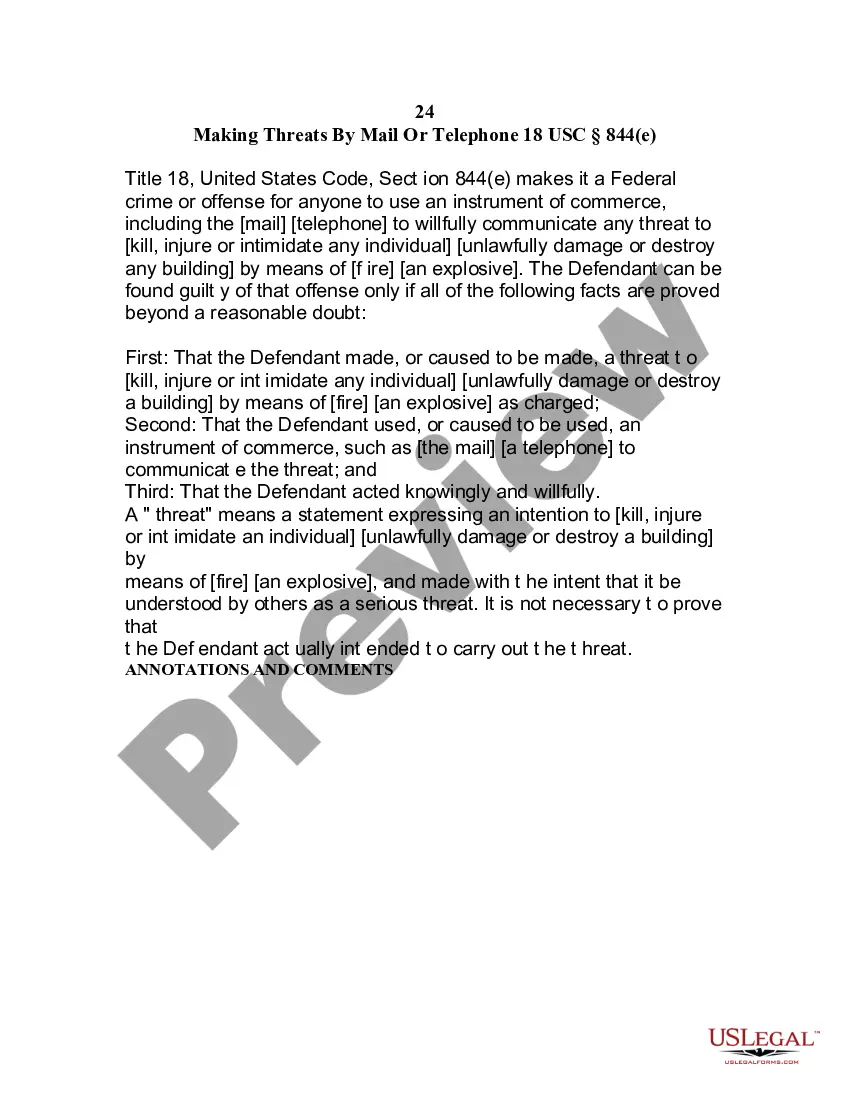
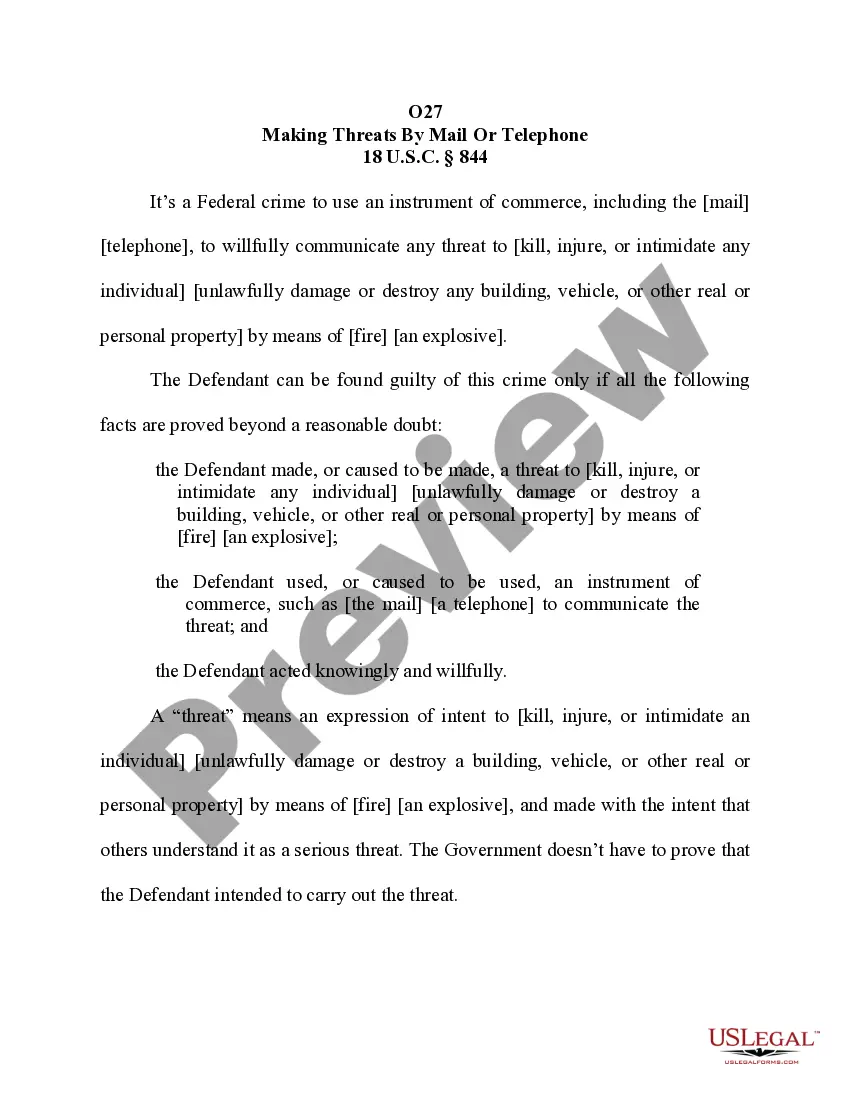
The Interstate Threatening Communications form is a legal document that outlines the requirements for proving a criminal charge related to threatening communications transmitted across state lines. It is particularly relevant in cases involving the transmission of threats to kidnap, injure, or extort from individuals or organizations. This form ensures that the legal standards for such cases are met and clarifies the definition of what constitutes a true threat, distinguishing it from mere political expressions or hyperbolic statements.
Key components of this form
- Definition of interstate commerce and its legal implications.
- Criteria for proven guilt under 18 U.S.C. Section 875.
- Elements required for each type of threatening communication.
- Explanations of what constitutes a true threat.
- Legal precedents affecting the interpretation of threatening communications.
Situations where this form applies
This form should be utilized in situations where an individual or organization believes they have received a threatening communication that was transmitted across state lines. It is applicable in legal proceedings where accusations of threats to kidnap, injure, or extort are made, and it serves to illustrate the legal framework that must be established for these charges to be valid.
Who can use this document
- Individuals who have received threatening communications and seek legal recourse.
- Legal professionals representing clients in cases of interstate threats.
- Law enforcement agencies needing a structured approach to prosecuting such threats.
- Victims of extortion who need to document the threatening nature of communications.
How to complete this form
- Identify the communicating parties involved in the threatening communication.
- Detail the nature of the communication, ensuring it includes the threat's context.
- Specify the interstate nature of the communication, proving it crossed state lines.
- Include any relevant evidence or documentation of the threat.
- Present information clearly to support each element of the accusations as per Section 875.
Is notarization required?
This form usually doesn’t need to be notarized. However, local laws or specific transactions may require it. Our online notarization service, powered by Notarize, lets you complete it remotely through a secure video session, available 24/7.
Get your form ready online
Our built-in tools help you complete, sign, share, and store your documents in one place.
Make edits, fill in missing information, and update formatting in US Legal Forms—just like you would in MS Word.
Download a copy, print it, send it by email, or mail it via USPS—whatever works best for your next step.
Sign and collect signatures with our SignNow integration. Send to multiple recipients, set reminders, and more. Go Premium to unlock E-Sign.
If this form requires notarization, complete it online through a secure video call—no need to meet a notary in person or wait for an appointment.
We protect your documents and personal data by following strict security and privacy standards.

Make edits, fill in missing information, and update formatting in US Legal Forms—just like you would in MS Word.

Download a copy, print it, send it by email, or mail it via USPS—whatever works best for your next step.

Sign and collect signatures with our SignNow integration. Send to multiple recipients, set reminders, and more. Go Premium to unlock E-Sign.

If this form requires notarization, complete it online through a secure video call—no need to meet a notary in person or wait for an appointment.

We protect your documents and personal data by following strict security and privacy standards.
Common mistakes to avoid
- Failing to establish that the communication was sent across state lines.
- Misinterpreting vague statements as true threats.
- Omitting crucial details about the intent behind the communication.
- Neglecting to include corroborating evidence to support claims.
- Confusing legal terminology or definitions within the accusations.
Why use this form online
- Convenience of accessing the form from anywhere, anytime.
- Easy editing options to customize the form to specific case needs.
- Reliable legal resources and templates created by licensed attorneys.
- Immediate download availability ensuring timely usage in legal proceedings.
Legal use & context
- Threats must carry a serious intent to commit violence to qualify as true threats under legal scrutiny.
- The distinction between a true threat and political speech is critical for court cases.
- Federal law applies uniformly across states, but interpretations may vary based on local jurisdictions.
- Successful prosecutions rely on meeting the burden of proof for each required element of Section 875.
What to keep in mind
- The Interstate Threatening Communications form is essential for addressing interstate threats legally.
- It provides clarity on what constitutes a true threat versus non-threatening speech.
- Caretakers of the law must gather and document evidence thoroughly to support claims.
- Understanding legal definitions is crucial in effectively using this form in court.
Looking for another form?
Form popularity
FAQ
Whoever, with intent to extort from any person any money or other thing of value, so deposits, or causes to be delivered, as aforesaid, any communication containing any threat to kidnap any person or any threat to injure the person of the addressee or of another, shall be fined under this title or imprisoned not more
Rapert, 75 M.J. 164 (communicating a threat under Article 134, UCMJ, requires the government to demonstrate four elements beyond a reasonable doubt: (1) that the accused communicated certain language expressing a present determination or intent to wrongfully injure the person, property, or reputation of another person,
Interstate communications. (a) Whoever transmits in interstate or foreign commerce any communication containing any demand or request for a ransom or reward for the release of any kidnapped person, shall be fined under this title or imprisoned not more than twenty years, or both.
115. Communicating threats. Any person subject to this chapter who wrongfully communicates a threat to injure the person, property, or reputation of another shall be punished as a court-martial may direct.
Whoever, being an officer, or employee of the United States or any department or agency thereof, or representing himself to be or assuming to act as such, under color or pretense of office or employment commits or attempts an act of extortion, shall be fined under this title or imprisoned not more than three years, or
Threatening the president of the United States is a federal felony under United States Code Title 18, Section 871. It consists of knowingly and willfully mailing or otherwise making "any threat to take the life of, to kidnap, or to inflict great bodily harm upon the president of the United States".
Current through 2023 Act No. 14. Section 16-17-425 - Student threats (A) It is unlawful for a student of a school or college in this State to make threats to take the life of or to inflict bodily harm upon another by using any form of communication whatsoever.
The penalties vary widely depending on the severity of the crime and the intention of the person charged. If someone threatens to physically hurt another person but does not actually hurt that individual, the penalty can be up a $500 fine and up to 30 days in jail for third-degree assault and battery.