South Carolina SMUGGLING
What is this form?
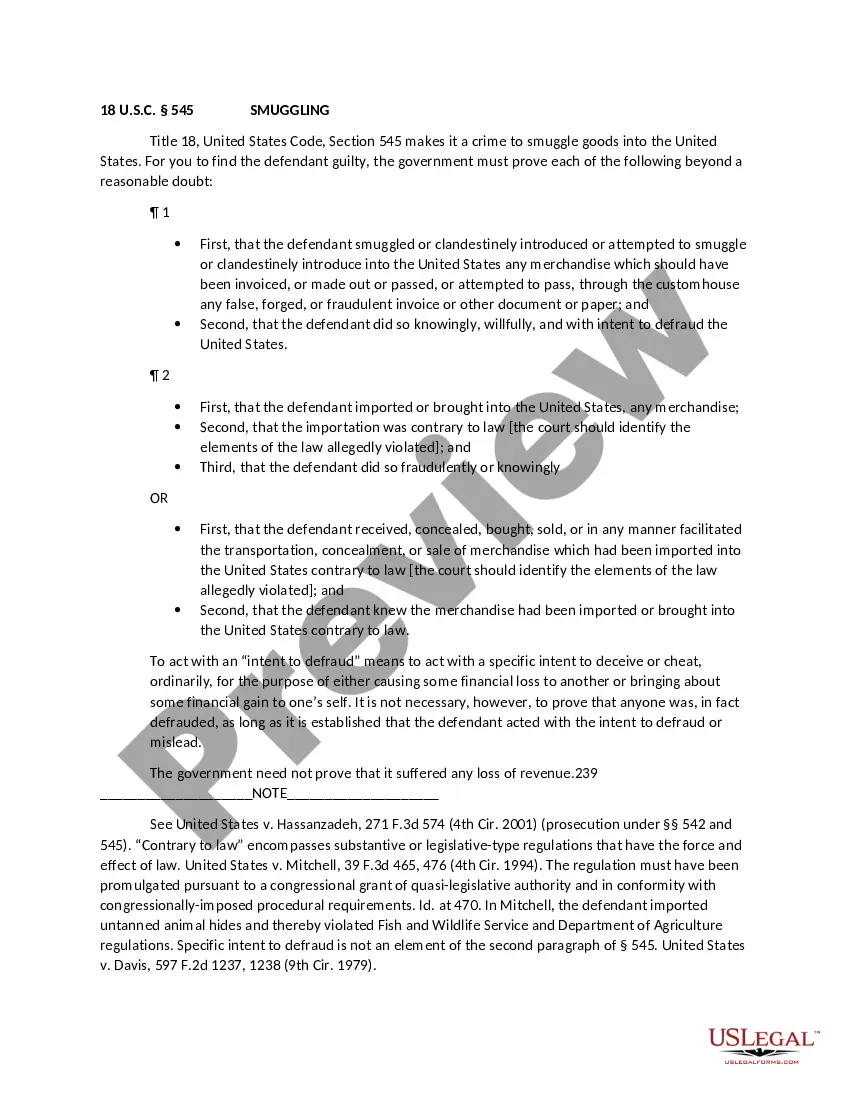
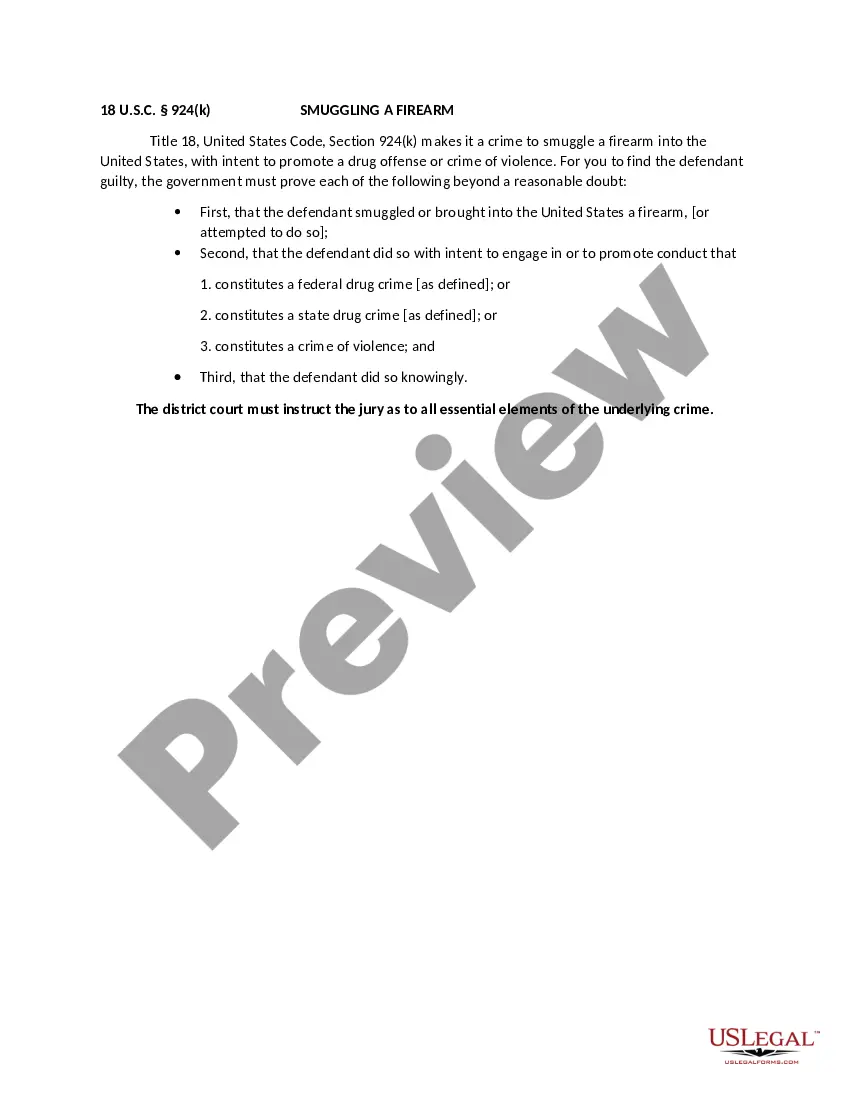
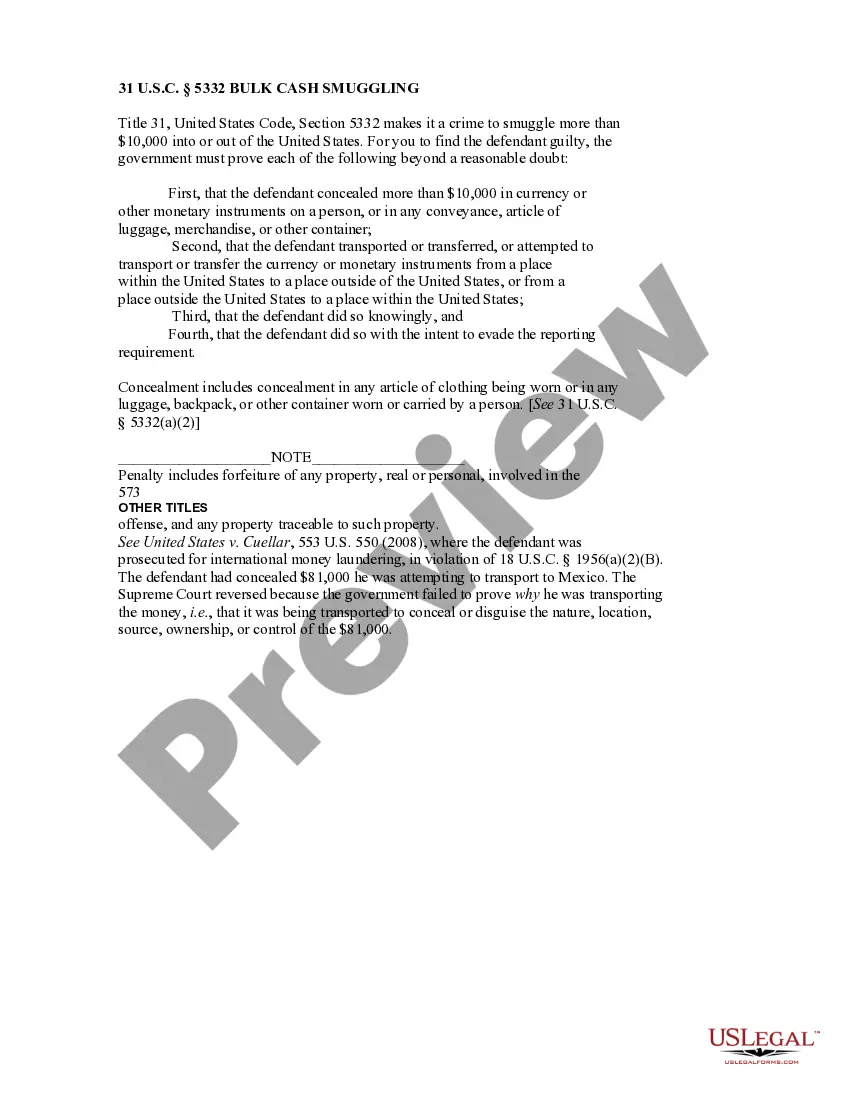
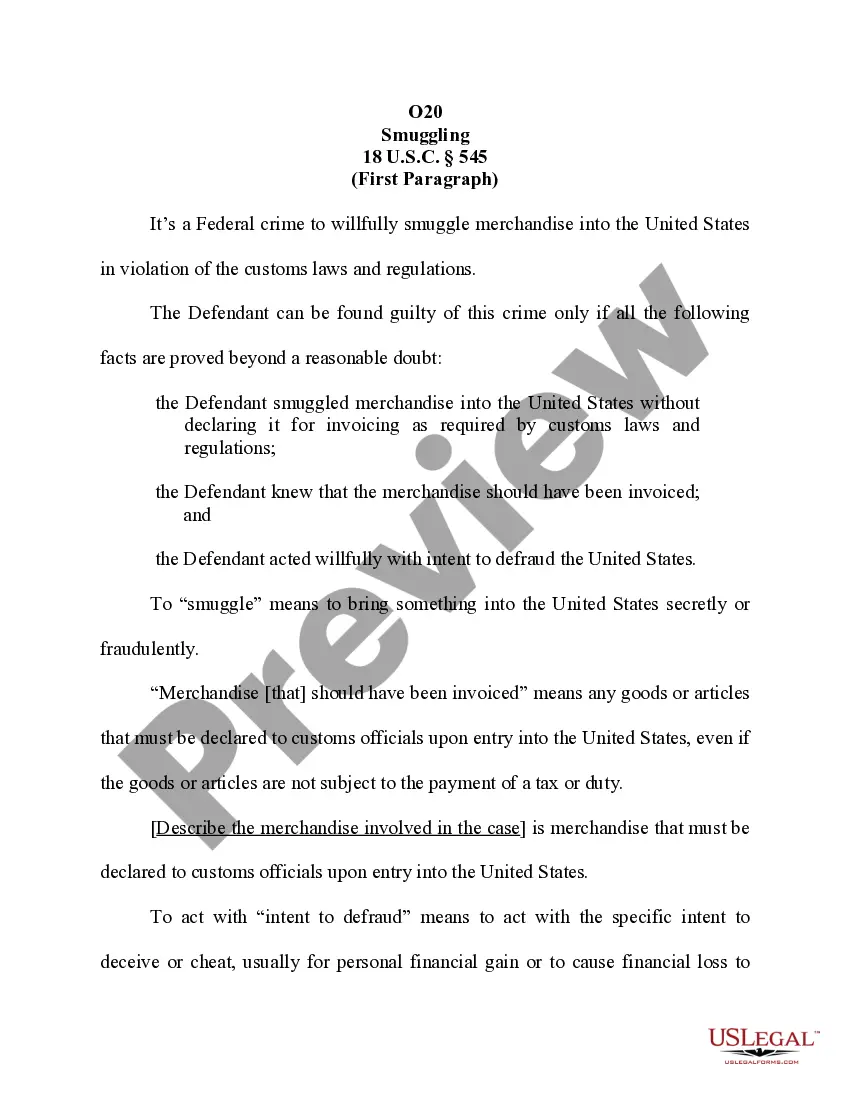
This form is the Official Pattern Jury Instructions for criminal cases related to smuggling in federal district courts of South Carolina. It outlines the legal criteria necessary for the prosecution of smuggling offenses under Title 18, United States Code, Section 545. Unlike other legal documents, this form is specifically designed for jury instructions, aiding jurors in understanding the elements of smuggling crimes and the requisite intent for conviction.
Key components of this form
- Definition of smuggling and related offenses.
- Requirements for the prosecution to prove the defendant acted knowingly and willfully.
- Explanation of fraudulent intentions behind smuggling activities.
- Clarification on the absence of need to prove actual financial loss.
- References to relevant legal precedents and definitions.
Common use cases
This form should be used in criminal trials involving allegations of smuggling goods into the United States. It is particularly applicable when the prosecution needs to demonstrate to jurors what actions constitute smuggling and the necessary mental state of the defendant. The form assists in framing the legal arguments presented in court regarding the specific elements of the offense.
Who needs this form
This form is intended for:
- Judges presiding over federal criminal trials involving smuggling.
- Prosecutors responsible for presenting smuggling cases to a jury.
- Defense attorneys representing clients accused of smuggling.
- Jurors selected to deliberate in such criminal cases.
How to complete this form
- Familiarize yourself with Title 18, Section 545 of the United States Code to understand the smuggling laws.
- Incorporate the necessary legal definitions and parameters as outlined in the form.
- Ensure clarity on the prosecution's burden to prove the elements of smuggling beyond a reasonable doubt.
- Review past case references included in the form to support legal arguments.
- Adapt the instructions as needed to align with specific trial details and jury needs.
Does this form need to be notarized?
Notarization is generally not required for this form. However, certain states or situations might demand it. You can complete notarization online through US Legal Forms, powered by Notarize, using a verified video call available anytime.
Get your form ready online
Our built-in tools help you complete, sign, share, and store your documents in one place.
Make edits, fill in missing information, and update formatting in US Legal Forms—just like you would in MS Word.
Download a copy, print it, send it by email, or mail it via USPS—whatever works best for your next step.
Sign and collect signatures with our SignNow integration. Send to multiple recipients, set reminders, and more. Go Premium to unlock E-Sign.
If this form requires notarization, complete it online through a secure video call—no need to meet a notary in person or wait for an appointment.
We protect your documents and personal data by following strict security and privacy standards.

Make edits, fill in missing information, and update formatting in US Legal Forms—just like you would in MS Word.

Download a copy, print it, send it by email, or mail it via USPS—whatever works best for your next step.

Sign and collect signatures with our SignNow integration. Send to multiple recipients, set reminders, and more. Go Premium to unlock E-Sign.

If this form requires notarization, complete it online through a secure video call—no need to meet a notary in person or wait for an appointment.

We protect your documents and personal data by following strict security and privacy standards.
Typical mistakes to avoid
- Failing to adequately explain the specific intent necessary for a smuggling conviction.
- Misinterpreting the legal criteria for what constitutes fraudulent behavior.
- Overlooking the requirement to prove the defendant's guilt beyond a reasonable doubt.
Why use this form online
- Convenient access to the latest legal formats suitable for this type of case.
- Easier to edit and customize as needed based on case specifics.
- Reliable source of legal information as it is drafted by licensed attorneys.
Looking for another form?

Form popularity
FAQ
During June 1998, at the Wando Terminal, the largest terminal at the Port of Charleston, authorities seized 1,403 kilograms of cocaine hidden in soft luggage inside a 40-foot shipping container on a Greek-flagged vessel. The ship arrived from Colombia, South America, by way of the Bahamas.
In the 1970s, kingpins and Columbia natives Les Riley and Barry Foy smuggled an astounding amount of marijuana and hashish into South Carolina, equating $1.8 billion in today's dollars. The two men were nicknamed ?the Gentlemen Smugglers? given their standards and college education.
?It might surprise people that cartel drug trafficking happens in South Carolina, but it does and we're fighting to stop it,? Wilson said. ?By working with our partners at SLED and local agencies, we're able to investigate and prosecute complex trafficking conspiracies like this one and defend the rule of law.
Gentlemen Smugglers Versus Operation Jackpot: Defying The War On Drugs. Throughout the 1970s and 1980s, Foy, Les Riley, and Bob Byers established their successful smuggling operation, moving cannabis around the globe with unlikely allies such as an all-female boating crew.
During June 1998, at the Wando Terminal, the largest terminal at the Port of Charleston, authorities seized 1,403 kilograms of cocaine hidden in soft luggage inside a 40-foot shipping container on a Greek-flagged vessel. The ship arrived from Colombia, South America, by way of the Bahamas.
The South American cartels had their origins in the late 1960s and early 1970s, when the United States cracked down on Mexican drug trafficking and thereby opened the market to South American suppliers. At the same time, demand for marijuana and cocaine increased substantially in the United States.
The Five Most Famous Drug Cartels Guadalajara Cartel. Sinoloa Cartel. Tijuana Cartel. Juarez Cartel. Gulf Cartel.
The DEA's latest assessment found major Mexican cartels operating in at least 60 American cities. That activity extends as far south as Miami, Florida, and as far north as Bellingham, Washington.