Rhode Island Quitclaim Deed - Trust to Individual
What is this form?
The Quitclaim Deed - Trust to Individual is a legal document that enables a trust (the grantor) to transfer property rights to an individual (the grantee). This form is particularly useful when a property held in a trust needs to be conveyed to an individual beneficiary. Unlike a warranty deed, which guarantees clear title, a quitclaim deed provides no such assurance and simply conveys whatever interest the grantor may have in the property, making it essential for parties to understand the risks involved.
Form components explained
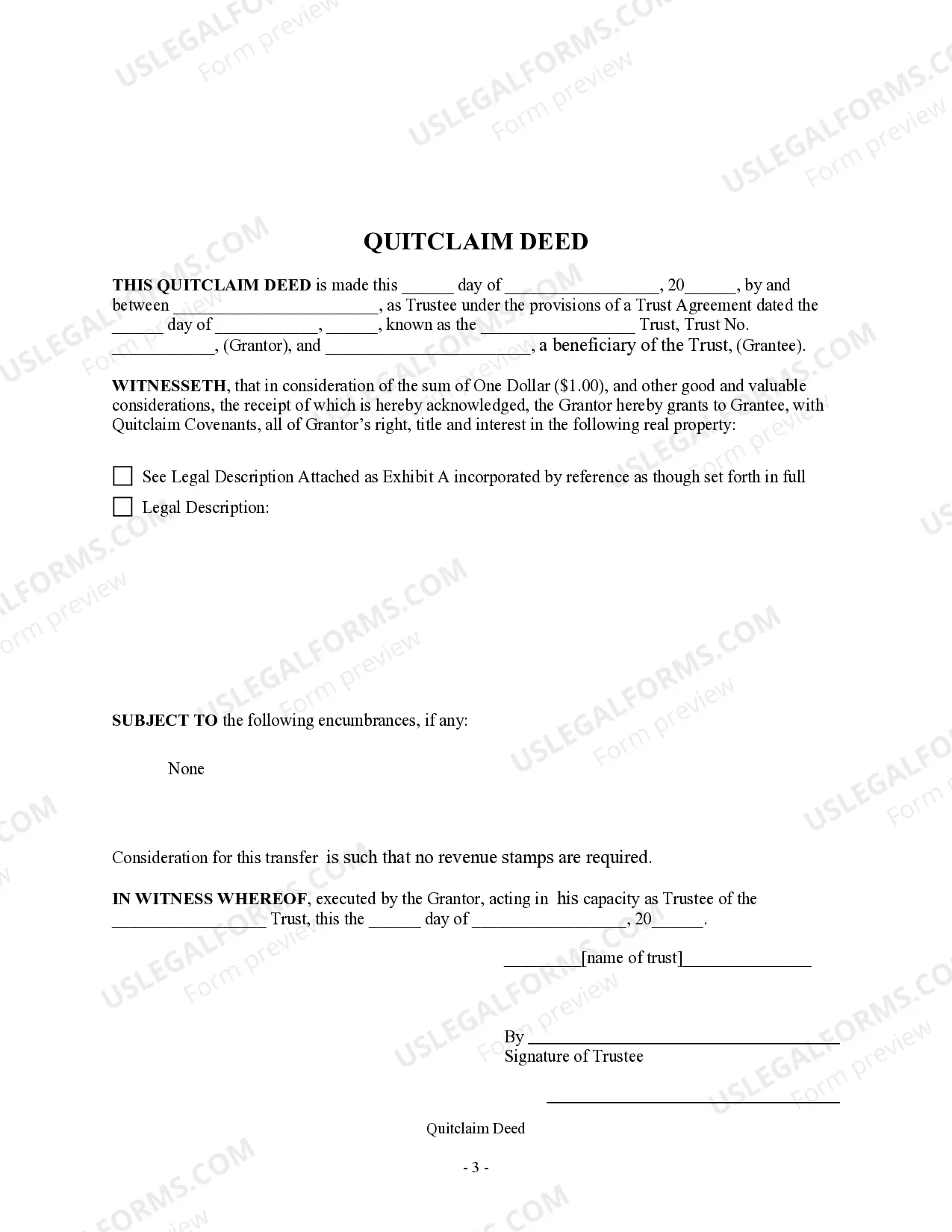
- Identification of the grantor (the trust) along with the trustee's signature.
- Identification of the grantee (the individual receiving the property).
- Legal description of the property being transferred.
- Statement of consideration for the property.
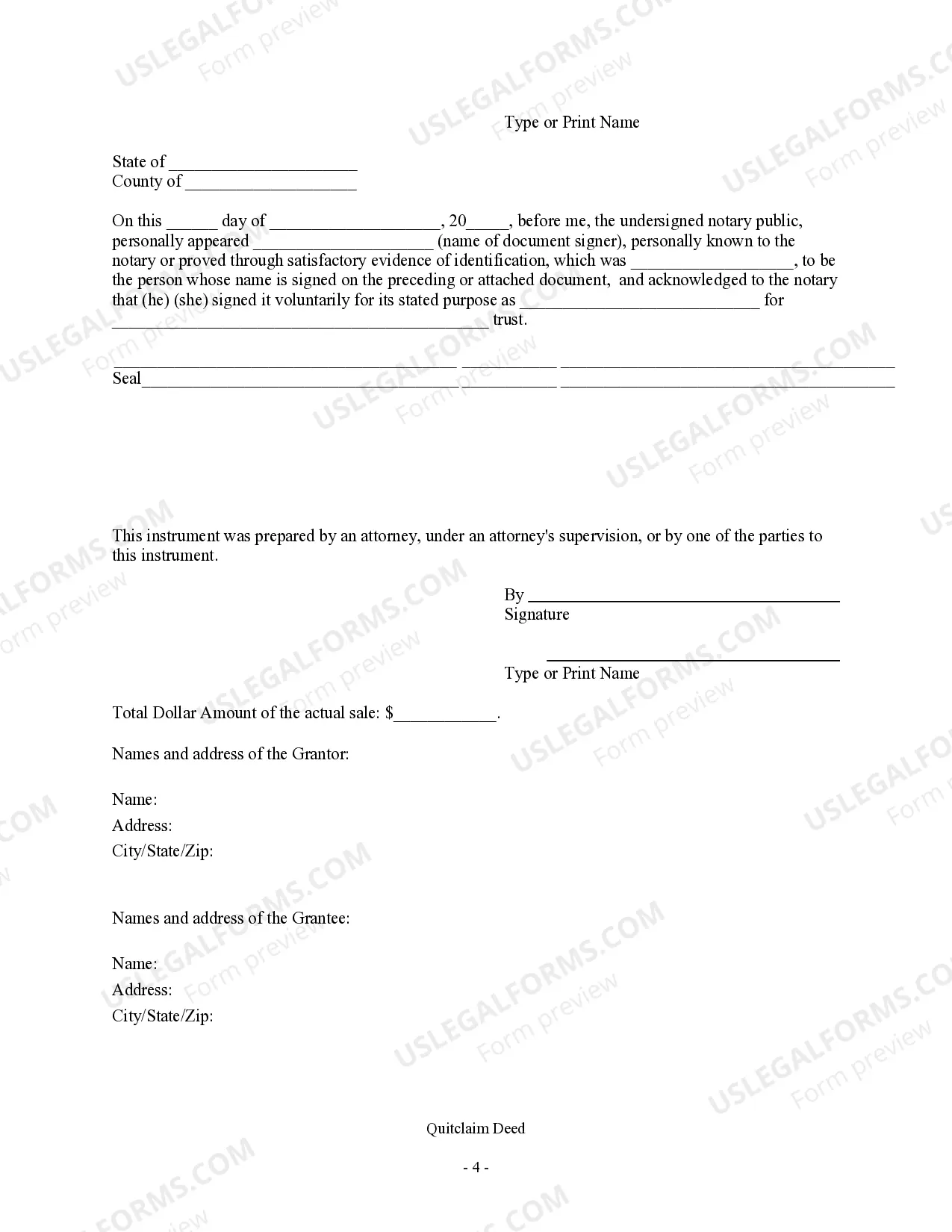
- Notary acknowledgment to validate the execution of the deed.






When this form is needed
This quitclaim deed is suitable in scenarios such as transferring property from a family trust to a family member, executing a property transfer after a divorce settlement, or clarifying property rights among co-trustees or beneficiaries of a trust. It is often used when there is no need for the grantor to warrant the title against claims from other parties.
Who can use this document
This form is intended for:
- Trustees who need to transfer property from a trust to an individual.
- Individuals who are beneficiaries of a trust and are receiving property.
- Attorneys or legal representatives tasked with facilitating property transfers related to trusts.
How to prepare this document
- Identify the parties involved, including the trust as grantor and the individual as grantee.
- Specify the property being transferred by including a complete legal description.
- Enter the date of the transfer and the amount consideration (typically $1.00).
- Have the trustee sign the deed in the presence of a notary public.
- Ensure the notary completes the acknowledgment section for validation.
Notarization guidance
This form must be notarized to be legally valid. US Legal Forms provides secure online notarization powered by Notarize, allowing you to complete the process through a verified video call.
Get your form ready online
Our built-in tools help you complete, sign, share, and store your documents in one place.
Make edits, fill in missing information, and update formatting in US Legal Forms—just like you would in MS Word.
Download a copy, print it, send it by email, or mail it via USPS—whatever works best for your next step.
Sign and collect signatures with our SignNow integration. Send to multiple recipients, set reminders, and more. Go Premium to unlock E-Sign.
If this form requires notarization, complete it online through a secure video call—no need to meet a notary in person or wait for an appointment.
We protect your documents and personal data by following strict security and privacy standards.

Make edits, fill in missing information, and update formatting in US Legal Forms—just like you would in MS Word.

Download a copy, print it, send it by email, or mail it via USPS—whatever works best for your next step.

Sign and collect signatures with our SignNow integration. Send to multiple recipients, set reminders, and more. Go Premium to unlock E-Sign.

If this form requires notarization, complete it online through a secure video call—no need to meet a notary in person or wait for an appointment.

We protect your documents and personal data by following strict security and privacy standards.
Typical mistakes to avoid
- Failing to include a complete legal description of the property.
- Not obtaining a notarization, which can invalidate the deed.
- Leaving out the appropriate signatures from either the trustee or the grantee.
Why complete this form online
- Easily editable fields that allow for quick customization on your computer.
- Convenience of downloading the form instantly without waiting for delivery.
- Access to a form created by licensed attorneys, ensuring it meets legal standards.
Legal use & context
- This deed conveys property rights but does not guarantee marketable title.
- Ideal for straightforward property transfers between trusts and individuals.
- Could lead to disputes if the underlying title is contested, so caution is advised.
Summary of main points
- The Quitclaim Deed - Trust to Individual is essential for transferring property from a trust to an individual.
- Ensure all details are accurately completed to avoid legal complications.
- Notarization is required for the form to be effective.
Looking for another form?

Form popularity
FAQ
Fill out the quit claim deed form, which can be obtained online, or write your own using the form as a guide. The person giving up the interest in the property is the grantor, and the person receiving the interest is the grantee.
Yes, you can use a Quitclaim Deed to transfer a gift of property to someone. You must still include consideration when filing your Quitclaim Deed with the County Recorder's Office to show that title has been transferred, so you would use $10.00 as the consideration for the property.
If you own your own home, you are free to gift or sell an interest in the real property to someone else.You'll need to transfer an interest by writing up another deed with the person's name on it. In California, you can use either a grant deed, a quitclaim deed or an interspousal deed, depending on your circumstances.
A person who signs a quitclaim deed to transfer property they do not own results in no title at all being transferred since there is no actual ownership interest. The quitclaim deed only transfers the type of title you own.
Yes, a quit claim deed supercedes the trust. The only thing that can be done is to file a suit in court challenging the deed as the product of fraud and undue influence. A court action like that will cost thousands of dollars, but might be worth it if the house was owned free and clear.
To use a Quitclaim Deed to add someone to a property deed or title, you would need to create a Quitclaim Deed and list all of the current owners in the grantor section. In the grantee section, you would list all of the current owners as well as the person you would like to add.
But you might be wondering if an owner can transfer a deed to another person without a real estate lawyer. The answer is yes. Parties to a transaction are always free to prepare their own deeds.A quitclaim deed, for example, is far simpler than a warranty deed.
Quitclaim deeds are most often used to transfer property between family members.Examples include when an owner gets married and wants to add a spouse's name to the title or deed, or when the owners divorce and one spouse's name is removed from the title or deed.