Mississippi Final Judgment of Dismissal with Prejudice
What this document covers
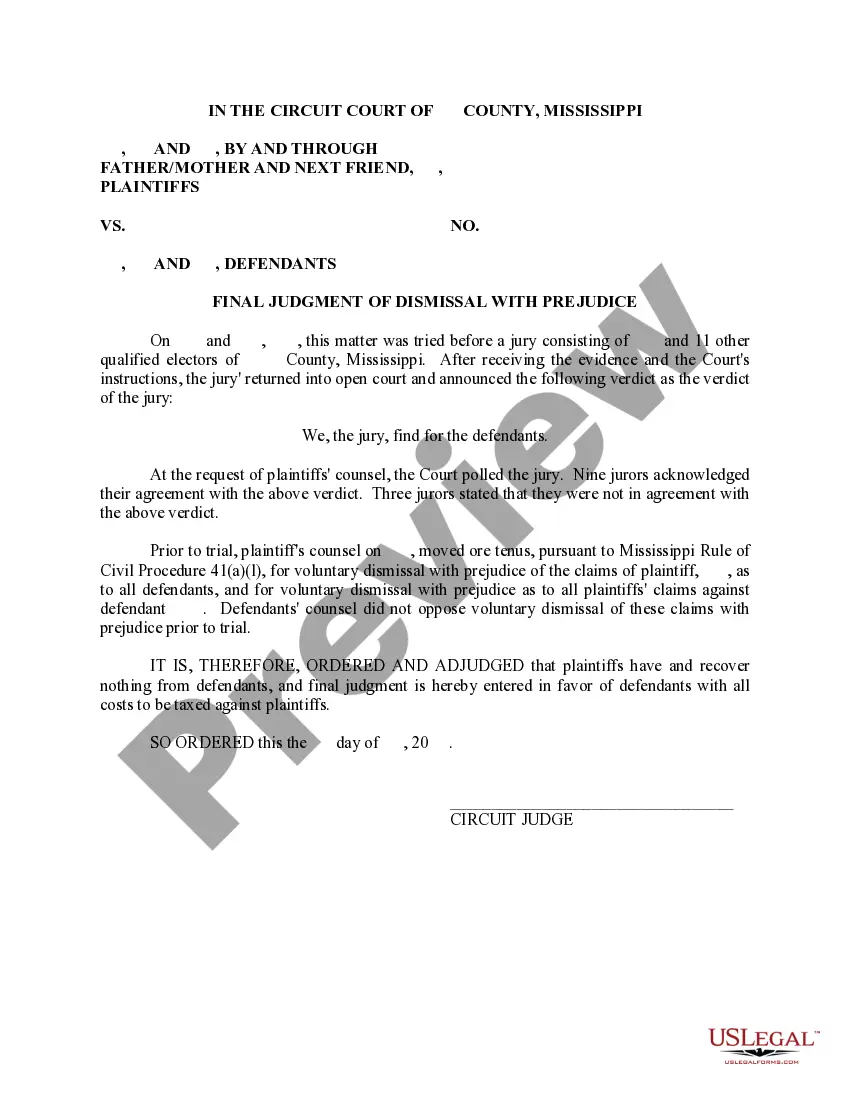
The Final Judgment of Dismissal with Prejudice is a legal document used in Mississippi to officially conclude a lawsuit, stating that all claims have been resolved and the matter is no longer active. This form is vital for ensuring that the plaintiff cannot refile the same claims against the defendants in the future, distinguishing it from other dismissal forms that may allow for further action. It serves as a final resolution to the case, providing closure for all parties involved.
Form components explained
- Caption with the names of the parties involved and case number.
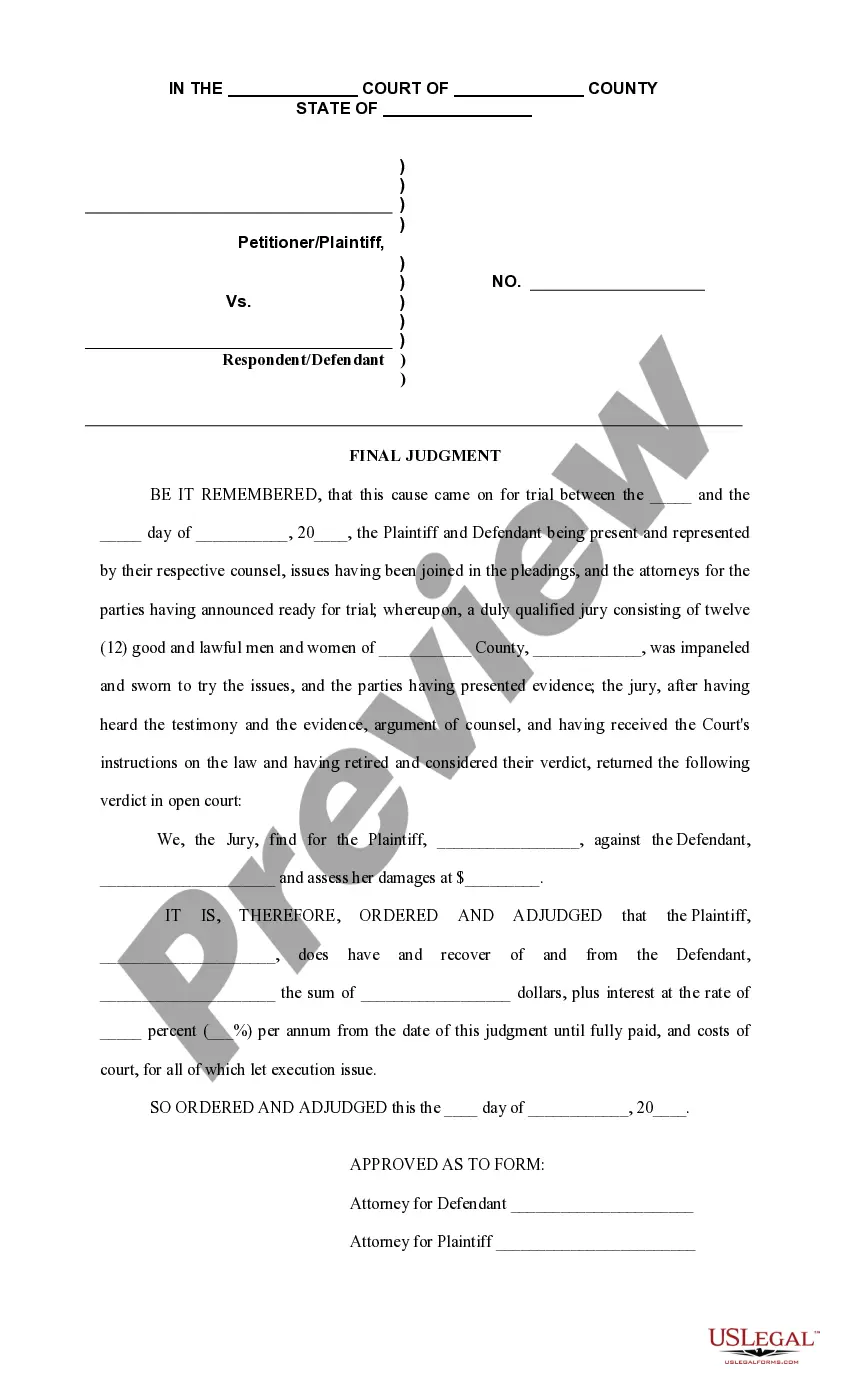
- Information about the jury verdict and polling results.
- Motion for voluntary dismissal with prejudice prior to trial.
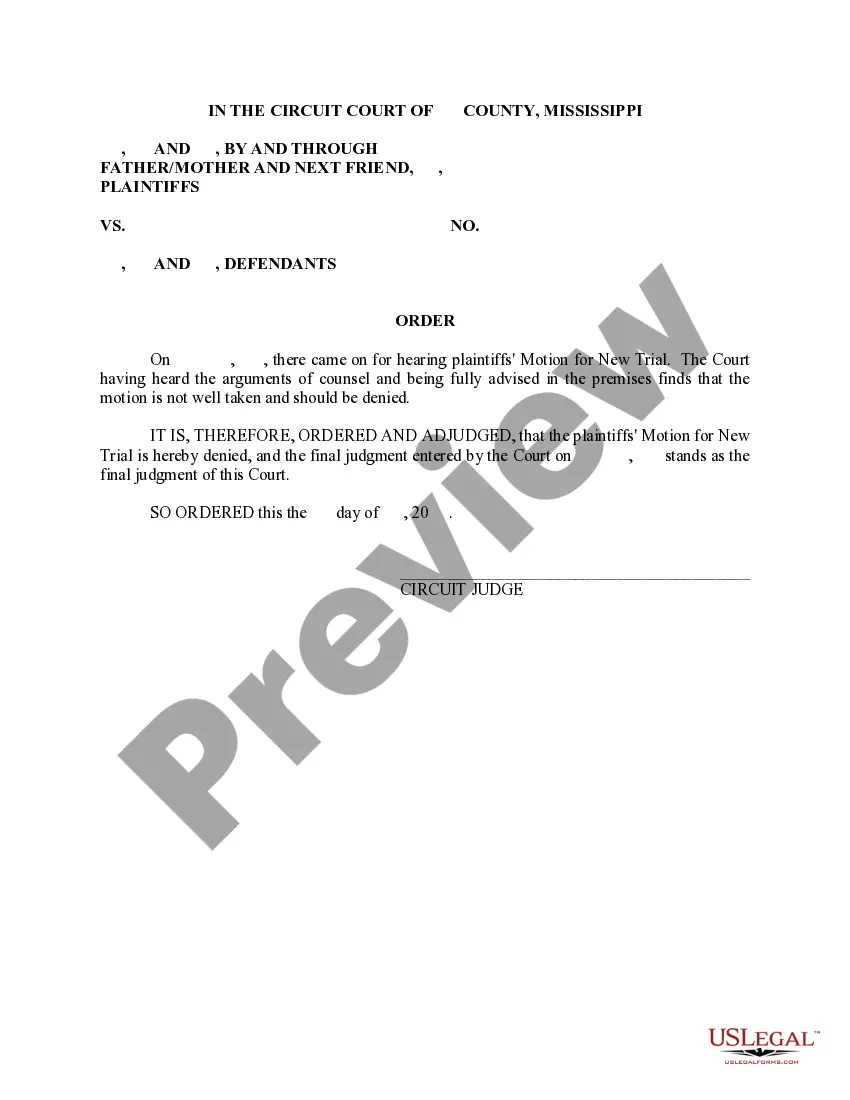
- Final judgment declaration, stating the plaintiffs recover nothing.
- Order signature line for the Circuit Judge.
Situations where this form applies
This form should be utilized when a plaintiff decides to voluntarily dismiss their lawsuit with prejudice, meaning they cannot pursue the same claims again. It is commonly used after a trial where a jury has determined the verdict or in situations where parties have reached a settlement and wish to conclude the legal matter definitively.
Who should use this form
- Plaintiffs in a lawsuit who seek to dismiss their claims against a defendant.
- Legal representatives or attorneys acting on behalf of a plaintiff.
- Defendants who have reached an agreement with plaintiffs regarding dismissal of claims.
How to complete this form
- Identify and fill in the names of the plaintiffs and defendants at the top of the form.
- Enter the case number assigned to your lawsuit.
- Document the date of the jury trial and the verdict details.
- Include the motion details for voluntary dismissal with prejudice.
- Provide the judgeâs signature line, and ensure the date is clearly indicated.
Does this document require notarization?
This form does not typically require notarization unless specified by local law. However, it is advisable to check with legal counsel to ensure compliance with specific requirements in your case.
Get your form ready online
Our built-in tools help you complete, sign, share, and store your documents in one place.
Make edits, fill in missing information, and update formatting in US Legal Forms—just like you would in MS Word.
Download a copy, print it, send it by email, or mail it via USPS—whatever works best for your next step.
Sign and collect signatures with our SignNow integration. Send to multiple recipients, set reminders, and more. Go Premium to unlock E-Sign.
If this form requires notarization, complete it online through a secure video call—no need to meet a notary in person or wait for an appointment.
We protect your documents and personal data by following strict security and privacy standards.

Make edits, fill in missing information, and update formatting in US Legal Forms—just like you would in MS Word.

Download a copy, print it, send it by email, or mail it via USPS—whatever works best for your next step.

Sign and collect signatures with our SignNow integration. Send to multiple recipients, set reminders, and more. Go Premium to unlock E-Sign.

If this form requires notarization, complete it online through a secure video call—no need to meet a notary in person or wait for an appointment.

We protect your documents and personal data by following strict security and privacy standards.
Common mistakes to avoid
- Failing to accurately fill in the names and case number.
- Omitting important details about the jury verdict.
- Not properly signing or dating the form before submission.
Benefits of using this form online
- Convenience of downloading and printing from home.
- Editable fields allow for easy customization to your case.
- Reliability of forms drafted by licensed attorneys.
Quick recap
- The Final Judgment of Dismissal with Prejudice permanently closes a lawsuit, preventing future claims.
- Essential for plaintiffs and defendants to formally end litigation.
- Must comply with Mississippi law for validity and enforcement.
Looking for another form?
Form popularity
FAQ
Dismissal with prejudice is a final judgment and the case becomes res judicata on the claims that were or could have been brought in it; dismissal without prejudice is not.
A case will be dismissed with prejudice if there is reason for the case not to be brought back to court; for example, if the judge deems the lawsuit frivolous or the the matter under consideration is resolved outside of court.
When a lawsuit is dismissed with prejudice, the court is saying that it has made a final determination on the merits of the case, and that the plaintiff is therefore forbidden from filing another lawsuit based on the same grounds.
Definitions of judgment of dismissal. noun. a judgment disposing of the matter without a trial.
When a lawsuit is dismissed with prejudice, the court is saying that it has made a final determination on the merits of the case, and that the plaintiff is therefore forbidden from filing another lawsuit based on the same grounds. See also: dismiss, dismissal without prejudice. courts.
The last decision from a court that resolves all issues in dispute and settles the parties' rights with respect to those issues. A final judgment leaves nothing except decisions on how to enforce the judgment, whether to award costs, and whether to file an appeal.
If a case is dismissed with prejudice, then the charges are dropped completely. A dismissal with prejudice is a final decision on your criminal case. Once dismissed, the case will have no effect on your criminal record.
Dismissal with Prejudice A dismissal with prejudice is a judgment rendered in a lawsuit on its merits that prevents the plaintiff from bringing the same lawsuit against the same defendant in the future. It is a harsh remedy that has the effect of canceling the action so that it can never again be commenced.
In a criminal court, a judge can dismiss a case with prejudice, for example, when false accusations and lingering suspicions may do harm to the defendant's reputation or position in the community.