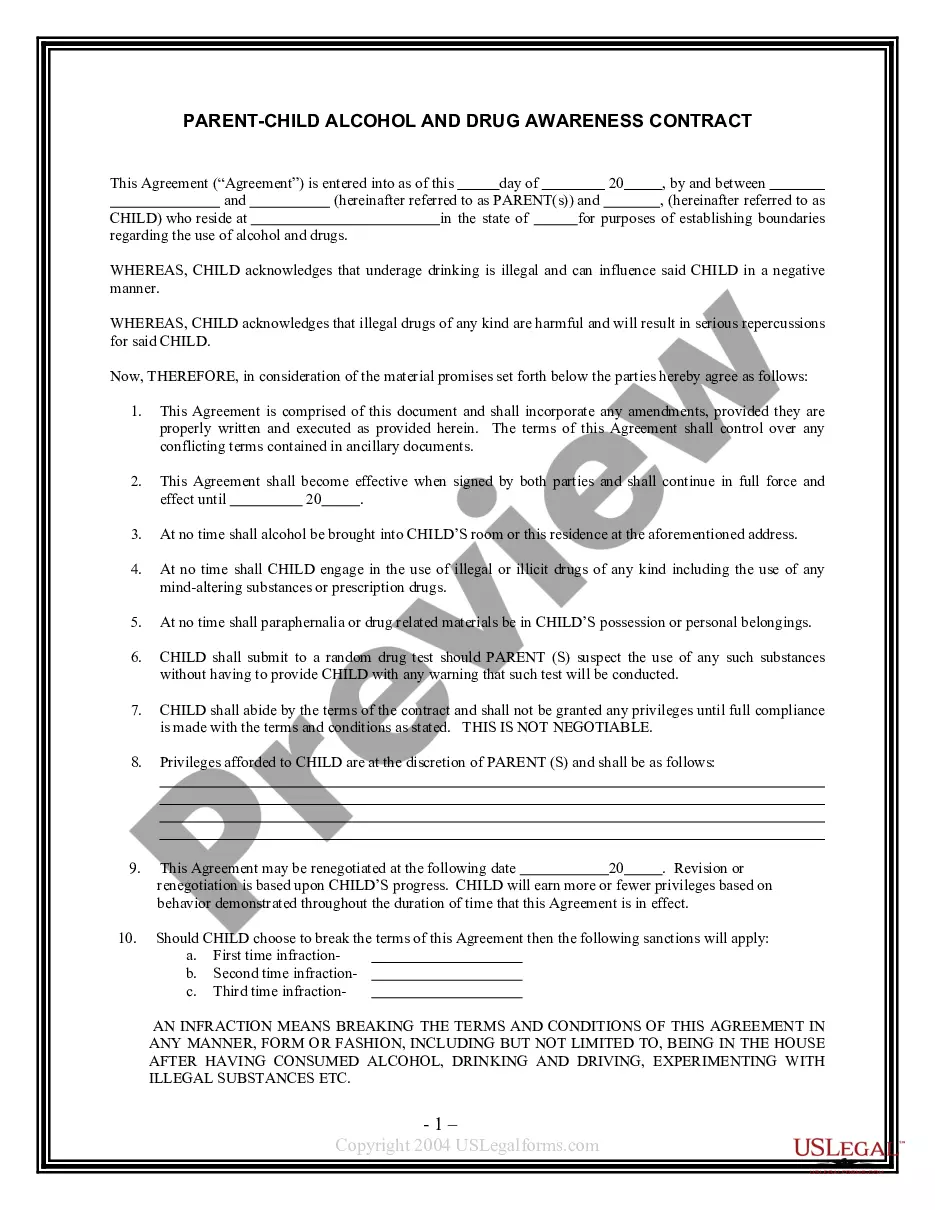
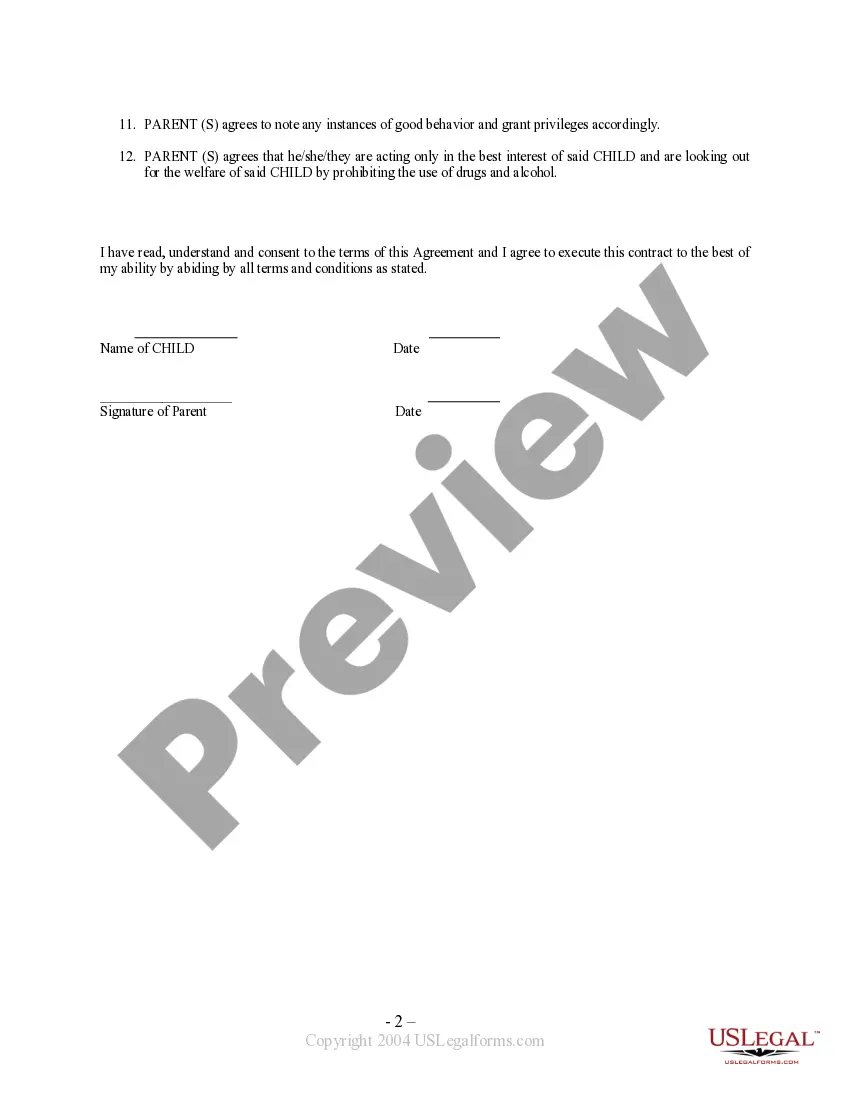
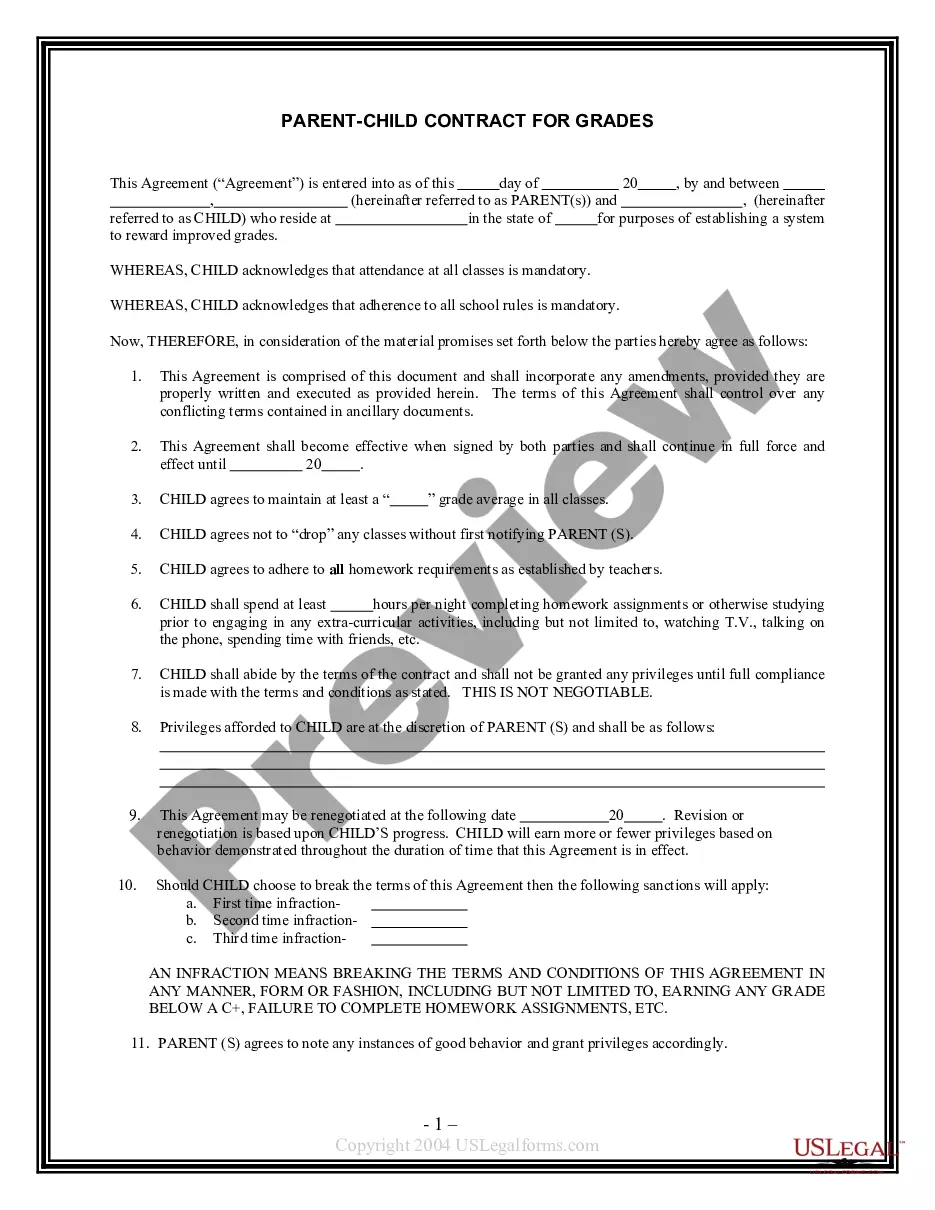
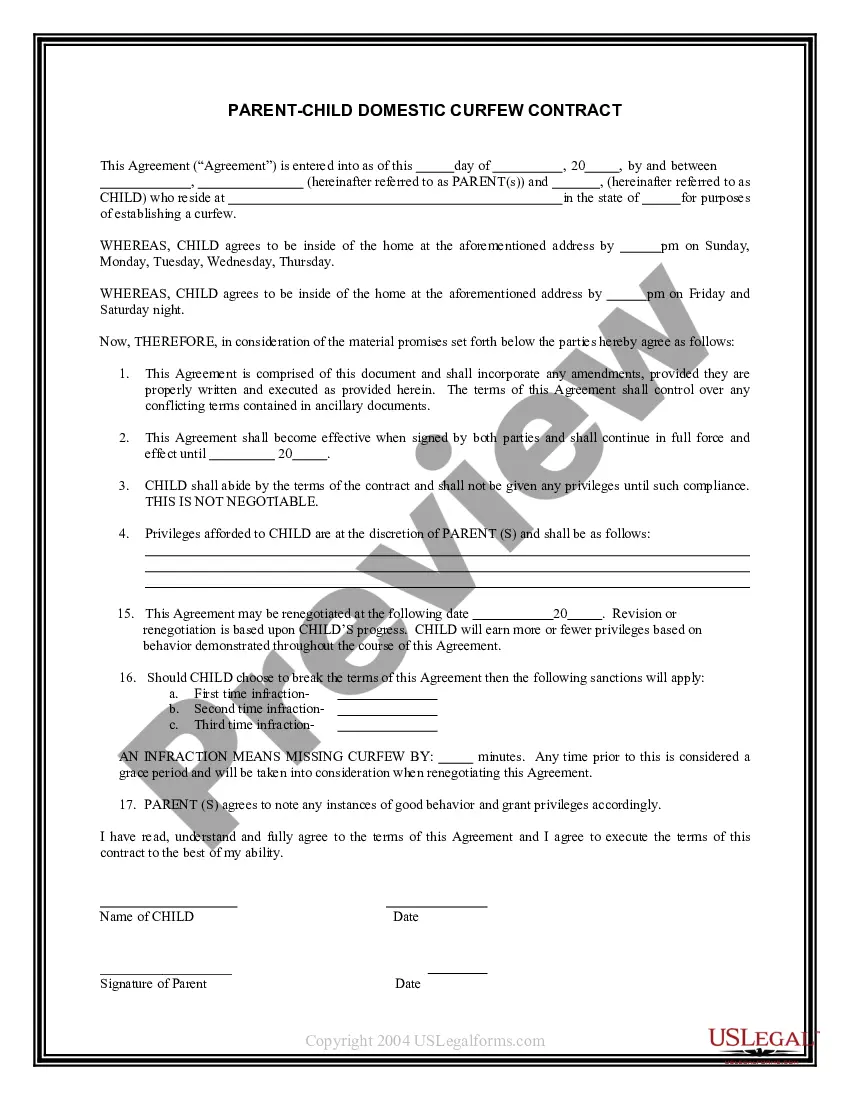
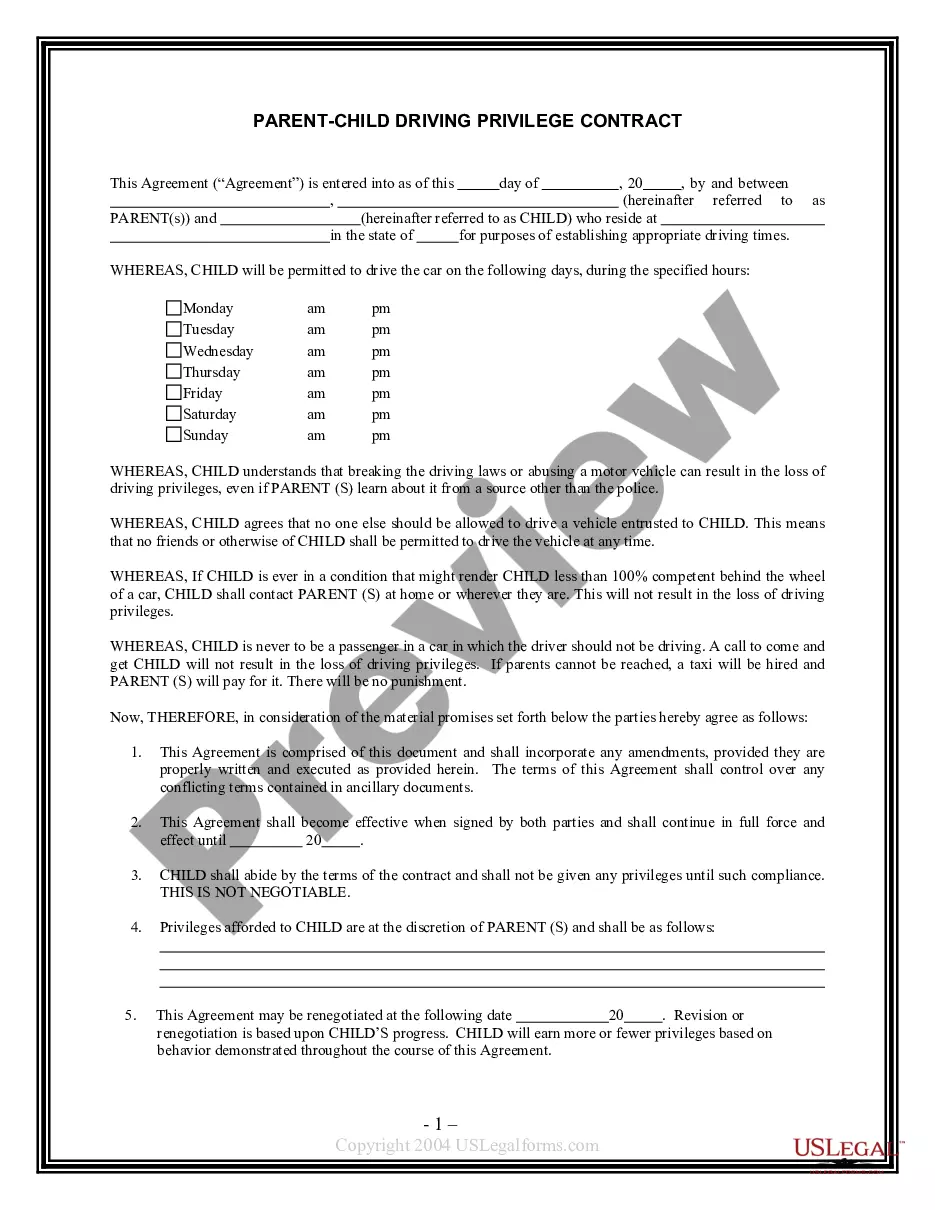
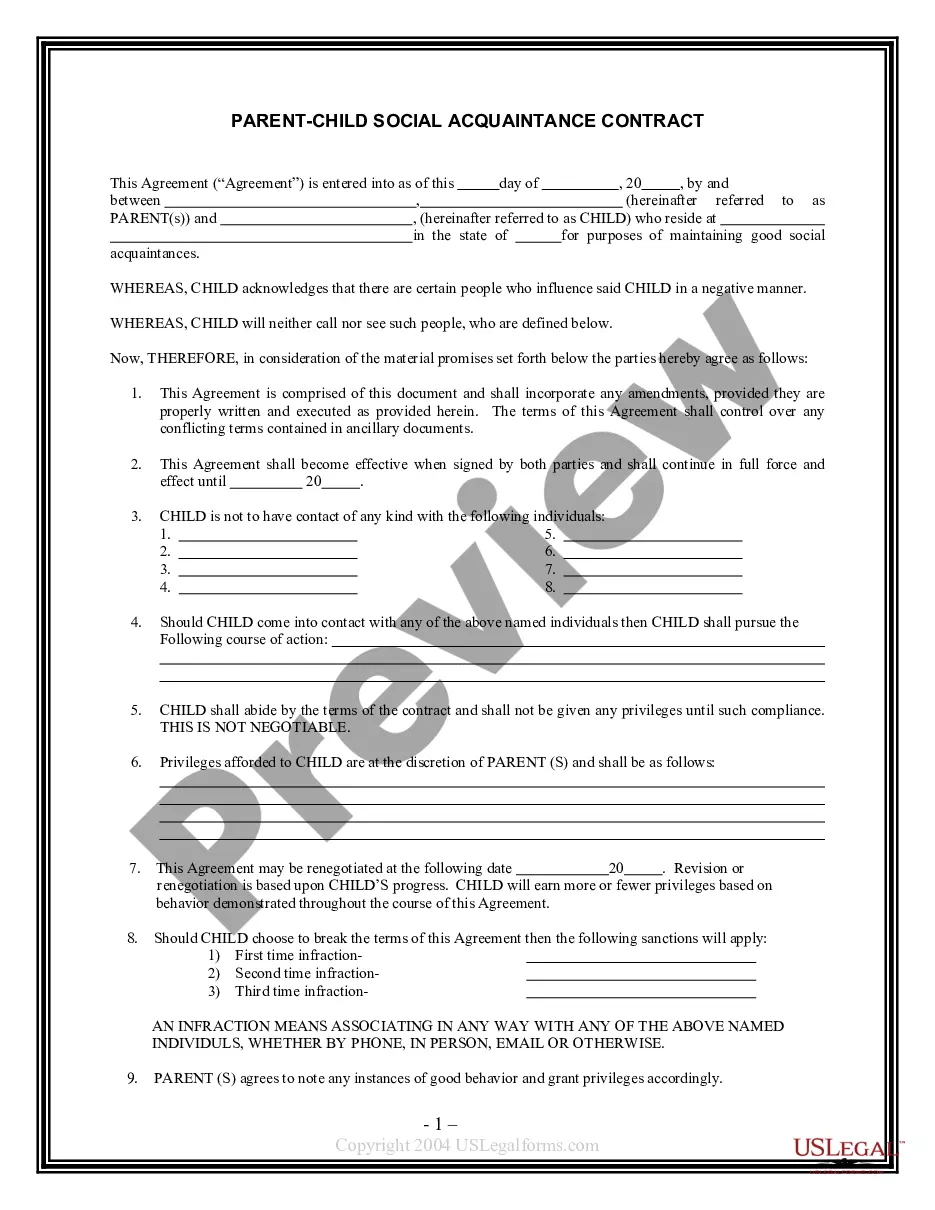
This is a contract between parent(s) and child regarding the use of drugs and alcohol and the repercussions for failing to abide by the terms as indicated. Child is also afforded certain privileges for good behavior as agreed upon by the parents.
Pennsylvania Parent - Child Contract For Alcohol And Drug Awareness
Category:
State:
Multi-State
Control #:
US-PC02
Format:
Word;
Rich Text
Instant download
Description
Free preview

How to fill out Parent - Child Contract For Alcohol And Drug Awareness?
You might spend hours online searching for the sanctioned document template that meets the state and national requirements you need. US Legal Forms offers a vast collection of legal forms that are reviewed by experts.
You can download or print the Pennsylvania Parent - Child Agreement For Alcohol And Drug Awareness from the service. If you already possess a US Legal Forms account, you can Log In and click the Download button. After that, you can complete, modify, print, or sign the Pennsylvania Parent - Child Agreement For Alcohol And Drug Awareness.
Every legal document template you purchase becomes your property indefinitely. To obtain another copy of a purchased form, go to the My documents section and click the appropriate button.
Choose the format of your document and download it to your device. Make modifications to your document if necessary. You can complete, edit, sign, and print the Pennsylvania Parent - Child Agreement For Alcohol And Drug Awareness. Download and print a multitude of document templates from the US Legal Forms website, which offers the largest variety of legal forms. Utilize professional and state-specific templates to address your business or personal needs.
- If you are using the US Legal Forms website for the first time, follow the simple instructions below.
- First, ensure you have selected the correct document template for the state/city of your choice. Review the form description to confirm you have chosen the right one.
- If available, utilize the Review button to examine the document template as well.
- If you wish to find another version of the form, use the Search field to locate the template that fits your needs and criteria.
- Once you have identified the template you desire, click on Purchase now to proceed.
- Select the pricing plan you prefer, enter your credentials, and register for an account on US Legal Forms.
- Complete the transaction. You may use your credit card or PayPal account to buy the legal document.
Form popularity
FAQ
It's important to start conversations about drugs as early as possible, ideally around age 8 or 9. At this age, children are more receptive to learning about the risks and consequences associated with drug use. The Pennsylvania Parent - Child Contract For Alcohol And Drug Awareness can facilitate these discussions, helping parents provide consistent messaging and support as their children grow.
In Pennsylvania, minors can legally drink alcohol only in specific situations, such as during a religious ceremony or with their parents at home. However, consuming alcohol in public or at events is still prohibited. The Pennsylvania Parent - Child Contract For Alcohol And Drug Awareness serves as a valuable tool for parents to discuss these laws with their children and promote safe practices around alcohol consumption.
In Pennsylvania, if parents furnish alcohol to minors or allow them to consume it on their property, they may face legal consequences. This can include fines or potential civil liability for any damages that occur as a result of underage drinking. The Pennsylvania Parent - Child Contract For Alcohol And Drug Awareness can help parents understand these risks and establish clear guidelines for responsible behavior.
Let's take a look at the types of neglect.Physical Neglect. The failure to provide necessary food, clothing, and shelter; inappropriate or lack of supervision.Medical Neglect. The failure to provide necessary medical or mental health treatment.Educational Neglect.Emotional Neglect.
Believe they should lie to others to hide the effects of their parents problems.Prescription Drug Abuse.Illegal Drug Abuse.Alcohol Abuse.Solvent Abuse.Legal High Abuse.03-Aug-2016
The use of illegal drugs or the use of prescription or over-the-counter drugs or alcohol for purposes other than those for which they are meant to be used, or in excessive amounts. Substance abuse may lead to social, physical, emotional, and job-related problems.
Children with parents who use substances are at an increased risk for child maltreatment. Drugs and alcohol inhibit a parent's ability to function in a parental role and may lessen impulse control, allowing parents to behave abusively.
Safeguarding children in education: types and indicators of abusePhysical abuse.Sexual abuse.Emotional abuse.Neglect.Disguised compliance.How SCIE can support you and your setting.
Physical neglect is by far the most common type of neglect. In most cases, the parent or caregiver is not providing the child with all of the basic necessities like food, clothing and shelter. In some cases, young children are left without proper supervision for extended periods of time.
Substance abuse, as a recognized medical brain disorder, refers to the abuse of illegal substances, such as marijuana, heroin, cocaine, or methamphetamine. Or it may be the abuse of legal substances, such as alcohol, nicotine, or prescription medicines. Alcohol is the most common legal drug of abuse.